
For more than two centuries, dogs have been part of life at the White House. From George Washington’s hunting hounds to Barack Obama’s Portuguese Water Dogs, Bo and Sunny, presidential pets have provided companionship, entertained visiting dignitaries, and occasionally stolen the spotlight from their famous owners.
Donald Trump has been a notable exception.
Now serving as the 47th President of the United States, Trump remains one of the few modern presidents not to have a dog living at the White House. His first term, from 2017 to 2021, passed without a presidential pooch, and his return to office in January 2025 has not changed that tradition.
Which raises an interesting question.
What if President Trump owned a dog?
Could a four-legged companion improve his public image, help him unwind after a difficult day, or even change the atmosphere inside the White House?
It might sound like a strange proposition, but dog owners know that the right canine companion can have a remarkable influence on a person’s life.
And perhaps even on a presidency.
Why Having a Dog Could Help President Trump
Donald Trump has never presented himself as much of a dog person. His first wife, Ivana Trump, reportedly owned a Poodle named Chappy, whose presence was not initially welcomed by her future husband.
Nevertheless, dogs have a habit of winning over even the most reluctant members of a household.
So, purely hypothetically, what might happen if President Trump decided to welcome a dog into his life?
1. It Could Improve His Public Image
Presidents spend considerable time trying to connect with the American public. They deliver speeches, visit communities, attend ceremonies, and participate in carefully organized appearances.
A dog, on the other hand, requires very little organization to steal the show.
Imagine President Trump walking across the White House lawn with a faithful canine companion at his side. Or sitting in the Oval Office with a dog sleeping peacefully beside his desk.
For many Americans, those images would offer a glimpse of a more personal side of the presidency.
Dogs have a way of making powerful people appear approachable. They don’t care about approval ratings, political parties, or the latest headlines. They simply want affection, attention, and perhaps a biscuit.
Of course, adopting a dog purely to improve public relations would be a terrible idea. Dogs deserve genuine affection and lifelong commitment, not a temporary role in a political communications strategy.
But if the relationship were sincere, it could reveal a different side of a president whose public personality often dominates the news.
2. It Could Humanize a Polarizing Figure
Few jobs create as much distance between an individual and the general public as the presidency.
Most Americans will never travel aboard Air Force One, meet foreign leaders behind closed doors, or make decisions that influence millions of lives.
But millions understand what it means to share a home with a dog.
They know the routine of morning walks, the excitement of being greeted at the door, and the peculiar ability of a dog to claim the most comfortable seat in the house.
They also understand the responsibility involved.
A dog needs food, exercise, medical attention, patience, and affection. It doesn’t matter whether its owner is a schoolteacher, a construction worker, a billionaire, or the President of the United States.
The responsibilities remain much the same.
That shared experience can create an unexpected connection between people whose lives are otherwise completely different.
And in an increasingly divided political environment, a little common ground is never a bad thing.
3. It Could Provide a Different Perspective
Dogs have an extraordinary ability to rearrange our priorities.
An important phone call may have to wait because the dog needs to go outside. A busy afternoon can be interrupted by an unexpected veterinary appointment. A perfectly planned evening might disappear because someone has decided to eat something they shouldn’t.
Dog owners quickly learn that not everything revolves around their schedules.
For a president accustomed to having an entire staff coordinate nearly every detail of his day, that might be an interesting adjustment.
Dogs also teach patience.
They don’t understand political deadlines, international negotiations, or the pressures of public office. They operate according to simpler priorities: food, companionship, exercise, and a comfortable place to sleep.
There is something refreshing about that perspective.
Perhaps spending time with a dog could provide President Trump with a reminder that not every problem requires an immediate response.
Sometimes the best course of action is simply to go for a walk.
4. It Could Help Reduce Stress
Regardless of political affiliation, most people can agree that being president is an extraordinarily stressful occupation.
The responsibilities are enormous, the hours are demanding, and public scrutiny is constant.
Dogs can offer a welcome escape from that pressure.
Research suggests that positive interactions with dogs can help some people feel calmer, encourage physical activity, and provide emotional companionship.
Imagine President Trump returning to the White House after a particularly difficult day.
Instead of another briefing, another telephone call, or another television interview, he finds a dog waiting enthusiastically at the door.
The dog has absolutely no interest in the day’s political controversies.
It just wants to see him.
A few minutes of playing fetch, taking a walk, or sitting quietly with a canine companion might provide a welcome change of pace.
And there is another advantage.
A dog makes an excellent listener.
President Trump could discuss the economy, international relations, or the latest political controversy without being interrupted.
His canine confidant wouldn’t leak the conversation, request a television appearance, or write a memoir about what happened in the Oval Office.
No security clearance required.
Admittedly, the advice might be limited, but sometimes having someone listen is enough.
5. It Could Make the White House Feel More Like a Home
The White House is one of the most recognizable buildings in the world.
It is a workplace, a historic landmark, a ceremonial setting, and the official residence of the American president.
But for the families who live there, it must also function as a home.
Dogs have helped generations of presidential families bridge those two worlds.
They have played on the lawns, accompanied their owners through the residence, greeted visitors, and occasionally caused the sort of harmless chaos familiar to dog owners everywhere.
A dog doesn’t understand that the carpet is historic or that the furniture may be worth a small fortune.
It simply sees a comfortable place to lie down.
And that is part of the charm.
A dog could introduce an element of ordinary family life into a building where very little is ordinary.
For the American public, seeing a president enjoying an everyday moment with a beloved pet can make the White House seem a little less distant.
Presidential Dogs Have a Long History
Dogs have accompanied American presidents since the earliest days of the republic, although not every president has owned one.
George Washington was particularly fond of hunting dogs, while Abraham Lincoln’s dog Fido became part of presidential pet history despite remaining in Springfield rather than moving to Washington.
Franklin D. Roosevelt’s Scottish Terrier, Fala, became a national celebrity. John F. Kennedy’s family kept several dogs, and George H. W. Bush’s English Springer Spaniel, Millie, even inspired a bestselling book.
More recently, Barack Obama’s Portuguese Water Dogs, Bo and Sunny, became familiar faces around the White House. Joe Biden continued the tradition with German Shepherds, including Champ, Major, and Commander.
These animals became part of the personal histories of the presidents and their families.
Their popularity also demonstrates something interesting: Americans may disagree passionately about politics, but they often find common ground in their affection for dogs.
But Would President Trump Actually Want a Dog?
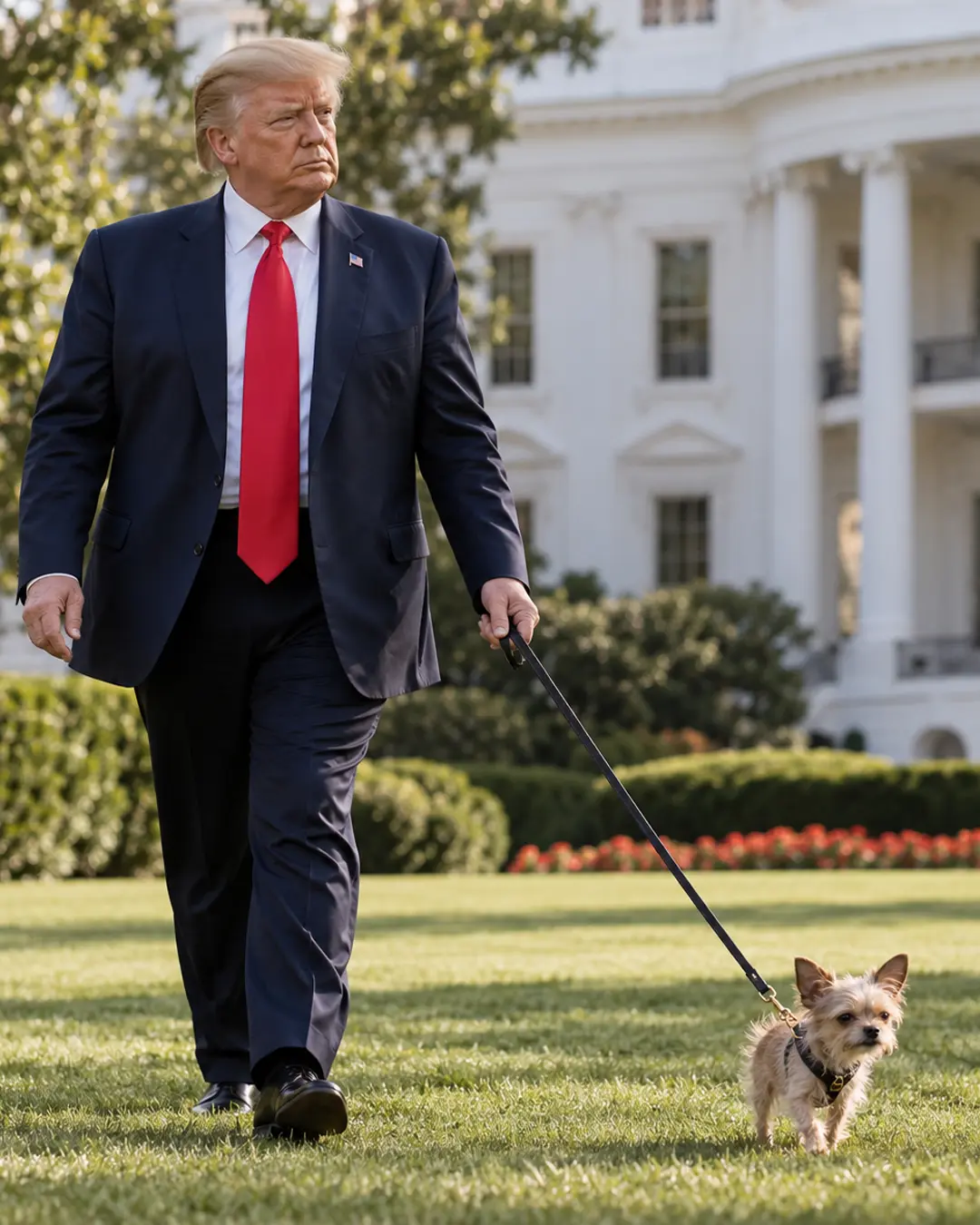
AI-generated illustration imagining President Donald Trump walking a dog at the White House.
That is ultimately the most important question.
A dog should never be brought into a home simply because tradition suggests there ought to be one.
Nor should any president feel obligated to own a pet to satisfy public expectations.
Dogs require time, patience, attention, and a genuine desire for companionship.
President Trump has made it clear through his actions that dog ownership is not among his personal priorities.
And that’s his choice.
There is nothing wrong with not wanting a dog. In fact, recognizing that you are not interested in the responsibility is far better than acquiring an animal you have no intention of caring for.
Still, for those of us who love dogs, it is difficult not to wonder what might happen if he changed his mind.
Would he prefer a German Shepherd, a Labrador Retriever, or perhaps a dignified little Terrier?
Would the dog accompany him around the White House grounds?
Would it be allowed into the Oval Office?
And perhaps most importantly, would the president discover that a dog is one member of the household who cannot be impressed by wealth, fame, or political power?
Could a Dog Change the White House?
A dog certainly couldn’t solve the country’s political disagreements, improve the economy, or make difficult presidential decisions disappear.
And owning a dog doesn’t automatically make anyone a better leader.
But a genuine relationship with an animal can bring companionship, laughter, routine, and moments of perspective into an otherwise demanding life.
Those are benefits that extend well beyond the White House.
In fact, the same principles apply to executives, business owners, and managers facing their own daily pressures. We explore that idea further in Why All CEOs, Presidents and Managers Should Have a Dog.
As for President Trump, perhaps he will never become a dog person.
But it’s entertaining to imagine a presidential companion who couldn’t care less about politics, refuses to be impressed by an executive order, and occasionally interrupts an important meeting because it’s time for dinner.
Could a dog change the White House?
Maybe not the policies.
But it could certainly change the atmosphere.
And sometimes, a little unconditional love can make even the most powerful house in America feel more like home.
Note: Originally published during Donald Trump’s first presidency. Updated October 2026 to reflect his return to the White House and the history of presidential dogs.