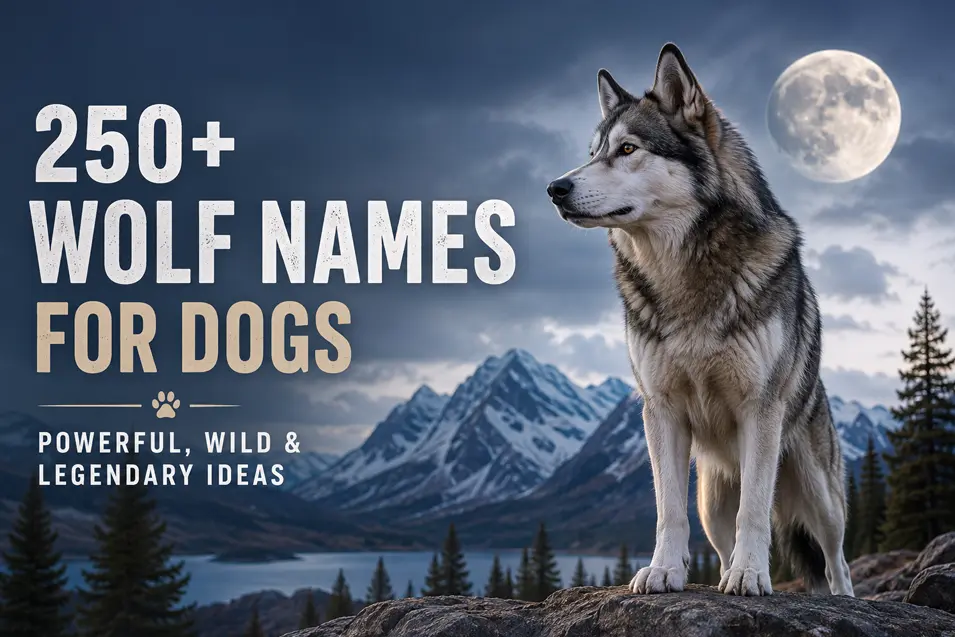
There is something about wolves that has always captured our imagination. They are powerful without being showy, fiercely loyal to their pack, remarkably intelligent and completely at home in some of the wildest places on Earth. It is little wonder they have inspired stories, legends and names for thousands of years.
For a dog with a little of that wild spirit, there are plenty of places to look for inspiration. You might choose a name connected to an actual wolf from mythology, something drawn from the mountains and forests they inhabit, a word associated with snow and the North, or a name that simply sounds strong enough to belong to the leader of the pack.
And your dog certainly doesn’t have to look like a wolf to carry one well. Fenrir may seem made for an enormous Malamute, but it can be considerably funnier attached to a six-pound Chihuahua who considers himself the most dangerous creature in the neighbourhood.
We’ve gathered more than 250 ideas ranging from powerful and legendary to beautiful, unusual and occasionally ridiculous. Whether you share your home with a Husky, German Shepherd, tiny terrier or lovable mixed breed, somewhere in this collection may be the name that captures a little bit of your dog’s own wild side.
Our Favourite Wolf-Inspired Names
If you want to skip straight to some of the strongest choices, start here. These names combine mythology, wilderness, northern landscapes and that unmistakable sense of the wild. Some feel powerful and imposing, while others are quieter choices that simply suit a dog with an adventurous spirit.
- Fenrir — The enormous wolf of Norse mythology and one of the most legendary choices for a powerful dog.
- Luna — Latin for “moon,” and a beautiful choice given the long association between wolves and moonlit nights.
- Ghost — Mysterious, pale and almost silent. Especially fitting for a white or silver dog.
- Kodiak — Rugged and unmistakably northern, inspired by Alaska’s Kodiak Island and its surrounding wilderness.
- Sköll — A wolf from Norse mythology who chases the sun across the sky.
- Freya — The name of the Norse goddess associated with love, beauty and battle. Elegant but still wonderfully strong.
- Timber — A direct nod to the timber wolf and a terrific outdoorsy name that doesn’t feel overly serious.
- Tundra — Inspired by the vast, treeless landscapes of the far North where wolves still roam.
- Loki — The Norse trickster god. An excellent choice for the dog who is clever, mischievous and perpetually up to something.
- Yukon — Wild, northern and adventurous, with an unmistakably Canadian feel.
- Nyx — The ancient Greek goddess and personification of night. Short, striking and unusual.
- Denali — Inspired by North America’s highest mountain, making it a magnificent choice for an adventurous dog.
- Storm — Perfect for a dog with a dramatic personality, a dark coat or seemingly limitless energy.
- Koda — Short, friendly and easy to call, with just enough wilderness character to suit an outdoorsy dog.
- Hati — The great wolf of Norse mythology who pursues the moon.
- Aspen — A softer nature-inspired choice taken from the beautiful tree found throughout northern forests and mountain country.
- Raven — Dark, intelligent and mysterious, with strong connections to northern landscapes, folklore and mythology.
- Frost — Crisp and simple, particularly good for a white, grey or silver-coated dog.
- Akela — The wise wolf leader from Rudyard Kipling’s The Jungle Book, and a natural choice for a calm, confident dog.
- Summit — A bold wilderness name for the dog who always seems happiest when the trail keeps climbing.
Names for Boys
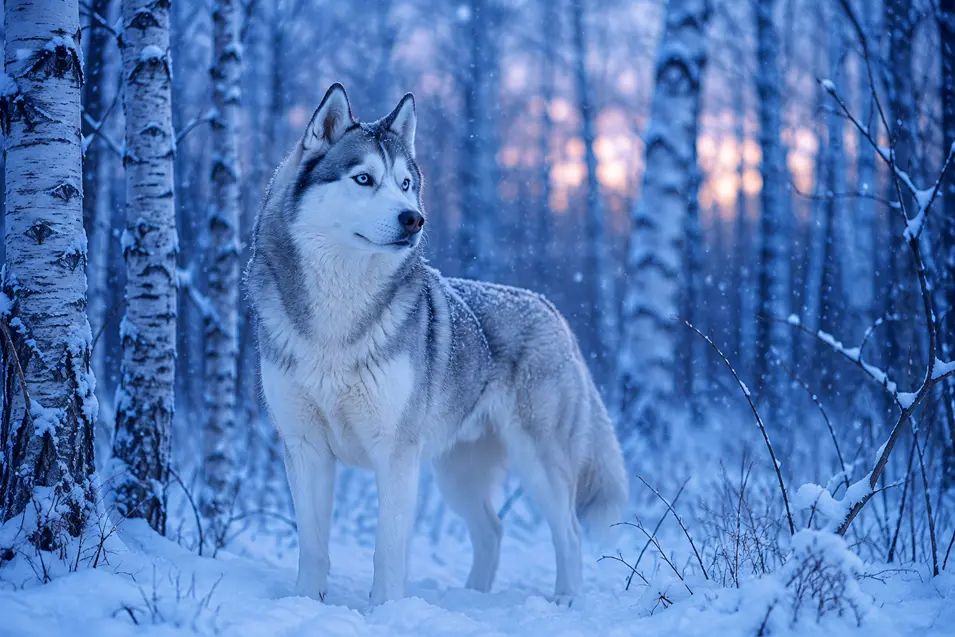
For a male dog, you can go rugged and imposing, lean into mythology, or choose something inspired by the forests and mountains associated with wolves. These range from commanding names for big northern breeds to easygoing choices that work just as well for the smallest member of the pack.
- Ares — The Greek god of war; a bold choice for a fearless, confident dog.
- Arlo — Friendly and outdoorsy, with a softer sound that suits an adventurous companion.
- Atlas — The Titan who carried the heavens in Greek mythology. Ideal for a large or exceptionally strong dog.
- Balto — Inspired by the famous sled dog who helped deliver lifesaving medicine to Nome, Alaska, in 1925.
- Bjorn — A Scandinavian name meaning “bear,” with exactly the rugged northern character this collection calls for.
- Boone — A frontier-inspired choice that feels right at home on trails, in forests and around campfires.
- Cedar — Taken from the evergreen tree, this is an understated nature name with plenty of character.
- Conan — Strong, unmistakable and perhaps perfect for a dog who believes he is considerably tougher than he actually is.
- Dakota — A handsome place-inspired name with an open-country, adventurous feel.
- Drake — Short and strong, with an old-world quality that suits a confident dog.
- Everest — Named for the world’s highest mountain and fitting for a dog with an enormous presence.
- Flint — Rugged, compact and inspired by the hard stone once essential for tools and starting fires.
- Gunnar — An Old Norse name associated with battle and warriors.
- Hunter — A natural choice for an alert dog who never misses a movement in the trees.
- Kenai — Inspired by Alaska’s spectacular Kenai Peninsula, a landscape of mountains, forests, glaciers and wilderness.
- Leif — A classic Scandinavian name strongly associated with Norse explorer Leif Erikson.
- Magnus — From Latin for “great,” and a suitably grand name for a dog with presence.
- Maverick — Perfect for the independent dog who has never been especially interested in following everyone else’s rules.
- Odin — The powerful All-Father of Norse mythology, associated with wisdom, war, magic and knowledge.
- Orion — The famous hunter of Greek mythology whose constellation dominates winter skies.
- Ragnar — An imposing Old Norse name with strong Viking associations.
- Ranger — Made for the dog who would happily spend every day exploring forests, mountains and backcountry trails.
- Remus — One of the legendary founders of Rome, whose story famously begins with a she-wolf caring for him and his twin brother.
- Thor — The Norse god of thunder and strength. Particularly appropriate for a dog whose arrival can be heard from three rooms away.
- Togo — Named for the extraordinary sled dog who led the longest and most dangerous portion of the 1925 serum run to Nome.
- Torin — A strong-sounding name with Celtic roots that feels wonderfully at home among wilderness-inspired choices.
- Wilder — Practically made for an adventurous dog with an independent streak.
- Zeus — King of the Greek gods; a suitably commanding choice for the dog who already believes the household belongs to him.
The best choice does not necessarily have to sound fierce. Sometimes a name like Arlo, Cedar or Leif suits a gentle dog far better than something enormous like Thor or Zeus. The goal is to find the one that feels natural when you say it—and still suits him once you know his personality.
Names for Girls
A wild-inspired name can be beautiful without losing its strength. Some of these choices come from mythology and northern landscapes, while others evoke forests, winter skies and the quiet confidence of a wolf moving through the wilderness.
- Astrid — An Old Norse name often interpreted as “divinely beautiful,” combining strength with Scandinavian elegance.
- Aurora — Inspired by the northern lights that illuminate Arctic and subarctic skies.
- Briar — A wonderfully untamed botanical name for a dog with a little wildness in her personality.
- Callisto — A figure from Greek mythology whose name is also carried by one of Jupiter’s moons.
- Circe — The powerful enchantress of Greek mythology; distinctive, mysterious and slightly magical.
- Dawn — Simple and beautiful, evoking the first light breaking over a wilderness landscape.
- Echo — A figure from Greek mythology and an especially fitting name for a dog whose bark carries through the neighbourhood.
- Ember — Warm and glowing, like the last light of a campfire on a cold night.
- Fable — A lovely choice for a dog who seems as though she belongs in an old legend.
- Freydis — A striking Old Norse name associated with Freydís Eiríksdóttir, remembered in the Norse sagas for her formidable character.
- Gaia — The personification of Earth in Greek mythology, making this a natural fit for an outdoors-loving dog.
- Hazel — Gentle and earthy, inspired by the hazel tree and particularly lovely for a brown or golden-eyed dog.
- Juno — The powerful queen of the gods in Roman mythology. Short, dignified and easy to call.
- Kaia — A simple, modern-sounding choice with a distinctly adventurous feel.
- Lyra — Named for the small northern constellation, giving it a subtle connection to clear night skies.
- Maeve — A legendary queen of Irish mythology whose name carries plenty of strength and character.
- Nova — Inspired by a star that suddenly becomes dramatically brighter in the night sky.
- Runa — A Scandinavian name with an old, mysterious quality that feels particularly suited to a northern breed.
- Sable — Sleek and sophisticated, and especially fitting for a dog with a dark coat.
- Saga — Both a Scandinavian given name and a word inseparable from the great stories and legends of the North.
- Selene — The Greek goddess and personification of the moon.
- Skadi — The formidable Norse goddess associated with winter, mountains, skiing and hunting—almost impossibly well suited to a snow-loving dog.
- Sora — A light, graceful name that means “sky” in Japanese.
- Vega — One of the brightest stars in the night sky and a beautifully uncommon name for a dog.
- Vesper — Associated with evening, giving this unusual name a dark and atmospheric quality.
- Willow — Inspired by the graceful tree found across much of the Northern Hemisphere.
- Winter — An obvious choice perhaps, but an exceptionally good one for a white, silver or northern dog.
- Wren — Small, spirited and nature-inspired; particularly fun for a little dog with a very large personality.
- Ylva — A Scandinavian name meaning “she-wolf,” making it one of the most directly fitting choices on the entire list.
There is no reason a strong name has to sound harsh. Aurora, Lyra and Willow have a softer quality, while Skadi, Freydis and Ylva carry considerably more edge. Sometimes that contrast is part of the fun—a tiny, affectionate dog named after a formidable Norse woman can be every bit as fitting as a powerful northern breed with the same name.
Strong & Powerful
Some dogs simply need a name with a little more weight behind it. These choices draw inspiration from warriors, storms, stone, fire and other forces that feel difficult to ignore. They can be especially fitting for large breeds and confident personalities, although there is also something undeniably entertaining about giving an enormous name to a very small dog.
- Ajax — A legendary Greek warrior celebrated for his tremendous strength and courage during the Trojan War.
- Avalanche — A dramatic choice for a big white dog—or one who tends to come charging through the house at full speed.
- Blaze — Fast, fiery and energetic, with a particularly good sound for an active dog.
- Brutus — Heavy, commanding and impossible to mistake for a delicate name.
- Colossus — Meaning something of enormous size or power. Magnificent on a giant breed and objectively funny on a Pomeranian.
- Diesel — Tough and industrial, with the kind of rumbling character that suits a solidly built dog.
- Fang — Short, unmistakably wild and particularly appropriate for a dog with an impressive set of teeth.
- Fury — A compact name packed with energy, ideal for a dog who approaches everything at maximum intensity.
- Goliath — The biblical giant whose name has become synonymous with enormous size and strength.
- Granite — Inspired by one of the hardest and most recognizable rocks, with a rugged mountain feel.
- Havoc — Perhaps less a name than an accurate description of life with certain puppies.
- Khan — A historic title used by rulers across parts of Central Asia, giving it a commanding, authoritative sound.
- Onyx — Named for the dark gemstone, making it particularly striking for a black or charcoal-coated dog.
- Rex — Latin for “king.” Short, classic and still difficult to beat for a dog who carries himself like royalty.
- Riot — Made for a dog who brings noise, energy and joyful disorder everywhere he goes.
- Rocky — A familiar favourite with associations of both rugged landscapes and the ultimate cinematic underdog.
- Sabre — Sharp, distinctive and inspired by the curved blade historically carried by cavalry soldiers.
- Spartan — Inspired by the warriors of ancient Sparta and synonymous today with toughness and discipline.
- Steel — Cool, strong and particularly good for a blue-grey or silver-coated dog.
- Titan — The Titans were powerful primordial deities in Greek mythology, and the word itself has come to suggest enormous strength.
- Thunder — An appropriately booming choice for a big dog—or one whose paws make the entire house shake when he runs.
- Valkyrie — Inspired by the formidable female figures of Norse mythology who selected warriors slain in battle.
- Vandal — Rebellious and mischievous, especially suitable for a dog with a documented history of destroying cushions.
- Warrior — Direct and unapologetically strong, fitting for a resilient dog with plenty of courage.
- Wrath — Dark and dramatic, and perhaps best reserved for a dog whose actual personality makes the name wonderfully ironic.
Power can come across in very different ways. Titan and Goliath feel enormous, Steel and Onyx are quieter and cooler, while Havoc and Riot suit dogs whose strength is mostly demonstrated by what happens to the living room when they get the zoomies. The best choice is the one that captures your dog’s particular version of powerful.
Strong & Powerful
Some dogs simply need a name with a little more weight behind it. These choices draw inspiration from warriors, storms, stone, fire and other forces that feel difficult to ignore. They can be especially fitting for large breeds and confident personalities, although there is also something undeniably entertaining about giving an enormous name to a very small dog.
- Ajax — A legendary Greek warrior celebrated for his tremendous strength and courage during the Trojan War.
- Avalanche — A dramatic choice for a big white dog—or one who tends to come charging through the house at full speed.
- Blaze — Fast, fiery and energetic, with a particularly good sound for an active dog.
- Brutus — Heavy, commanding and impossible to mistake for a delicate name.
- Colossus — Meaning something of enormous size or power. Magnificent on a giant breed and objectively funny on a Pomeranian.
- Diesel — Tough and industrial, with the kind of rumbling character that suits a solidly built dog.
- Fang — Short, unmistakably wild and particularly appropriate for a dog with an impressive set of teeth.
- Fury — A compact name packed with energy, ideal for a dog who approaches everything at maximum intensity.
- Goliath — The biblical giant whose name has become synonymous with enormous size and strength.
- Granite — Inspired by one of the hardest and most recognizable rocks, with a rugged mountain feel.
- Havoc — Perhaps less a name than an accurate description of life with certain puppies.
- Khan — A historic title used by rulers across parts of Central Asia, giving it a commanding, authoritative sound.
- Onyx — Named for the dark gemstone, making it particularly striking for a black or charcoal-coated dog.
- Rex — Latin for “king.” Short, classic and still difficult to beat for a dog who carries himself like royalty.
- Riot — Made for a dog who brings noise, energy and joyful disorder everywhere he goes.
- Rocky — A familiar favourite with associations of both rugged landscapes and the ultimate cinematic underdog.
- Sabre — Sharp, distinctive and inspired by the curved blade historically carried by cavalry soldiers.
- Spartan — Inspired by the warriors of ancient Sparta and synonymous today with toughness and discipline.
- Steel — Cool, strong and particularly good for a blue-grey or silver-coated dog.
- Titan — The Titans were powerful primordial deities in Greek mythology, and the word itself has come to suggest enormous strength.
- Thunder — An appropriately booming choice for a big dog—or one whose paws make the entire house shake when he runs.
- Valkyrie — Inspired by the formidable female figures of Norse mythology who selected warriors slain in battle.
- Vandal — Rebellious and mischievous, especially suitable for a dog with a documented history of destroying cushions.
- Warrior — Direct and unapologetically strong, fitting for a resilient dog with plenty of courage.
- Wrath — Dark and dramatic, and perhaps best reserved for a dog whose actual personality makes the name wonderfully ironic.
Power can come across in very different ways. Titan and Goliath feel enormous, Steel and Onyx are quieter and cooler, while Havoc and Riot suit dogs whose strength is mostly demonstrated by what happens to the living room when they get the zoomies. The best choice is the one that captures your dog’s particular version of powerful.
Norse Mythology
Few mythologies are better suited to a wolf-inspired name. The Norse stories are filled with wolves, gods, giants, warriors, ravens, magical creatures and the frozen landscapes of the Nine Worlds. Some choices have a direct connection to wolves, while others simply carry the strength and atmosphere of the old Norse legends.
- Fenrir — The colossal wolf and son of Loki, feared by the gods and destined to kill Odin during Ragnarök.
- Geri — One of Odin’s two wolves, who accompany the All-Father in the surviving Norse sources.
- Freki — Odin’s other wolf companion and the natural counterpart to Geri.
- Sköll — The wolf who pursues the sun across the sky and is destined to catch it during Ragnarök.
- Hati — The wolf who chases the moon, making this an especially good choice for a nocturnal or silver-coated dog.
- Odin — The chief Norse god associated with wisdom, magic, poetry and war, accompanied by wolves Geri and Freki and ravens Huginn and Muninn.
- Thor — The thunder god and wielder of the mighty hammer Mjölnir. Short, powerful and particularly appropriate for a large dog.
- Loki — The famously cunning and unpredictable figure of Norse mythology—and father of Fenrir. An obvious candidate for a clever troublemaker.
- Tyr — The courageous god who sacrifices his hand while the gods bind Fenrir. One of the best short, strong names in Norse mythology.
- Skadi — A formidable jötunn associated with mountains, winter, hunting and skiing. Nearly perfect for a snow-loving dog.
- Freya — The goddess associated with love, beauty, fertility, magic and battle. A strong name that still sounds elegant.
- Frigg — Odin’s wife and an important goddess associated with marriage, motherhood and foreknowledge.
- Heimdall — The ever-watchful guardian of the gods and protector of Bifröst, the rainbow bridge. A fitting choice for a particularly vigilant dog.
- Balder — Also written Baldr, the beloved son of Odin and Frigg, remembered for his beauty and tragic death.
- Vidar — A son of Odin who avenges his father by killing Fenrir during Ragnarök.
- Sif — A goddess known for her extraordinary golden hair and the wife of Thor. A lovely choice for a golden, cream or pale-coated dog.
- Huginn — One of Odin’s two ravens, whose name is associated with “thought.”
- Muninn — Odin’s second raven, whose name is associated with “memory.” Huginn and Muninn make especially good names for a pair of dogs.
- Yggdrasil — The immense world tree at the centre of Norse cosmology, connecting the Nine Worlds. Unusual, imposing and easily shortened to Yggy for everyday use.
- Ragnarök — The catastrophic sequence of events that brings the deaths of several gods and the destruction and renewal of the world. Ragnar makes an easier everyday nickname for a dog.
Fenrir, Sköll and Hati provide the clearest wolf connections, but you certainly don’t have to stop there. Tyr brings courage, Skadi evokes snowy mountains, Odin carries authority and Loki is almost suspiciously well suited to certain dogs. Norse mythology gives you something for nearly every personality—from the noble guardian to the puppy who appears determined to bring about Ragnarök before breakfast.
Wolves From Myth & Legend
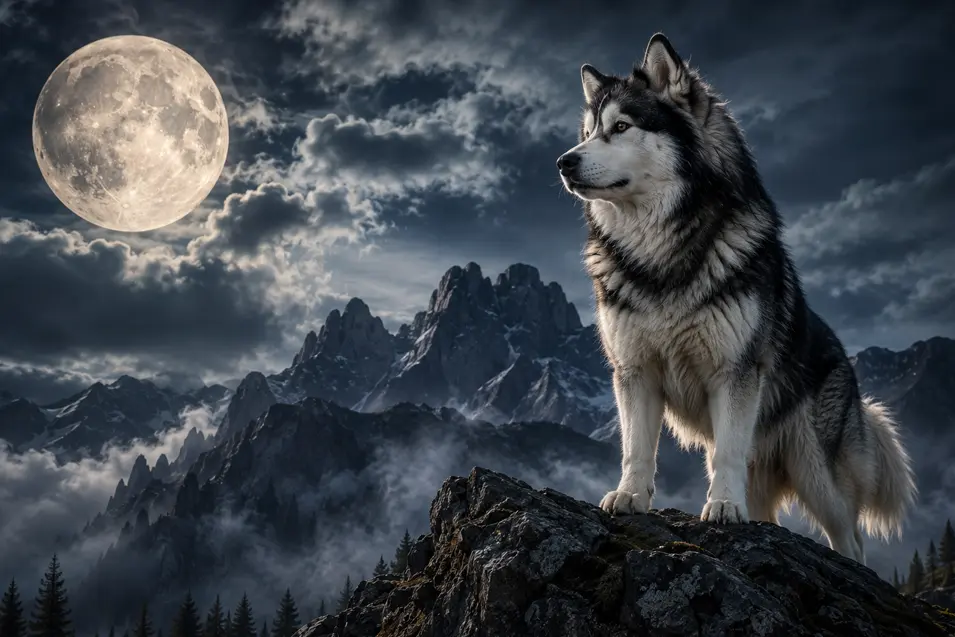
Long before wolves appeared in wildlife documentaries, they were prowling through human stories. Across cultures they have been portrayed as guardians, monsters, ancestors, teachers and creatures powerful enough to challenge the gods themselves. These names come from mythology, folklore, literature and legends in which wolves—or distinctly wolf-like creatures—play an unforgettable role.
- Akela — The wise leader of the Seeonee wolf pack in Rudyard Kipling’s The Jungle Book.
- Amarok — A gigantic wolf-like creature from Inuit storytelling, traditionally described as a formidable solitary hunter.
- Asena — A legendary she-wolf associated with Turkic origin traditions, where she becomes an ancestral and protective figure.
- Fenrir — The monstrous wolf of Norse mythology, destined to break free from his bonds during Ragnarök and kill Odin.
- Freki — One of the two wolves that accompany Odin in Norse mythology.
- Garmr — A fearsome hound or wolf-like guardian associated with Hel in Norse mythology and the events of Ragnarök.
- Geri — The other of Odin’s two wolves, frequently mentioned alongside Freki.
- Hati — A great wolf in Norse mythology who pursues the moon across the heavens.
- Lupa — Latin for “she-wolf,” and a fitting reference to the famous wolf of Roman tradition who nurses the abandoned twins Romulus and Remus.
- Lycaon — A king in Greek mythology who is transformed into a wolf by Zeus, giving us one of antiquity’s best-known tales of human-to-wolf transformation.
- Moro — The enormous wolf goddess who raises San in Hayao Miyazaki’s Princess Mononoke.
- Raksha — The protective mother wolf who adopts the infant Mowgli in The Jungle Book.
- Romulus — Legendary founder of Rome who, along with his twin Remus, was said to have been suckled by a she-wolf as an infant.
- Remus — Romulus’s twin brother and another name forever connected to Rome’s famous she-wolf legend.
- Sköll — The great wolf of Norse mythology who pursues the sun through the sky.
- White Fang — The wolf-dog at the centre of Jack London’s classic novel set in the Yukon during the Klondike Gold Rush.
- Wepwawet — An ancient Egyptian deity depicted with a canine form, traditionally associated with warfare and opening the way; historically his animal has been interpreted as a wolf or jackal.
- Werewolf — Not exactly subtle, but centuries of European folklore have made the human who transforms into a wolf one of the world’s most enduring supernatural creatures.
Norse mythology gives us many of the most dramatic choices, but looking beyond it reveals how often wolves have appeared in stories around the world. Some were feared, others revered, and a few became protectors or family. That makes this group especially interesting if you want a name with an actual story behind it rather than one that merely sounds wild.
Inspired by the North
Snow-covered forests, frozen lakes, Arctic coastlines and immense stretches of wilderness make the North a natural source of inspiration. These names draw from northern places, landscapes and winter itself, making them especially appealing for Huskies, Malamutes and other cold-weather dogs—but there is no rule saying your little couch-loving companion can’t have an adventurous northern name too.
- Alaska — Vast, rugged and instantly evocative of mountains, glaciers and wilderness.
- Arctic — A crisp, unmistakable choice for a white, silver or cold-weather-loving dog.
- Aurora — Inspired by the aurora borealis, the spectacular northern lights that dance across high-latitude skies.
- Baffin — Taken from Canada’s Baffin Island, a dramatic Arctic landscape of mountains, glaciers and remote coastline.
- Boreal — Inspired by the enormous boreal forest that stretches across much of northern North America and Eurasia.
- Denali — Named for North America’s highest mountain, rising above the Alaskan wilderness.
- Frost — Simple, wintry and particularly striking for a pale or silver-coated dog.
- Glacier — A magnificent choice for a large white, grey or blue-eyed dog.
- Hudson — A nod to Canada’s enormous Hudson Bay and an easy name to call in everyday life.
- Inuvik — Inspired by the northern Canadian town in the Northwest Territories, well above the Arctic Circle.
- Juneau — Alaska’s capital, surrounded by mountains, forests, waterways and glaciers.
- Kenai — Taken from Alaska’s Kenai Peninsula, known for its mountains, forests, rivers and wild coastline.
- Klondike — Inspired by the famous northern region associated with the Yukon gold rush. Rugged, historical and wonderfully distinctive.
- Kodiak — Named for Alaska’s Kodiak Island, giving this choice an unmistakably wild northern character.
- Nome — The remote Alaskan city forever associated with sled dogs and the legendary 1925 serum run.
- North — Minimal, modern and surprisingly strong as a dog’s name.
- Polar — An obvious but charming choice for a fluffy white dog who looks perfectly equipped for an Arctic expedition.
- Sitka — Inspired by the Alaskan city and the Sitka spruce, a towering evergreen native to the Pacific Northwest.
- Snow — Clean, simple and timeless, especially for a white dog.
- Tundra — Named for the treeless northern biome stretching across Arctic regions, with a suitably wild sound.
- Whitehorse — The capital of Yukon and a name filled with northern character; Horse probably isn’t the nickname we’d choose, but Whitey or Whit could work.
- Winter — Beautiful, familiar and perfectly suited to a dog who comes alive when the temperature drops.
- Yukon — Inspired by Canada’s wild northwestern territory and the river that runs through it into Alaska.
- Polar Bear — An affectionate, slightly ridiculous choice for a huge fluffy white dog who occupies roughly the same amount of space on the sofa.
- Blizzard — Ideal for an energetic white dog who enters a room like a sudden weather event.
Northern names can feel adventurous without necessarily sounding fierce. Yukon and Denali have grandeur, Frost and North are clean and understated, while Blizzard and Polar Bear bring a little more personality. For a dog who loves snow, wilderness and cold morning walks—or merely looks as though he should—there are few better places to look for inspiration.
Mountains & Wilderness
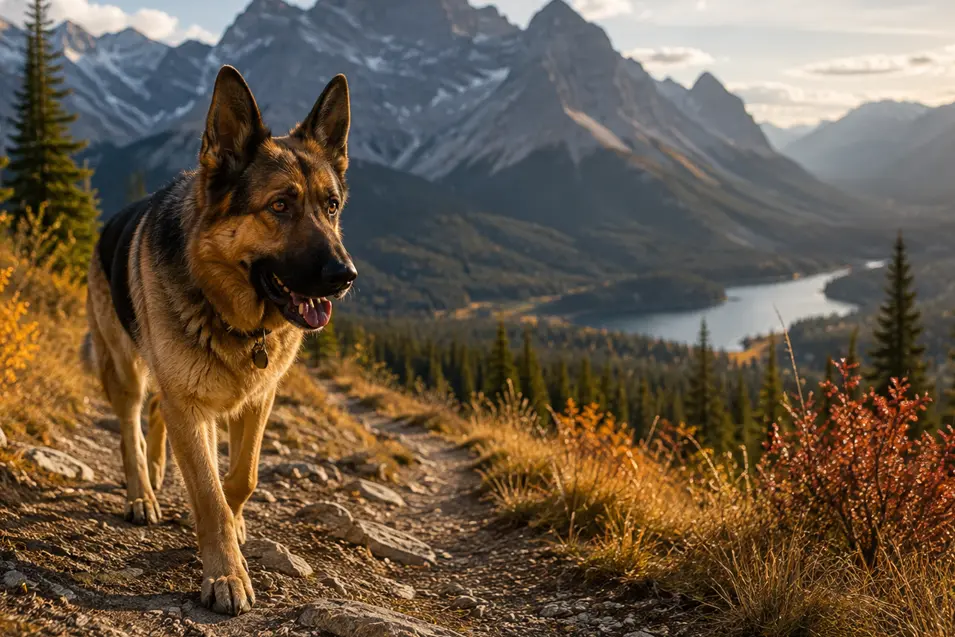
Wolves belong to landscapes that still feel genuinely wild—deep forests, mountain valleys, rocky ridges and enormous stretches of country far beyond the edge of town. That makes the outdoors a particularly rich source of names, whether your dog spends weekends on mountain trails or considers an expedition to the backyard sufficiently adventurous.
- Alpine — Inspired by high mountain country above the tree line; crisp, distinctive and naturally outdoorsy.
- Aspen — Named for the beautiful tree common throughout mountain and northern forests.
- Boulder — Solid and rugged, and particularly fitting for a big dog who is approximately as easy to move from your side of the bed.
- Canyon — A dramatic landscape name with a strong Western wilderness feel.
- Cedar — Warm and earthy, inspired by the magnificent evergreen trees found in forests across North America.
- Cliff — Short, traditional and subtly connected to rugged mountain terrain.
- Crag — A wonderfully unusual choice inspired by steep, rugged rock faces and mountain outcrops.
- Everest — Named for the highest mountain above sea level on Earth. A suitably enormous name for a dog with presence.
- Forest — Simple, peaceful and directly connected to one of the wolf’s most familiar habitats.
- Granite — Inspired by the hard stone that forms many spectacular mountain landscapes.
- Jasper — A natural gemstone name as well as a nod to Jasper National Park in the Canadian Rockies.
- Kananaskis — Inspired by Alberta’s spectacular mountain country west of Calgary. Kanan or Kani can make it considerably easier to shout across a dog park.
- Lodgepole — Named for the lodgepole pine, an iconic tree of western North American forests. Lodge makes a more practical everyday version.
- Moraine — A beautiful geological name for the rock and sediment deposited by glaciers, with an unmistakable mountain character.
- Peak — Short, energetic and ideal for a dog who always wants to reach the top.
- Pine — Clean and understated, inspired by the evergreen forests of wolf country.
- Ridge — One of the strongest wilderness names: simple, rugged and easy to call.
- Rocky — A natural reference to rocky terrain and the Rocky Mountains, with plenty of familiar charm.
- Sequoia — Named for some of the largest and most magnificent trees on Earth.
- Sierra — From the Spanish word for a mountain range, and strongly associated with California’s Sierra Nevada.
- Spruce — An uncommon but appealing choice inspired by the evergreens that dominate many northern forests.
- Summit — The highest point of a mountain and a terrific name for an adventurous trail dog.
- Timber — Evokes deep forests while also giving a subtle nod to the timber wolf.
- Trail — Simple and unconventional, especially fitting for a dog who is happiest disappearing around the next bend.
- Wilder — A handsome name that captures the spirit of wilderness without being tied to one particular place.
Some of the best outdoor names are the simplest. Ridge, Aspen, Timber and Summit immediately suggest the wilderness without trying too hard, while Moraine, Crag and Kananaskis offer something considerably less common. And if your dog’s idea of conquering the wilderness is finding the warmest patch of sunlight on the living-room floor, an ambitious mountain name may be even better.
Moon & Night
The image of a wolf silhouetted against a full moon may owe plenty to folklore and popular culture, but it remains one of our most enduring associations with the animal. The night sky offers some beautiful possibilities of its own, from moons and constellations to darkness, stars and the mysterious hours after sunset.
- Artemis — The Greek goddess of the hunt and wilderness, later strongly associated with the moon.
- Celeste — From the Latin caelestis, meaning “heavenly” or “of the sky.” Elegant and especially lovely for a gentle dog.
- Comet — Bright, fast and memorable, making it an excellent choice for an energetic dog.
- Cosmo — Inspired by the cosmos and perfect for a dog whose personality seems slightly larger than this planet.
- Crescent — A distinctive reference to one of the moon’s most recognizable shapes.
- Dusk — That brief transition between daylight and darkness makes a wonderfully atmospheric name.
- Eclipse — Dramatic and mysterious, particularly striking for a black, grey or unusually marked dog.
- Halo — Inspired by the glowing ring that can sometimes appear around the moon.
- Luna — Latin for “moon” and also the Roman goddess of the moon. Popular for good reason: it is beautiful and exceptionally easy to call.
- Midnight — A classic choice for a black or dark-coated dog with a little mystery about them.
- Moon — Simple, unusual and impossible to misunderstand.
- Nebula — A vast cloud of gas and dust in space, often spectacularly beautiful when photographed.
- Night — Minimal and dramatic, especially fitting for a sleek black dog.
- Nova — A star that suddenly increases dramatically in brightness. Short, lively and modern.
- Nyx — The primordial Greek goddess and personification of night. One of the strongest short names in this collection.
- Orion — The famous hunter of Greek mythology and one of the most recognizable constellations in the night sky.
- Selene — The Greek goddess and personification of the moon, offering a more unusual alternative to Luna.
- Shadow — A natural fit for a dark-coated dog—or the one who quietly follows you from room to room all day.
- Sirius — The brightest star in Earth’s night sky and, appropriately enough, known as the Dog Star.
- Stella — Latin for “star,” giving this familiar name a beautiful celestial connection.
- Twilight — The soft light between day and night, with a mysterious wilderness quality.
- Vega — One of the brightest stars visible from Earth and part of the constellation Lyra.
- Vesper — From a Latin word associated with evening; sophisticated, uncommon and slightly mysterious.
- Wolf Moon — The traditional name commonly given to January’s full moon. Wolfie or Moon can make it more practical for everyday use.
- Zenith — The point in the sky directly overhead and a striking choice for a dog who deserves something unusual.
You don’t need a black dog or a Husky with ice-blue eyes to borrow a name from the night sky. Luna and Stella are soft and familiar, Nyx and Eclipse feel darker and more dramatic, while Sirius comes with the perfect canine connection. And there is something rather wonderful about standing beneath a full moon calling Cosmo home because he has once again decided the evening walk isn’t over.
Names That Mean Wolf
Sometimes the strongest connection is also the simplest: choose a name that literally means “wolf,” “little wolf,” or contains an old word for wolf within its original meaning. Languages across Europe and beyond have incorporated the animal into personal names for centuries, giving us some genuinely unusual possibilities.
- Amaruq — An Inuit name meaning “wolf” in Inuktitut. Strong, distinctive and one of the most direct choices on this list.
- Arnulf — A Germanic name formed from elements meaning “eagle” and “wolf”—two formidable animals in one name.
- Bleddyn — A Welsh name derived from blaidd, meaning “wolf,” combined with a diminutive suffix. It can be understood along the lines of “little wolf” or “wolf cub.”
- Lowell — An English name derived from a Norman French nickname based on lou, meaning “wolf,” with a diminutive suffix—essentially a “little wolf.”
- Randolf — From Germanic elements meaning “shield rim” and “wolf.” The more familiar Randolph developed from this name.
- Ráðúlfr — An Old Norse name combining ráð, meaning “counsel” or “advice,” with úlfr, meaning “wolf.”
- Rudolf — From the Germanic name Hrodulf, combining elements meaning “fame” and “wolf.”
- Ulf — From the Old Norse Úlfr, literally meaning “wolf.” Short, authentic and wonderfully easy to call.
- Valko — A Bulgarian name derived from the Bulgarian word for “wolf.”
- Varg — A rare Scandinavian given name derived from a word meaning “wolf.” Compact and appropriately rugged.
- Velvel — A Yiddish name meaning “little wolf,” derived as a diminutive of the Yiddish word for wolf.
- Vuk — A traditional Serbian name that quite simply means “wolf.”
- Vukašin — A Serbian name derived from Vuk, giving it the same underlying wolf connection.
- Wolf — It doesn’t get much more straightforward. Used as a German and Yiddish name and occasionally in English, it is also found as a shortened form of longer Germanic names containing the wolf element.
- Wolfgang — An old German name combining elements meaning “wolf” and “path” or “way.” It is one of the most recognizable traditional names built around the animal.
- Wolfhard — A German name combining “wolf” with an element meaning “hard,” “firm,” “brave” or “hardy.”
- Wolfram — A German name constructed from elements meaning “wolf” and “raven”—an exceptionally fitting combination for this particular collection.
- Wulfila — A Gothic name meaning “little wolf.” Ancient, unusual and surprisingly appealing as a modern dog’s name.
- Ylva — A Scandinavian feminine name ultimately connected to the Old Norse word for wolf and traditionally understood as “she-wolf.”
These choices have something the more loosely inspired names don’t: the wolf is built directly into their linguistic history. Ulf, Vuk and Ylva are wonderfully usable, while Bleddyn, Wolfram and Wulfila offer something you’re unlikely to hear called across the average dog park. For an unusual name with a genuine meaning behind it, this may be one of the richest sections of the list.
Rare & Unusual
If Luna, Loki and Thor are a little too familiar for your taste, there are plenty of less obvious directions to explore. These names borrow from remote landscapes, ancient languages, astronomy, weather and the natural world. Some are genuinely rare as dog names, while others are familiar words that simply aren’t often heard at the dog park.
- Alder — A tree found across northern forests and along rivers and wetlands. Quiet, earthy and understated.
- Altair — One of the brightest stars in the night sky and the brightest star in the constellation Aquila.
- Boreas — The ancient Greek god of the north wind, making this a particularly fitting choice for a cold-weather dog.
- Cairn — A mound of stones used for centuries as a landmark or trail marker in wild and mountainous country.
- Cinder — Dark, smoky and slightly mysterious; especially good for a charcoal or grey-coated dog.
- Drift — Inspired by drifting snow, but also wonderfully suited to a laid-back dog who seems content to go wherever life takes him.
- Eira — A Welsh word meaning “snow.” Short, beautiful and particularly fitting for a white dog.
- Elara — One of Jupiter’s moons and an elegant celestial choice that remains relatively uncommon.
- Fjord — Inspired by the spectacular steep-sided sea inlets associated particularly strongly with Norway.
- Gale — A powerful wind and a compact choice for a dog who never seems to move slowly.
- Iskra — A word meaning “spark” in several Slavic languages. Excellent for a lively dog with an explosive personality.
- Kestrel — Named for the small, swift falcon; an unusual nature choice with plenty of character.
- Lumen — Latin for “light” and also a modern scientific term associated with measuring visible light.
- Nival — From a word meaning “snowy” or relating to snow, giving this rare choice a wonderfully wintry feel.
- Obsidian — Named for the dark volcanic glass formed when lava cools rapidly. Obi makes an easy everyday nickname.
- Omen — Dark and atmospheric, with just enough mystery for a dog who has a habit of silently appearing behind you.
- Rune — Inspired by the letters of the ancient runic alphabets used by Germanic peoples, including Scandinavians.
- Sable — A sleek name associated with deep black and with the small northern mammal prized historically for its dark fur.
- Solstice — Inspired by the longest and shortest days of the year. Sol makes a simple nickname.
- Tempest — A violent storm and a magnificent choice for a dog who arrives everywhere with considerable enthusiasm.
- Vale — An old word for a valley, giving this short name a quiet, almost storybook wilderness quality.
- Zephyr — Traditionally a gentle west wind, from Zephyrus, the Greek god of the west wind.
- Astra — Derived from the Latin word for “stars,” with a beautiful celestial sound.
- Rime — The delicate ice that forms when supercooled water droplets freeze onto exposed surfaces in cold, foggy weather.
- Serein — A wonderfully obscure word for fine rain falling from an apparently clear evening sky.
Rare doesn’t have to mean difficult to pronounce or impossible to explain. Alder, Rune, Vale and Gale are simple enough to use every day, while Boreas, Solstice and Serein are for people who want something almost nobody else will have. Sometimes the best unusual name is the one that makes someone ask, “Where did you come up with that?”
Funny Choices
Not every wolf-inspired name needs to sound as though it was carved into an ancient Viking shield. Sometimes the best choice plays with the contrast between the mighty wolf and the domestic dog currently asleep upside down on your sofa. These are especially good for tiny dogs, gentle giants and anyone who prefers a name with a little personality.
- Bad Wolf — A wonderfully dramatic name for a dog whose most serious offence to date is stealing a sandwich.
- Big Bad — Inspired by the Big Bad Wolf of fairy-tale fame. Particularly good for a Chihuahua, Yorkie or other pocket-sized menace.
- Chewbarka — Part Star Wars, part enthusiastic canine commentary and entirely ridiculous.
- Direwolf — Borrowed from the enormous wolves made famous by Game of Thrones. Considerably funnier when attached to a Pug.
- Dogtor Wolf — For the highly educated member of the pack who specializes in treats, naps and unexplained barking.
- Fang — An intimidating name until you discover Fang is a twelve-pound dog wearing a raincoat.
- Furball — Less legendary predator, more accurate description of what is currently covering your sofa.
- Hairy Pawter — An excellent choice for a shaggy dog with a little magic—or one who mysteriously makes unattended food disappear.
- Howler — Perfect for the dog who believes every siren, piano note and neighbour’s lawn mower requires a vocal response.
- Little Red — A playful reversal of Little Red Riding Hood, especially fun for a reddish-coated dog.
- Lone Wolf — Ideal for the fiercely independent dog who nevertheless follows you into the bathroom.
- Moon Moon — An internet-famous joke name for the slightly less dignified member of the wolf pack—the one who would probably run into a tree while everyone else was hunting.
- Pupnir — A ridiculous little spin on Fenrir for a puppy who hasn’t quite grown into world-destroying-monster status.
- Sir Howls-a-Lot — Distinguished, noble and absolutely incapable of remaining quiet when someone walks past the front window.
- Snarls Barkley — A canine twist on Gnarls Barkley that works particularly well for a dog with plenty to say.
- Timber Woof — Part timber wolf, part terrible pun. We make no apologies.
- Werepup — By day, an ordinary dog. By full moon, still an ordinary dog—but now running around the house at 11 p.m.
- Wolfgang Pup — A playful take on Wolfgang that sounds strangely respectable until you say the whole thing aloud.
- Wolfie McWolfface — For the dog whose naming process was perhaps allowed to become a little too democratic.
- Woofgar — A vaguely Viking-sounding creation for a dog who believes he should be welcomed into Valhalla immediately after dinner.
A funny name works best when it matches the dog rather than simply delivering a good pun. Big Bad becomes considerably better when the dog weighs seven pounds, while Lone Wolf is almost perfect for the clingiest dog you’ve ever met. After all, living with a descendant of wolves is impressive—but living with one who is frightened of the vacuum cleaner keeps things in perspective.
How to Choose the Right Name
With hundreds of possibilities, narrowing the list down can be harder than finding names in the first place. A great name should capture something about your dog, but it also needs to work during everyday life. The name that looks magnificent written on a list still has to sound right when you’re calling it across the park.
Start With Your Dog
Appearance can provide an obvious starting point. Frost, Tundra or Ghost might immediately suit a white or silver dog, while Onyx, Midnight or Raven can complement a darker coat. A big Malamute may seem born to be called Fenrir or Titan.
Personality can be even more useful. Loki fits the dog who is constantly engineering trouble, Summit suits an adventurous hiking companion, and Shadow is wonderful for the dog who follows you everywhere.
Don’t feel that the name has to match, though. Sometimes the complete opposite is far more memorable. There is considerable charm in meeting an eight-pound dog named Goliath.
Say It Out Loud
You’ll probably say your dog’s name thousands of times, so try your favourites aloud rather than judging them only on the page.
Imagine calling the name on a walk, introducing your dog at the veterinarian and trying to get his attention when he has just spotted a rabbit. Names such as Ulf, Nyx, Koda and Thor are short and easy to say, while longer choices may benefit from an obvious nickname.
If you love Yggdrasil but know you’re never going to yell it across a field, Yggy solves the problem nicely.
Avoid Names That Sound Like Commands
Dogs learn by distinguishing sounds, so a name that is very similar to a command you use regularly can potentially create unnecessary confusion. Say the name alongside words such as sit, stay, come, down and no and make sure they sound sufficiently different.
The same applies if you already have other pets. Names that sound almost identical can make it difficult for either animal to know who you’re talking to.
Think Beyond the Puppy Stage
A tiny ball of fluff can make almost any name seem adorable, but puppies have an inconvenient habit of becoming adult dogs.
Try imagining the same name several years from now. Something playful can absolutely work for life, but make sure you genuinely like it rather than choosing it solely because it suits a twelve-week-old puppy.
Look at the Story Behind It
One of the advantages of mythology and wilderness-inspired names is that many come with fascinating stories.
Fenrir isn’t merely a name that sounds powerful; he is one of the great wolves of Norse mythology. Skadi brings associations with winter and mountains. Yukon evokes an enormous northern landscape, while Sirius is both the brightest star in the night sky and the Dog Star.
A connection like that can make a name feel more personal and give you a great answer when someone asks how your dog got it.
Make a Shortlist
Instead of trying to choose immediately, pick five or six favourites and live with them for a day or two. Say them aloud. Try the likely nicknames. See which one you naturally keep returning to.
You may even find that your dog helps make the decision. The dignified puppy you were planning to call Odin might spend his first evening falling off the sofa, stealing socks and getting his head stuck in a cereal box.
At that point, Loki may have chosen himself.
Ultimately, the right name doesn’t have to be the fiercest, rarest or most historically impressive choice on this list. It simply has to feel like your dog. When you find yourself saying one name without having to think about it anymore, you’ve probably found the one.
More Wolf, Wilderness & Dog Inspiration
If wolves, mountains and wild places are your thing, there is plenty more to explore.
Looking for a name with a little wild spirit? Browse our 250+ Wolf Names for Dogs: Powerful, Wild & Legendary Ideas for names inspired by mythology, the North, mountains, moonlight and wilderness.
Prefer enjoying the wilderness with considerably softer bedding? Take a look at 25 Luxury Dog Glamping Setups You’ll Want to Book This Weekend for some seriously beautiful ways to escape outdoors with your dog.
And if you spend time hiking or camping in bear country, don’t miss Dogs and Bears: What Every Dog Owner Should Know for practical advice on keeping your dog safer around one of the wilderness’s other large predators.