
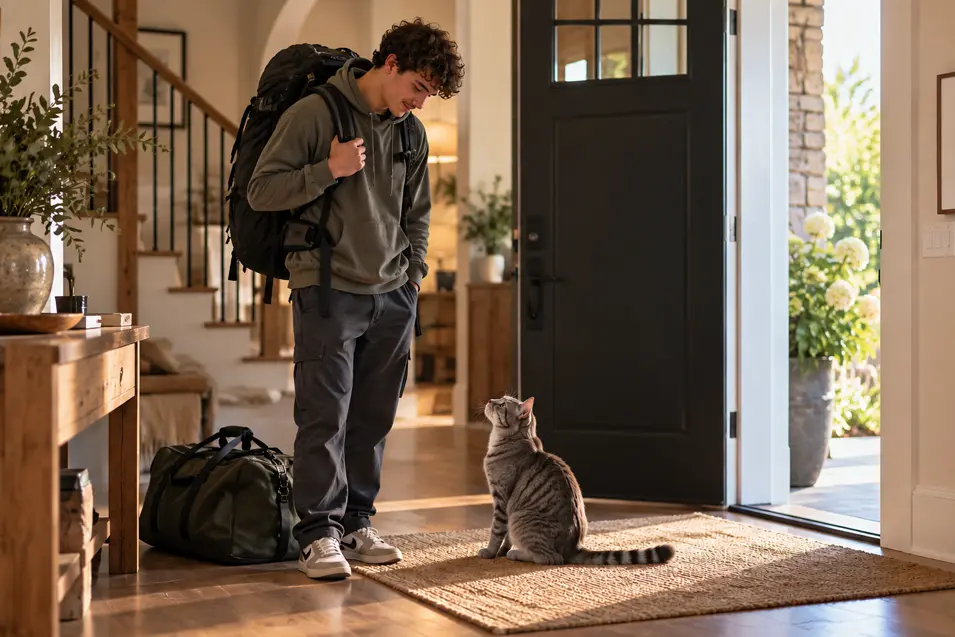
When my son Owen was 13, he wanted a cat.
His parents were getting divorced, and one of his good friends, whose family was going through much the same thing, had cats. Somewhere in the middle of everything changing around him, Owen decided he wanted one too.
I wasn’t particularly interested in getting a cat.
We got a kitten.
Her name is Simba.
Four years later, Simba is still here, but Owen is getting ready to leave for New Zealand on a work visa. He’ll be gone for about a year, possibly longer, and recently he asked me a question that neither of us had really needed to think about before.
Did I still want Simba while he was away, or should she go live with his mom?
My immediate thought was fairly simple: Of course I want her.
Owen may still refer to Simba as his cat, and technically he’s right. He’s the reason we got her. But I’m the person who has fed her, changed her litter box and lived with her every day for the past four years. Somewhere along the way, without anybody formally deciding it, his cat also became my cat.
It made me wonder how many families eventually have some version of this conversation.
A child begs for a puppy in Grade 6 or brings home a kitten as a teenager. Years pass. Then university happens, or travel, or a first apartment, a relationship, a job in another city or simply adulthood.
The kid moves out.
The pet doesn’t necessarily go with them.
And suddenly a family has to answer a question that seemed completely unnecessary when everyone lived under the same roof:
Who actually gets the pet?
Whose Pet Is It, Really?
Families tend to describe pets in surprisingly possessive terms.
That’s Owen’s cat. That’s Sarah’s dog. The rabbit belongs to the youngest. Dad has his dog, while the cat clearly prefers Mom.
Reality is usually messier.
The person who originally wanted an animal isn’t necessarily the person who eventually becomes most responsible for it. Parents buy food, schedule veterinary appointments, clean litter boxes, walk dogs, administer medication and arrange their lives around feeding schedules.
Meanwhile, relationships form independently of whatever agreement existed when the animal first came home.
A dog bought for a 12-year-old may spend every evening beside Dad. A daughter’s cat may sleep on Mom’s bed. The teenager who desperately wanted the puppy may eventually become the least important person in that dog’s daily routine.
None of that means the pet has somehow been stolen from the child.
It simply means families—and animals—change.
By the time that child is ready to leave home, asking who originally wanted the pet may be considerably less useful than asking where that animal’s life actually is now.
Start With What’s Best for the Pet
It’s tempting to approach the decision emotionally.
She’s my dog, so she’s coming with me.
Sometimes that’s absolutely the right answer.
If the animal is strongly bonded to the person leaving, the new home is suitable, the lifestyle works and the young adult is ready for the financial and practical responsibility, moving together may make perfect sense.
But ownership shouldn’t automatically determine the decision.
Consider the animal’s existing life.
A cat that has spent eight years in the same quiet house may not benefit from suddenly moving into a small apartment with three roommates simply because her original person has gone to university.
An older dog accustomed to a yard, predictable walks and someone being home much of the day may struggle if moved into a situation where he’s alone for ten hours while his person works.
On the other hand, a young dog intensely bonded with the child who’s leaving may find staying behind more disruptive than moving.
There isn’t one answer that works for every family.
The better question is:
Where is this particular animal most likely to have a stable, comfortable and well-cared-for life?
That can produce a very different answer from simply asking whose name belongs beside the word owner.
Going Away Isn’t the Same as Moving Out
There’s also a significant difference between leaving home and actually establishing another home.
A student heading to university residence isn’t necessarily moving out permanently. Neither is someone travelling through Europe for six months or, in Owen’s case, heading to New Zealand for a year.
Their bedroom may still be their bedroom. Their driver’s licence may still list the family address. Half their belongings may still be downstairs.
And their pet may remain exactly where it has always lived.
That doesn’t necessarily require a formal transfer of ownership.
Sometimes Dad is simply looking after the dog while his daughter finishes university. Sometimes Grandma keeps the cat while someone travels. Sometimes that temporary arrangement lasts six months.
Sometimes it quietly lasts six years.
That’s why it’s worth discussing expectations before anyone leaves.
Is the pet staying temporarily?
Is the person leaving expecting to take the animal once they have suitable housing?
Does the person caring for the pet understand that?
And perhaps most importantly, will everyone reconsider the arrangement based on what is best for the animal when that day actually arrives?
A lot can change in a year.
Don’t Assume Mom or Dad Wants Your Pet
There’s another side to this conversation that young adults sometimes overlook.
Just because your parents have looked after the family dog for years doesn’t mean they’ve volunteered to do it indefinitely.
They may love him enormously and happily keep him.
But ask.
The child leaving home may suddenly have freedom from feeding schedules, walks, litter boxes, veterinary appointments and arranging pet care before every trip. The parent remaining behind inherits all of those responsibilities.
That isn’t a trivial favour.
A dog might live another decade. A young cat could easily remain part of the household long after the child has established a career, married and started a family of their own.
Owen asking whether I wanted Simba to stay mattered for precisely this reason.
He didn’t simply assume that because I’d been caring for her, I’d continue doing so for however long he was away. He gave me the opportunity to say no.
I didn’t want to.
But another parent might.
And they shouldn’t feel guilty about it.
Have the Money Conversation Too
Food and litter are predictable.
Veterinary medicine isn’t.
Before leaving a pet behind, families should talk about who is financially responsible—not merely for the ordinary expenses, but for the potentially enormous ones nobody expects.
Who buys the food?
Who pays for vaccinations and annual examinations?
What about dental work?
Medication?
Pet insurance?
What happens when the dog tears a cruciate ligament or the cat suddenly needs several thousand dollars of emergency treatment?
There may be a very simple answer. In our case, Simba will remain with me and I wouldn’t expect Owen to cover her expenses while he’s travelling.
Other families will handle it differently.
Perhaps the child continues paying insurance while the parents cover food. Maybe major veterinary expenses are shared. Perhaps keeping the pet means the parent accepts complete financial responsibility.
The particular arrangement matters less than making sure everybody understands it.
Because the worst time to discover that two people have completely different ideas about who is paying a $4,000 veterinary bill is while somebody is standing at an emergency clinic waiting for an answer.
Talk About the Things Nobody Wants to Talk About
Money isn’t the hardest conversation.
Pets get sick.
Pets grow old.
And sometimes, while the person who loves them is thousands of kilometres away, they die.
Nobody wants to discuss that while an 18-year-old is excitedly planning a year overseas, but avoiding the subject doesn’t prevent it from happening.
If a pet becomes seriously ill, who has authority to approve treatment?
Does the person travelling want to be contacted before major medical decisions are made?
Is there a financial limit that should trigger a conversation?
If the veterinarian eventually recommends euthanasia because the animal’s quality of life has deteriorated, who makes that decision?
These questions become even more complicated when somebody is on the other side of the world, possibly in another time zone and not always reachable.
There are emotional questions as well.
If euthanasia is planned, would they want the opportunity to say goodbye over a video call? Would they want the collar kept? Ashes? A paw impression? Photographs?
There is no universally correct answer.
There is considerable value, however, in knowing what somebody would want before the worst day arrives.
Life Can Change for the People at Home Too
Contingency planning shouldn’t stop with the pet.
The person agreeing to keep the animal has a life as well.
People become ill. Family circumstances change. Jobs disappear. Homes are sold. Relationships change. Parents age.
Sometimes people die.
If someone is leaving a pet behind for several years, particularly while travelling internationally, it’s worth knowing what happens if the person caring for that animal suddenly can’t do it anymore.
Who is the second call?
Is another parent available? A sibling? Grandparent? Family friend?
Again, this doesn’t require drafting a 40-page emergency manual before someone boards an airplane.
It requires a conversation.
The point isn’t to anticipate every terrible possibility. It’s to make sure nobody is trying to invent a family plan during a crisis.
What Happens When They Come Home?
This may be the most interesting question of all.
Imagine a daughter leaves her cat with her parents while attending university. Four years later she graduates, finds an apartment and announces that she’s finally ready to take her cat.
Except the cat is now four years older.
She’s spent those years sleeping beside Mom, sitting in the same window every afternoon and following Dad into the kitchen every morning.
Is automatically moving her still the right thing to do?
Maybe.
Maybe not.
The original plan deserves consideration, but so does the life the animal has lived since that plan was made.
This isn’t about a parent claiming ownership through some strange version of squatters’ rights.
It’s about acknowledging that pets experience time too.
Relationships deepen. Routines become important. Animals age. Their needs change.
A decision that made perfect sense when someone left home at 18 may deserve another conversation when they’re 22.
Sometimes the Answer Is Surprisingly Simple
In our house, there wasn’t much debate.
Simba is staying.
Owen will go to New Zealand, have his adventure and figure out what comes next. Simba will continue eating at the same place, sleeping wherever she has decided she’s entitled to sleep and expecting me to clean the same litter box I’ve been cleaning for four years.
She’ll still be Owen’s cat.
She’ll also be mine.
Perhaps that’s the part families don’t anticipate when they bring home the puppy or kitten their child desperately wants.
You think you’re agreeing to their pet.
Then you spend years living together. You feed them before work. You clean up after them. You worry when they’re sick. You recognize their different meows, know where they’ll be at particular times of day and notice when something about them isn’t quite right.
Eventually the child who asked for them grows up.
And one day they stand in the kitchen and ask whether you still want their cat.
By then, the answer may have been decided years ago.