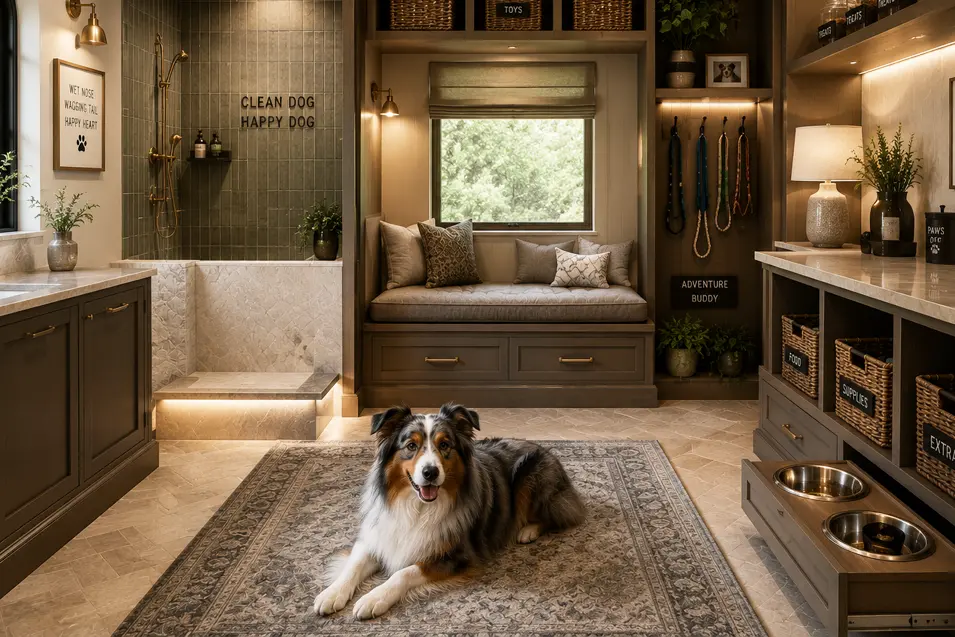
We have given dogs their own bedrooms before.
Beautiful ones, actually.
But eventually we started wondering whether we had been thinking too small.
Why give the dog a spare bedroom?
Why not give him the master bedroom?
Not a human bedroom with a dog bed pushed into the corner.
Not a normal bedroom where someone happens to have left a basket of toys beside the dresser.
We mean the entire room.
The best bedroom in the house, designed around the dog who lives there.
And once you accept that premise, bedrooms start becoming considerably more interesting.
The Industrial Loft

Apparently the dog got the loft.
Exposed brick, concrete, steel and enormous artwork give this bedroom the kind of character that doesn’t come from buying everything at once.
The bed is lower and better proportioned for its four-legged owner, while storage at the foot handles the less glamorous realities of balls, blankets and toys.
Leashes and collars have their place.
So does the dog.
And somehow none of it makes the room feel like a pet store.
Remove the dog and this would still be a terrific bedroom.
Put him back in and suddenly the entire thing makes sense.
The Former Model

She doesn’t own much.
She doesn’t need to.
One exceptional leather leash. Two collars displayed like watches in a jewellery store. Four toys that appear to have survived a meeting with a luxury fashion house. Even her feeding station looks commissioned rather than purchased.
And hanging above it all is a framed advertisement from an earlier chapter of her life.
Yes, that’s her.
Paris, 2023.
She doesn’t like to make a big thing about it.
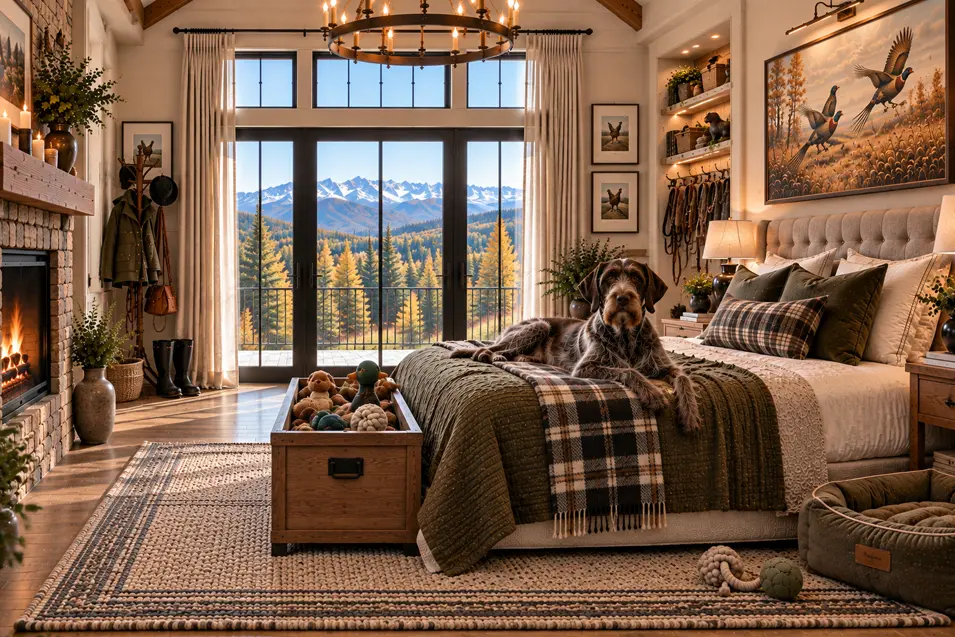
The Log Cabin

This dog doesn’t need polished marble.
He has timber beams, plank floors, a stone fireplace and a fire waiting for the temperature to drop.
A broad, low wooden bed feels more appropriate here than a towering human mattress, leaving room for an old chest, a comfortable place beside the fire and the things required for a life spent outdoors.
Blankets are piled where they can actually be used.
A lead and dog coat wait near the door.
There may be a little mud involved.
Nobody seems particularly concerned about it.
This isn’t luxury because it cost a fortune.
It’s luxury because on a cold winter night, there may be nowhere either of us would rather sleep.
The Inherited House

We have absolutely no explanation for this one.
Somewhere along the way, a dog appears to have inherited the house.
And for the most part, he left the master bedroom exactly as he found it.
The old paintings stayed.
So did the faded rugs, beautiful furniture and enormous antique bed that had probably been in the family considerably longer than he had.
There were, however, a few practical improvements.
The legs came off the bed.
Apparently jumping three feet into the air every night seemed unnecessarily complicated.
The old trunk at the foot of it lost its lid and became toy storage. Leashes replaced a few things on the hooks by the door. An antique ceramic bowl found a considerably less dignified second career as a water dish.
And somewhere among the inherited paintings, one newer piece of art appeared.
His taste, presumably.
It’s still very much the bedroom he inherited.
It’s just becoming increasingly obvious who owns the house now.
The Contemporary Art Collector

Some dogs collect tennis balls.
This one apparently collects art.
The architecture is restrained, the furniture sculptural and the palette relatively quiet until the artwork arrives and completely changes the room.
Colour appears where it matters.
One extraordinary painting can do more than a dozen meaningless pieces scattered around the walls.
Even the dog’s bed becomes part of the architecture: low, wide and deliberately proportioned for the animal using it.
Toy storage disappears into cabinetry.
Collars and leads are organized rather than displayed as decoration.
Nothing screams “dog room.”
It simply happens to be an exceptional room designed for someone who sleeps on four legs.
The White Room

There is nowhere for bad design to hide in a white room.
So there isn’t any.
White plaster, pale oak, cream upholstery and enough daylight to make the entire room feel almost weightless. The bed is wonderfully simple and unapologetically comfortable, while one enormous piece of art does nearly all the decorating.
Even the dog’s things have been edited down.
A beautifully designed feeding station sits near the window, while collars and leashes disappear into the walk-in closet rather than becoming wall decoration.
Apparently minimalism is much easier when you don’t own clothes.
The Small Condo

He doesn’t have a huge master bedroom.
He has a very clever one.
In a genuinely compact condo, the bed has been designed specifically for the room rather than squeezed into whatever space remained. Storage is built underneath, possessions disappear into the architecture and every awkward inch has been put to work.
Nothing feels miniature.
Nothing feels compromised.
It turns out you don’t need 600 square feet to take over the master bedroom.
You just need to be very clear about whose bedroom it is.
The Black Room

Subtle wasn’t really the objective.
Matte charcoal wraps the room almost completely, interrupted by a pale floor, a brilliant white bed and one enormous piece of figurative art.
That’s about it.
There is no rustic timber, no theatrical gothic furniture and absolutely nothing resembling a bachelor pad.
It’s sharp, graphic and remarkably disciplined.
The dog, naturally, considers himself the most important piece of contrast in the room.
He may have a point.
The Concrete Minimalist

Concrete.
Pale timber.
White linen.
A dog.
There are perhaps four other things in the entire room, and every one of them had to earn its place.
The result isn’t unfinished. It’s extraordinarily deliberate—a master bedroom where material, proportion and light have been asked to do the work usually handed to decoration.
His possessions are equally restrained.
He owns what he needs.
Admittedly, what he needs appears to have been selected by an architect.
The Private Boutique

He doesn’t have a closet.
He has a boutique.
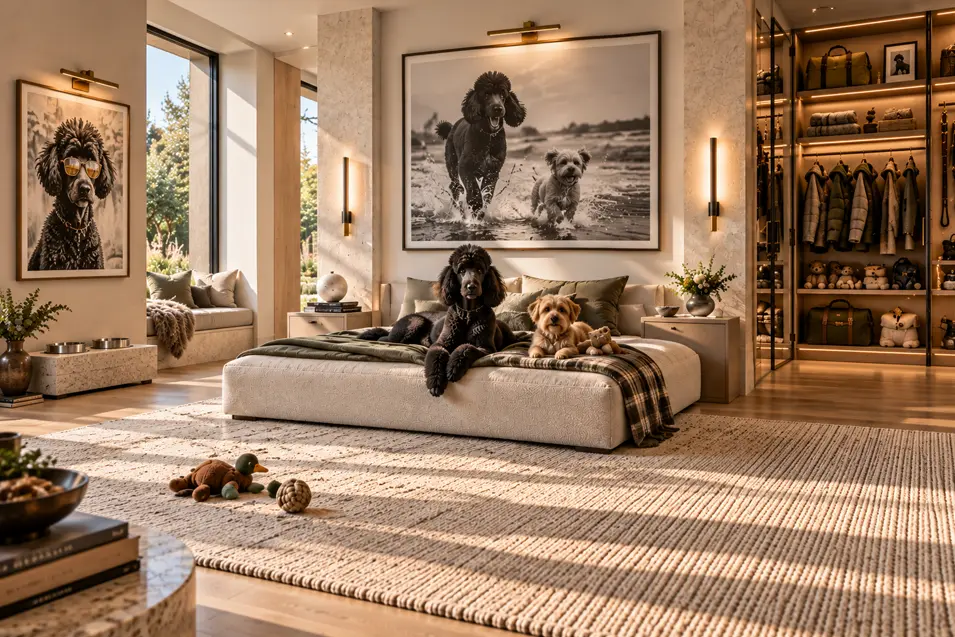
Behind illuminated glass, coats hang beside harnesses, leather leashes are arranged like accessories and toys, blankets and travel gear occupy shelves normally reserved for shoes and handbags.
There isn’t a human shirt anywhere.
The bedroom itself is polished and sophisticated, allowing the wardrobe to provide most of the personality.
Nothing is for sale.
Although judging by the display, he appears perfectly comfortable with retail pricing.
The Sculptural Modern

Most of the room knows when to be quiet.
The architecture is restrained. The bed is beautifully simple. The palette barely raises its voice.
And then there is that piece.
Part furniture, part sculpture and the sort of object that makes guests immediately ask who designed it, it provides virtually all the drama the room needs.
The dog has never answered the question.
Whether that’s because he enjoys the mystery or simply doesn’t know is difficult to establish.
Either way, it looks fantastic beside his bed.
The High-End City Condo

You can tell this room was expensive without anything shouting about it.
Walnut millwork, beautifully tailored upholstery, precision lighting and details that become more impressive the closer you look.
Beyond the window, just enough city appears to remind you where you are.
Inside, everything has been designed around the actual resident—including a bed that looks less like something from a pet store and more like something specified by an interior designer.
Which, presumably, it was.
Some dogs have a bed in the condo.
This dog has the condo.
The Warm Modern Room

Modern doesn’t have to mean cold.
Cream textiles, walnut, caramel leather and soft daylight give this room warmth without sacrificing its clean contemporary lines.
The dog’s bed is generous, beautifully upholstered and positioned exactly where the best light reaches it.
Coincidence seems unlikely.
Everything feels sophisticated, but nothing feels precious.
Which is probably wise when the person occupying the master bedroom occasionally comes inside with wet feet.
The Tiny Old-House Master

The window isn’t enormous.
The walls aren’t perfectly symmetrical.
There is an awkward little alcove nobody quite knows what to call.
And somehow, it all works.
Rather than fighting the old house, the room uses its peculiarities: a custom bed fits where ordinary furniture wouldn’t, storage slips into otherwise wasted space and the original trim becomes part of the design.
It’s small, intelligent and completely convincing.
Proof that taking over the master bedroom has very little to do with square footage.
The Colour Room

One colour was enough.
A deep, confident architectural shade transforms the room while everything around it remains remarkably restrained.
There are no matching accessories scattered around to explain the decision.
No cushions desperately trying to participate.
No collection of objects repeating the colour because somebody got nervous.
Just one bold move, excellent proportions and a dog who seems entirely comfortable living with commitment.
The Coastal Minimalist

There isn’t a seashell anywhere.
No anchors.
No rope.
No blue-and-white striped cushions announcing that water exists nearby.
Instead, the coast arrives through washed timber, pale natural materials, soft moving light and the slightest glimpse of the landscape beyond.
The room feels calm because the place itself is calm.
And somewhere in the middle of all that restraint is a dog who has secured the best bedroom in the house.
Apparently beachfront property works the same way in every species.
The Movie Star Suite

And then there is this dog.
Apparently the movies went well.
The bed is enormous.
The bedroom is glamorous.
There’s a dressing area, beautiful lighting, upholstered furniture and perhaps a view that makes you question some of your own career decisions.
Small stairs provide easy access to the bed because there is no reason to sacrifice dignity at bedtime.
A secondary dog bed offers another place to sleep, although we suspect it is largely decorative.
There are drawers for toys, storage for coats and enough collars to suggest that somebody has a stylist.
Most dogs are thrilled when you bring home a new squeaky toy.
This one may have an agent.
The Colourful Eccentric

There was never any chance this dog was choosing beige.
Wallpaper meets painted trim.
Vintage furniture sits beside something completely contemporary.
Art is everywhere.
Colour turns up on the ceiling, the lamps, the rug and probably somewhere we haven’t noticed yet.
Yet somehow it works.
The dog’s sleeping area is tucked into the architecture rather than dominating the middle of the room, freeing up space for everything else that gives the bedroom its personality.
It isn’t trying to look expensive.
It’s trying to be interesting.
Mission accomplished.
The Lake House

Some bedrooms are designed around television placement.
This one is designed around the window.
Because when your daily schedule includes swimming, dock inspections, squirrel surveillance and monitoring every boat that passes the property, the view matters.
The dog’s bed occupies one of the best positions in the room.
Naturally.
A basket holds towels and toys.
A lead waits near the door.
There is another comfortable spot for drying off after an enthusiastic swim that probably wasn’t authorized.
The room is relaxed, bright and slightly imperfect.
Exactly as a good lake house should be.
The Converted Stable

Nobody tried too hard to polish this one.
That’s why we like it.
Old stone, heavy timber and the scars of the building’s previous life give the bedroom more character than new construction could easily reproduce.
The dog’s bed is almost mattress-like: broad, simple, low to the floor and pushed against the old stone wall.
That leaves room for a wood stove, storage, an old bench and perhaps a piece of furniture that has survived several generations of country dogs.
Dog gear lives in what might once have been a tack cabinet.
Nothing is particularly delicate.
Which is useful when the owner occasionally comes home wearing half the field.
The Mid-Century Modern Dog

Somewhere in California, a dog has discovered built-ins.
And life will never be the same.
Warm timber, strong geometry, period lighting and graphic artwork give this room its distinctly mid-century character.
But instead of dropping a conventional bed into the middle of it, the dog’s sleeping platform becomes part of the cabinetry.
Drawers underneath hide toys, blankets and all the mysterious objects dogs accumulate.
A sunny lounging spot occupies another part of the room.
Everything has a purpose.
Everything has a place.
Even the tennis ball that will inevitably end up underneath something.
The Entire Primary Suite

Eventually, giving the dog the master bedroom wasn’t enough.
He took the suite.
There is a sleeping area, a fireplace, a sitting space, built-in storage and perhaps a window seat overlooking his private piece of the garden.
There are several places to nap because committing to one seems unnecessarily restrictive.
One cabinet holds toys.
Another handles collars, leads, coats and the collection of things required by a dog whose lifestyle has become surprisingly complicated.
And after all that space, all that architecture and all those carefully considered places to sleep, his actual bed might be relatively small.
Because that is the part we sometimes forget when designing spaces for dogs.
They don’t necessarily want what we want.
They want what works for them.
The Hunting Dog

He doesn’t decorate around a hobby.
He decorates around a lifestyle.
His coats and field gear hang beside the leashes. Duck decoys occupy shelves. A collection of suspiciously realistic birds has migrated onto the rug.
And above his bed hangs a photograph from one of those mornings when getting wet, muddy and disappearing into the reeds was considered a very successful day.
His owner likes to say they go hunting together.
The bedroom suggests one of them takes it considerably more seriously.
Perhaps We Have Been Designing Dog Bedrooms Backwards
There is an easy way to make a bedroom “for a dog.”
Take a normal bedroom.
Add a dog bed.
Put a basket of toys in the corner.
Hang something dog-related on the wall.
Done.
But that’s not nearly as interesting as asking a different question:
If this particular dog actually owned the best bedroom in the house, what would the room become?
A mountain dog might want warmth, heavy materials and somewhere to collapse after being outside.
A lake dog wants the view.
A small older dog might need a lower bed or stairs.
A city dog needs storage for leads, coats and everything required before heading downstairs.
Another dog might simply inherit an enormous four-poster bed and decide that this arrangement is perfectly reasonable.
That’s what makes these rooms work.
The dog isn’t an accessory added after the decorating was finished.
The life of the dog is part of the design.
And perhaps that’s the idea worth stealing for our own homes.
Not necessarily giving the dog the master bedroom.
Although judging by some of these rooms, we can understand the temptation.