Dogs have built a fairly impressive résumé over the years.
They herd sheep. Guard homes. Find missing people. Detect explosives. Guide people through busy cities. Some can apparently identify everything from low blood sugar to contraband hidden inside luggage.
But furniture?
As far as we know, they’ve largely stayed out of the industry.
Perhaps that’s been an oversight.
Because if dogs ever wandered into the trades, learned to use the tools and eventually decided to build furniture using the materials they understood best, we suspect the results would be spectacular.
A carpenter wouldn’t simply build a wooden chair. He’d turn joinery into sculpture.
An electrician would look at several hundred feet of copper wire and wonder why nobody had made a lounge chair from it.
A welder would build a sofa capable of surviving the collapse of the house around it.
And somewhere, inevitably, a Chihuahua would be standing beside the finished product insisting everything had been done under his supervision.
Welcome to the world’s first furniture workshop run entirely by dogs.
The Welder
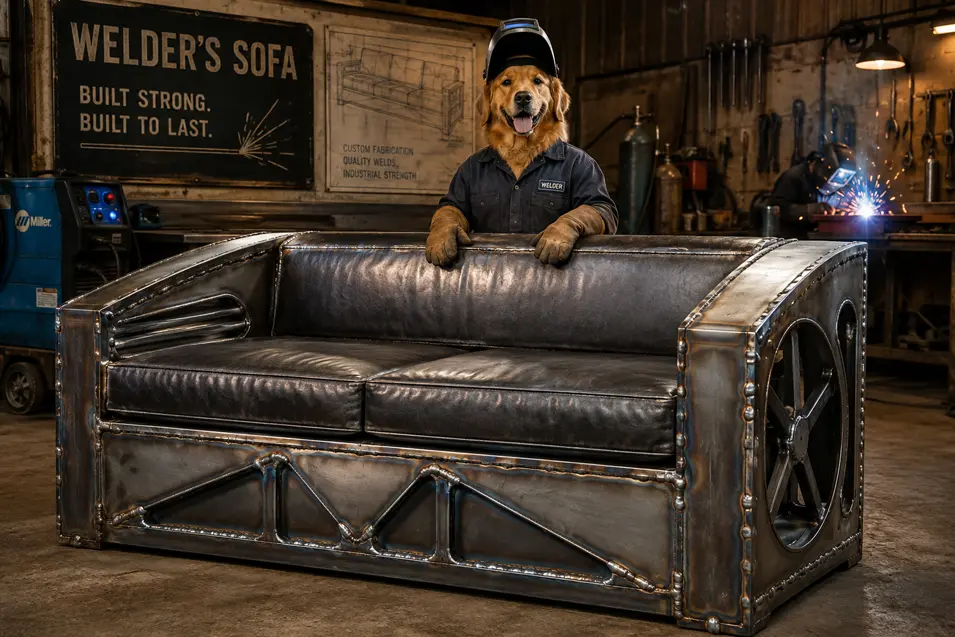
Nobody asks the welder whether his sofa is sturdy.
They can see that from across the shop.
The enormous piece begins with a fabricated steel frame constructed from plate, tubing and carefully formed structural supports. Instead of hiding the fabrication, the design celebrates it. Weld beads remain visible along the edges, subtle heat colouring surrounds several joints and beautifully ground sections of steel catch the workshop lights.
Dark leather cushions soften the industrial structure without disguising what it is.
Nearby, sparks shower across the concrete floor as the final piece of steel is attached.
When the work is finished, the welder lowers his helmet, wipes his gloves on a battered pair of coveralls and stands proudly behind his creation.
He’s a Boxer.
Of course he is.
The sofa probably weighs 600 pounds.
It may also be the first piece of furniture ever sold with a structural engineering certificate.
The Electrician
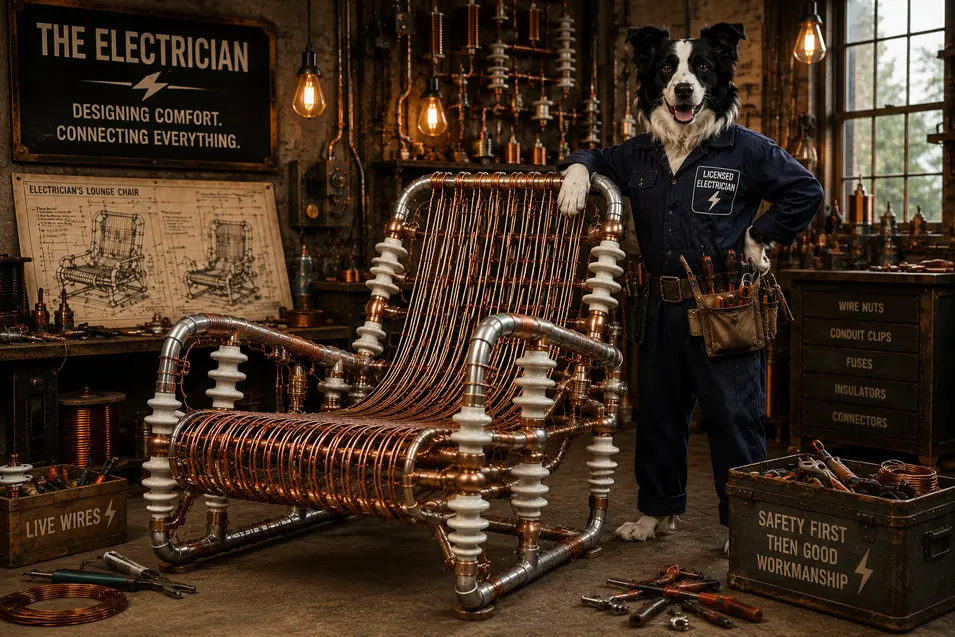
The electrician has spent his entire career looking at copper wire, conduit and ceramic insulators.
Eventually, an idea occurred to him.
A lounge chair begins with polished metal conduit bent into sweeping arms and a surprisingly elegant frame. Hundreds of strands of copper form the seat and back, carefully tensioned and arranged like an enormous piece of woven metal.
Large white ceramic insulators appear throughout the structure, becoming decorative spacers, supports and architectural details.
The result sits somewhere between industrial furniture, sculpture and a piece of electrical infrastructure somebody accidentally made comfortable.
Standing beside it is a black-and-white Border Collie wearing dark work coveralls and a heavily loaded tool belt.
Naturally, everything is perfectly aligned.
Behind him, coils of copper cover the workbench, electrical drawings are pinned to the wall and half-finished experiments suggest this isn’t going to be his last chair.
He rests one paw on the finished piece and looks directly at the camera.
Good connections matter.
Apparently that applies to furniture too.
The Carpenter
If there is one dog in the building who believes everyone else is making this unnecessarily complicated, it’s the carpenter.
He needs wood.
That’s about it.
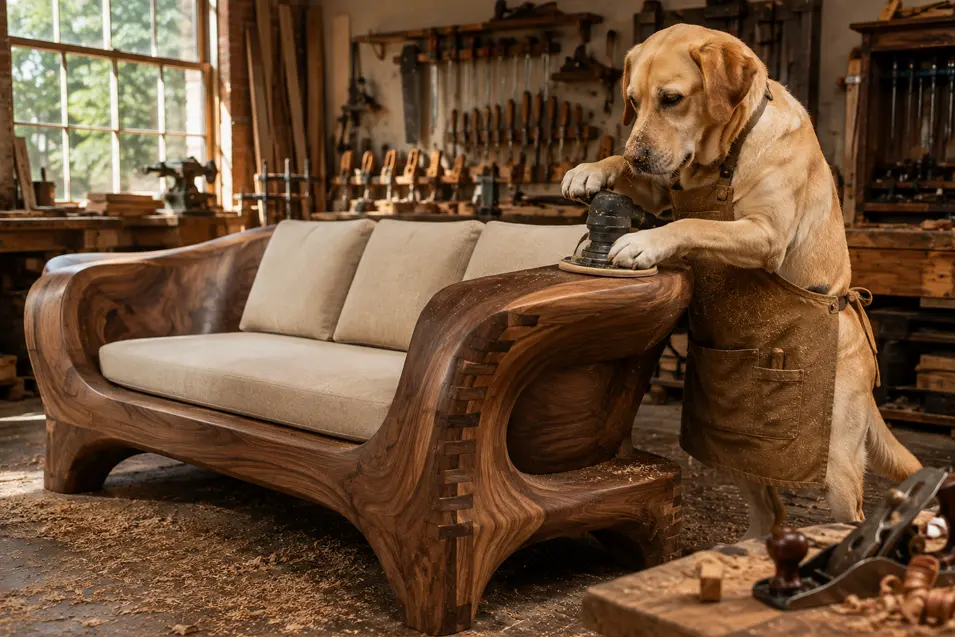
A massive slab of walnut becomes the starting point for a sculptural sofa whose arms, legs and frame appear to flow continuously from one piece into another.
There are no obvious screws. No exposed brackets. No unnecessary decoration.
Instead, traditional joinery becomes the decoration.
Beautiful dovetails appear at the corners. Carefully fitted mortise-and-tenon joints connect the structural elements, while hand-shaped curves soften areas that will eventually meet the body.
A Labrador stands at the workbench sanding one enormous arm smooth.
Sawdust covers his apron.
More sawdust covers his nose.
Behind him, hand planes, chisels and clamps line the wall while afternoon sunlight pours through tall workshop windows.
He doesn’t pose for the photograph.
He’s still sanding.
Apparently the arm isn’t quite right yet.
The Plumber
Most people see copper pipe beneath a sink and think about water.
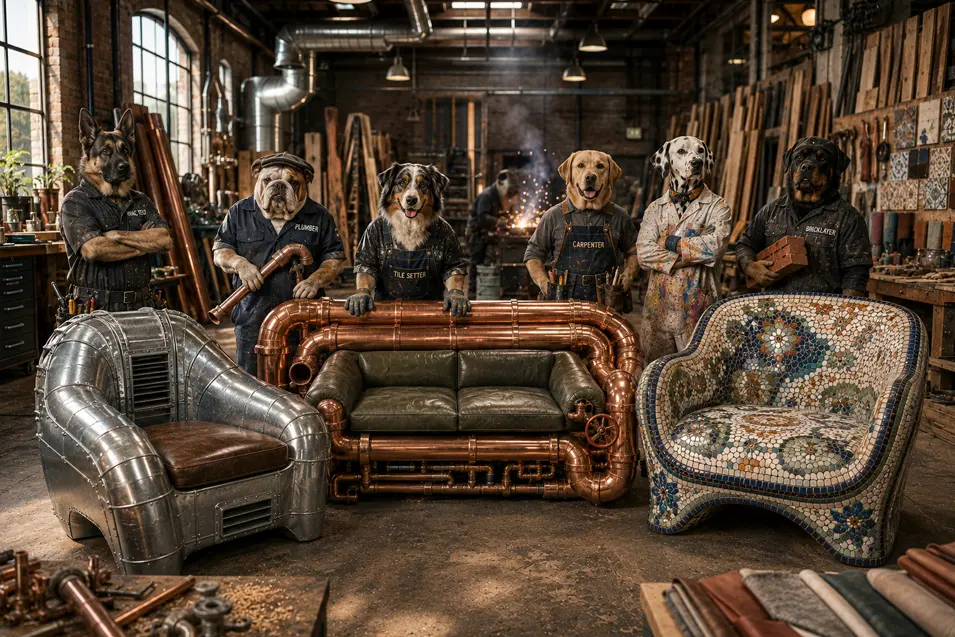
The plumber sees a sectional.
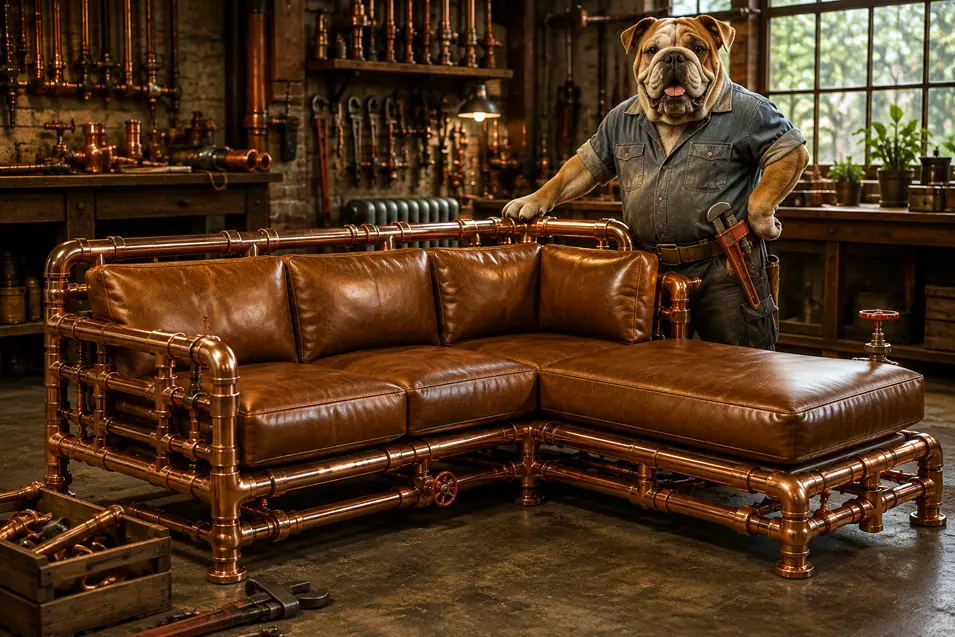
Lengths of polished copper pipe create the entire exposed skeleton of an unexpectedly sophisticated sofa. Elbows form sweeping corners. Tees become structural intersections. Valves appear in places where absolutely no valve is necessary, other than the fact that they look fantastic.
Thick cognac leather cushions sit inside the copper framework.
The metal will eventually develop a natural patina, meaning the furniture will slowly change character as it ages.
A stocky English Bulldog stands behind the finished sectional wearing work trousers, heavy boots and a slightly battered work shirt.
A pipe wrench hangs from his belt.
He looks extraordinarily pleased with himself.
There is absolutely no plumbing connected to the sofa.
He installed two shutoff valves anyway.
The Bricklayer
There are easier ways to build a sofa.
The bricklayer isn’t interested in them.
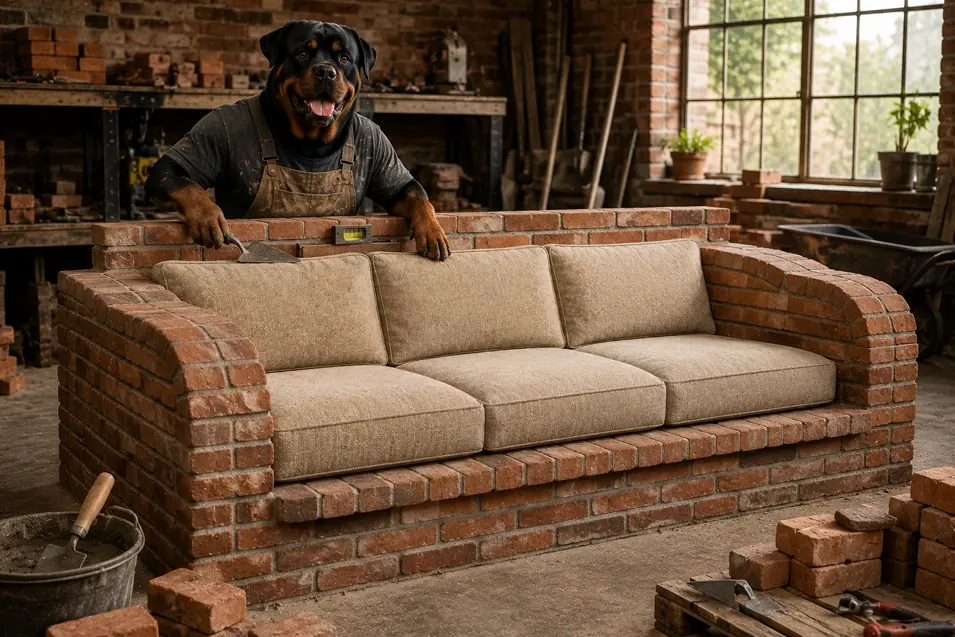
A low masonry base rises from the workshop floor, carefully constructed from warm handmade brick. Instead of resembling part of a building, however, the brickwork curves upward to create broad arms and wraps gently around the back.
The mortar joints are immaculate.
Deep upholstered cushions in soft neutral fabric sit within the structure, transforming several hundred pounds of masonry into something unexpectedly inviting.
A muscular Rottweiler works on the final corner, tapping one last brick into alignment before checking it with a small spirit level.
Later, he stands behind the completed sofa wearing dusty work clothes and looking extremely satisfied.
Moving the sofa will require four people.
Possibly six.
The bricklayer considers this somebody else’s problem.
The HVAC Technician
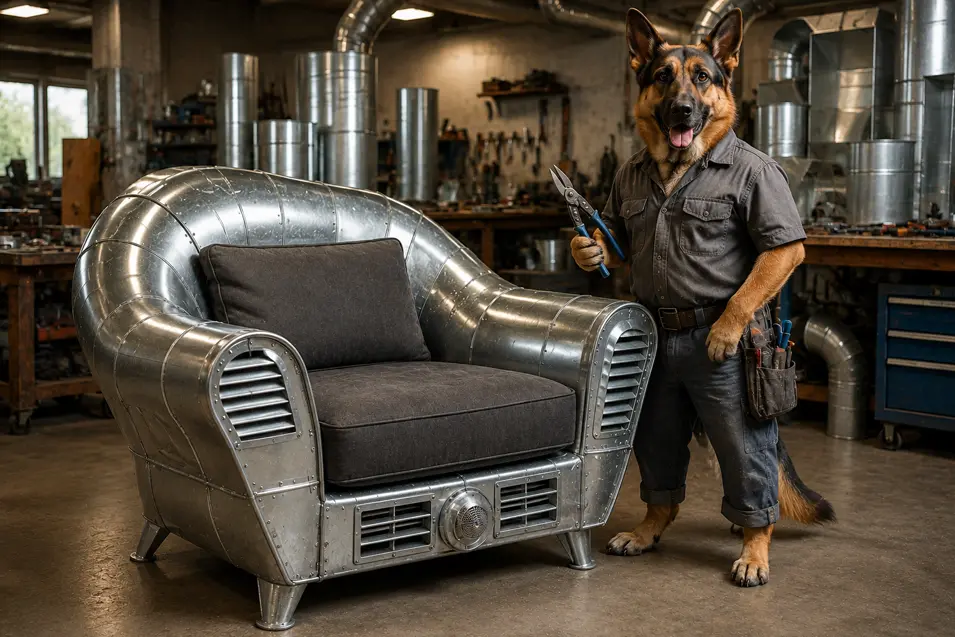
Sheet metal was never supposed to look this comfortable.
The HVAC technician begins with galvanized ductwork, curved transitions, vents and beautifully fabricated sections of folded metal.
Then things get strange.
Large sweeping ducts become the arms of a futuristic lounge chair. A broad curved section forms the back. Narrow ventilation slots create decorative details along the sides, while exposed rivets make the construction part of the design.
Inside sits a perfectly fitted charcoal cushion.
A German Shepherd wearing work trousers and a company shirt stands beside the chair holding a sheet-metal snip.
Behind him, the workshop is filled with ductwork in various stages of fabrication.
The chair looks like something that escaped from the mechanical room of an exceptionally expensive spaceship.
There is even an adjustable vent beneath the seat.
Nobody knows why.
The German Shepherd refuses to remove it.
The Tile Setter
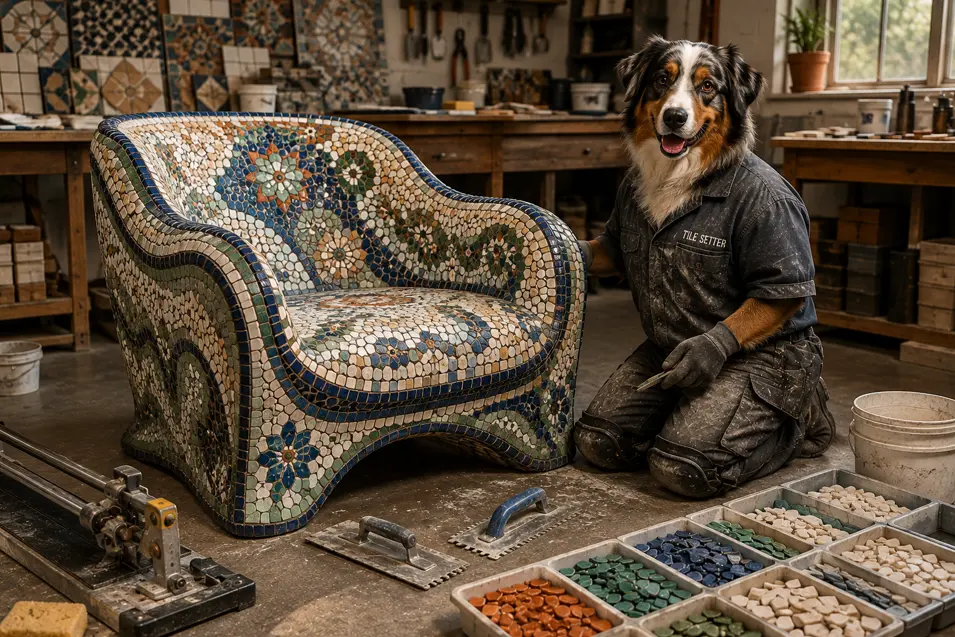
The tile setter approaches furniture differently.
She doesn’t really build the chair.
She covers every available inch of it.
A simple sculptural lounge chair becomes the canvas for thousands of individually placed pieces of tile. Deep blues, greens, creams and burnt oranges create a complex mosaic that flows continuously across the arms, back and base.
From across the room, it looks almost like patterned fabric.
Up close, the craftsmanship becomes extraordinary.
Every curve required hundreds of tiny cuts. Every transition had to be planned. Even the grout lines contribute to the overall pattern.
An Australian Shepherd kneels beside the chair setting the final pieces into place.
Several tile cutters, buckets and carefully organized trays surround her.
Later, cleaned and polished, the finished chair glows beneath the studio lights.
She sits beside it for the photograph.
Nobody is allowed to use it for another 24 hours.
The grout is still curing.
The Concrete Finisher
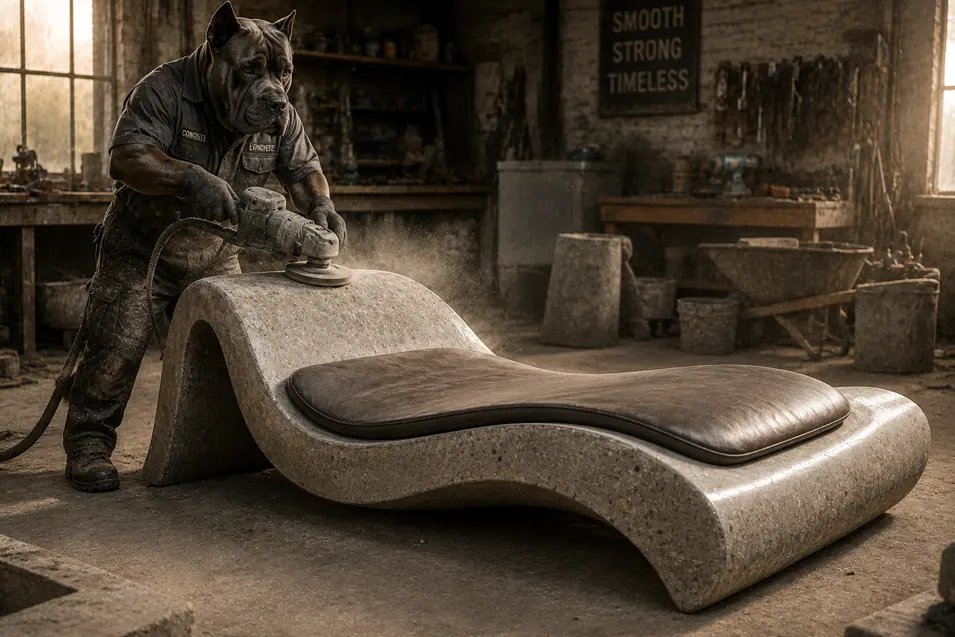
Concrete furniture has one obvious disadvantage.
The concrete finisher considers that a challenge rather than a warning.
His chaise begins as a flowing reinforced form that sweeps upward from the floor in one continuous movement. There are no separate legs, arms or visible structural components.
Just one enormous sculptural shape.
After the forms are removed, hours of grinding and polishing reveal subtle aggregate beneath the surface. The finished concrete becomes remarkably smooth, with rounded edges and a soft satin sheen.
A powerful Cane Corso works a polishing machine across the final section while fine dust hangs in the workshop light.
The completed chaise looks less like conventional furniture and more like something commissioned for the lobby of a modern art museum.
A single fitted leather pad provides just enough comfort.
It is elegant.
It is indestructible.
It also weighs approximately as much as a small automobile.
Delivery is not included.
The Painter
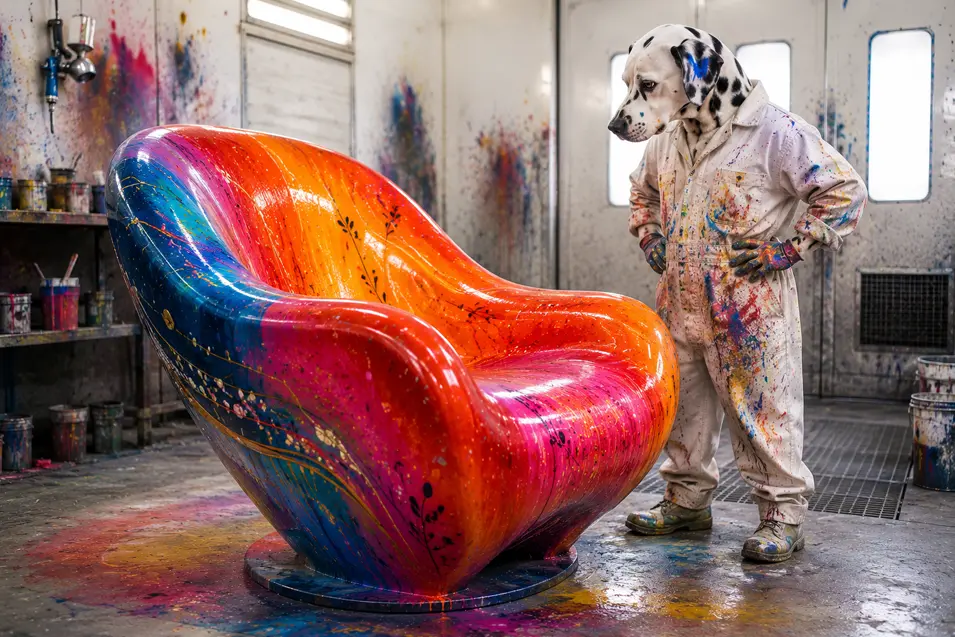
Everyone else has spent days arguing about materials and structural engineering.
The painter wants colour.
She starts with a beautifully shaped but completely unfinished chair and wheels it into an immaculate spray booth.
Then restraint disappears.
Layers of saturated orange, crimson, pink, blue and yellow sweep across the frame in carefully controlled gradients. Smaller hand-painted details appear over the surface, turning the entire chair into something between furniture and contemporary art.
A Dalmatian wearing paint-splattered white coveralls studies the piece from several feet away.
There is colour on her gloves.
Colour on her boots.
Colour on the floor.
Somehow there is even a blue streak across one ear.
The finished chair is outrageous.
It is also spectacular.
In a quiet neutral room, it would be the only thing anybody noticed.
Which is precisely the point.
The Upholsterer
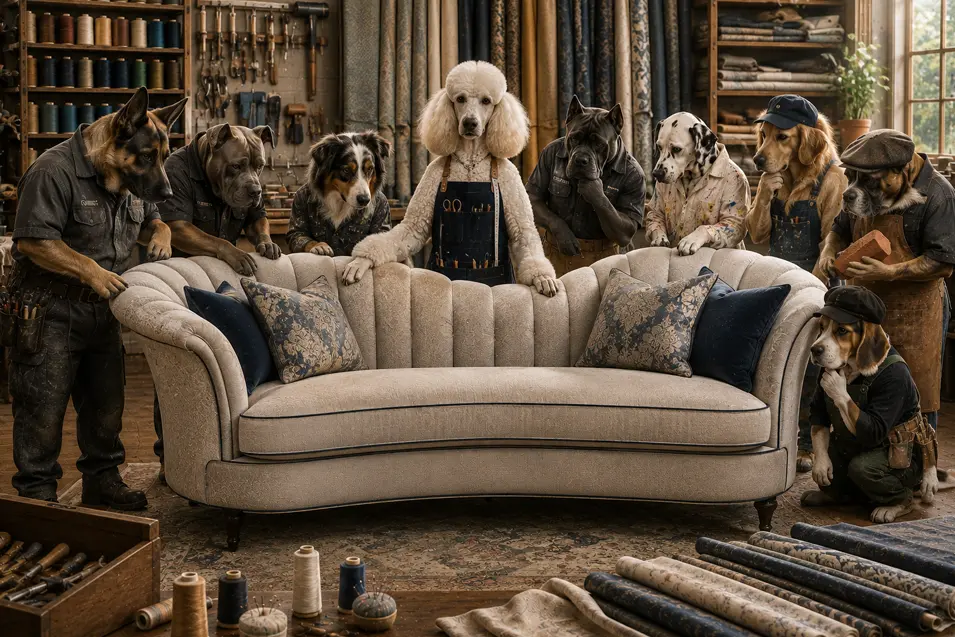
After visiting the rest of the workshop, the upholsterer’s corner feels suspiciously civilized.
There are rolls of beautiful fabric instead of steel plate.
Scissors instead of grinders.
Thread instead of electrical wire.
And sitting in the middle of it all is an extraordinarily elegant sofa.
A Standard Poodle carefully stretches fabric across the back while wearing a tailored work apron filled with chalk, needles and small upholstery tools.
The sofa combines deep channel tufting, gently curved arms and beautifully tailored cushions. Contrasting piping follows every important line. The pattern across the back has been matched so precisely that it appears continuous from one panel to the next.
Nothing is exaggerated.
Nothing is unnecessarily complicated.
It is simply exceptionally well made.
Eventually, the other nine tradespeople wander over to inspect it.
The welder studies the frame.
The electrician looks underneath for wiring.
The plumber seems disappointed by the complete absence of valves.
The bricklayer asks how much it weighs.
The upholsterer ignores all of them.
She straightens one cushion, steps behind the sofa and poses for the photograph.
Somebody around here had to make furniture people could actually put in their living room.
Built by Dogs
Would we actually recommend a chair made from electrical insulators?
Probably not.
Moving the bricklayer’s sofa would be a nightmare, the concrete chaise may require reinforced flooring and we’re reasonably certain furniture shouldn’t contain operational plumbing valves.
But that’s also what makes imagining these pieces so much fun.
Every trade develops its own relationship with materials.
A welder understands steel differently than a carpenter understands walnut. A plumber sees possibilities in copper that most of us never consider. A tile setter thinks in patterns, an upholsterer thinks in fabric and a painter understands just how dramatically colour can transform an ordinary object.
Give those skills to ten dogs with fully equipped workshops and apparently this is what happens.
Furniture becomes craftsmanship.
Craftsmanship becomes personality.
And personality becomes something worth looking at.
Although before placing an order, we’d probably still ask whether the electrician’s chair is grounded.