There are certain objects humans probably shouldn’t be allowed to design.
Fire hydrants may be one of them.
We’ve had plenty of time.
For more than a century, we’ve been installing essentially the same little red or yellow metal posts along our streets while completely ignoring the opinions of their most enthusiastic users.
Dogs.
Perhaps it’s time we let them have a go.
Not at the water system, obviously.
We’re not completely irresponsible.
But the design?
Absolutely.
So we imagined what might happen if dogs were invited into the room with architects, industrial designers and urban planners and given one simple assignment:
Redesign the fire hydrant.
Things got out of hand remarkably quickly.
The Luxury Hydrant
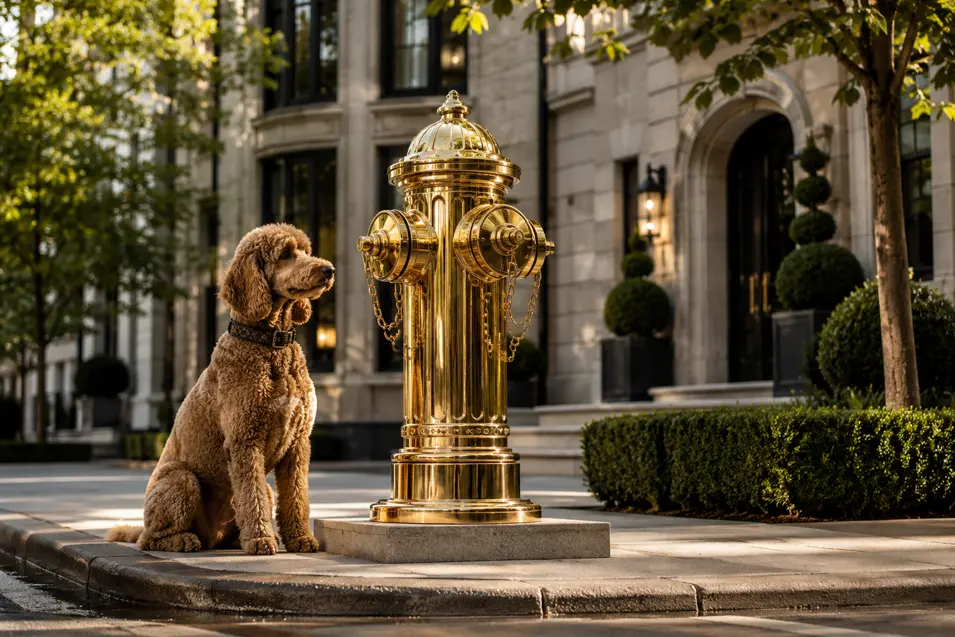
Naturally, somebody decided the fire hydrant needed to become considerably more expensive.
Gone is the chipped municipal paint.
In its place is polished brass, beautifully machined fittings and proportions that wouldn’t look out of place on an expensive piece of Italian furniture.
The hydrant sits on a perfectly landscaped city corner surrounded by limestone, clipped greenery and architecture that strongly suggests nobody nearby is particularly concerned about property taxes.
Functionally, it does exactly what every other fire hydrant does.
But it looks spectacular doing it.
A well-dressed dog pauses beside it for an inspection.
Apparently, municipal infrastructure can have curb appeal.
The Great Dane Hydrant
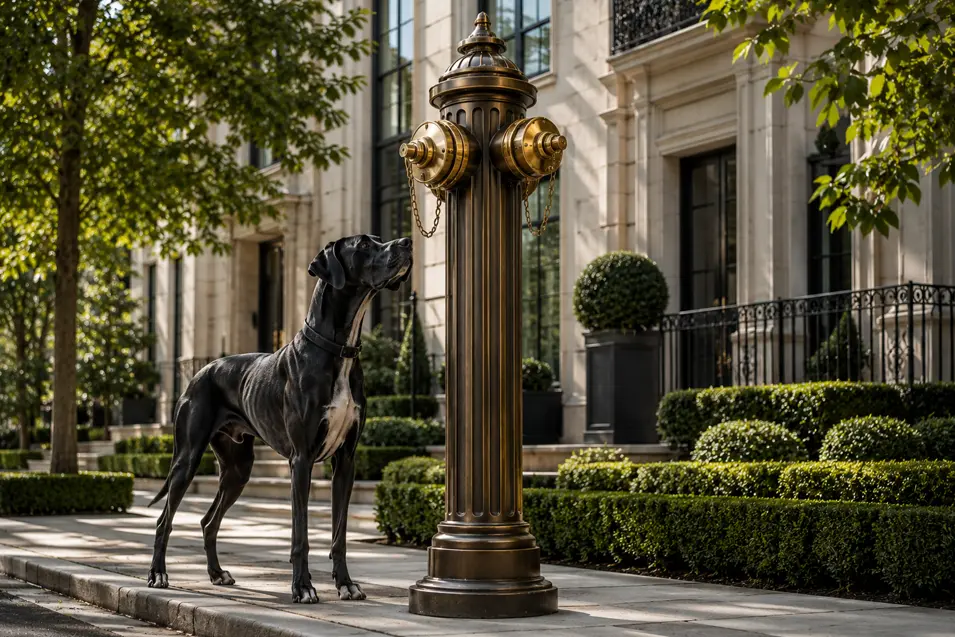
For decades, fire hydrants have been designed without properly considering one of the most important principles in design:
Ergonomics.
The Great Dane delegation noticed immediately.
Their solution is an unusually tall, beautifully proportioned hydrant that rises from the sidewalk almost like an architectural column.
Everything has been moved upward.
The connections are higher.
The body is taller.
Even the decorative cap has been elevated to a considerably more respectable height.
For the first time in municipal history, Great Danes feel seen.
Chihuahuas have already filed a complaint.
The Dachshund Hydrant
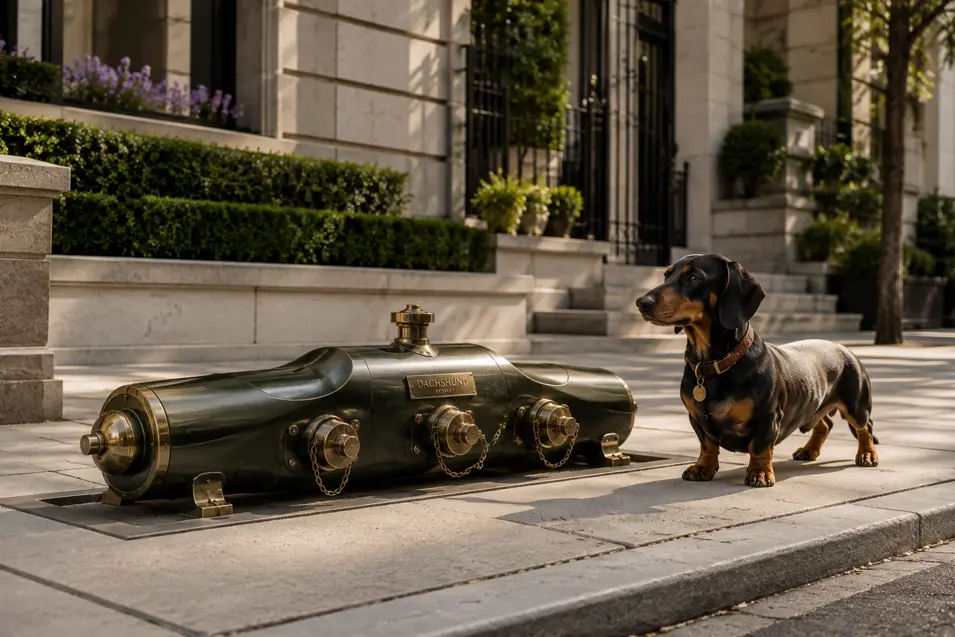
That complaint resulted in the next prototype.
The Dachshund Hydrant sits barely above the ground.
Long, low and beautifully engineered, its horizontal body contains several compact connections beneath a sculpted metal shell.
It looks less like a conventional fire hydrant and more like something an expensive European design studio might produce after being given far too much creative freedom.
Beside it stands a Dachshund.
Finally.
Infrastructure at eye level.
The Hydrant Tree
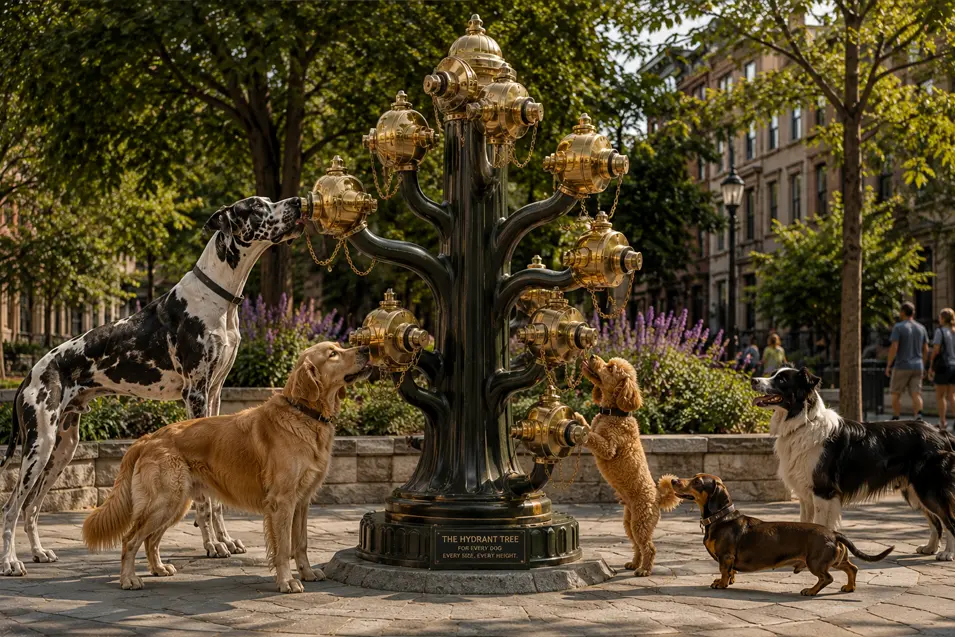
Eventually somebody asked the dangerous question:
Why does a fire hydrant need to have only one hydrant?
Nobody stopped the meeting.
The result is the Hydrant Tree.
A heavy central trunk rises from a landscaped plaza before branching outward into multiple hydrant-like connections positioned at different heights.
Small dogs have lower branches.
Large dogs have higher ones.
Several can approach simultaneously.
From a distance, the entire structure looks like an enormous piece of contemporary public art.
Urban planners describe it as unnecessary.
Dogs describe it as progress.
The Mid-Century Modern Hydrant
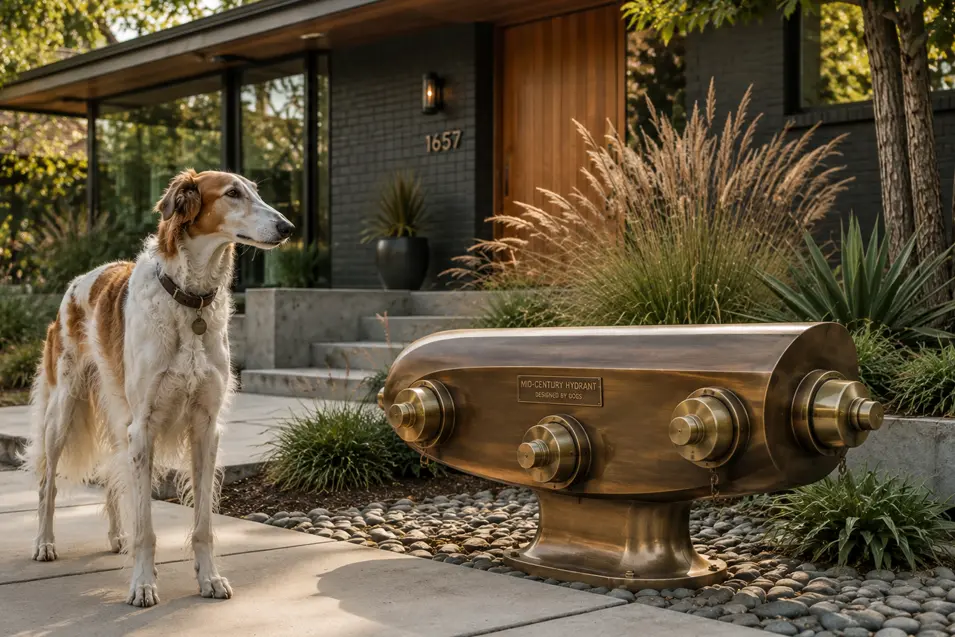
Some dogs have been spending too much time around beautiful furniture.
It shows.
The Mid-Century Modern Hydrant replaces the usual chunky municipal proportions with smooth curves, restrained hardware and a warm bronze finish.
Installed outside a beautiful 1960s-inspired home, it sits among ornamental grasses, concrete pavers and mature trees.
There isn’t a bright red surface anywhere.
There isn’t even an exposed bolt unless absolutely necessary.
For perhaps the first time ever, somebody walking past a house stops and says:
“That’s a beautiful fire hydrant.”
The dog who designed it pretends not to hear.
The New York Hydrant
Not every hydrant needs reinventing.
Some simply deserve a little respect.
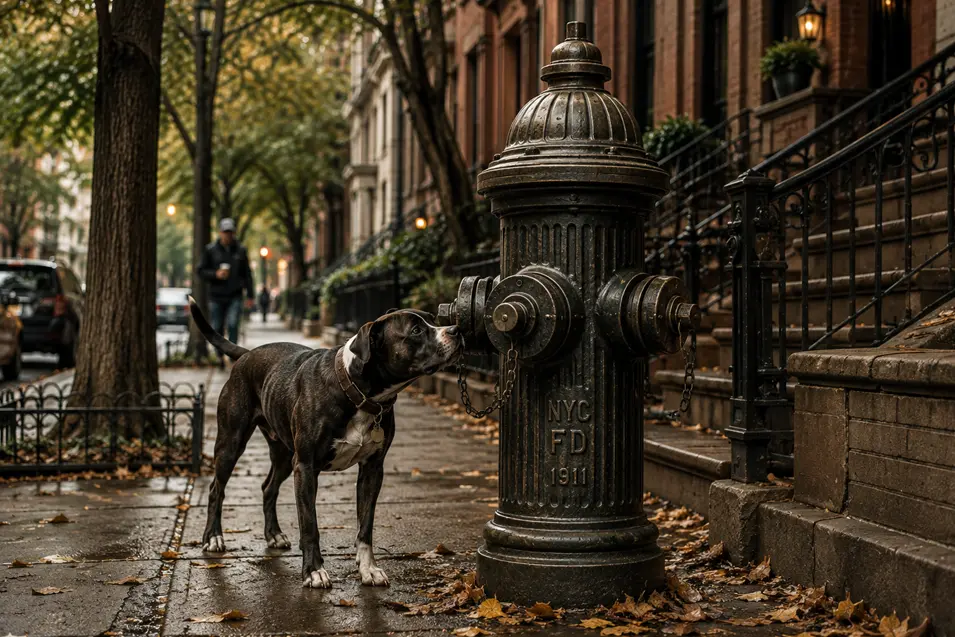
The New York Hydrant begins with the familiar heavy cast-iron shape found along generations of city streets, then adds subtle Art Deco detailing, beautiful proportions and the kind of patina that cannot be manufactured convincingly.
It stands beside an old brownstone beneath mature street trees.
Leaves gather around its base.
People pass carrying coffee.
Traffic moves beyond it.
And another neighbourhood dog arrives to inspect a piece of infrastructure that countless dogs before him have already thoroughly reviewed.
Some designs become classics for a reason.
The Country Hydrant
City dogs aren’t the only ones represented on the design committee.
The country dogs want something too.
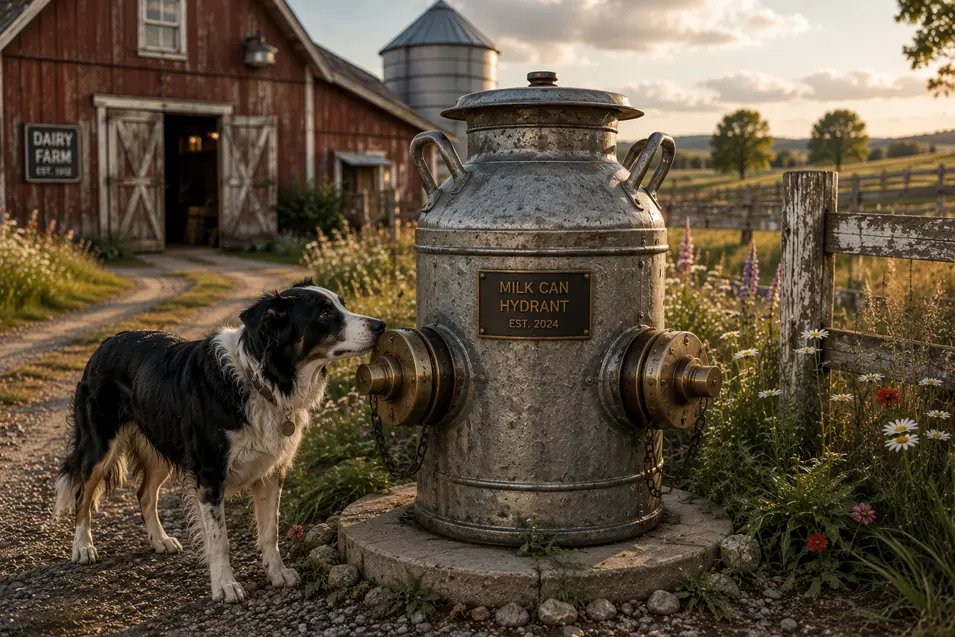
Their hydrant is built from thick weathered steel and stone, positioned beside a gravel lane surrounded by fencing, tall grasses and open fields.
At first glance it resembles an old piece of agricultural equipment that has been sitting there for generations.
Then you notice the fittings.
This isn’t municipal infrastructure trying to disappear into the countryside.
It belongs there.
A farm dog walks over for the official inspection.
Approval appears likely.
The Hydrant of the Future
Apparently dogs are still interested in fire hydrants in 2085.
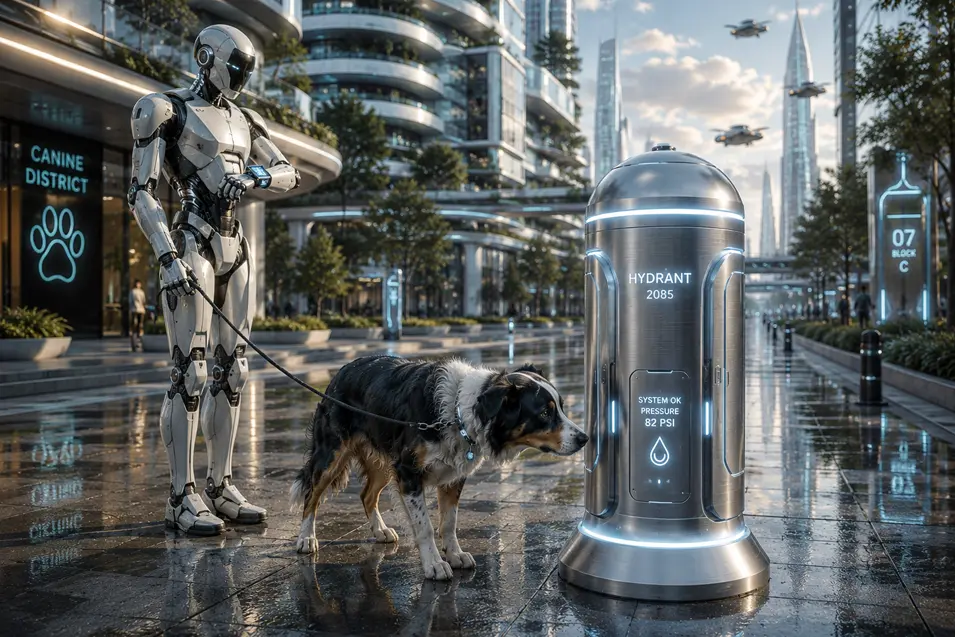
The futuristic version barely resembles the object we know today.
Its seamless brushed-metal body rises cleanly from the pavement without visible bolts or conventional fittings.
Subtle illuminated sections indicate water pressure and system status.
Connections remain hidden behind perfectly integrated panels until they’re needed.
It is elegant.
Efficient.
Technologically advanced.
And probably connected to an app nobody asked for.
A dog stands beside it looking slightly suspicious.
Sometimes progress takes adjustment.
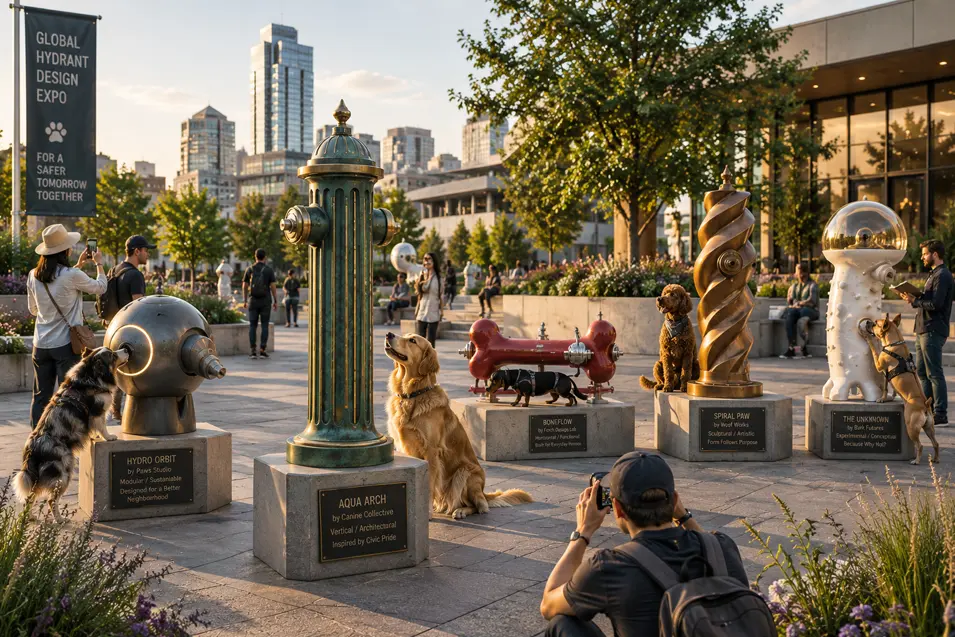
The Community Hydrant Park
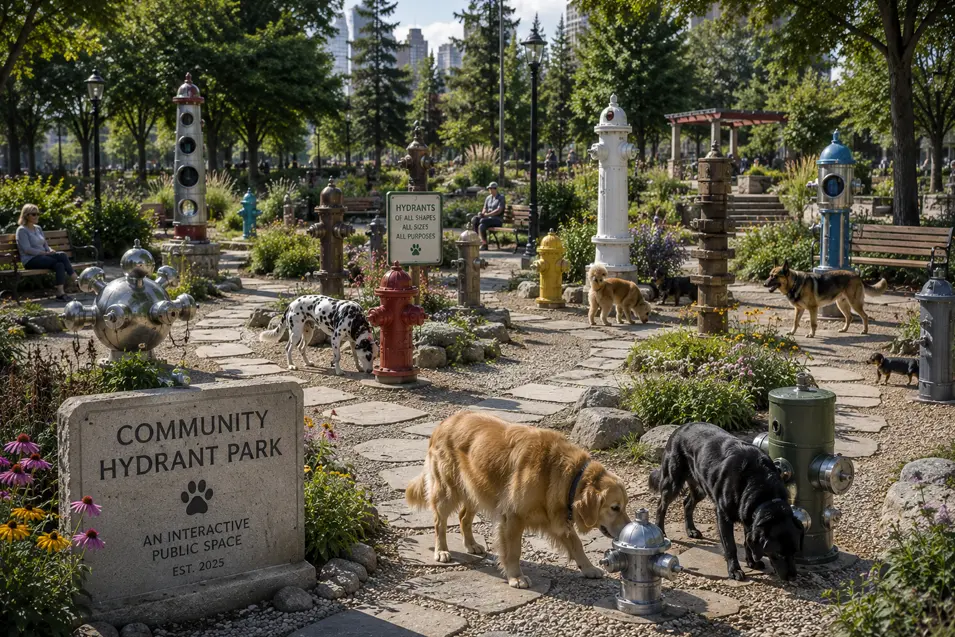
This is what happens when dogs are given access to the municipal parks budget.
Someone initially proposed installing a new fire hydrant.
The project became considerably larger.
Stone pathways now wind through landscaped gardens containing hydrants of different heights, shapes, materials and sizes.
There are traditional hydrants.
Modern hydrants.
Small hydrants.
Tall hydrants.
A few designs nobody can adequately explain.
Benches allow humans to sit nearby while dogs wander through what has effectively become the world’s first fire hydrant garden.
The city calls it an interactive public space.
Dogs know exactly what it is.
The Monument
Every design movement eventually produces something excessive.
Dogs are no exception.
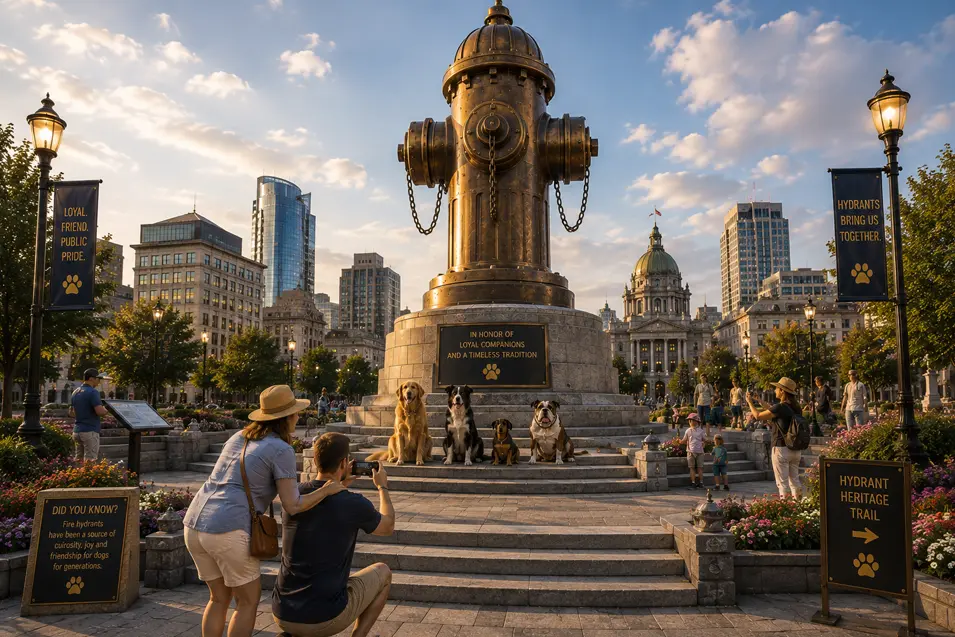
Standing in the centre of a grand civic plaza is a twenty-foot-tall bronze fire hydrant.
Not a fountain.
Not a functional piece of emergency infrastructure.
A monument.
Broad stone steps lead toward it.
Beautiful landscaping surrounds the plaza.
Architectural lighting illuminates the enormous bronze structure after dark.
Tourists take photographs.
Children climb the steps.
City officials continue avoiding questions about the final construction cost.
At the base of the monument, several dogs sit looking remarkably pleased with themselves.
After generations spent appreciating the humble fire hydrant, they apparently decided it deserved proper recognition.
And perhaps they’re right.
Maybe Dogs Shouldn’t Design Fire Hydrants
To be fair, humans have done reasonably well.
Our hydrants are durable, practical and considerably more concerned with helping firefighters than impressing the neighbourhood Labrador.
Which is probably how it should be.
But there’s something wonderfully ordinary about the relationship between dogs and fire hydrants.
We barely notice them.
Dogs rarely seem to miss one.
So perhaps if they were ever invited to redesign our streets, the fire hydrant wouldn’t remain an anonymous piece of infrastructure.
It would become furniture.
Architecture.
A neighbourhood meeting place.
Possibly a twenty-foot bronze monument.
Would any of this make our cities better?
We’re not sure.
But the daily walk would certainly become more interesting.