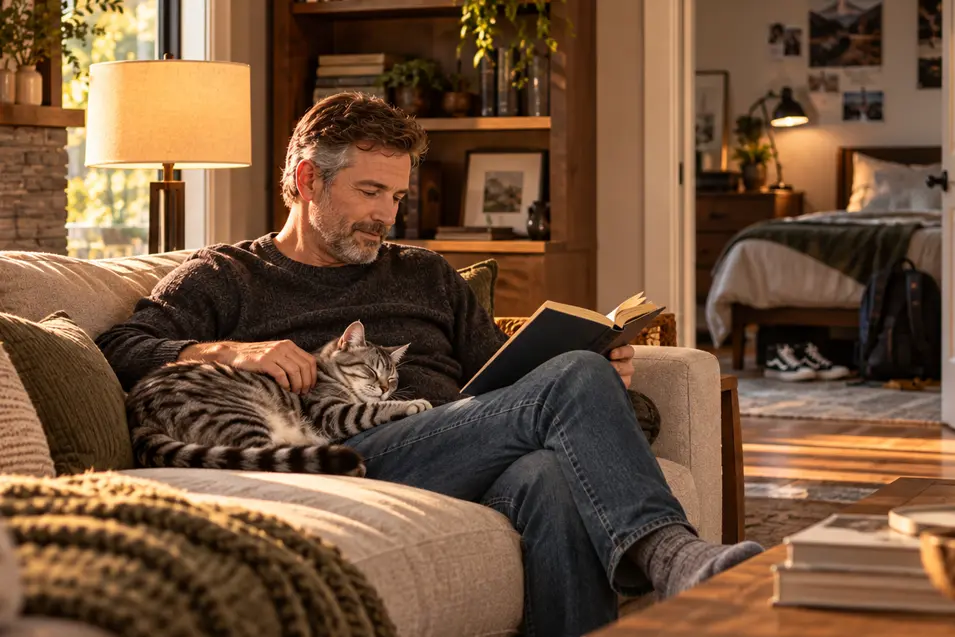
There is a strange period after a child moves out when the house looks almost exactly the same but doesn’t feel the same at all.
Their shoes may still be by the door. There are probably things in the bathroom that apparently nobody owns anymore. Their bedroom might remain untouched for weeks because you’re not quite ready to decide whether you’re preserving it, cleaning it or finally throwing out the collection of empty water bottles that has somehow been classified as décor.
But the biggest difference is simply that they’re no longer there.
And you’re not the only one living in the changed house.
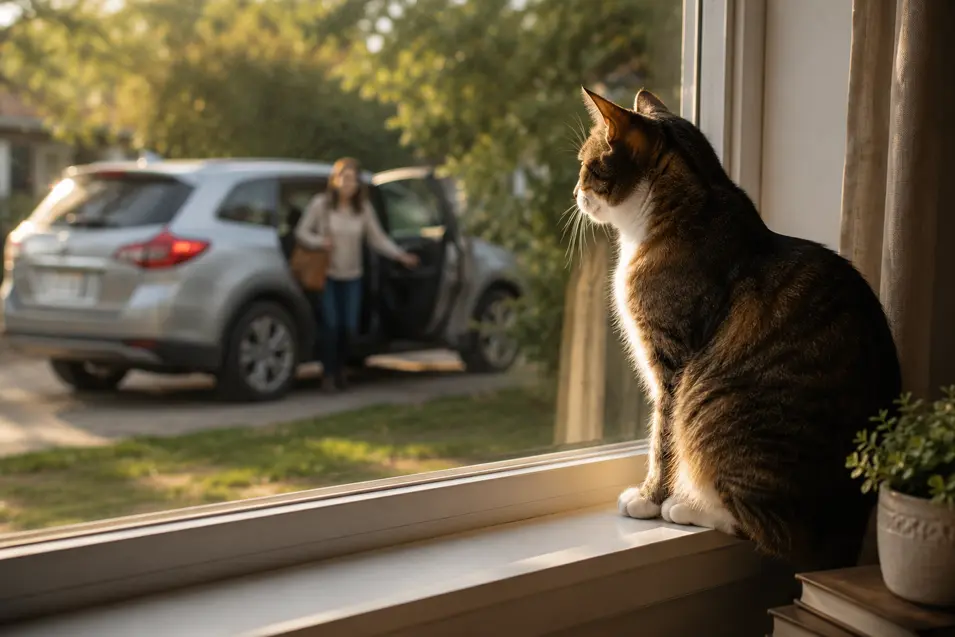
The dog who used to hear them come through the door every afternoon still hears the door.
The cat who wandered into their bedroom every night can still wander into the bedroom.
The difference is that nobody is there.
In the previous article, I looked at [what may happen to a cat or dog when someone they love moves away]. Some pets seem to adapt without much difficulty. Others become more affectionate, spend more time watching doors or windows, change where they sleep or show more obvious signs of stress.
But once you’ve noticed the change, the practical question becomes much more useful:
What can you actually do about it?
When my son Owen leaves for New Zealand, his cat Simba will stay with me. I don’t expect her world to collapse. She’ll still be in the house she knows, with the same food, the same litter box and the same guy who’s been taking care of those things for years.
But one member of her household will suddenly disappear.
I can’t explain where he went.
What I can do is make sure the rest of her world still makes sense.
Don’t Redesign the Pet’s Life Because Your Kid Redesigned Theirs
When someone leaves home, there’s a temptation to make everything feel new.
Maybe you’re cleaning rooms, moving furniture, changing schedules or suddenly discovering that the basement contains enough abandoned belongings to open a small sporting-goods store.
For the pet, however, familiar can be valuable.
Veterinary behaviour guidance recommends maintaining a predictable routine when animals are dealing with changes in companionship or time spent alone. That doesn’t mean dinner has to hit the bowl at precisely 5:07 every evening, but regular patterns around feeding, exercise, play, social interaction and rest can help make the day easier to anticipate.
If your dog has always been walked after dinner, keep the walk.
If your cat expects breakfast shortly after you stumble into the kitchen, continue the arrangement.
If everyone settles in the living room at night and the dog has slept in the same corner for six years, there probably isn’t a compelling reason to relocate his bed the week your daughter leaves for university.
One major thing has already changed.
You don’t necessarily need to change six more.
Figure Out What Your Kid Actually Did for the Pet
This sounds obvious until you start thinking about it.
A child may not have been the person who bought the food or booked veterinary appointments, but they could still have occupied a surprisingly large part of the animal’s day.
Maybe your son threw the ball in the backyard every afternoon.
Maybe your daughter let the dog out when she came home from school.
Maybe the cat slept in her room.
Maybe somebody sat on the sofa gaming for three hours every evening with a dog stretched beside them.
Those things don’t appear on the official pet-care checklist.
They still matter.
Before your child leaves—or after, if they’ve already gone—think about which little pieces of the pet’s routine disappeared with them.
Then decide which ones are worth preserving.
If the 4 p.m. dog walk vanished, somebody else can take it over. If your daughter played with the cat before bed, you can introduce your own evening play session. If the dog spent hours simply being around your son while he did homework, you might find that the dog now wants to be closer to wherever you spend your evenings.
You don’t have to impersonate the person who left.
You just don’t want half the animal’s normal day to quietly disappear along with them.
Give Them Something to Do With the Extra Quiet
A house can become dramatically quieter after the kids leave.
Depending on the family, this may be one of the great rewards of parenthood.
The dog may have a different opinion.
Veterinary behaviour guidance emphasizes that dogs and cats need more than food and a place to sleep. Physical exercise, mental stimulation, social interaction, opportunities to explore and restful sleep are all part of their behavioural needs.
If your pet suddenly has several additional hours without the activity they were accustomed to, look for sensible ways to replace some of it.
For a dog, that might mean a longer sniffing walk, a short training session, a food puzzle or another game in the yard.
For a cat, it could mean interactive play, climbing opportunities, a window perch, food puzzles or simply making time for the type of interaction that particular cat enjoys.
The point isn’t to create a daily entertainment department because your teenager moved out.
It’s to recognize that the pet may have lost stimulation as well as companionship.
Let the Pet Build a New Relationship With the People Who Are Still There
This may happen without any help from you.
After our dog Ollie died, I noticed Simba became more affectionate with me.
I can’t say why with certainty. Maybe the changed household altered where she chose to spend her time. Maybe our relationship simply developed as she got older. Maybe Simba held a meeting with herself and decided I had finally achieved acceptable standards.
Whatever the explanation, our relationship changed.
Something similar can happen when a child moves out.
A dog who spent most evenings with your son might start following you into your office. A cat that slept on your daughter’s bed may eventually start appearing on yours. An animal that previously divided its social attention among four people now has three.
Let that relationship develop naturally.
Offer attention, play and companionship, but don’t turn the pet into your emotional support system for the empty nest.
They are adjusting to a new household too.
Sometimes the nicest thing you can do is simply make room for them beside you.
But Don’t Accidentally Teach Them That They Can Never Be Alone
This is where good intentions can create another problem.
Your child moves away. You feel sorry for the dog. The dog starts following you everywhere.
So you allow it.
Every room. Every errand. Every moment.
Soon the dog goes from living with several people to depending almost entirely on one.
For dogs that struggle with separation, veterinary behaviourists often work on the opposite skill: learning to settle comfortably and independently while their person is still home. A predictable resting place such as a bed or mat can become somewhere the dog learns to relax without constantly following somebody around.
That doesn’t mean suddenly ignoring your dog.
It means allowing affection and independence to coexist.
The goal isn’t to replace the missing person by becoming available 24 hours a day.
The goal is a pet who feels secure in the new version of the household.
Keep a Familiar Place for Them
Animals often have remarkably specific ideas about where they belong.
The corner of the sofa.
The sunny patch beside the patio door.
The upstairs landing.
The end of someone’s bed.
When your child leaves, don’t be surprised if the pet continues visiting spaces associated with them.
Unless there’s a reason not to, you don’t have to immediately close the bedroom door and erase every trace of the person who lived there.
Familiar surroundings and familiar smells can be part of the environment the pet already knows. Keeping an animal in its usual home can itself reduce the stress of a person’s absence because the sights, sounds and scents around it remain familiar.
Eventually that bedroom may become an office, guest room or, as we’ll get to later in this series, a pet-friendly flex room.
But you don’t have to transform it the weekend after somebody leaves.
The pet isn’t waiting for the HGTV reveal.
Exercise Helps, but You Don’t Need to Exhaust Them
With dogs in particular, “more exercise” becomes the answer to nearly every behavioural question.
Sometimes it’s good advice.
A dog whose afternoon activity disappeared when a teenager moved away may genuinely need another walk or play session. Appropriate physical activity also forms part of the routine recommended for dogs dealing with separation difficulties.
But the goal isn’t to run the animal into the ground so it’s too tired to notice anyone is missing.
Think in terms of a satisfying day rather than a physically exhausted dog.
A walk that allows sniffing and exploring may offer both physical activity and mental stimulation. Ten minutes of reward-based training can make the dog think. A game in the yard provides interaction as well as exercise.
Cats need activity too, although convincing a cat that your proposed exercise program is in its best interests remains between you and the cat.
Short interactive play sessions are often a more realistic negotiation.
Watch What Happens When Everybody Else Leaves Too
This can reveal something important.
Before the kids moved out, perhaps there was almost always someone home.
One child arrived from school at 3:30. Another had evening classes. Somebody worked weekends. Somebody else slept until noon.
Without anyone intentionally planning it, the pet had companionship for much of the day.
Then the kids leave.
Now both parents go to work at 8 a.m., and for the first time in years the dog is alone until 5:30.
That is a much bigger lifestyle change than simply losing one favourite person.
Veterinary behaviour specialists note that a household schedule change—including children leaving for school or adults returning to work—can suddenly leave a dog facing long periods without the companionship it previously had.
If that’s your situation, think about the actual hours the animal is now alone.
A dog walker, trusted neighbour, family member or pet sitter may help break up a long day. For some dogs, daycare may be appropriate; for others, it would be their idea of hell.
Know your animal.
The answer doesn’t have to be the same for every pet.
A Pet Camera Can Tell You More Than Guessing Can
You leave for work.
Your dog gives you the saddest expression ever recorded in canine history.
You spend the next eight hours imagining him lying against the front door contemplating the collapse of his family.
Meanwhile, there’s a reasonable possibility he’s been asleep since 8:17.
If you’re genuinely concerned about how a pet is coping when the house is empty, a camera can be useful.
Veterinary behaviour guidance specifically recommends video monitoring as a way to see whether a pet relaxes after you leave or shows signs such as pacing, panting, vocalizing or restlessness.
That information is far more useful than judging the animal from the thirty seconds surrounding your departure and return.
You may discover there’s no problem at all.
Or you may discover something you couldn’t have known because it only happens when nobody is home.
Don’t Punish Stress
Suppose the dog starts chewing things after your son leaves.
Or there’s an accident in the house.
Or a cat begins scratching somewhere it shouldn’t.
It’s easy to read the behaviour as retaliation.
He’s angry because she left.
She’s punishing us.
But destructive behaviour, vocalization and house soiling can occur with separation-related distress, and punishment after the fact doesn’t resolve the underlying anxiety. In dogs with separation problems, punishment can actually increase anxiety surrounding future absences.
Deal with the immediate practical problem—protect the furniture, remove unsafe objects, provide appropriate outlets—but also ask why the behaviour changed.
And remember that behavioural changes can have medical causes.
Which brings us to the part where the internet needs to stop diagnosing your Labrador.
Know When This Has Gone Beyond Adjustment
Most pets aren’t going to need professional behavioural treatment because somebody went to university.
But some will struggle.
Warning signs can include persistent pacing, barking or howling, destructive behaviour around doors or windows, house soiling, excessive grooming, refusal to eat when alone or frantic attempts to escape.
If those behaviours appear suddenly or become significant, talk to your veterinarian.
A medical problem should be ruled out where appropriate, and genuine separation-related distress may require a structured behaviour plan rather than a collection of internet tricks. Veterinary teams can also refer families to qualified behaviour professionals when necessary.
There’s no prize for waiting until the dog has eaten half the drywall.
Don’t Rush Out and Get Them Another Pet
This deserves its own warning.
The dog looks lonely.
The house feels empty.
Clearly the solution is another dog.
Maybe.
But another animal isn’t a replacement for the person who left, and it isn’t a guaranteed treatment for separation-related distress.
Some pets enjoy animal companionship tremendously. Some tolerate it. Some would strongly prefer that you stop trying to improve their life.
Adding another pet changes territory, routines, resources, attention and household dynamics all over again.
If you’ve been considering another animal anyway and the timing, finances and personalities make sense, that’s a separate decision.
But don’t bring home a puppy on Tuesday because the Labrador looked sad on Monday.
He’s already had one major household change.
He doesn’t necessarily need a roommate.
Let the New Normal Become Normal
This may be the hardest part for the humans.
Your child has left.
The house is quieter.
Dinner feels different. Weekends feel different. You walk past a bedroom and notice nobody is in it.
The temptation is to treat this period as though the household is temporarily malfunctioning and needs to be restored to what it was.
But eventually this isn’t the transition anymore.
It’s simply home.
The same is true for the pet.
New routines form. Relationships shift. The dog learns who takes the afternoon walk now. The cat discovers a different lap. Everybody works out where they’re going to sit on the sofa.
When Owen leaves, I expect Simba will notice.
Maybe she’ll look for him.
Maybe she’ll spend more time with me.
Maybe absolutely nothing obvious will happen and I’ll realize I’ve written thousands of words worrying about a cat who spent the entire transition asleep.
That’s possible too.
What I won’t do is assume she needs to be rescued from the change.
I’ll keep her world familiar. I’ll pay attention. I’ll make sure the things she needs are still there and give her time to establish whatever her new routine becomes.
Because helping a pet after the kids leave isn’t really about replacing the person who moved away.
It’s about showing them that even though one part of their world changed, the rest of it is still home.