
Christmas decorations bring sparkle, colour, and excitement into our homes, but some of those festive touches can pose unexpected dangers to our pets. Tinsel is one of them. Those shiny, shimmering strands may look beautiful draped across a Christmas tree, but to a curious dog, they can resemble an irresistible toy.
Unfortunately, swallowing tinsel can lead to serious digestive problems, including intestinal blockages and potentially life-threatening complications. Before decorating your home this holiday season, it’s worth understanding why tinsel and dogs are a dangerous combination.
Why Are Dogs Attracted to Christmas Tinsel?
Dogs explore the world with their noses and mouths, and Christmas decorations introduce an entirely new collection of interesting objects into their environment.
Tinsel is particularly tempting because it moves, reflects light, and hangs from branches at just the right height for a curious nose to investigate.
A playful puppy might grab a dangling strand and start pulling. Another dog might mistake a fallen piece for something worth chewing. Some dogs are attracted to the crinkling texture, while others simply enjoy investigating anything new.
Even dogs that normally leave household decorations alone can become curious when the Christmas tree goes up.
The trouble begins when a dog decides to swallow what it has discovered.
What Happens If a Dog Eats Tinsel?
Unlike food, tinsel cannot be properly digested by a dog’s digestive system.
Small pieces may occasionally pass through without causing harm, but longer strands can become trapped in the stomach or intestines.
One of the most serious concerns is a condition known as a linear foreign body obstruction.
This occurs when a long, string-like object becomes caught somewhere in the digestive tract while the intestines continue trying to move it along.
As the intestines contract, they can bunch together around the material. The tension may damage the intestinal walls, restrict blood flow, or even cause a perforation.
A perforated intestine can allow bacteria and digestive contents to leak into the abdominal cavity, causing a potentially fatal infection called peritonitis.
Not every dog that swallows tinsel will develop these complications, but the possibility makes any suspected ingestion a reason to contact a veterinarian promptly.
Signs Your Dog May Have Swallowed Tinsel
Sometimes, owners actually witness their dog eating tinsel. In other cases, the first indication is a missing decoration or an unexplained change in their dog’s behaviour.
Symptoms of a possible intestinal obstruction include:
- Vomiting or repeated attempts to vomit
- Loss of appetite or refusing favourite treats
- Lethargy or unusual tiredness
- Abdominal discomfort or a hunched posture
- Diarrhea or difficulty passing stool
- Excessive drooling
- Restlessness or signs of distress
- A swollen or painful abdomen
These symptoms can develop gradually or appear relatively quickly, depending on where the material becomes lodged.
Importantly, a dog may initially appear perfectly normal after swallowing tinsel. The absence of symptoms does not guarantee that the material will pass safely.
If you suspect your dog has swallowed tinsel, contact your veterinarian rather than waiting for symptoms to develop.
What Should You Do If Your Dog Eats Christmas Tinsel?
Discovering that your dog has swallowed tinsel can be frightening, but taking the right steps is important.
1. Contact your veterinarian immediately.
Explain what your dog may have swallowed, approximately how much, and when the incident occurred. Your veterinarian can determine whether an examination or emergency treatment is necessary.
2. Do not induce vomiting unless instructed by a veterinarian.
Long strands of tinsel can cause additional damage when moving back through the digestive tract. Never attempt to make your dog vomit using home remedies.
3. Never pull tinsel from your dog’s mouth or rear end.
This is particularly important. If a strand is anchored somewhere inside the digestive system, pulling it can seriously injure the intestines.
4. Follow your veterinarian’s instructions.
Depending on the circumstances, your veterinarian may recommend an examination, diagnostic imaging, endoscopy, or surgery.
Early intervention can sometimes prevent more serious complications.
Can Tinsel Pass Naturally Through a Dog?
It is possible for a small piece of tinsel to pass through a dog’s digestive system without causing an obstruction.
However, there is no reliable way for an owner to determine whether swallowed tinsel will pass safely.
The risk depends on several factors, including the length and type of tinsel, the amount swallowed, and the dog’s size.
A small dog swallowing a long strand may face different risks than a large dog swallowing a tiny fragment, but neither situation should automatically be considered harmless.
Because intestinal injuries can become serious before obvious symptoms appear, veterinary advice is always the safest approach.
Is Modern Christmas Tinsel Safer Than Older Tinsel?
Traditional tinsel was sometimes manufactured using metal, including lead-containing materials. Modern decorative tinsel is generally made from lightweight plastics or metallic films.
While these newer materials avoid some of the concerns associated with older products, they are not necessarily safer when swallowed.
The primary danger is mechanical rather than chemical.
Plastic tinsel can still become tangled, trapped, or stretched through the digestive tract, causing the same potentially serious complications.
Biodegradable or environmentally friendly decorations should not automatically be considered safe for dogs to swallow either.
How to Keep Your Dog Away From Christmas Tinsel
The simplest way to prevent tinsel-related injuries is to avoid using loose, string-like tinsel in homes with dogs.
If you enjoy a beautifully decorated Christmas tree, there are plenty of ways to create a festive appearance without introducing unnecessary risks.
Consider these precautions:
- Skip loose tinsel entirely. This eliminates the most obvious source of danger.
- Keep decorations out of reach. Avoid dangling ornaments and ribbons on lower branches.
- Supervise curious puppies. Young dogs may be especially interested in unfamiliar decorations.
- Use a Christmas tree barrier. A decorative fence or pet gate can help prevent unsupervised access.
- Clean up fallen decorations. Check around the tree regularly for broken ornaments, ribbons, hooks, and other small objects.
- Provide appropriate toys. Giving your dog something safe to chew or play with can help redirect their attention away from the tree.
Remember that placing tinsel higher on the tree is not a guarantee of safety. Strands can fall, and determined dogs may still find ways to reach them.
Safer Alternatives to Christmas Tinsel
You don’t need to sacrifice Christmas sparkle to keep your dog safe.
Instead of loose tinsel, consider decorating with shatter-resistant ornaments, securely attached decorations, and pet-safe festive accessories.
LED Christmas lights can provide plenty of sparkle, although cords and bulbs must still be kept away from dogs that like to chew.
Fabric bows and ribbons can also look beautiful, but they should be securely attached and kept out of reach because they can create similar intestinal hazards if swallowed.
Decorative garlands made from rigid or securely attached materials may be a better option than loose strands, provided they cannot be chewed apart or swallowed.
The goal isn’t to create a completely decoration-free home. It’s to choose decorations that are less likely to become dangerous when a curious dog comes investigating.
Other Christmas Decorations That Can Be Dangerous for Dogs
Tinsel isn’t the only holiday decoration that deserves extra attention.
Christmas trees introduce several potential hazards, including:
- Glass ornaments: Broken pieces can cut paws, mouths, or the digestive tract.
- Ornament hooks: Small metal hooks can cause injuries if swallowed.
- Electrical cords: Chewing Christmas light cords can cause burns or electric shock.
- Ribbon and gift-wrapping string: Like tinsel, these can create dangerous linear foreign body obstructions.
- Salt dough ornaments: Their high salt content can cause serious poisoning if eaten.
- Chocolate decorations: Chocolate contains substances that are toxic to dogs.
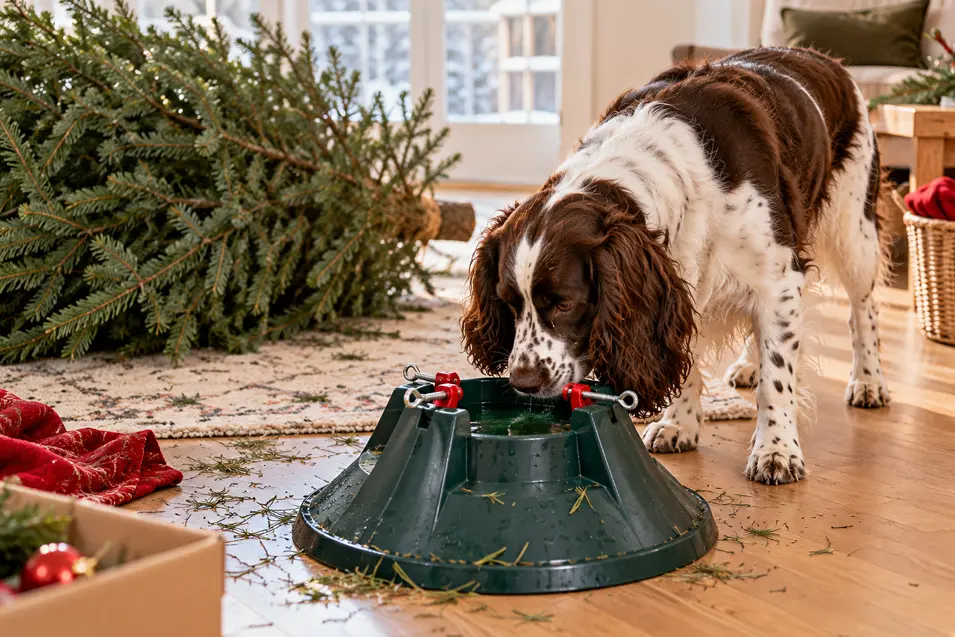
- Christmas tree water: Water containing additives or contaminants may cause illness if consumed.
Taking a few extra minutes to inspect your decorations can help prevent an emergency during what should be a happy time of year.
Frequently Asked Questions About Dogs and Christmas Tinsel
Is Christmas tinsel poisonous to dogs?
Modern tinsel is generally more dangerous because of the physical damage it can cause than because of chemical toxicity. Swallowed strands can become trapped in the digestive system and cause intestinal obstructions or injuries.
What if my dog ate just a small piece of tinsel?
A small piece may pass naturally, but you should still contact your veterinarian for advice. The amount swallowed, the type of tinsel, and your dog’s size all influence the risk.
How long does it take for symptoms to appear after a dog eats tinsel?
Symptoms may appear within hours or take longer to develop. Some dogs initially behave normally despite having swallowed a potentially dangerous object. Do not wait for symptoms before contacting a veterinarian.
Can I give my dog bread or food to help the tinsel pass?
No. There is no reliable home remedy that makes swallowed tinsel safe. Do not attempt to push it through the digestive system with food, oil, or other substances. Contact your veterinarian for guidance.
What should I do if tinsel is hanging from my dog’s rear end?
Never pull it. The strand may still be attached or trapped farther inside the digestive tract. Prevent your dog from pulling at it and seek immediate veterinary assistance.
Is tinsel garland safer than loose tinsel?
Thicker garlands may be less likely to scatter individual strands, but they can still be dangerous if a dog chews off and swallows pieces. Any string-like decoration should be kept out of reach.
A Little Less Sparkle, a Lot More Peace of Mind
Christmas is a wonderful time to include our dogs in family traditions, from decorating the tree to opening presents on Christmas morning.
But while tinsel may add a little extra sparkle to the holidays, it isn’t worth the risk of an emergency veterinary visit.
Fortunately, there are countless ways to create a beautiful Christmas home without loose, dangling decorations that might tempt a curious dog.
Sometimes the safest Christmas decorations are simply the ones your dog has absolutely no interest in eating.
And that’s one holiday tradition worth keeping.
More Reading: Keeping Your Dog Safe and Happy at Christmas
Tinsel isn’t the only Christmas decoration that can cause trouble for curious dogs. From electrical hazards to finding safer ways to celebrate, these articles offer helpful advice for enjoying the holidays with your four-legged family members.
- Are Christmas Lights Dangerous for Dogs? – Discover the potential dangers of Christmas lights, including electrical shocks, broken bulbs, and tangled cords, along with practical ways to keep your dog safe.
- How to Keep Your Dog From Chewing Electrical Cords – Chewing electrical cords can lead to serious injuries. Learn why dogs develop this habit and how to protect your pet from dangerous household wiring.
- Christmas Traditions You Can Share With Your Dog – Christmas doesn’t have to be all about decorations and presents. Explore fun, meaningful, and dog-friendly traditions that let your four-legged companion join in the holiday celebrations.