Flower girls have been charming wedding guests for generations, but there’s no rule saying the member of the wedding party walking among the flowers has to be human.
Enter the flower dog.
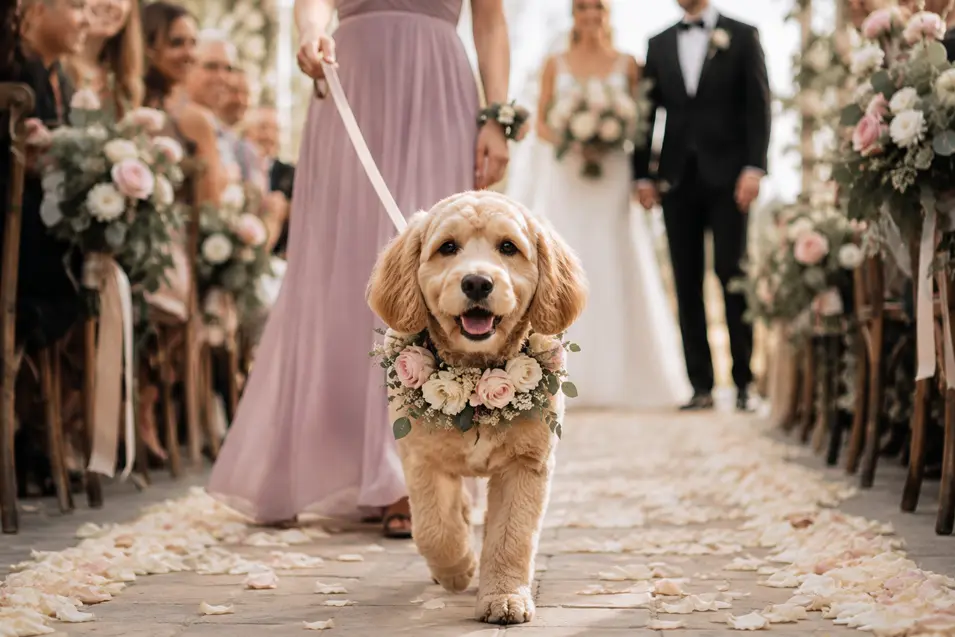
Having your dog walk down the aisle as part of the wedding procession can be a wonderful way to include an important member of your family without entrusting them with the wedding rings. They can walk with a bridesmaid, accompany a traditional flower girl, wear a beautiful floral collar or simply trot down the aisle looking extremely pleased with themselves.
And unlike a traditional flower girl, your flower dog may stop halfway to sniff the decorations, greet someone in the third row or decide that the aisle is an excellent place to lie down.
That’s part of the appeal.
But flowers, crowds, unfamiliar venues and excited dogs also introduce some practical considerations. If you’re thinking about appointing your dog as the flower dog, here’s how to make the role beautiful, safe and enjoyable for everyone — especially the dog.
What Exactly Is a Flower Dog?
A flower dog is simply a dog given a place in the wedding procession similar to a traditional flower girl or flower child.
There aren’t any official rules.
Your dog might walk down the aisle wearing a floral collar. They could accompany a bridesmaid or groomsman, walk beside a flower girl, carry a small decorative basket or simply wear a bow tie and enjoy their moment.
The dog doesn’t actually need to scatter flower petals.
In fact, unless you’ve somehow trained your dog in the surprisingly specialized art of floral distribution, it’s probably better if they don’t.
Think of “flower dog” as the name of the wedding role rather than a job description.
Why Have a Flower Dog?
For couples who consider their dog part of the family, giving them a place in the procession can make the ceremony feel more personal.
Perhaps your dog has been with you throughout the relationship. Maybe you adopted them together. Perhaps they were there for the proposal or have followed you through apartments, houses, jobs and every other stage that eventually led to the wedding.
Giving that dog thirty seconds in the procession can be a simple way of acknowledging the role they’ve already played in your life together.
It can also be incredibly cute.
There is nothing wrong with admitting that.
Flower Dogs Can Create Fantastic Wedding Photos
A dog walking down a beautifully decorated aisle can produce wonderful photographs.
The flowers, formal clothing and ceremony setting create the elegance.
The dog provides the unpredictability.
Your photographer might capture a perfectly composed portrait of your dog walking toward the altar. They might also capture your dog turning around, stopping to greet a guest, looking directly into the camera or becoming distracted by something completely unrelated to the wedding.
Those spontaneous photographs often end up being favorites.
Don’t make perfection the goal.
A flower dog is likely to be most memorable when allowed to behave like a dog.
Can a Dog Replace a Flower Girl?
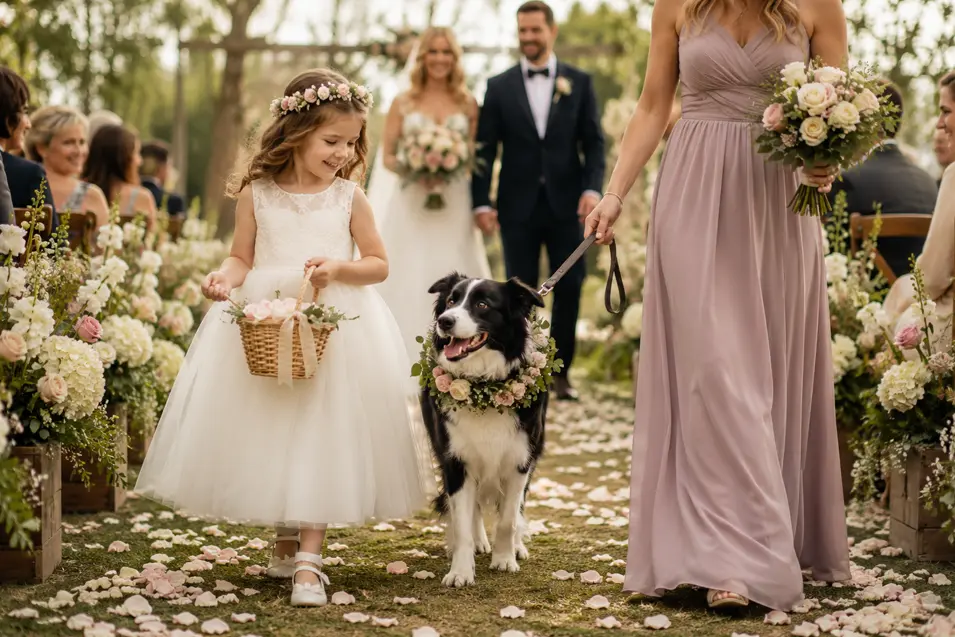
Absolutely.
There is no requirement that a wedding have a traditional flower girl at all, so your dog can easily fill that place in the procession.
You could also have more than one flower dog if your household includes multiple dogs that would genuinely enjoy participating.
Just remember that adding more dogs also adds more leashes, handlers and opportunities for chaos.
Sometimes one enthusiastic flower dog is plenty.
Can You Have a Flower Girl and a Flower Dog?
Yes, and it can make for an adorable procession.
A child and dog walking down the aisle together can create a lovely family moment, particularly when they already know each other well.
However, a young child shouldn’t automatically become responsible for controlling the dog.
Even a friendly dog can suddenly pull toward someone, become startled or change direction. If the child isn’t old enough or physically capable of safely handling the dog, have an adult walk close beside them or control the leash.
The photograph is never more important than keeping both child and dog safe.
Can a Male Dog Be a Flower Dog?
Of course.
Flower dog is a wedding role, not a gender.
Your male Great Dane can be a flower dog.
Your female Chihuahua can be a ring bearer.
Your elderly mixed-breed dog can walk down the aisle wearing nothing more elaborate than their everyday collar.
Wedding traditions are flexible.
Dogs are even more flexible about job titles.
Does a Flower Dog Have to Carry Flowers?
No.
Your dog doesn’t need to carry anything.
In many cases, the safest and easiest option is simply having the dog wear a comfortable floral collar, a small arrangement securely attached to a harness, a bow tie or another simple wedding accessory.
They can also wear no special accessory at all.
Your guests will understand that the dog walking down the aisle is part of the wedding party without requiring visual evidence of their official floral responsibilities.
Be Careful Which Flowers You Use
This is one of the most important differences between decorating a person and decorating a dog.
Not every flower or plant used in wedding arrangements is appropriate around pets.
Dogs may chew flowers, lick greenery or grab something that falls from an arrangement. A floral collar also places plant material very close to the dog’s mouth and face.
Tell your florist that the arrangement is specifically being created for a dog. Ask them to choose materials that are appropriate for use around pets and to avoid potentially harmful plants.
Artificial flowers can be another option, but they aren’t automatically harmless. Loose petals, wire, plastic pieces and other small components can create chewing or swallowing hazards.
Whatever you use, inspect it carefully before putting it on your dog.
Keep Floral Collars Comfortable
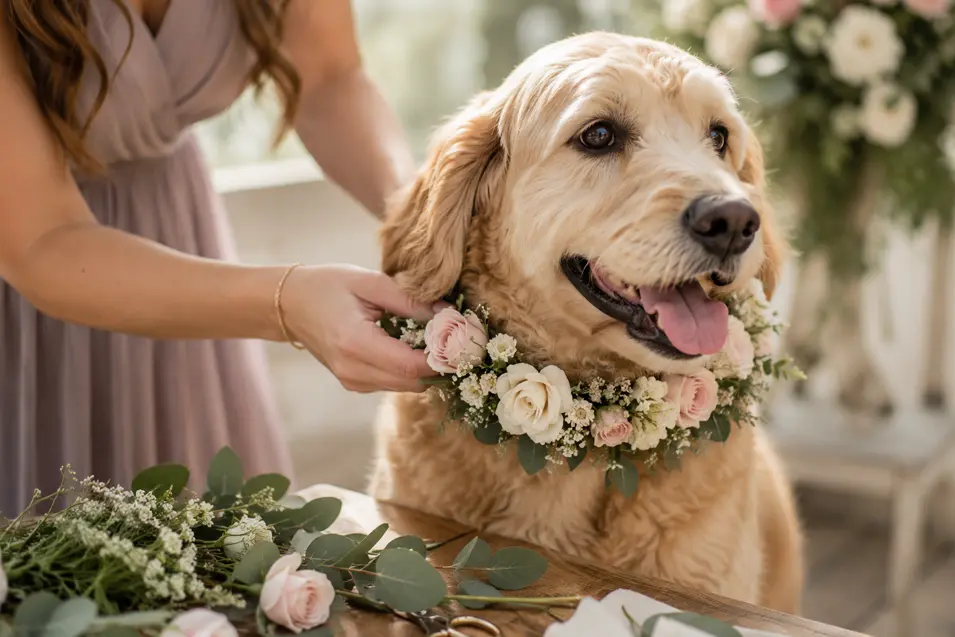
A spectacular floral arrangement may look wonderful in photographs but still be completely wrong for the dog wearing it.
Keep arrangements relatively lightweight.
Nothing should restrict the dog’s breathing, movement or vision. Flowers shouldn’t poke the dog’s eyes, press against the nose or interfere with the leash or harness.
Watch your dog’s body language when you try the arrangement.
If they’re repeatedly scratching at it, shaking their head, trying to bite it or otherwise attempting to remove it, don’t force the issue.
A simple collar on a comfortable dog will produce much better wedding photographs than an elaborate floral masterpiece on a dog who desperately wants it off.
Try Everything Before the Wedding
The wedding day should not be the first time your dog encounters their flower-dog outfit.
Try the collar, harness, bow tie, flowers or other accessories well beforehand.
Let your dog wear them briefly at home and observe their reaction.
You can also practice walking while wearing the accessories to make sure nothing moves, catches on the leash or becomes uncomfortable.
If your dog hates the outfit during practice, there’s no reason to assume they’ll suddenly appreciate it once surrounded by wedding guests.
Simplify.
The dog is the important part, not the costume.
Should Your Flower Dog Scatter Petals?
Probably not.
A dog could theoretically be trained to carry a basket or participate in some elaborate petal-scattering arrangement, but most couples don’t need to turn their wedding ceremony into an advanced obedience demonstration.
Avoid attaching containers designed to spill objects as the dog walks. Anything dangling from the dog’s body can become tangled, frightened or unexpectedly interesting to chew.
And don’t throw petals directly over or at your dog to manufacture the effect.
If you want petals along the aisle, have someone scatter them beforehand.
Then let your flower dog concentrate on the much more achievable task of reaching the other end.
Who Should Walk the Flower Dog Down the Aisle?
Choose someone your dog already knows and trusts.
That might be a bridesmaid, groomsman, family member or friend. It could also be the person who will care for the dog during the rest of the wedding.
The handler should be physically capable of controlling the dog and comfortable responding if they stop, pull, become frightened or get excited.
Avoid choosing someone purely because the pairing will look good in photographs.
The best handler is the person who makes your dog feel secure.
Should Your Flower Dog Walk on a Leash?
For most dogs, yes.
A leash gives the handler control if the dog becomes distracted or frightened and reduces the risk of an escape.
This is particularly important at outdoor weddings, where roads, wildlife, other animals and open spaces may be nearby.
You can choose a simple attractive leash that works with the wedding without sacrificing safety.
If your dog is exceptionally well trained and you’re considering an off-leash entrance, think carefully about the environment and venue rules before deciding.
A wedding ceremony is not the place to discover that your dog’s normally excellent recall disappears when eighty people simultaneously say, “Awwww.”
Practice Walking the Aisle
If possible, bring your dog to the ceremony location before the wedding.
Let them sniff around and become familiar with the space.
Then practice walking the actual aisle with the person who will accompany them.
This gives you an opportunity to discover potential problems. Your dog may dislike a particular type of flooring, become nervous around an archway or be distracted by something near the ceremony space.
Rehearsing won’t eliminate every surprise.
It can eliminate some of them.
What Happens When the Flower Dog Reaches the Altar?
Plan this part.
It’s surprisingly easy to focus so much on the adorable entrance that nobody considers what happens afterward.
Will the handler keep the dog beside them?
Will someone else take the leash?
Will the dog leave through a side aisle immediately after the procession?
Will they stay for the ceremony?
There isn’t one correct answer.
A calm dog who settles easily may be perfectly happy remaining nearby. An excitable dog may do much better making a grand entrance and then quietly disappearing with their caregiver.
The important thing is that everyone involved knows the plan.
Your Dog May Bark, Jump or Change the Schedule
Dogs don’t know they’re attending a wedding.
They don’t understand that music means the procession is beginning or that everyone is expected to remain quiet during the vows.
Your flower dog might bark.
They might jump on their handler.
They might sit down halfway along the aisle.
They might recognize someone in the audience and attempt an unscheduled reunion.
If those possibilities would genuinely ruin your ceremony, think carefully before giving your dog a role in it.
If they’d make you laugh, you may have exactly the right attitude for a flower dog.
Give Your Dog a Bathroom Break Before the Ceremony
This isn’t the most romantic piece of wedding planning advice.
It may be one of the most useful.
Take your dog for a proper walk before the procession and give them plenty of opportunity to relieve themselves.
Then make sure the handler carries waste bags anyway.
There is no wedding tradition powerful enough to override biology.
Watch the Weather
Outdoor weddings require additional planning when a dog is involved.
Hot weather can make formal outdoor ceremonies uncomfortable or dangerous for dogs, particularly when shade and water are limited. Pavement and other surfaces can also become extremely hot.
Cold, rain and storms can create different problems.
Have water available, provide somewhere comfortable to rest and be prepared to change the plan if weather conditions aren’t suitable for your dog.
The fact that you ordered a beautiful floral collar six months ago doesn’t mean the dog needs to wear it through dangerous heat.
Your Flower Dog Needs a Designated Caregiver
Once again, the bride and groom cannot realistically be responsible for the dog throughout their wedding day.
Someone needs to know that the dog is specifically their responsibility.
That person should handle water, bathroom breaks, supervision, feeding if necessary and transportation.
They should also have permission to decide that the dog has had enough.
If your flower dog becomes stressed or tired, the caregiver shouldn’t need to track down the newlyweds and request authorization to leave.
Your Flower Dog Doesn’t Need to Attend the Reception
Walking down the aisle can be the dog’s entire wedding contribution.
And that may be perfect.
After the ceremony and a few photographs, a trusted caregiver can take the dog home or somewhere quiet.
This avoids many of the challenges associated with receptions: loud music, dropped food, alcohol, open doors, dancing crowds and hours of stimulation.
Your dog still gets to be part of the wedding.
They simply don’t have to attend the after-party.
Have a Backup Plan
Dogs can get sick.
Weather changes.
Venues become overwhelming.
A dog who seemed perfectly happy during rehearsal might arrive on the wedding day and decide they want absolutely nothing to do with the ceremony.
Have a Plan B.
Perhaps the handler walks without the dog. Perhaps you skip that part of the procession. Perhaps your dog joins you for photographs later if they’re feeling more comfortable.
Whatever you choose, don’t build the entire ceremony around the assumption that the dog must participate.
A backup plan makes it much easier to put your dog’s wellbeing first.
Is Your Dog Really Flower-Dog Material?
Before making the appointment official, think about your actual dog rather than your imagined wedding photographs.
Does your dog enjoy meeting people?
Are they comfortable in unfamiliar environments?
Can someone else handle them?
How do they respond to music, applause and crowds?
Can they walk reasonably calmly on leash?
Can they settle after becoming excited?
A confident, sociable dog may absolutely love their moment.
A nervous, reactive or noise-sensitive dog may find the same experience miserable.
The best wedding role is one your dog can enjoy.
So, Should Your Dog Be a Flower Dog?
If your dog enjoys people, handles unfamiliar environments reasonably well and can comfortably walk the aisle with someone they trust, becoming a flower dog can be a wonderful way to include them in your wedding.
Keep the role simple.
Choose flowers and accessories with your dog’s safety and comfort in mind. Use a trusted handler. Practice beforehand. Decide what happens once the dog reaches the altar, and have someone ready to take them home whenever they’ve had enough.
Most importantly, don’t expect your flower dog to perform like a tiny four-legged member of the professional wedding party.
They might walk perfectly.
They might stop.
They might bark.
They might wander slightly off course.
They might look directly at the photographer and accidentally produce the best picture of the day.
That’s the risk you take when you put a dog in a wedding.
And really, that’s half the fun.
More Wedding Stuff for Dog People
Planning a wedding with your dog involved? We’ve got plenty more ideas, advice and inspiration to help you figure out where your best friend fits into the big day.
Wondering whether your dog has what it takes for an important ceremony job? Read Should Your Dog Be Your Wedding Ring Bearer? Pros, Cons & What Could Go Wrong. If you’re still deciding whether bringing your dog to the wedding is a good idea at all, start with Should You Include Your Dog in Your Wedding? The Pros & Cons to Consider. And when you’re ready for the fun part, browse 20 Beautiful Wedding Photos With Dogs for plenty of inspiration for capturing your dog as part of the celebration.