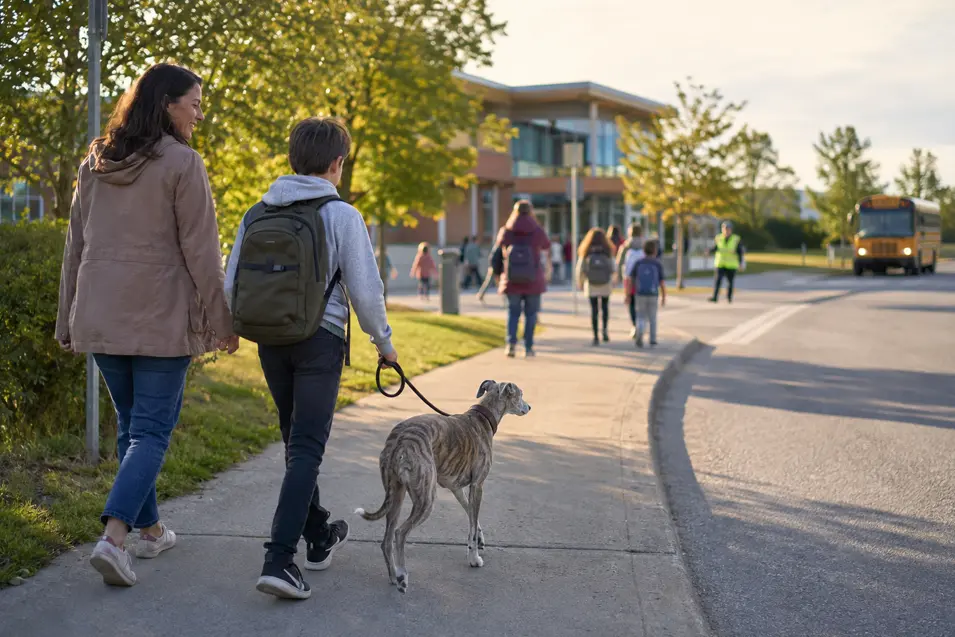
Walking to school can be one of the simplest ways for children to begin the day. It provides fresh air, a little exercise and time to talk before everyone disappears into separate routines.
Bringing the family dog may make that walk even more enjoyable.
However, the school run is not the same as an ordinary neighbourhood dog walk. Sidewalks can become crowded, traffic increases and excited children may approach the dog without asking. There may be bicycles, scooters, school buses and other dogs arriving from several directions.
There is also one important practical question: what happens to the dog when the child reaches school?
For some families, including the dog in the morning walk can become a wonderful routine. For others, the crowds, schedule and logistics make a quieter walk at another time the better choice.
Who Will Take the Dog Home?
Before considering anything else, the family needs a clear plan for the dog after arrival.
A child cannot leave the dog tied outside the school for the day. A dog should never be tethered to a fence, bike rack, tree or sign while the child goes inside.
Leaving a dog unattended creates several risks. The dog could become frightened, escape, be approached by unfamiliar children or become involved in a conflict with another dog. There is also a risk of theft, injury, overheating or exposure to poor weather.
In most cases, a parent or another responsible adult will need to accompany the child and walk the dog home.
An older student should not be expected to leave school property again after arriving simply to return the dog. This may conflict with school rules and could make the student late or unsupervised.
Unless an adult is completing the return trip, the dog should remain at home.
Check the School’s Rules
Schools may have specific policies about animals on their property. Dogs may be prohibited from playgrounds, sports fields, entrances or drop-off areas, even when they are leashed.
These rules may exist because of allergies, fear of dogs, sanitation concerns or previous incidents. A busy school also has a responsibility to protect children who may not know how to behave around an unfamiliar animal.
Check the school’s policy before bringing your dog. Do not assume that remaining on the edge of the property will always be acceptable.
Service dogs are different from family pets and may have legal access rights that ordinary companion animals do not. Children should be taught not to distract, touch or call to a working service dog.
Consider the Entire Route
A peaceful neighbourhood walk can change dramatically near a school.
Spend a morning observing the route without the dog. Look for:
- Busy intersections
- School bus loading zones
- Congested parking areas
- Narrow or crowded sidewalks
- Bicycles and scooters
- Construction
- Off-leash dogs
- Homes with dogs behind fences
- Areas where children suddenly run into the street
- Limited space near the school entrance
A dog that walks beautifully on a quiet evening may behave very differently when surrounded by shouting children, rolling backpacks, traffic and ringing bells.
Choose the safest route, even if it takes a few minutes longer.
Is Your Dog Comfortable Around Crowds?
Not every dog enjoys a busy school environment.
Some dogs become excited by children and may jump, pull or bark. Others are worried by sudden movement, loud sounds or unfamiliar people approaching from several directions.
Signs that a dog may be uncomfortable include:
- Trying to turn around or leave
- Refusing to move
- Pulling hard toward home
- Crouching or lowering the body
- Tucking the tail
- Repeatedly licking the lips or yawning
- Panting when the weather is not warm
- Barking or lunging
- Hiding behind the handler
- Becoming unusually still or stiff
A dog does not need to growl or snap before their discomfort should be taken seriously.
If the dog finds the school run stressful, do not force repeated exposure in the hope that they will eventually become used to it. Choose a quieter walking time or consult a qualified trainer or behaviour professional for guidance.
Can Your Child Safely Handle the Dog?
A child’s ability to walk a dog depends on much more than age.
Consider the dog’s size, strength, training and reactions to distractions. A small child may be unable to hold onto a powerful dog that suddenly lunges toward a squirrel or pulls toward another dog.
Even a small dog can create a dangerous situation if the child becomes tangled in the leash, steps into traffic or is knocked off balance.
Children should not independently walk a dog they cannot reliably control. An adult should remain responsible for the leash in busy areas until the child has demonstrated the necessary strength, judgement and handling skills.
If a child is helping, the adult may allow them to hold a second handle or practise in quiet sections of the route. The adult should be able to take control immediately.
Never attach the leash to the child’s wrist, waist, backpack, bicycle or scooter.
Keep the Dog on a Standard Leash
A standard fixed-length leash is generally easier to manage in a crowd than a retractable leash.
Retractable leashes can allow a dog to move unexpectedly into traffic, approach another dog or become tangled around children. The thin cord can also be difficult for other pedestrians to see.
Keep the dog close enough that they do not block the sidewalk or reach people passing nearby. Avoid wrapping the leash tightly around your hand, as this can cause injury if the dog suddenly pulls.
The dog should wear secure, properly fitted equipment and current identification.
Not Every Child Wants to Meet Your Dog
A friendly dog may attract attention during the school run. Children may call out, run toward the dog or reach for their head.
However, some children are frightened of dogs, have allergies or come from families where close contact with animals is uncommon. They should be able to arrive at school without having to squeeze past a dog.
Keep your dog out of narrow entrances and do not allow them to block sidewalks, gates or bike racks.
If a child asks to pet the dog, consider the situation before agreeing. The dog may already be overstimulated, and a line of children waiting for a turn can quickly become overwhelming.
It is always acceptable to say, “Not today—we’re heading home.”
Be Careful Around Other Dogs
Morning drop-off can attract several family dogs to the same area. Do not assume the dogs should meet simply because their owners are walking children to school.
On-leash greetings can become tense, particularly when the dogs are surrounded by traffic and people. Leashes restrict natural movement and can become tangled.
Give other dogs space. Cross the street, step onto a wide section of the sidewalk or allow another family to pass when necessary.
Watch for dogs waiting inside parked vehicles, behind fences or near school entrances. A sudden bark from an unseen dog may startle both your dog and your child.
Allow Extra Time
The school walk should not become a race against the bell.
Dogs need time to sniff and may stop to relieve themselves. A child who is worried about being late may become impatient or pull on the leash, while an adult may be tempted to rush the dog across an intersection.
Leave early enough to manage the walk calmly.
Always carry waste bags and clean up immediately. Do not leave filled bags beside a path, fence or school garbage area unless there is an appropriate bin.
Think About the Weather
September weather can range from summer heat to cold rain, depending on where you live.
Hot pavement can be uncomfortable or dangerous for a dog’s paws. Test the surface and choose shaded routes during unusually warm weather. Bring water if the total walk is long.
Cold rain and strong wind may make the trip unpleasant for children and dogs. As autumn progresses, darker mornings can also reduce visibility. Reflective clothing or a light attached to the dog’s leash or harness can help drivers see the group.
During severe weather, wildfire smoke, extreme heat or dangerous cold, the dog should stay home.
Do Not Combine the Walk With a Bicycle or Scooter
Children should not walk a dog while riding a bicycle, skateboard or scooter.
A sudden pull can cause the child to fall, while the leash may become caught in the wheels. The child may also be unable to brake safely while controlling the dog near traffic.
If the child wants to ride to school, leave the dog at home or have an adult walk the dog separately.
Puppies May Find the School Run Overwhelming
Families may view the walk to school as a useful opportunity to socialize a new puppy. Gentle exposure to different people, sounds and environments can be valuable, but more stimulation is not always better.
A busy school entrance may overwhelm a young puppy. Puppies also need age-appropriate exercise and should not be expected to complete long, rushed walks before they are physically ready.
Vaccination status must also be considered before visiting areas used by many dogs. Ask your veterinarian when and where it is appropriate for your puppy to walk.
A quieter route near the school, observed from a comfortable distance, may be more suitable than entering the busiest drop-off area.
When Walking the Dog to School Can Work
The routine may be a good fit when:
- An adult is available to walk the dog home
- The school permits dogs in the area being used
- The route is safe and has adequate sidewalk space
- The dog is calm around children, traffic and other dogs
- The child can walk without becoming distracted or late
- The weather is appropriate
- The dog remains comfortable throughout the trip
- The family allows enough time for a relaxed walk
When these conditions are met, the morning walk can provide exercise and a positive transition into the day.
It may also give parents and children a few quiet minutes together before school.
When the Dog Should Stay Home
A different routine is likely better when:
- Nobody can return the dog home
- Dogs are prohibited on school property
- The dog is fearful or reactive
- The route involves dangerous traffic
- Sidewalks are extremely crowded
- The child cannot safely handle the dog
- The dog becomes overexcited around children
- The weather creates a health or safety risk
- The morning schedule requires everyone to rush
The dog is not missing an important experience by staying home. A calm walk after drop-off or later in the day may be far more enjoyable.
Make the Walk About the Dog Too
Walking to school with the family dog can be a lovely routine, but only when the plan works for everyone.
The school’s rules, the child’s safety and the dog’s comfort all matter. An adult must be prepared to manage the dog, navigate the crowded areas and complete the return trip.
If the dog enjoys the outing and the family can avoid the busiest entrances, the morning walk may become a favourite part of the school year.
If it creates stress, rushing or complicated logistics, leave the dog at home and promise them a better walk once the school bell rings.