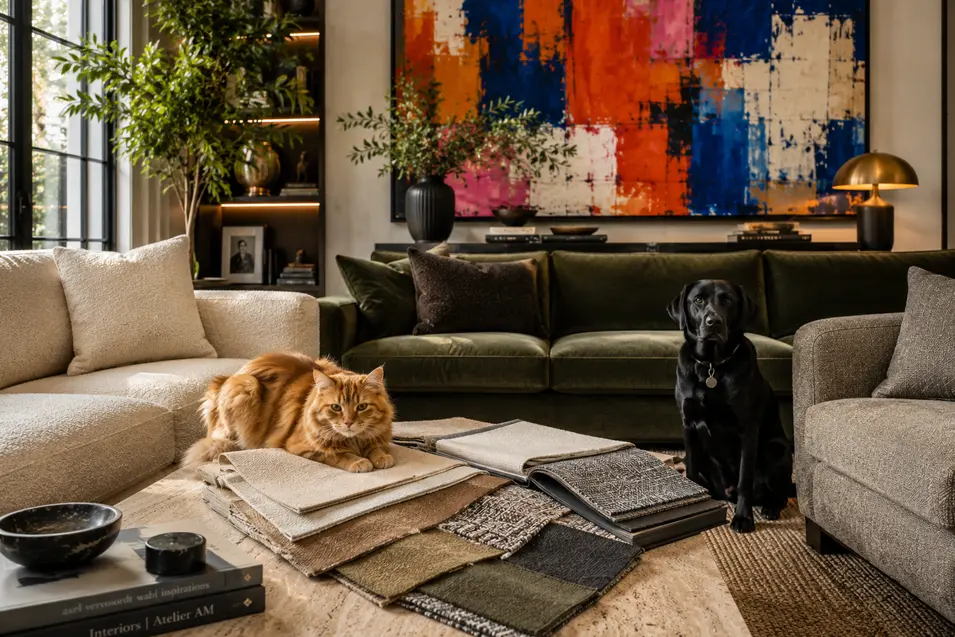
Choosing a new sofa usually involves a familiar list of questions.
Does it fit the room?
Is it comfortable?
Will that colour still look good five years from now?
And if you share your home with a dog or cat, there may be one more question worth asking:
Does this sofa match the pet?
It sounds ridiculous.
It may also be one of the more practical decorating decisions you make.
Anyone who has owned a black cat and a cream sofa—or a white dog and a charcoal sectional—already understands the problem. Pet hair doesn’t necessarily become more noticeable because there is more of it.
Sometimes there is simply more contrast.
The solution isn’t necessarily to buy a sofa the exact colour of your Labrador.
But thinking about your pet’s coat when choosing upholstery colour, pattern and texture can make everyday shedding considerably less obvious.
And no, your living room does not have to look like it was decorated around the dog.
Done properly, nobody will know.
Except perhaps the dog.
Why Some Sofas Seem to Collect More Pet Hair
Put ten white hairs on a white sofa and you probably won’t notice them.
Put the same ten hairs on a black sofa and suddenly it looks as though the dog has been sleeping there for a week.
The amount of hair hasn’t changed.
The contrast has.
That simple principle explains why some perfectly clean homes seem constantly covered in pet hair while others can survive several days between vacuuming without looking particularly furry.
Colour matters.
But it isn’t the only thing that matters.
The weave, texture and pattern of the upholstery can determine whether individual hairs stand out, disappear visually or become embedded in the fabric.
That means the smartest sofa choice isn’t necessarily one that perfectly matches your pet.
It’s one that forgives the evidence that your pet lives there.
Should Your Sofa Actually Match Your Pet?
Sometimes, surprisingly, yes.
If you have a golden retriever, warm oatmeal, camel, taupe and softly flecked beige upholstery can make loose golden hairs much less noticeable.
A grey cat may disappear beautifully against charcoal, pewter or heathered grey.
A white dog can be remarkably forgiving on cream, ivory and pale stone upholstery.
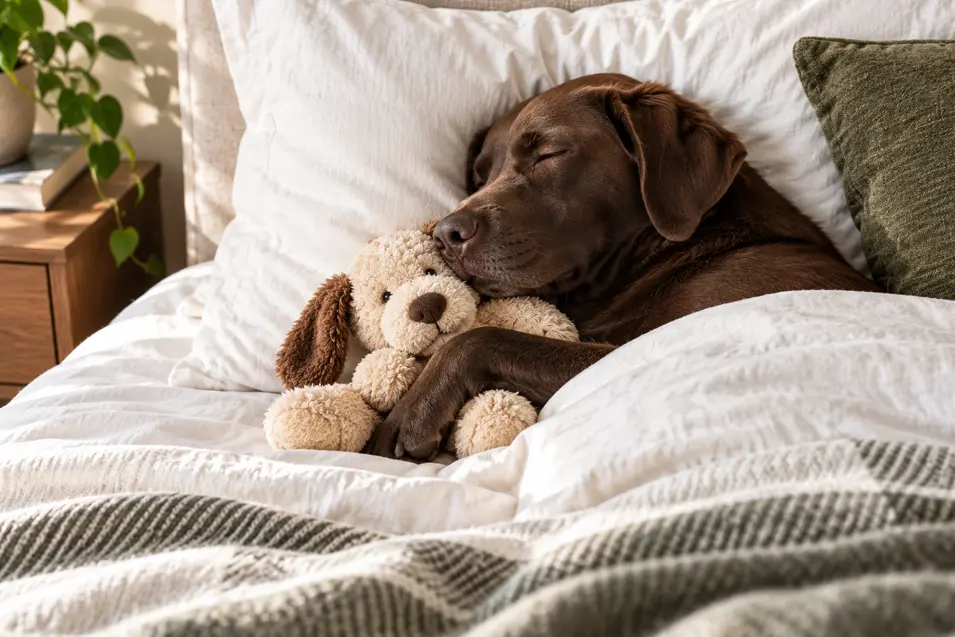
And a chocolate Lab lounging on a tobacco-coloured leather sofa may look suspiciously as though the entire room was designed around them.
There is nothing wrong with that.
But an exact colour match isn’t necessary.
The goal is simply to reduce contrast.
Think of your pet’s coat as another colour already present in the room.
You don’t have to match it precisely.
You just don’t want to fight it unnecessarily.
The Fabric Swatch Test
Here’s an unusually simple trick when shopping for furniture:
Take the swatches home.
Then introduce them to the pet.
Place several upholstery samples beside your dog’s coat or gently lay them across your cat while they’re relaxing.
You’ll immediately see which colours make loose hair disappear and which ones highlight every strand.
Better yet, rub the sample lightly against the area where your pet sheds and see what happens.
Does the hair sit visibly on top?
Does it work its way into the weave?
Can you brush it away easily?
A tiny upholstery sample can tell you surprisingly much about what living with an entire sofa covered in that fabric might be like.
Your cat may find this research methodology questionable.
Proceed accordingly.
Golden, Ginger and Tan Pets
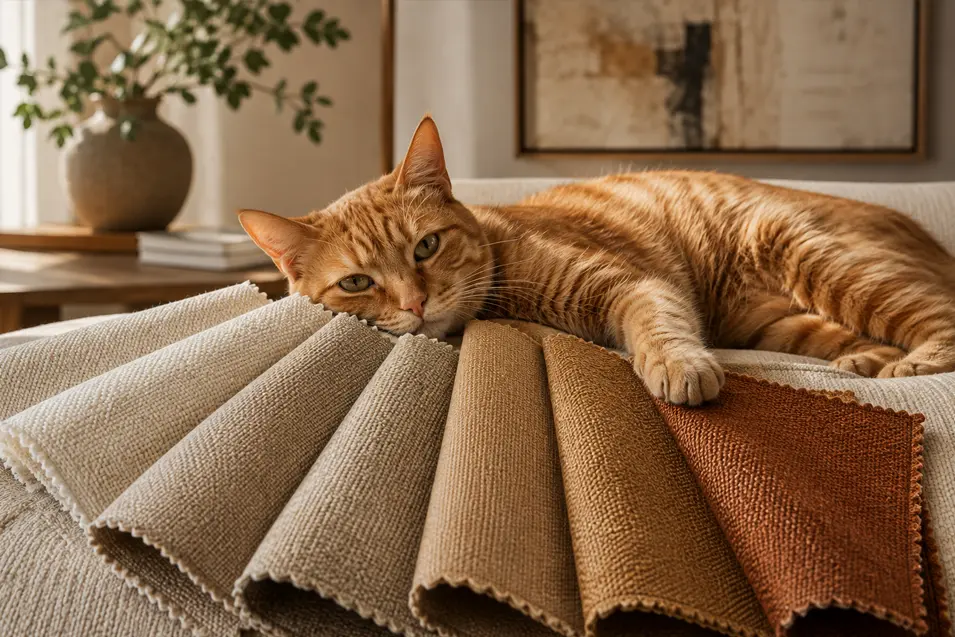
Golden retrievers, ginger cats, yellow Labs and tan dogs have one enormous decorating advantage:
Their coats work beautifully with many of today’s most popular upholstery colours.
Warm neutrals are particularly forgiving.
Think oatmeal, camel, sand, mushroom, warm taupe, cognac and softly mottled beige.
These colours don’t need to match the animal perfectly. They simply reduce the contrast enough that a few loose hairs don’t immediately announce themselves.
The bonus is that these shades are easy to incorporate into sophisticated interiors.
A beautifully proportioned oatmeal sofa beneath a dramatic piece of contemporary art doesn’t look like a sofa chosen to hide golden retriever hair.
It simply looks like a great sofa.
The dog is our little secret.
Black Pets
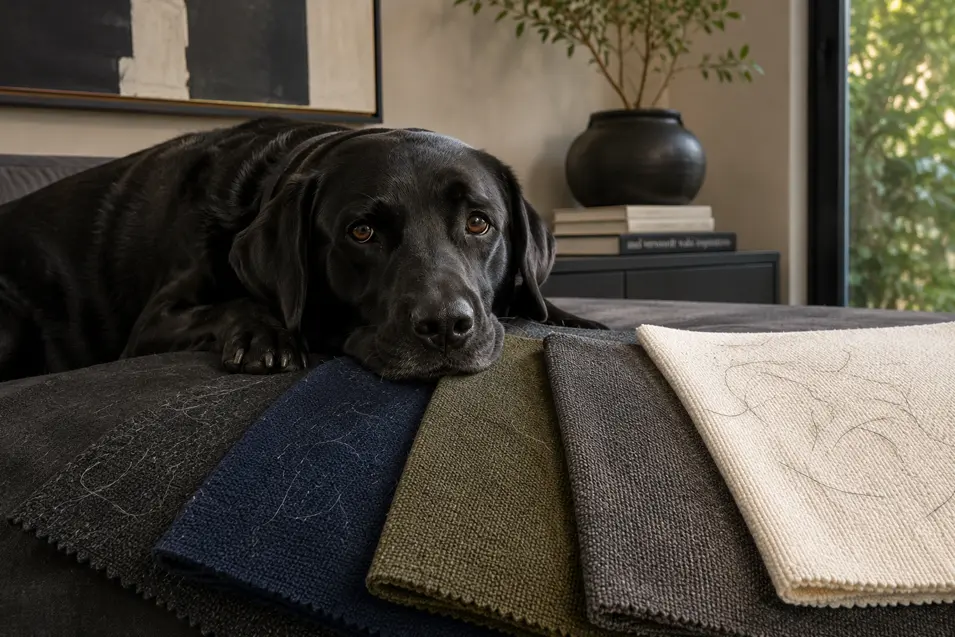
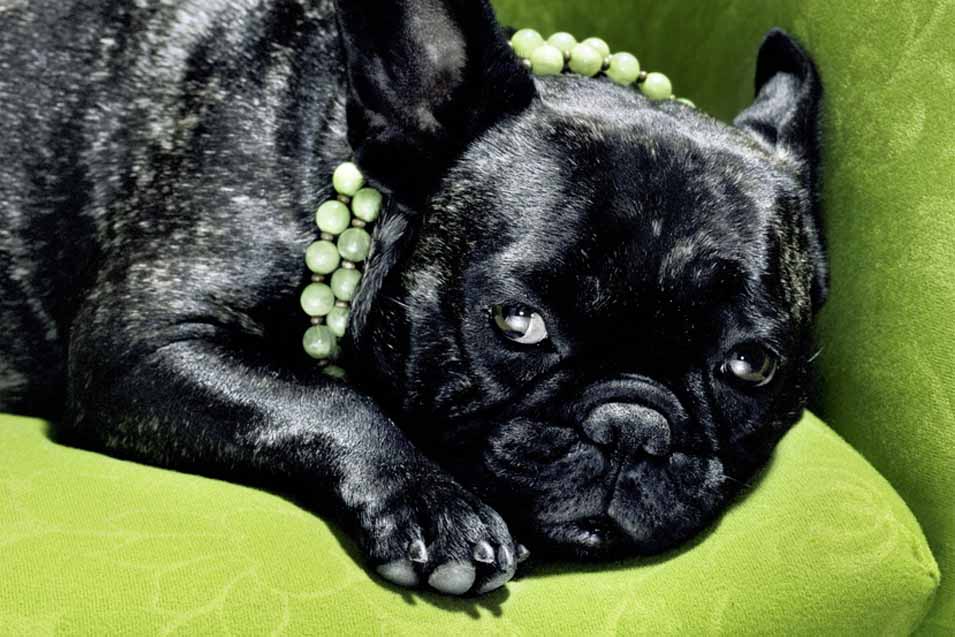
Black cats and dogs present almost the opposite problem.
Their hair can be spectacularly visible on pale upholstery.
That doesn’t mean you need a black sofa.
In fact, pure black upholstery can introduce its own problems by showing lint, dust and lighter debris.
Instead, look toward charcoal, deep olive, graphite, dark brown, navy and textured darker neutrals.
A fabric with slight tonal variation can be particularly effective because the surface isn’t visually uniform.
And if you happen to own a black cat who enjoys sleeping on a charcoal sofa?
You may occasionally sit on the cat.
This is one disadvantage of successful colour coordination.
White and Cream Pets
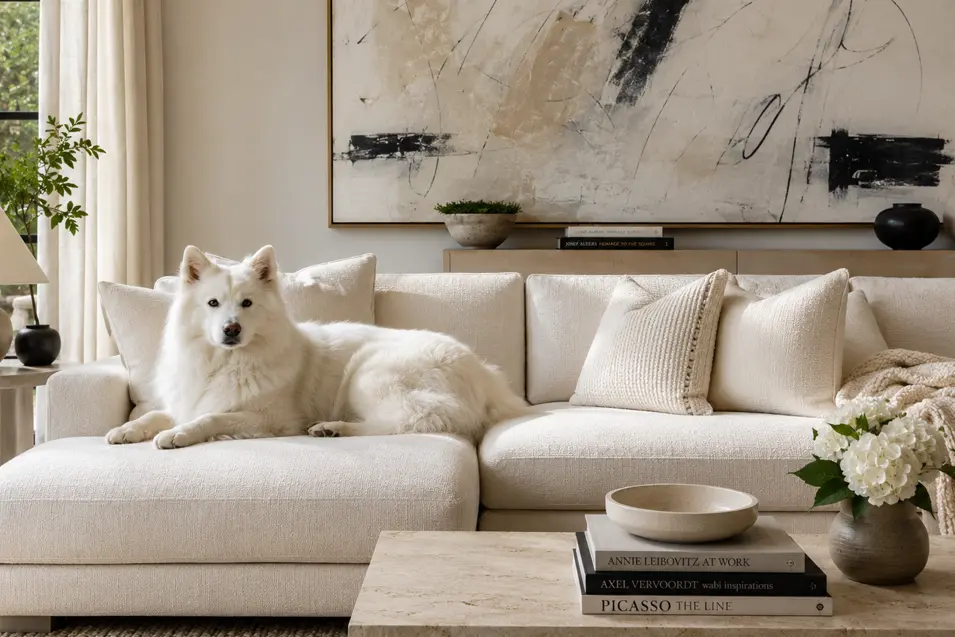
White pet hair has an almost supernatural ability to appear on dark clothing and dark furniture.
Cream, stone, pale grey, oatmeal and softly textured light neutrals can dramatically reduce the visual contrast.
But there’s an important trade-off.
A pale sofa may hide white pet hair beautifully while making muddy paws, food stains and everyday dirt more obvious.
This is where colour and fabric performance need to work together.
If you’re choosing light upholstery for a pet household, cleanability matters just as much as colour.
Beautiful is good.
Beautiful and washable is better.
Grey and Blue-Grey Pets
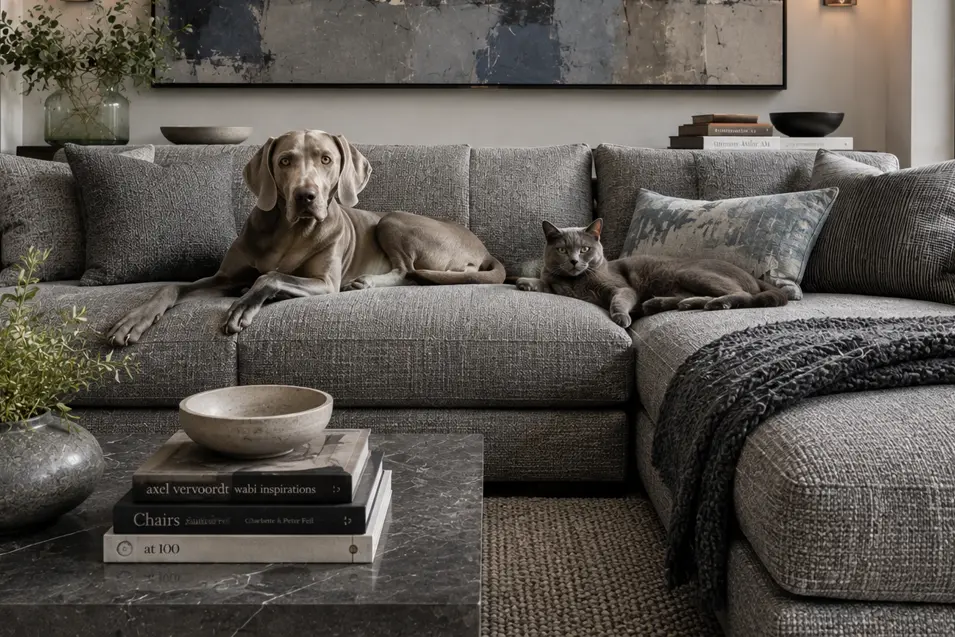
Grey pets may have won the furniture lottery.
Their coats tend to work beautifully with a huge range of sophisticated mid-tone upholstery colours.
Pewter, stone, mushroom, grey-green, charcoal, denim blue and heathered fabrics can all disguise grey fur remarkably well.
This is also where texture becomes particularly useful.
A slightly mottled or heathered fabric breaks up the surface visually, making individual hairs much less noticeable than they would be against a perfectly flat solid colour.
Your Russian Blue may have been coordinating with contemporary interiors all along.
What About Multi-Coloured Pets?
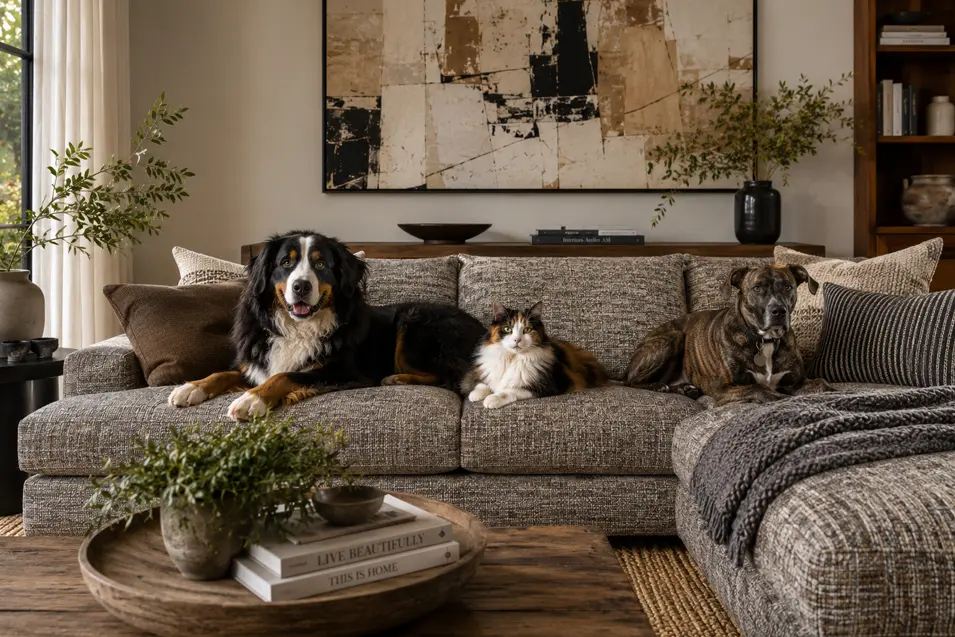
This is where things get interesting.
A calico cat does not offer a particularly straightforward colour palette.
Neither does a Bernese Mountain Dog.
Or a brindle dog.
Or a household containing one white cat, one black dog and something inexplicably orange.
Trying to match the sofa to everyone becomes impossible.
Fortunately, you don’t have to.
This is where mid-tones, texture and subtle pattern become far more useful than exact colour matching.
A fabric containing several tones can visually break up both light and dark hairs.
Small-scale patterns, flecks, tweeds and heathered effects can also prevent individual hairs from standing out against a perfectly uniform background.
Sometimes the best sofa colour for your pet isn’t really one colour at all.
Two Pets, Two Completely Different Coats
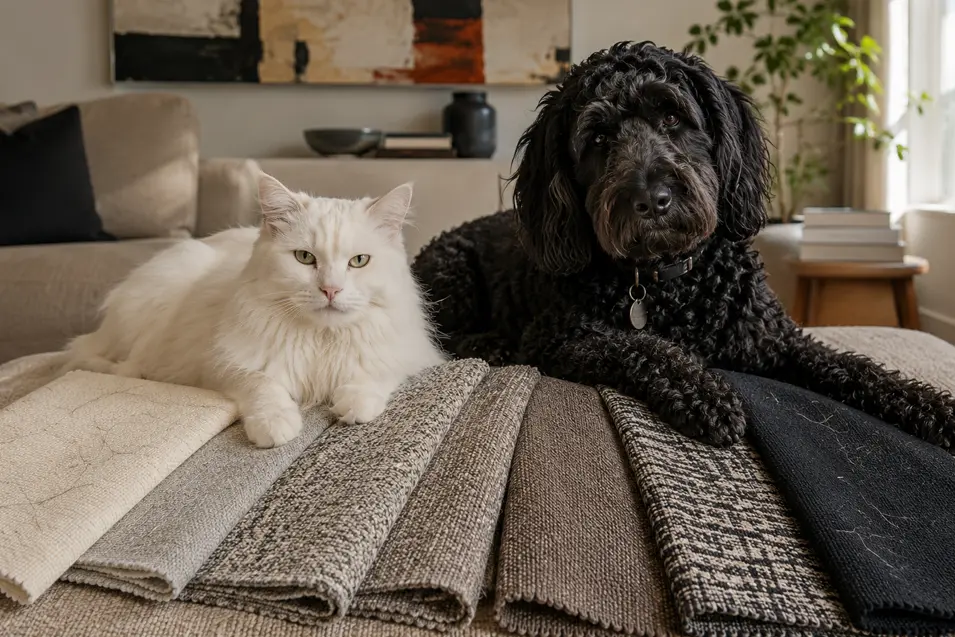
Suppose you have a black cat and a white dog.
Congratulations.
You have defeated the colour-matching strategy.
Anything dark will show the dog’s hair.
Anything pale will show the cat’s.
This is where trying to find a perfect match becomes pointless.
Instead, look for the middle ground.
Mid-tone upholstery, subtle patterns and fabrics containing several related shades tend to be much more forgiving in multi-pet homes.
Think heathered grey rather than solid charcoal.
Flecked oatmeal rather than pure cream.
A subtle woven pattern rather than one uninterrupted field of colour.
The objective changes from hiding one particular colour of hair to creating enough visual variation that no individual hair gets much attention.
Diplomacy has entered furniture design.
Pattern May Be Your Secret Weapon
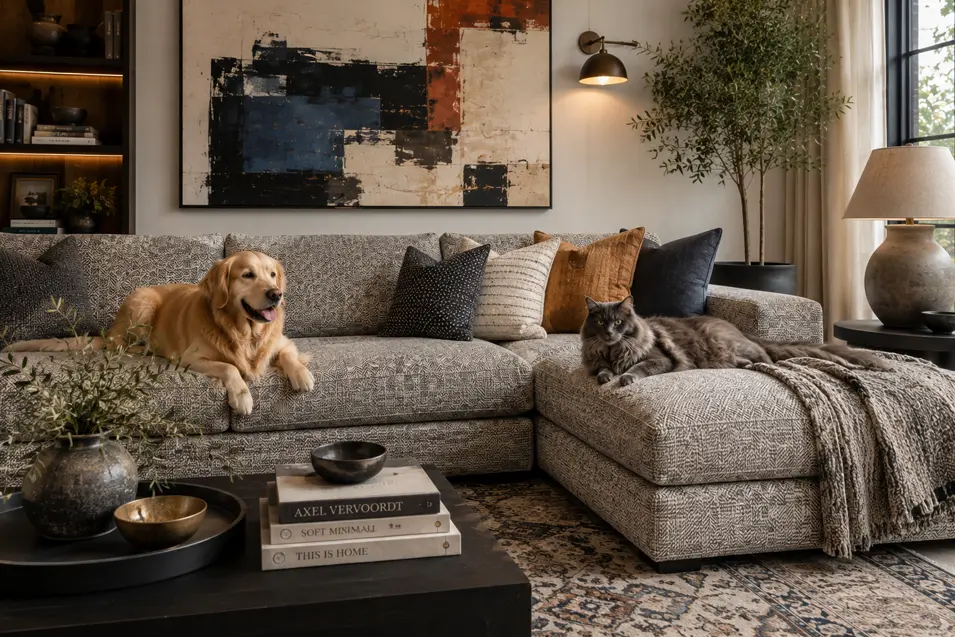
Pattern doesn’t have to mean floral sofas or dramatic stripes.
Some of the most useful upholstery patterns are barely noticeable from across the room.
A subtle herringbone.
A tiny geometric weave.
A softly mottled texture.
Two similar colours woven together.
These small variations help break up pet hair visually while still allowing the furniture to feel sophisticated.
Patterned rugs work for much the same reason.
There is simply more happening visually, so every stray hair doesn’t become the star of the composition.
Sometimes a little visual complexity makes a room considerably easier to live with.
Texture Matters More Than You Think
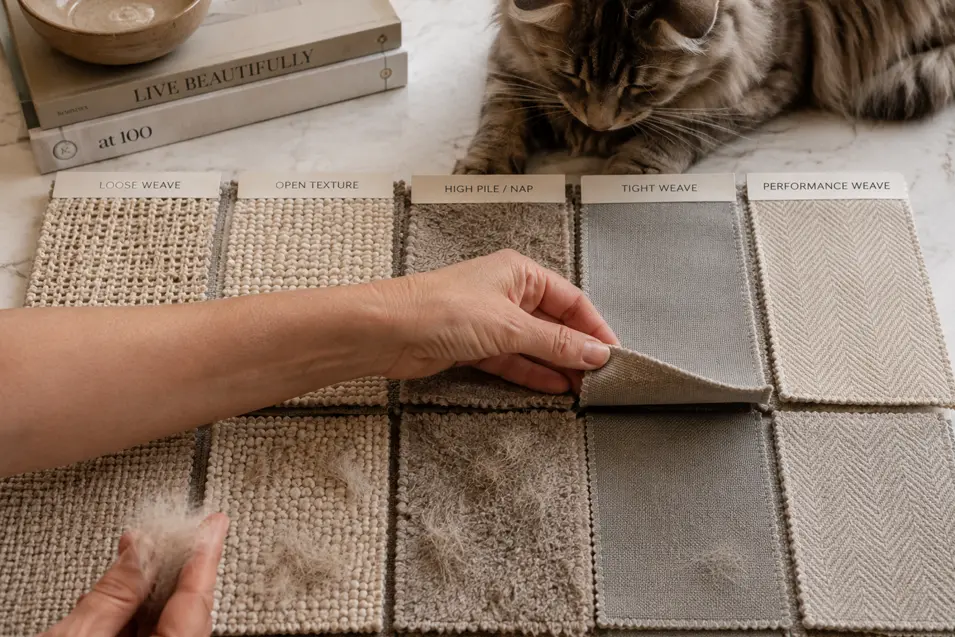
A fabric may be the perfect colour and still be a terrible choice for your pet.
Loose loops and open weaves can give claws something to catch, while some heavily textured fabrics can hold onto hair rather than allowing it to vacuum away easily.
Tighter, flatter weaves generally give claws less opportunity to snag and can make routine cleaning easier. Performance upholstery is also worth considering because many options are designed around durability and easier stain removal.
The practical test is wonderfully low-tech.
Look closely at the swatch.
Run your hand across it.
Rub some pet hair against it.
Try removing the hair.
If a small sample becomes furry immediately and refuses to give the hair back, imagine owning eight feet of it.
Be Careful With Beautiful Bouclé
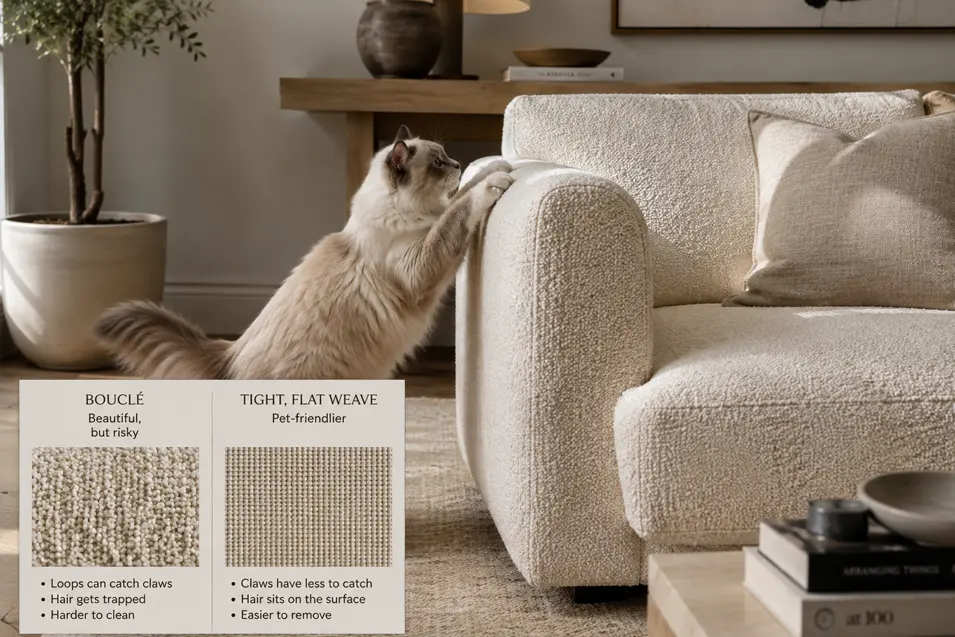
We understand the appeal.
Bouclé is soft, sculptural and exceptionally good at making a chair look as though it belongs in an expensive design magazine.
Cats may also appreciate its qualities.
Unfortunately, possibly for different reasons.
The loops and irregular surface that make bouclé visually interesting can also provide opportunities for claws to catch and hair to become lodged in the texture. Tighter, flatter constructions are generally safer choices in homes where scratching is a concern.
That doesn’t mean nobody with a pet can own bouclé.
A calm dog that rarely gets on the furniture presents a very different challenge from an enthusiastic cat who considers the sofa arm recreational equipment.
Choose for the pet you actually have.
Not the imaginary one who respects furniture.
Leather Changes the Equation
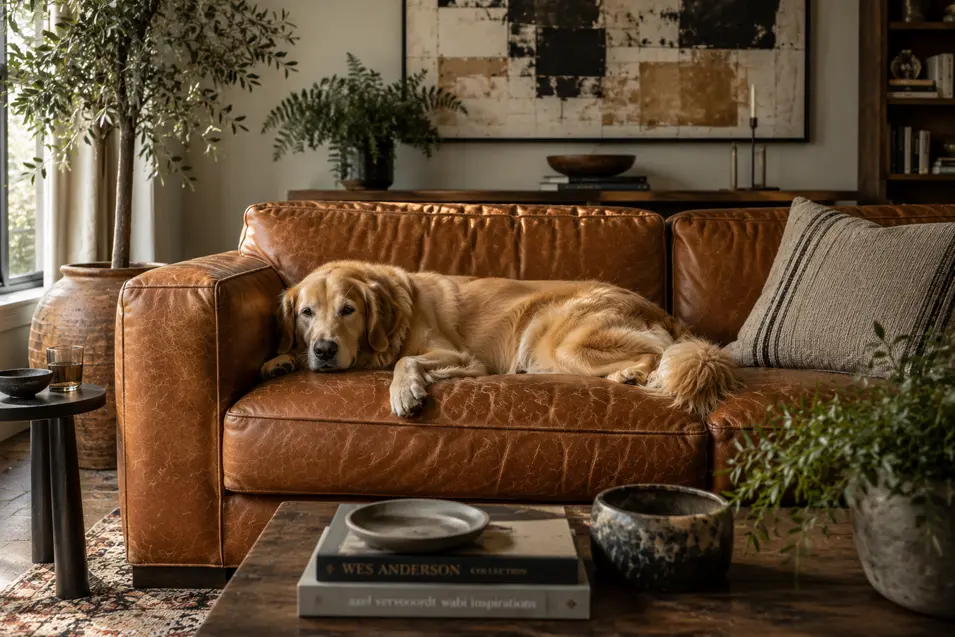
Leather handles pet hair differently because there is no weave for fur to work itself into.
Hair generally stays on the surface and can be wiped or vacuumed away easily.
The trade-off is claws.
Scratches can become visible, particularly on softer finishes.
For some homeowners, that isn’t necessarily a disaster.
A beautiful leather sofa that develops a little patina over years of dogs, books, children, naps and everyday life can become more attractive rather than less.
For others, the first visible claw mark will cause emotional damage far exceeding the damage to the sofa.
Know which person you are before buying the leather sofa.
Don’t Choose an Ugly Sofa Because You Own a Pet
This may be the most important point.
Pet-friendly does not have to mean boring.
You don’t need to buy the brown sofa you don’t particularly like simply because the dog is brown.
You don’t need to cover beautiful furniture in unattractive protective covers.
And you certainly don’t need to design the entire living room around shedding.
The objective is to make smarter choices within the style you already love.
If you want a deep green sofa, choose a green with enough texture or tonal variation to forgive some hair.
If you want cream, look carefully at performance and cleaning options.
If you love dramatic furniture, buy dramatic furniture.
A pet-friendly home should still look like your home.
Let the Art Do Some of the Heavy Lifting
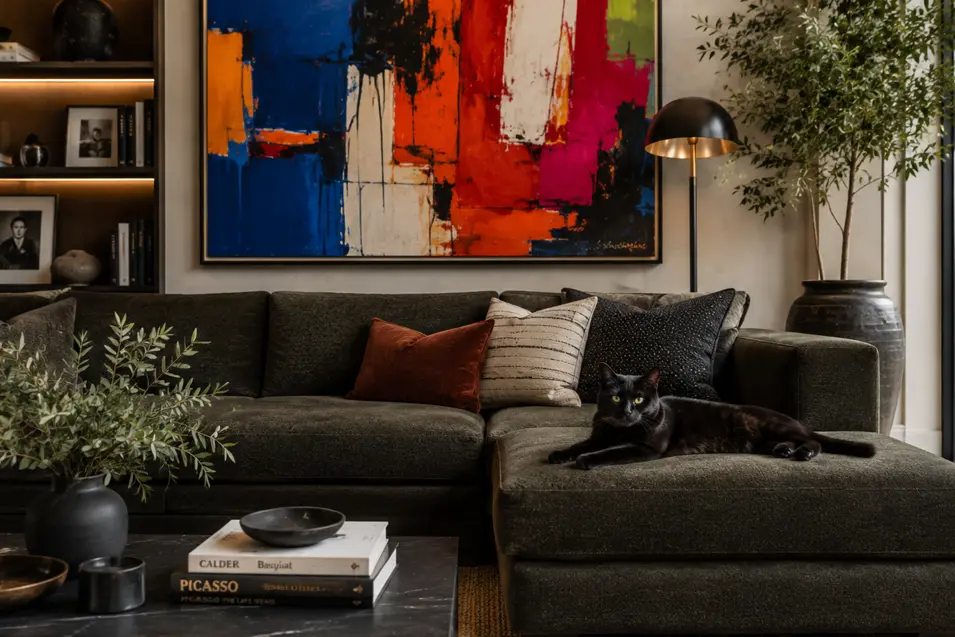
There is another advantage to choosing quieter, more forgiving upholstery colours.
You can let other things in the room be louder.
A warm neutral sofa can sit beneath an enormous piece of contemporary art.
A charcoal sectional can share a room with saturated colour.
An oatmeal chair can become the quiet foreground for a painting that completely owns the wall behind it.
The sofa doesn’t always need to be the visual event.
Sometimes its job is to be comfortable, beautiful, practical and capable of surviving a cat.
Let the art misbehave instead.
Think About Where Your Pet Actually Sits
Most pets develop favourite furniture spots.
One particular cushion.
The back of the sofa.
The chair beside the window.
The corner closest to you.
The entire sofa despite being allocated approximately fourteen inches of it.
Pay attention to those habits before buying new furniture.
If your dog always occupies one end of the sectional, removable cushion covers may matter more than perfect colour coordination.
If your cat sleeps along the back cushion, consider how easily that surface can be vacuumed.
If your pet loves one particular chair, perhaps that chair deserves the most forgiving upholstery in the room.
Designing around real behaviour is considerably more useful than designing around theoretical behaviour.
The Best Sofa Colour May Be the One You Love
Matching your sofa to your pet can absolutely make shedding less noticeable.
But that doesn’t mean your Labrador should become your interior designer.
Colour is only one part of the equation.
Texture matters.
Pattern matters.
Cleanability matters.
Durability matters.
And most importantly, you still have to love the furniture.
The smartest solution is often somewhere in the middle: a colour that works beautifully in your room, doesn’t dramatically contrast with your pet and comes in a fabric capable of handling real life.
Because pet hair isn’t actually a decorating failure.
It’s simply evidence that an animal lives in the house.
Beautiful Homes Are Allowed to Have Pet Hair
There is a strange idea that beautiful interiors must remain untouched.
Perfect cushions.
Perfect rugs.
Perfect sofas.
Nothing out of place.
Nobody actually living there.
But some of the most memorable homes are beautiful precisely because life is visible.
There are books on the table.
A blanket has been left on the sofa.
Someone’s coffee is beside the chair.
And a cat is asleep exactly where someone else intended to sit.
Choosing furniture intelligently doesn’t mean trying to erase your pet from the home.
It simply means making everyday life a little easier.
So should your sofa match your pet?
Maybe.
Or perhaps it should simply understand them.
Choose the colour thoughtfully.
Choose the fabric carefully.
Bring home the swatches.
Rub them against the dog.
Consult the cat if necessary.
Then buy the sofa you actually want.
A little pet hair was always going to end up on it anyway.