Your dog has a favorite bone. You walk toward him and suddenly his entire body changes.
He stops chewing. His head lowers over the bone. His body becomes stiff. Maybe he gives you a hard stare or quietly growls.
Your first instinct might be to take the bone away and show him that guarding isn’t acceptable.
Don’t.
What you’re seeing is resource guarding, and how you respond can make the situation better — or considerably worse.
Resource guarding occurs when a dog tries to maintain control of something he considers valuable. Food is probably the best-known example, but dogs can guard toys, chews, beds, stolen objects, favorite resting places and even particular people.
Some resource guarding is subtle. Other cases can escalate to snapping or biting.
Understanding what your dog is trying to communicate is the first step toward dealing with it safely.
What Is Resource Guarding?
Resource guarding is behavior intended to keep another person or animal away from something the dog values.
That resource might be:
- A food bowl
- Treats or chews
- Bones
- Toys
- A stolen sock or piece of garbage
- A bed or crate
- A favorite chair or section of the sofa
- A particular room or resting place
- In some cases, a person
Dogs don’t necessarily guard everything they value.
A dog might happily let you handle his toys but become uncomfortable when you approach his food bowl. Another may have no problem sharing food but guard objects he steals around the house.
The behavior can also be directed toward certain individuals. A dog may guard something from another dog but not from people, or behave differently around different members of the household.
What Does Resource Guarding Look Like?
Growling is one of the most obvious signs, but resource guarding often begins well before a dog growls.
Watch for changes in body language when you or another animal approach something your dog values.
Early warning signs can include:
- Suddenly becoming still or freezing
- Lowering the head over an object
- Positioning the body between you and the resource
- Eating much faster when someone approaches
- Carrying an object away
- Giving a hard or fixed stare
- Showing the whites of the eyes
- Becoming unusually tense
- Hovering over an object
As the dog’s discomfort increases, you might see:
- Growling
- Showing teeth
- Snarling
- Air snapping
- Lunging
- Biting
Don’t assume that a dog who hasn’t bitten doesn’t have a resource guarding problem.
A freeze or hard stare may be your dog’s first attempt to say, “Please don’t come any closer.”
Recognizing those quieter signals gives you an opportunity to respond before the situation escalates.
Why Do Dogs Guard Resources?
Resource guarding isn’t necessarily a sign that your dog is dominant, mean or trying to take control of the household.
From the dog’s perspective, protecting something valuable can make perfect sense.
Food, safe resting places and other resources matter to animals. Some dogs are naturally more inclined to protect them than others.
A dog’s history and experiences can also contribute.
Dogs that have competed for food, experienced scarcity, had valued objects repeatedly taken away or learned that people approaching means losing something may become particularly concerned about protecting resources.
In other cases, owners may never know exactly why the behavior developed.
The important question isn’t necessarily “Why did my dog become this way?”
It’s “How can I keep everyone safe and change what happens next?”
Don’t Punish the Growl
A growl can be frightening, particularly when it comes from a family dog.
But growling is communication.
Your dog is telling you that he is uncomfortable and wants more space.
Punishing a dog for growling may suppress the warning without changing the underlying emotion. The dog can still feel threatened when someone approaches his resource — he may simply become less likely to warn you about it.
You don’t want to teach your dog that communicating discomfort gets him punished.
You want to address why he feels the need to guard the resource in the first place.
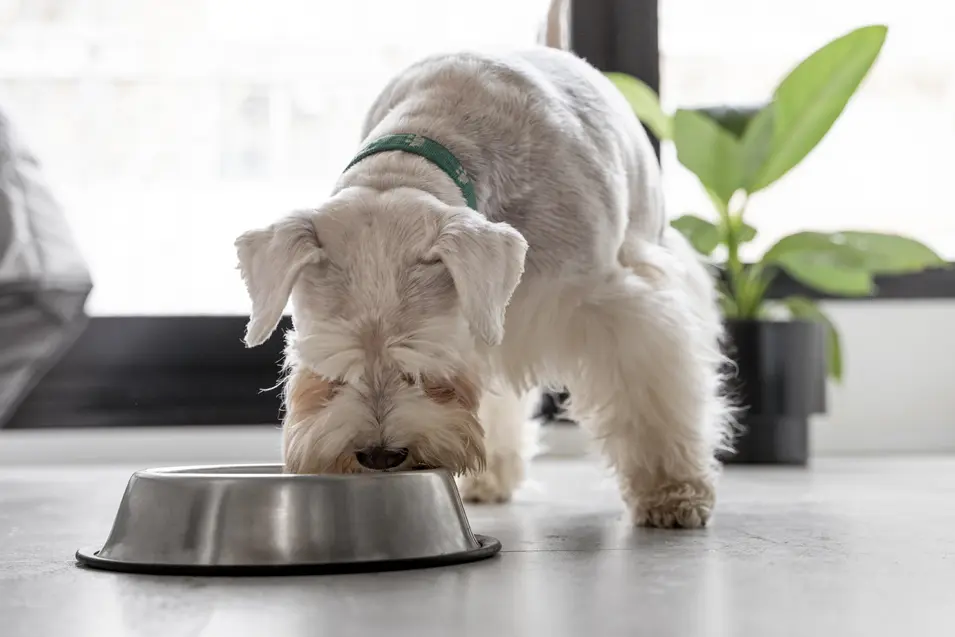
Don’t Keep Taking Your Dog’s Food Away
There was once a common piece of dog-training advice that owners should regularly put their hands in a dog’s food bowl or take the bowl away while the dog is eating.
The idea was that the dog needed to learn who was in charge.
This can backfire.
Imagine sitting down with your favorite meal and discovering that every time somebody walks past, there’s a good chance they’ll take your plate away.
You probably wouldn’t become more relaxed when they approached.
Instead, teach your dog that people approaching his food can predict good things rather than loss.
For a dog without an established guarding problem, that might be as simple as occasionally walking past at a comfortable distance and tossing an especially tasty treat toward the bowl before continuing on your way.
The goal is not to test whether you can take your dog’s food.
It’s to create a dog who doesn’t feel threatened by your presence.
What Should You Do If Your Dog Guards Something?
If your dog already has something and appears likely to guard it, don’t turn the situation into a confrontation.
Give him space.
If the object isn’t dangerous, you may simply be able to leave him alone until he’s finished with it.
If you need the object back, a trade can sometimes be useful with dogs that aren’t showing serious aggression.
Offer something your dog considers more valuable than what he currently has. When he voluntarily moves away from the original item, you can safely retrieve it.
The exchange should feel like a good deal from your dog’s perspective.
You aren’t stealing his treasure.
You’re offering an upgrade.
If your dog is stiff, growling, snapping or has previously bitten while guarding resources, don’t attempt to work through the problem by repeatedly approaching or taking things from him. Manage the situation and get professional help.
Teaching Your Dog to Trade
A good trade can become one of the most useful skills you teach your dog.
Start when there isn’t a conflict.
Give your dog a relatively ordinary toy. Then offer a high-value treat.
When he releases the toy to take the treat, calmly pick up the toy. In many training situations, you can then give the toy back.
Over time, your dog begins learning an important lesson:
Giving something up doesn’t necessarily mean losing it forever — and sometimes something even better appears.
Once your dog understands the game, you can introduce a cue such as “drop it.”
Practice with low-value objects before attempting the exercise with something your dog considers extremely valuable.
Training should feel easy and cooperative rather than like a contest.
“Leave It” Is Another Valuable Skill
“Leave it” teaches a slightly different lesson.
Instead of asking your dog to release something already in his mouth, you’re teaching him to disengage from something before he gets it.
That can be useful when your dog notices:
- Food dropped on the floor
- Garbage
- Children’s toys
- Socks
- Wildlife
- Potentially dangerous objects
Teaching these skills before you desperately need them makes life considerably easier.
A dog who happily responds to “leave it” or “drop it” gives you options other than chasing him around the house trying to retrieve whatever he’s stolen.
And chasing can sometimes turn stealing objects into a very entertaining game.
Resource Guarding in Puppies
Prevention is easier than dealing with an established guarding problem.
Teach your puppy from the beginning that people near his possessions are not a threat.
You can practice trades with toys, reward your puppy for willingly releasing objects and occasionally add something especially tasty to his meal rather than removing food from him.
Also teach everyone in the household the same rules.
Don’t allow one person to practice gentle exchanges while somebody else routinely grabs things from the puppy’s mouth.
Consistency matters.
And resist the temptation to deliberately provoke your puppy just to see whether he’ll guard something.
You don’t need to repeatedly test good behavior.
You want to reinforce it.
Resource Guarding Between Dogs
Dogs can guard resources from each other as well.
You might notice one dog blocking another from approaching:
- Food bowls
- Toys
- Chews
- Beds
- Doorways
- A favorite person
Management can make an enormous difference.
Feed dogs separately if necessary. Give high-value chews in different rooms or behind barriers. If a particular toy repeatedly causes conflict, don’t leave it lying around when the dogs are together.
Don’t expect dogs to “work it out themselves” when aggression is involved.
Repeated confrontations can increase tension and create opportunities for serious fights.
A peaceful household is more important than proving that two dogs should be able to share a bone.
Resource Guarding People
Some dogs appear to guard a favorite person.
A dog may wedge himself between his owner and another person, growl when somebody approaches the sofa, or react aggressively when another pet comes near.
This can look cute at first.
“My dog loves me so much he doesn’t want to share me.”
But guarding a person shouldn’t be romanticized.
If your dog is threatening people or animals who approach you, treat it as a behavior problem rather than evidence of extraordinary devotion.
Because the situation can become complicated quickly, professional guidance is often appropriate.
Resource Guarding and Children
Resource guarding becomes especially concerning when children are involved.
Young children aren’t good at recognizing subtle canine body language. They may reach for a dog’s toy, crawl toward a food bowl or try to hug a dog while he’s chewing something.
They can also move quickly and unpredictably.
A child should never be responsible for correcting or training a resource-guarding dog.
Children should be taught to leave dogs alone while they’re eating and to avoid taking toys, bones or other valued objects away from them.
Adults should manage the environment so the child doesn’t have access to the dog during situations known to trigger guarding.
Baby gates, closed doors, crates or separate feeding areas can provide physical separation when needed.
If a dog has shown aggression around a child, don’t experiment with training techniques you found online.
Separate the dog and child safely and seek qualified professional help.
What If Your Dog Guards Something Dangerous?
Sometimes the resource isn’t something you can simply let your dog keep.
He may grab medication, chocolate, a cooked bone, garbage or another potentially dangerous object.
Try to avoid creating a chase.
If your dog has a reliable trade or drop-it cue, use it and offer something extremely valuable in exchange.
Prevention is even better.
Keep medications, food, garbage and other dangerous objects where your dog can’t reach them. Dogs that frequently steal household objects may require more careful management while you’re working on training.
If your dog has swallowed something potentially toxic or dangerous, contact your veterinarian or an appropriate pet poison service promptly rather than waiting for symptoms to appear.
When Resource Guarding Suddenly Appears
A dog that has never guarded resources before and suddenly begins doing so deserves a closer look.
Pain, illness and other physical problems can influence behavior.
A dog experiencing pain may become particularly protective of a resting place or react when approached because he anticipates being touched.
If the behavior is new or accompanied by other changes in appetite, activity, mobility, sleep or personality, schedule a veterinary examination.
Behavioral changes can sometimes be the first indication that something isn’t right.
When Should You Get Professional Help?
Mild resource guarding and serious aggression aren’t the same problem.
Seek professional help if your dog:
- Has bitten someone
- Has attempted to bite
- Regularly snaps or lunges
- Guards numerous objects or locations
- Guards a person
- Is difficult to manage safely
- Guards resources around children
- Is becoming more intense or unpredictable
- Causes you to feel afraid in your own home
Start with your veterinarian, particularly if the behavior appeared suddenly.
For established aggression, look for a veterinary behaviorist or another qualified behavior professional with specific experience treating aggression and resource guarding using evidence-based, reward-focused methods.
The more serious the behavior, the less appropriate a do-it-yourself approach becomes.
What Not to Do With a Resource-Guarding Dog
Resource guarding can be frustrating, but confrontation usually isn’t the answer.
Avoid:
- Punishing your dog for growling
- Yelling or physically intimidating him
- Forcibly prying objects from his mouth
- Routinely taking away his food to establish control
- Cornering him when he has something valuable
- Allowing children to approach him while he’s eating
- Deliberately provoking guarding behavior to “test” him
- Encouraging dogs to fight over resources
- Ignoring escalating warning signs
The objective isn’t to prove that you can overpower your dog.
It’s to create safer behavior and help your dog feel less threatened when people or animals are around things he values.
What Should I Do Right Now?
If you’re reading this because your dog just growled at you over a bowl, bone or toy, don’t panic — and don’t turn it into a showdown.
Give your dog space.
Keep children and other pets away.
If the item isn’t dangerous, leave your dog alone and retrieve it later when he has moved away.
If the item is dangerous and your dog has safely traded objects before, offer a much higher-value reward from a comfortable distance rather than reaching toward him.
If you believe approaching your dog could result in a bite, don’t approach.
Once the immediate situation is safe, think about what triggered the guarding and how you can prevent the same setup from occurring again.
A single growl is information worth paying attention to.
Repeated growling, snapping, lunging or biting is a reason to involve a professional.
Resource Guarding Doesn’t Make Your Dog a Bad Dog
It can be unsettling to see your friendly family dog suddenly freeze over a bone or growl when somebody approaches his dinner.
But resource guarding doesn’t erase everything else you know about your dog.
It tells you that, in that particular situation, your dog feels strongly enough about keeping something that he’s prepared to warn others away.
Listen to that warning.
Use management to prevent unnecessary confrontations, teach useful skills such as trading and leaving objects alone, and seek professional guidance when the behavior presents a safety risk.
The goal isn’t to win a battle over the food bowl.
It’s to build a household where your dog doesn’t feel that there needs to be a battle in the first place.