
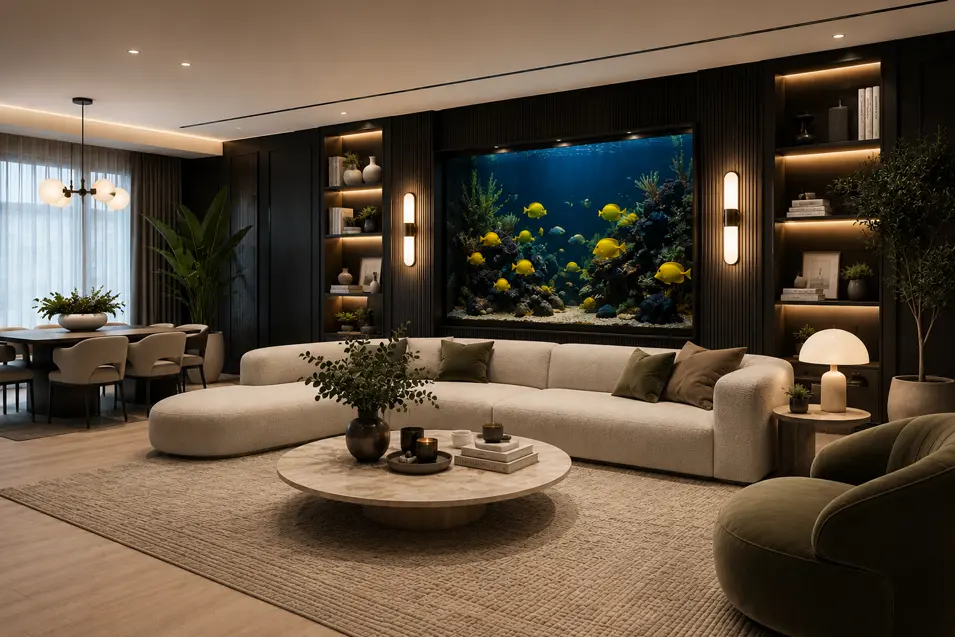
Walk into a home with a beautifully designed reef aquarium, and you’ll notice something remarkable.
People stop.
They don’t simply glance at it the way they might admire a painting or photograph. They walk closer. They study the details. They watch the fish glide between coral colonies. They notice the movement, the colors, and the ever-changing landscape hidden beneath the water’s surface.
A reef aquarium isn’t just another decorative feature.
It is living art.
Unlike a painting that remains unchanged for decades, a reef tank grows, evolves, and transforms over time. Every coral expands, every fish develops its own personality, and every aquascape matures into something slightly different than it was the day before.
For many hobbyists, maintaining a reef aquarium is as much an artistic pursuit as it is a scientific one.
The aquarium becomes a canvas.
The corals become the colors.
The rockwork becomes the sculpture.
The fish become living brushstrokes.
More Than an Aquarium
People unfamiliar with reef keeping often assume aquariums are simply collections of fish.
Experienced reef hobbyists know something entirely different.
A successful reef aquarium combines:
- Marine biology
- Water chemistry
- Engineering
- Lighting design
- Interior design
- Sculpture
- Color theory
- Composition
Creating a thriving reef requires technical knowledge, but creating a beautiful reef requires artistic vision.
The two are inseparable.
Aquascaping Is Sculpture Underwater
Before the first coral is ever added, every reef begins with aquascaping.
Aquascaping is the art of arranging live rock into a structure that is both beautiful and functional.
Like sculptors working with stone, reef keepers carefully consider:
- Shape
- Balance
- Height
- Depth
- Perspective
- Negative space
- Flow
Some aquascapes feature dramatic arches.
Others resemble isolated coral bommies rising from white sand.
Some create caves and tunnels.
Others emphasize open swimming space.
The goal isn’t simply to stack rocks.
It’s to create an underwater landscape that feels natural while providing room for corals to grow and fish to thrive.
Negative Space Is Just as Important
One of the most common mistakes beginners make is trying to fill every inch of the aquarium.
Experienced aquascapers often do the opposite.
They intentionally leave open areas.
These spaces allow fish to swim freely while giving the eye places to rest.
Negative space also creates the illusion of larger reefs and greater depth.
Interior designers use the same principle when arranging furniture.
Photographers use it in composition.
Artists use it in painting.
Great reef tanks embrace it too.
Coral Placement Is Like Arranging a Garden
Corals are often described as living flowers.
Like gardeners, reef keepers carefully decide where each colony belongs.
Different species create different visual effects.
Branching Acropora corals add height.
Soft corals introduce graceful movement.
Large-polyp stony corals become dramatic focal points.
Encrusting corals add texture.
Plate corals create horizontal balance.
Every placement affects the overall composition.
A thriving reef is rarely accidental.
It is carefully planned.
Color Theory Beneath the Surface
One of the most fascinating aspects of reef design is color.
Nature has already done much of the work.
Corals display incredible combinations of:
- Electric blue
- Neon green
- Bright orange
- Deep purple
- Fluorescent yellow
- Crimson red
- Soft pink
- Metallic gold
The challenge is arranging these colors so they complement rather than compete with one another.
Many experienced reef keepers think like painters.
Instead of collecting every colorful coral they can find, they consider:
- Contrast
- Harmony
- Focal points
- Color repetition
- Visual balance
The result feels intentional rather than crowded.
Lighting Is the Artist’s Brush
Without proper lighting, even the healthiest reef can appear flat.
Lighting determines:
- Color intensity
- Shadows
- Depth
- Mood
- Texture
Modern LED systems allow hobbyists to adjust spectrum, intensity, and timing with remarkable precision.
Some choose bright daylight settings.
Others prefer deeper blue tones that make fluorescent corals glow dramatically.
Lighting doesn’t simply keep corals alive.
It shapes the artistic presentation of the aquarium itself.
Fish Complete the Composition
Fish bring movement to an otherwise stationary reef.
Their colors, behavior, and swimming patterns influence the entire visual experience.
A pair of clownfish gently weaving through an anemone creates a focal point.
A yellow tang provides a burst of color.
Anthias move like living brushstrokes.
Wrasses add constant activity.
Mandarin dragonets become jewels hidden among the rockwork.
Choosing fish becomes an artistic decision as much as a biological one.
Too many fish can create visual clutter.
Too few can make a reef feel empty.
Finding balance is part of the design.
The Importance of Perspective
A well-designed reef aquarium should look interesting from multiple viewing angles.
This requires careful planning.
Corals placed too close together may block one another.
Rock structures positioned poorly can flatten the composition.
Experienced aquascapers often step back repeatedly during construction, viewing the aquarium from different heights and angles.
This mirrors the way sculptors evaluate their work before considering it complete.
A Living Work That Never Stops Changing
Unlike paintings or sculptures, reef aquariums never remain static.
Corals grow.
Fish mature.
Colonies spread.
Colors change.
New textures appear.
Some corals become centerpieces years after they were first introduced.
Others require pruning to maintain balance.
A reef aquarium is never truly finished.
It continues evolving throughout its life.
That constant change is part of its artistic appeal.
The Aquarium as Furniture
Modern homes increasingly treat aquariums as architectural features rather than accessories.
Large reef systems now appear:
- Between living spaces
- Built into walls
- As room dividers
- In home offices
- Beside dining rooms
- Within luxury kitchens
Rather than hiding equipment, designers integrate aquariums into cabinetry and custom furniture.
The aquarium becomes part of the home’s architecture.
It functions like a fireplace or dramatic picture window.
Why People Can’t Stop Watching
Few decorative objects hold attention the way a reef aquarium does.
Part of the reason is unpredictability.
Every glance reveals something different.
A shrimp emerges.
A coral opens.
A tang glides across the reef.
A clownfish disappears into its anemone.
The aquarium rewards observation.
Unlike television or digital screens, there is no script.
Nature creates its own.
Inspiration for Interior Design
Many homeowners extend the beauty of their reef aquarium throughout the rest of the house.
They incorporate:
- Reef photography
- Coral-inspired artwork
- Fish sculptures
- Ocean color palettes
- Glass art
- Coastal textures
Together, these elements create a cohesive aquatic theme without feeling overly decorative.
The aquarium becomes the centerpiece of a larger design story.
Wellness Through Nature
Research into biophilic design suggests that people often feel calmer when surrounded by natural elements.
Reef aquariums embody this concept beautifully.
They introduce:
- Living organisms
- Flowing water
- Organic movement
- Natural color
- Dynamic lighting
Many owners describe spending just a few minutes watching their aquarium after work as one of the most relaxing parts of their day.
The reef becomes a place to slow down, observe, and reconnect with nature.
Every Reef Reflects Its Creator
Perhaps the most fascinating aspect of reef keeping is that no two aquariums are ever identical.
Given the same equipment, the same corals, and the same fish, ten hobbyists would create ten completely different reefs.
Some prefer minimalist aquascapes.
Others create dense coral gardens.
Some focus on dramatic SPS colonies.
Others love soft coral movement.
Each aquarium reflects the owner’s personality, creativity, and artistic vision.
More Than a Hobby
To outsiders, reef keeping may appear to be simply another aquarium hobby.
To those who have built thriving marine systems, it often becomes something much deeper.
It is architecture.
It is sculpture.
It is gardening.
It is photography.
It is engineering.
It is marine biology.
And above all, it is art.
Final Thoughts
The finest reef aquariums are among the most extraordinary works of living art that can exist inside a home.
They combine science with creativity, patience with imagination, and technical skill with artistic expression. Every decision—from aquascaping and coral placement to lighting, fish selection, and long-term growth—shapes a living composition that continues to evolve every day.
Unlike a painting that captures a single moment, a reef aquarium tells an ongoing story.
It grows.
It changes.
It surprises.
It rewards careful observation.
That is why people don’t simply look at a beautiful reef tank.
They experience it.
And perhaps that is the greatest difference between art that hangs on a wall and art that lives beneath the water’s surface.