Christmas brings families together, fills homes with laughter, and creates memories that last long after the decorations have been packed away. But while humans look forward to visiting relatives, exchanging gifts, and enjoying festive gatherings, our dogs may have a very different opinion about all the excitement.
To a dog, Christmas can mean unfamiliar people entering their territory, children running through the house, loud conversations, strange smells, and a regular routine that suddenly disappears.
Some dogs love every minute of it. They’re delighted to greet visitors, investigate shopping bags, and collect attention from anyone willing to offer it.
Others find the experience overwhelming.
Even dogs that are normally friendly and relaxed can become stressed when too many people arrive at once or when the excitement continues for hours.
Fortunately, preparing your dog for Christmas visitors doesn’t have to be complicated. With a little planning, you can help your dog feel more comfortable while keeping holiday celebrations enjoyable for everyone.
Why Christmas Visitors Can Be Stressful for Dogs
Dogs generally appreciate predictability.
They become familiar with the people in their household, the sounds of their home, and the routines that shape their day.
Christmas can disrupt nearly all of these things.
Suddenly, the doorbell rings repeatedly. People arrive carrying packages. Furniture gets moved to accommodate extra chairs. Children play with unfamiliar toys, and conversations become louder than usual.
There may also be unfamiliar perfumes, food smells, decorations, and other pets.
For a dog that is sensitive to change, this combination can be overwhelming.
Even confident dogs may become overstimulated when they receive constant attention and have few opportunities to rest.
It’s important to remember that a dog doesn’t understand why Christmas is special.
They simply experience the changes happening around them.
Start Preparing Your Dog Before Christmas Day
One of the biggest mistakes owners make is waiting until guests arrive before thinking about their dog’s comfort.
If you know your home will be busy during the holidays, begin preparing several days or weeks in advance.
Think about how your dog typically responds to visitors.
Do they bark when someone knocks? Jump excitedly on guests? Hide behind furniture? Become nervous around children?
Understanding their usual behaviour will help you decide what preparations are necessary.
If your dog struggles with visitors, practise calm greetings with familiar people before the holidays.
Reward relaxed behaviour and avoid forcing interactions.
You can also rehearse simple cues such as going to a mat, settling in a designated area, or remaining calmly behind a gate while someone enters.
Keep training sessions short and positive.
The goal isn’t to make your dog perfectly obedient for Christmas. It’s to help them feel more comfortable and give them predictable ways to respond when the house becomes busy.
Create a Quiet Christmas Retreat for Your Dog
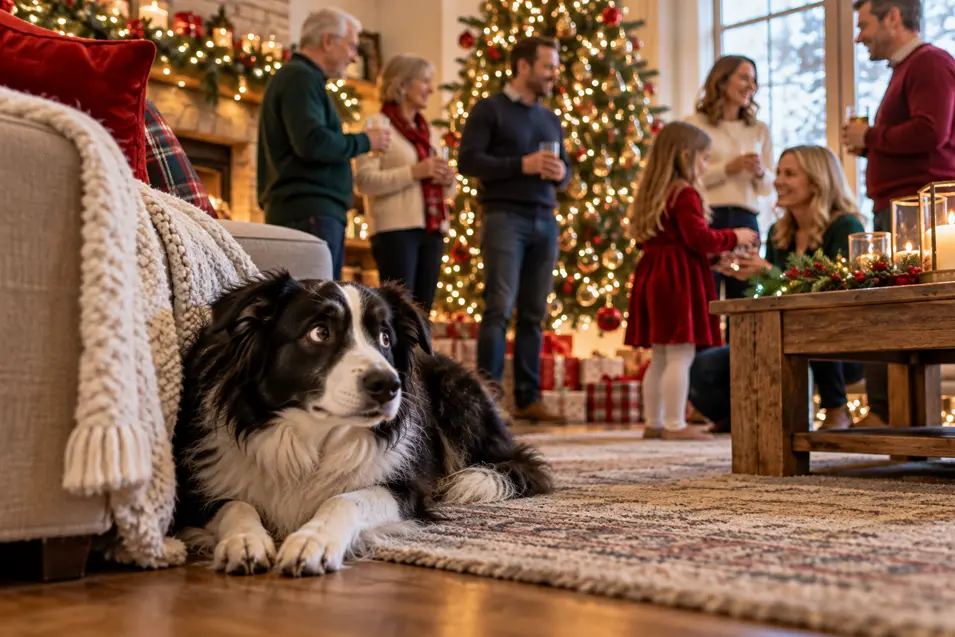
Every dog should have somewhere they can escape the excitement.
This is particularly important during Christmas gatherings when guests may remain for several hours.
Choose a quiet room or comfortable area away from the busiest parts of the house.
Include your dog’s familiar bed, fresh water, and a favourite toy or appropriate chew.
If your dog is comfortable using a crate, you can place it in the quiet area with the door open or use it according to their established routine.
Make sure the space is warm, comfortable, and free from holiday hazards.
Most importantly, explain to guests that this is your dog’s private resting area.
Children should not follow the dog into the room or disturb them while they’re sleeping.
A dog that chooses to retreat isn’t being antisocial or unfriendly.
They’re simply taking a break.
And during a busy Christmas gathering, that may be exactly what they need.
Manage the Doorbell and Excited Arrivals
For some dogs, the most stressful part of Christmas begins before guests even enter the house.
Repeated doorbell ringing, knocking, excited greetings, and people carrying large packages can create an overwhelming entrance.
Dogs may respond by barking, jumping, rushing toward the door, or attempting to escape.
If your dog becomes excited or anxious when visitors arrive, consider placing them in their quiet area before opening the door.
You can also use a secure baby gate to prevent access to the entrance.
Once guests have settled, you can decide whether your dog is comfortable joining them.
For dogs that enjoy meeting people, calm introductions are usually more successful than allowing everyone to crowd around them immediately.
Ask visitors to avoid shouting the dog’s name, reaching over their head, or encouraging jumping.
A relaxed greeting is much more enjoyable than a chaotic one.
Teach Guests How to Greet Your Dog
Not everyone understands canine body language.
Some visitors assume that every dog wants to be hugged, petted, or enthusiastically greeted.
Others may lean over a dog, stare directly into their eyes, or reach toward them without allowing the dog to approach first.
These behaviours can make some dogs uncomfortable.
Before guests arrive, establish a few simple expectations.
Ask visitors to let your dog approach voluntarily.
If the dog appears interested, they can offer gentle attention while watching for signs that the dog wants to continue.
Avoid forcing a dog to interact with someone simply because that person loves animals.
And if your dog prefers to observe from a distance, let them.
A dog doesn’t need to greet every Christmas visitor to be considered well behaved.
Be Especially Careful Around Children
Christmas gatherings often bring dogs and children together, sometimes for the first time.
Children may be excited, energetic, and unfamiliar with appropriate ways to interact with animals.
They might try to hug the dog, pull at their collar, chase them through the house, or interrupt them while eating or sleeping.
Even dogs that normally enjoy children can become uncomfortable with constant attention.
Always supervise interactions between dogs and young children.
Teach children to avoid grabbing ears, tails, or fur, and never allow them to climb on or ride a dog.
Children should also understand that a dog resting in their bed or quiet area must be left alone.
If your dog shows signs of stress, calmly separate them from the activity.
For dogs that are particularly nervous around children, physical separation may be the safest and most comfortable arrangement.
Supervision is important, but it doesn’t replace the need to give dogs space when they’re uncomfortable.
Recognize the Signs That Your Dog Is Overwhelmed
Dogs don’t always express discomfort through barking or growling.
Many communicate stress through subtle changes in body language.
Watch for behaviours such as:
- Repeated lip licking or nose licking
- Yawning when not tired
- Turning away from people
- Avoiding eye contact
- Holding the ears back
- Tucking the tail
- Pacing or restlessness
- Panting when not hot
- Trembling or hiding
- Freezing or becoming unusually still
- Attempting to leave the room
- Growling or showing teeth
These behaviours should be considered in context. A single yawn doesn’t necessarily mean your dog is stressed, but several signals occurring together may indicate discomfort.
Don’t wait until your dog growls or snaps before intervening.
If you notice signs of stress, calmly guide your dog to a quieter area.
Never punish a dog for growling.
Growling is a warning that communicates discomfort. Punishing that warning may discourage the signal without resolving the underlying fear.
Instead, respect the warning and create distance.
Keep Your Dog’s Normal Routine as Much as Possible
Christmas often disrupts the entire household schedule.
Meals happen at different times, visitors arrive unexpectedly, and normal walks may get postponed while everyone prepares dinner.
For dogs, these changes can add to the stress of a busy environment.
Try to maintain regular feeding times, bathroom breaks, exercise, and sleep schedules.
A familiar morning walk can help your dog settle before guests arrive.
Exercise and mental enrichment are useful, but avoid exhausting your dog in the hope that they’ll sleep through the festivities.
An overtired dog may become more irritable rather than calmer.
Instead, provide appropriate physical activity, opportunities to sniff and explore, and plenty of rest.
A predictable routine gives your dog something familiar to rely on when everything else feels different.
Be Careful With Christmas Food and Well-Meaning Guests
Christmas visitors often arrive with food, and some guests have difficulty resisting a dog watching them eat.
Unfortunately, holiday meals contain plenty of ingredients that dogs shouldn’t consume.
Chocolate, grapes, raisins, xylitol, onions, and garlic can be toxic to dogs.
Cooked bones can splinter or cause obstructions, while rich, fatty foods may trigger digestive upset or pancreatitis.
Even guests who mean well may offer a piece of Christmas ham, turkey skin, gravy, or dessert without realizing the potential risks.
Before dinner, politely explain that your dog should not receive table scraps.
If you’d like guests to offer treats, provide a small container of dog-safe treats and explain how much your dog may have.
Keep serving platters, desserts, and leftovers out of reach.
And remember that a crowded Christmas gathering provides plenty of opportunities for a clever dog to steal food when nobody is watching.
Prevent Your Dog From Escaping During Holiday Gatherings
With guests arriving and leaving throughout the day, exterior doors may be opened frequently.
This creates an opportunity for dogs to slip outside unnoticed.
The risk can be greater when visitors are unfamiliar with the household rules or children are moving between indoor and outdoor activities.
Before Christmas Day, make sure your dog’s identification tag and microchip registration contain current contact information.
Use baby gates, closed doors, or another secure barrier to prevent access to busy entrances.
Remind guests to check for the dog before opening exterior doors.
If your dog is nervous around strangers, keeping them in a separate comfortable room during arrivals and departures may be the safest option.
A little preparation can prevent a frightening search for a missing dog on Christmas Day.
What If Your Guests Bring Their Own Dogs?
Some Christmas visitors may ask whether they can bring their dogs along.
While this can work beautifully in some households, introducing unfamiliar dogs during a busy gathering requires careful consideration.
Don’t assume that dogs will get along simply because they’re normally friendly.
Discuss the arrangement with your guests beforehand.
Consider each dog’s temperament, previous experiences with other animals, and comfort around unfamiliar environments.
If introductions are appropriate, arrange them in a calm setting with sufficient space and supervision.
Keep food bowls, treats, favourite toys, and resting areas separate to reduce the risk of conflict.
If either dog appears uncomfortable, provide separate spaces.
And if your dog doesn’t enjoy the company of unfamiliar dogs, it’s perfectly reasonable to ask guests to leave their pets at home.
Your dog’s comfort matters just as much as everyone else’s holiday plans.
Should You Put Your Dog Away During Christmas Dinner?
For some households, allowing the dog to relax in a separate room during Christmas dinner is an excellent idea.
It prevents begging, food stealing, accidental feeding, and the stress of navigating a crowded dining area.
This arrangement can be particularly helpful for dogs that become overexcited around food or nervous when many people gather in one space.
Prepare a comfortable resting area with water and an appropriate enrichment activity.
If your dog is accustomed to spending time in that space, they may be perfectly happy relaxing while everyone eats.
However, don’t suddenly isolate a dog that experiences significant separation distress.
Prepare them gradually beforehand, or arrange for someone to stay with them if necessary.
The goal is to provide a comfortable break, not create another stressful situation.
Don’t Force Your Dog to Participate in Christmas Activities
Christmas photographs, family games, gift exchanges, and holiday traditions can be wonderful experiences.
But dogs don’t need to participate in every activity.
A dog that dislikes being dressed up shouldn’t be forced into a Christmas costume.
A nervous dog shouldn’t be made to sit beside unfamiliar relatives for photographs.
And a dog that prefers to sleep in another room shouldn’t be repeatedly brought back into the festivities.
Some dogs genuinely enjoy being the centre of attention.
Others are happiest observing from a comfortable distance.
Respecting these preferences helps prevent stress and allows your dog to enjoy Christmas in their own way.
When Your Dog Has Serious Anxiety Around Visitors
Some dogs experience more than ordinary excitement or mild nervousness when people visit.
They may bark continuously, panic, hide for extended periods, attempt to escape, or react defensively when approached.
If your dog has a history of severe fear, aggression, or biting, don’t rely on Christmas Day as an opportunity to practise socialization.
Instead, develop a management plan before the gathering.
This may involve keeping your dog safely separated from visitors, arranging care elsewhere, or working with a qualified reward-based trainer or veterinary behaviour professional.
Your veterinarian can also assess whether medical problems or anxiety-related conditions may be contributing to the behaviour.
In some cases, medication may be appropriate as part of a broader treatment plan.
The important thing is to prioritize safety and your dog’s emotional well-being rather than expecting them to tolerate a situation they find frightening.
Frequently Asked Questions About Dogs and Christmas Visitors
Why does my dog bark at Christmas guests?
Dogs may bark because they’re excited, anxious, territorial, startled, or simply responding to unfamiliar activity. Understanding the reason behind the barking is important when choosing an appropriate management strategy.
Should I let everyone pet my dog at Christmas?
No. Allow your dog to choose whether they want to interact. Some dogs enjoy attention from visitors, while others prefer to keep their distance.
How can I calm my dog before Christmas guests arrive?
Maintain a familiar routine, provide appropriate exercise and enrichment, prepare a quiet resting space, and manage arrivals calmly. Dogs with significant anxiety may need additional professional support.
Is it okay to keep my dog in another room during Christmas?
Yes, provided your dog is comfortable in that space and has access to water, rest, and appropriate care. A quiet room can be a helpful retreat during busy gatherings.
Why does my normally friendly dog hide at Christmas?
The combination of unfamiliar people, noise, changed routines, and constant activity can overwhelm even sociable dogs. Hiding may be your dog’s way of seeking safety and quiet.
What should I do if my dog growls at a Christmas visitor?
Calmly create distance between your dog and the visitor. Don’t punish the growling or force further interaction. Growling is a warning signal that should be respected.
Can Christmas visitors cause anxiety in dogs?
Yes. Large gatherings, unfamiliar people, excited children, and changes to the household environment can contribute to anxiety, particularly in dogs that are sensitive to noise or social interactions.
A Merry Christmas Doesn’t Require a Perfectly Social Dog
Christmas is about spending time with the people and animals we love, but that doesn’t mean everyone has to celebrate in exactly the same way.
Some dogs will happily greet every visitor, investigate every present, and spend the afternoon collecting affection from relatives.
Others will decide that the best place to spend Christmas is curled up in a quiet bedroom, far away from the noise.
Neither dog is doing anything wrong.
By preparing ahead of time, respecting your dog’s boundaries, and providing a comfortable place to retreat, you can help make Christmas safer and more enjoyable for everyone.
And if your dog chooses to skip the family gathering in favour of a peaceful nap, perhaps they’re simply demonstrating a little holiday wisdom.
After all, even the most enthusiastic Christmas host occasionally needs a break from the relatives.