There are people who say money doesn’t change you.
They have clearly never met a French Bulldog with access to significant capital.
His life was already pretty good.
He had a comfortable home, good food, a cat he adored, a collection of friends and a woman who loved him considerably more than was probably reasonable.
Then he won the lottery.
Technically, she dealt with the paperwork.
He dealt with the architect.
The brief was surprisingly simple.
More comfortable places to sleep. Better snacks. Somewhere for his friends to hang out. A proper place for the cat. More time outside. And absolutely no compromise on the wardrobe.
The resulting house is spectacular.
It is also, when you look closely, unmistakably his.
The House

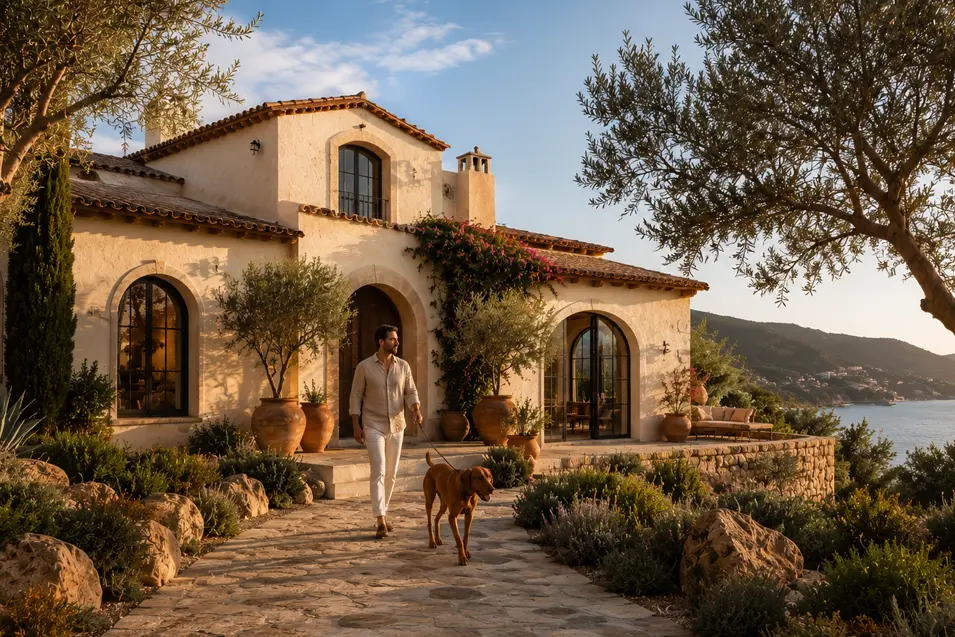
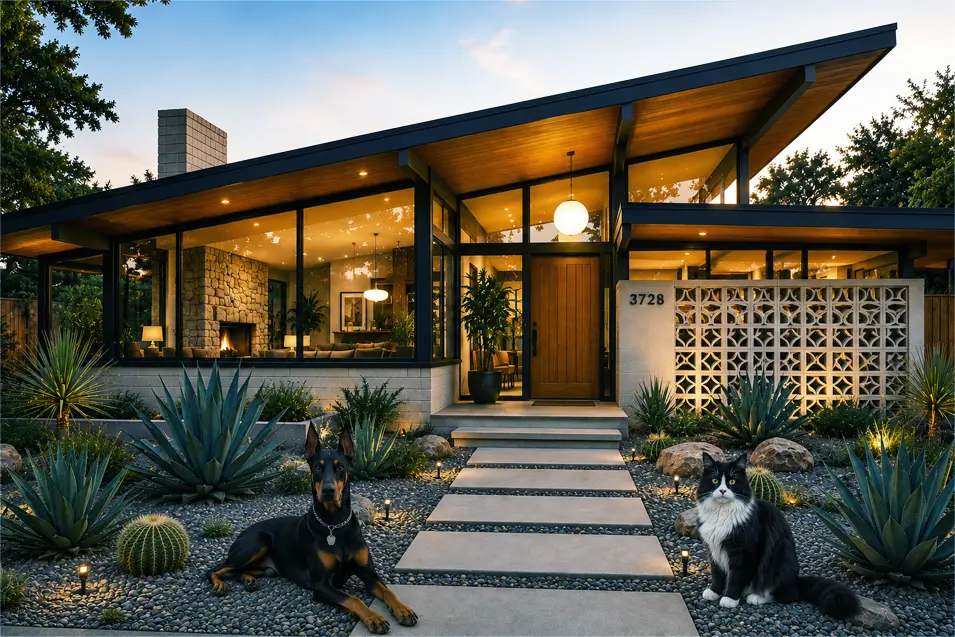
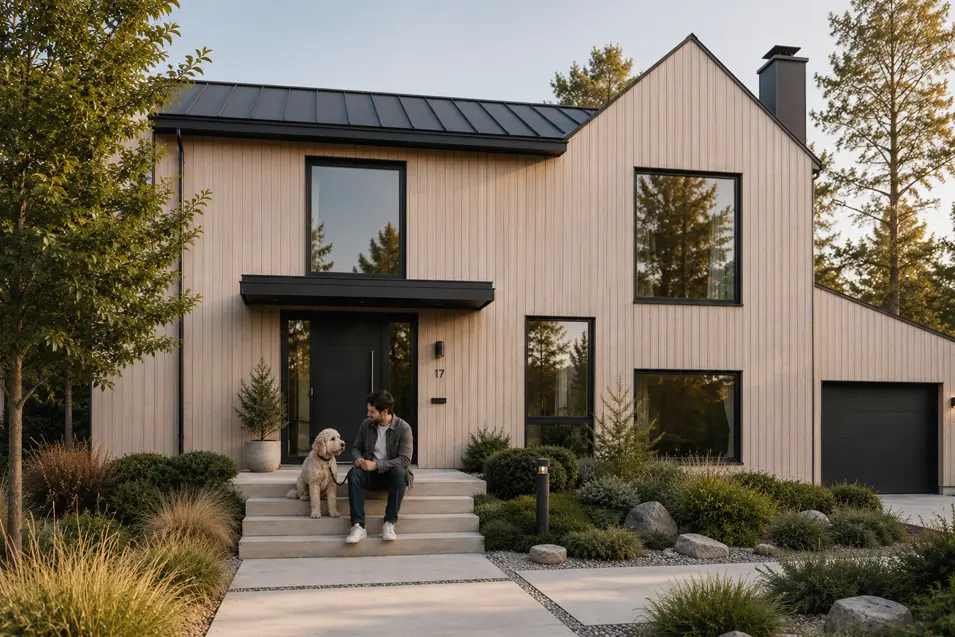
From the street, there is very little indication that a dog had anything to do with it.
That was intentional.
There are no giant bones over the entrance. No paw prints in the concrete. Nothing announces A DOG LIVES HERE.
Instead, there is architecture.
Stone, glass and timber stretch across the landscape, with enormous openings connecting the house to the gardens beyond.
He requested easy access to the outside.
The architect interpreted this somewhat generously.
The Kitchen

The kitchen gets darker.
Almost-black cabinetry wraps the room. Warm light slips from concealed fixtures. A long stone island occupies the centre, while an enormous planted aquarium glows quietly from one wall.
It is less dog kitchen and more private restaurant where the owner happens to be four inches off the ground.
There is, however, the Barkery.

Treats are stored properly. Biscuits are displayed with the seriousness normally reserved for French pastry. Food, supplements and travel snacks have their own beautifully organized cabinetry.
His bowls are considerably less theatrical.
They’re on the floor.
Because despite the considerable construction budget, nobody has yet found a convincing reason for a French Bulldog to eat dinner from a shelf.
The Primary Suite

His person technically shares the bedroom.
This arrangement appears satisfactory to everyone.
The room itself is calm and restrained—a welcome change after the kitchen—with warm pale materials, beautiful lighting and very little clutter.
He has his own exceptionally good bed.
He sleeps in hers.
More specifically, he sleeps on her side of hers.
Money can solve many problems.
This isn’t one of them.
The Boutique

Calling it a walk-in closet would be inaccurate.
It’s a boutique.
Across an entire wall of illuminated walnut shelving, coats hang beside harnesses, leather leashes are arranged like accessories, and collars receive the sort of carefully directed lighting normally reserved for watches and jewellery. Travel bags, folded blankets and an improbable collection of toys occupy shelves where shoes and handbags might ordinarily be expected.
There isn’t a human shirt anywhere.
His person has a closet elsewhere, which suggests there were, eventually, limits to the sharing arrangement.
Nothing here is for sale, although judging by the presentation, he appears perfectly comfortable with retail pricing.
Something for the Cat

He didn’t forget his best friend.
The cat did not receive a cat tree.
She received architecture.
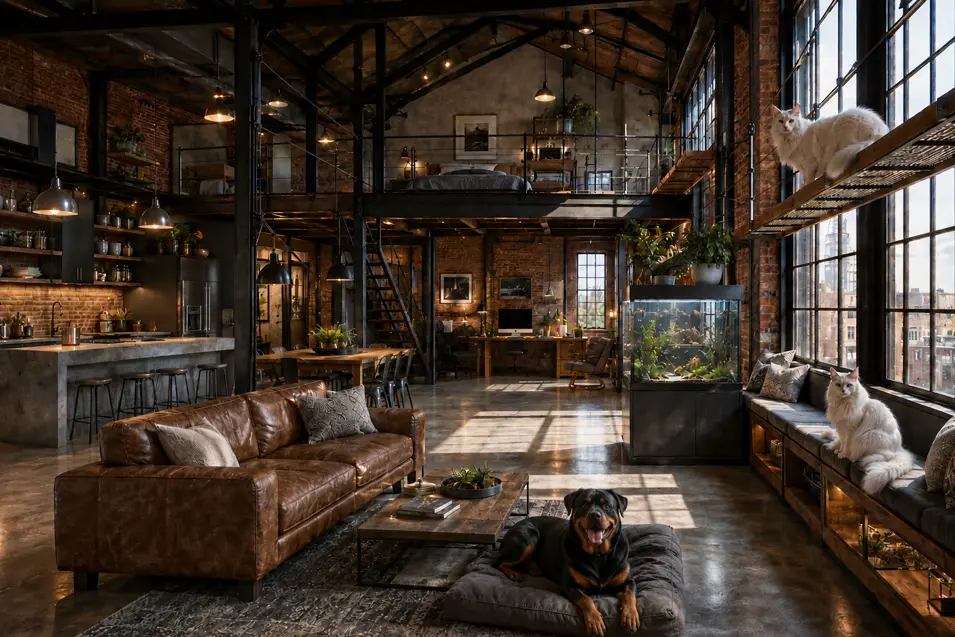
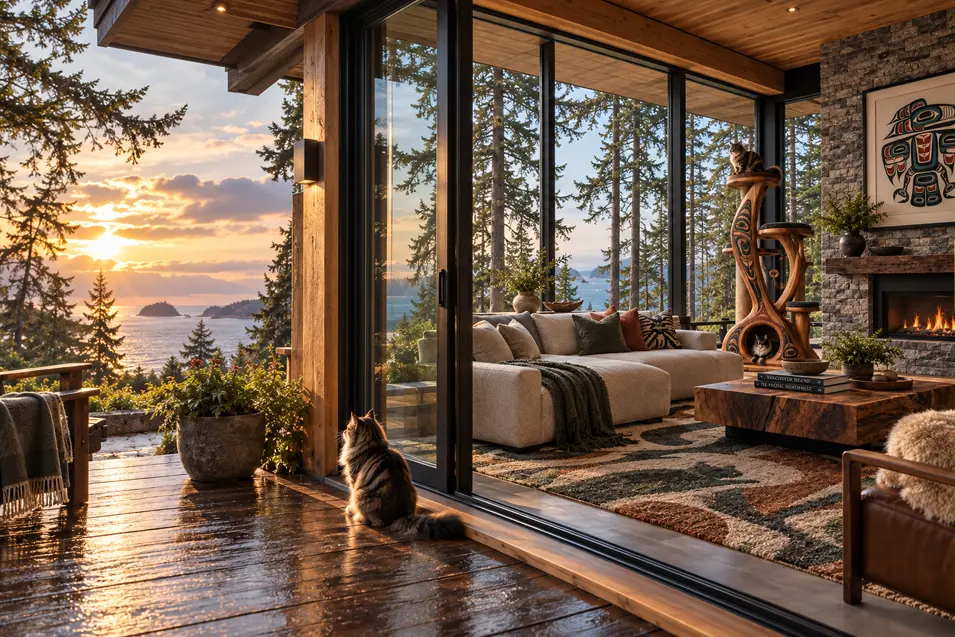
A sculptural climbing installation rises through part of the living space, creating shelves, bridges, concealed retreats and elevated places from which she can quietly judge everyone below.
It is beautiful enough that a visitor might initially mistake it for part of the house.
That was the idea.
She occasionally ignores the entire thing and sleeps in a cardboard delivery box.
The architect has chosen not to comment.
The Living Room

There are several exceptionally good places to sit here.
A deep sofa faces the view. Sculptural chairs occupy the quieter corners. A long window seat catches the afternoon sun.
He generally chooses hers.
Most evenings, he can be found pressed against his person on the sofa, frequently occupying considerably more space than his physical dimensions would suggest.
The cat sometimes joins them.
For all the things money changed about this house, this room reveals something it didn’t.
He never wanted a better person.
He just wanted more time with the one he already had.
The Spa

Of course there’s a spa.
There is a proper step-in dog wash, warm stone underfoot, beautiful storage for towels and grooming supplies and enough room to make bath day considerably easier.
It is perhaps the most thoughtfully designed dog-washing space we have ever seen.
He hates it.
Apparently nobody consulted him on this portion of the project.
The Pool

The backyard is where the lottery win becomes difficult to disguise.
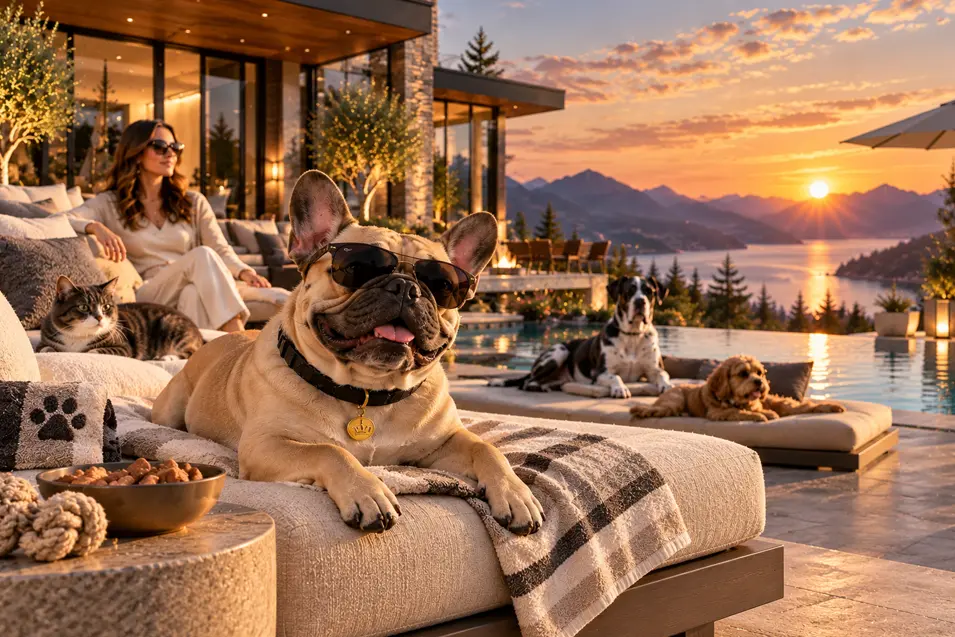
The pool stretches toward the view, with shade when the dogs want it, sun when they don’t, grass for running, water for swimming and enough loungers to accommodate an increasingly suspicious number of new friends. His social calendar has expanded considerably since the win, although nobody is suggesting a connection.
Most of the furniture was selected with his regular guests in mind. The Great Dane, however, is a friend of a friend and wasn’t included in the original specifications, which explains the rather obvious problem with his chair.
It is much too small.
He appears entirely unconcerned.
His host has been assured that he is very well behaved, so if the afternoon goes smoothly, a custom lounger will apparently be ordered before his next visit.
Until then, the Great Dane seems perfectly content with the arrangement.
Anyone who has ever lived with a dog understands completely.
What He Actually Bought
By evening, the house has finally become quiet. The aquarium casts its strange blue glow across the kitchen, the lights in the boutique have gone dark, and the last of his friends have disappeared down the drive. Somewhere upstairs, the cat has abandoned several thousand dollars’ worth of custom architecture in favour of a cardboard box that arrived with something considerably less expensive.
The French Bulldog, meanwhile, is on the sofa beside his person.
It is here that the fantasy becomes a little less ridiculous, because given unlimited resources, most of us would probably do some version of this for the animals we love. Perhaps not the private boutique or a kitchen with a dedicated Barkery, but we would buy the better bed, build the bigger yard, find the extraordinary food and create every comfort we could imagine they might enjoy.
Dogs, unfortunately, have an irritating habit of exposing the flaw in this kind of thinking. Their definition of luxury has never had much to do with ours.
A walk that isn’t rushed matters more than an expensive leash. A familiar friend is more exciting than a perfectly landscaped garden. A comfortable place to sleep, something delicious to eat and the reassuring knowledge that their person is nearby constitute a remarkably complete version of the good life.
So, yes, if my dog won the lottery, you would notice. You would notice the house, you would certainly notice the wardrobe, and you might have legitimate questions about the Barkery.
But at the end of the evening, after all that money had been spent and every improbable request accommodated, you would probably find him exactly where he was before he became rich: curled up beside the person he loves.
Some things wouldn’t change at all.
People Dream About Houses. Why Wouldn’t Dogs?
There is a particular freedom in imagining a house that doesn’t have to exist.
People do it constantly. We imagine kitchens larger than our first apartments, bathrooms overlooking oceans, impossible gardens, perfect libraries and rooms devoted entirely to things that, in the real world, are usually squeezed into a cupboard. Architecture has always been partly about necessity and partly about imagining how life might be if the usual constraints disappeared.
For this house, we decided to extend that privilege to the dog.
We removed the budget, ignored most practical limitations and stopped worrying about whether any reasonable person would actually commission half of what we were imagining. The question wasn’t what a pet owner should put in a house. It was what might happen if a beautiful home were conceived in a world where the needs, habits and pleasures of the animals living there carried as much weight as those of the people.
The result is deliberately excessive. There is a boutique filled with dog clothes, a kitchen designed around food and treats, an architectural playground for the cat and a pool terrace where the dogs have somehow secured better seating than the humans. Even by our standards, things got a little out of hand.
But beneath all of it is an idea we take seriously.
What would a genuinely beautiful home look like if pets were considered from the very beginning, rather than accommodated after everything else had been designed?
That question is where the fantasy ends and the real project begins.
The World’s Most Pet-Friendly House
At Pet Friendly House, we’re working toward creating a real home designed around that idea.
It won’t be this house, nor should it be. We aren’t trying to reproduce an imaginary millionaire dog’s wish list, and there is little chance the real dog will require quite this much wardrobe space. What we want to explore instead is something far more interesting: how thoughtful architecture, interior design, furniture, art and products can make a home better for pets without making it any less beautiful for people.
The dog will have a room of his own, but it will still be a room someone might genuinely want in their house. There will be places to sleep, feed, wash, play and store the inevitable accumulation of leashes, toys, coats and other evidence that an animal has taken over a portion of your life. There will be art worth hanging whether or not it happens to feature a dog, pet furniture that belongs in a considered interior, and products that solve problems without announcing themselves as solutions to pet problems.
The same thinking applies throughout the house. A window might be positioned partly because a dog spends an hour every afternoon watching the street through it. A mudroom might acknowledge that four wet paws arrive before two clean shoes. Cat furniture might become part of the architecture rather than something reluctantly placed against it. A feeding area might be designed with the same attention given to every other detail in a good kitchen.
None of those ideas requires a lottery win.
That is perhaps the most important difference between the fantasy house and the one we hope to build. The real project isn’t about creating something so extravagant that people can only admire it from a distance. It is about assembling ideas—some ambitious, some remarkably simple—that could find their way into homes anywhere in the world.
If someone sees a room and borrows one detail for their own house, the project has worked. If a designer sees a problem differently, a manufacturer creates a better product, or a homeowner realizes that accommodating a pet doesn’t have to mean compromising the room, it has worked even better.
Because ultimately, the World’s Most Pet-Friendly House isn’t really an exercise in spoiling animals, although there will undoubtedly be plenty of that.
It is an exploration of what happens when we acknowledge something millions of homes already know to be true: our pets aren’t accessories to the way we live. They are part of the way we live.
The lottery house allowed us to imagine what that idea looks like without boundaries.
Now we want to see what happens when we build it for real.