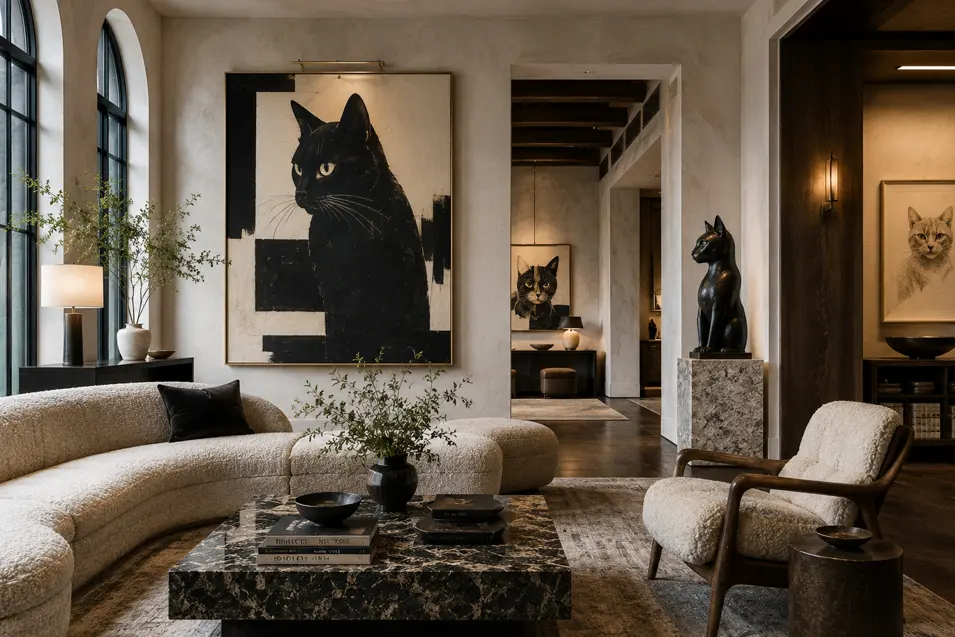
There is cat art, and then there is art that happens to feature a cat.
The difference matters.
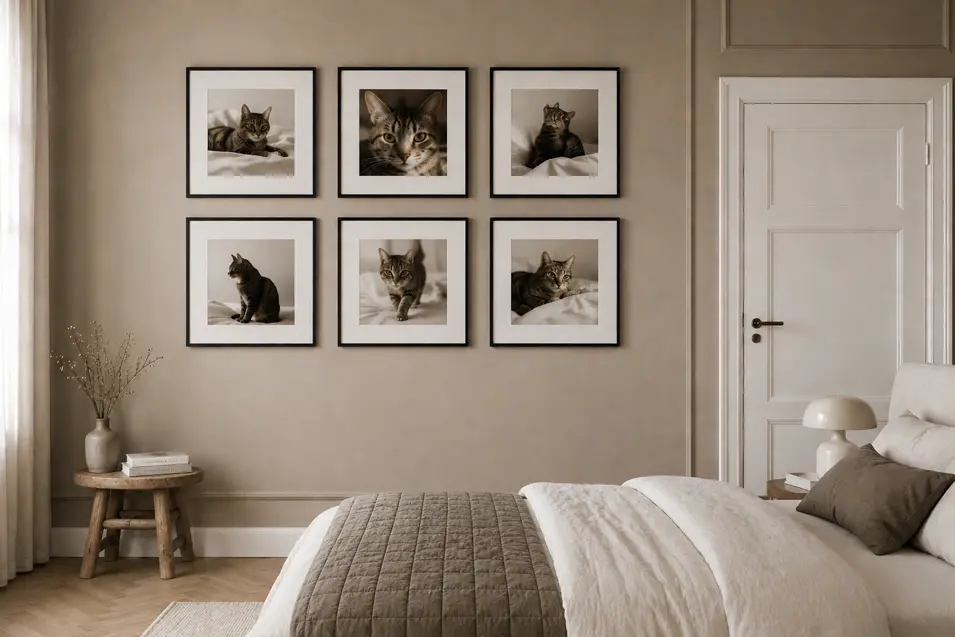
A small framed illustration of a cat can be charming, but that isn’t what we’re interested in here. These are rooms where the artwork has presence. Pieces chosen because of their scale, composition, texture, colour, craftsmanship or sheer ability to command a wall.
And the homes need to hold their own.
Beautiful furniture, interesting architecture, natural materials and rooms that would still be exceptional if we removed every trace of a cat.
The goal isn’t to decorate a home around a pet.
It’s much simpler than that:
Great art. Great room. The odd real cat.
The Portrait That Owns the Loft
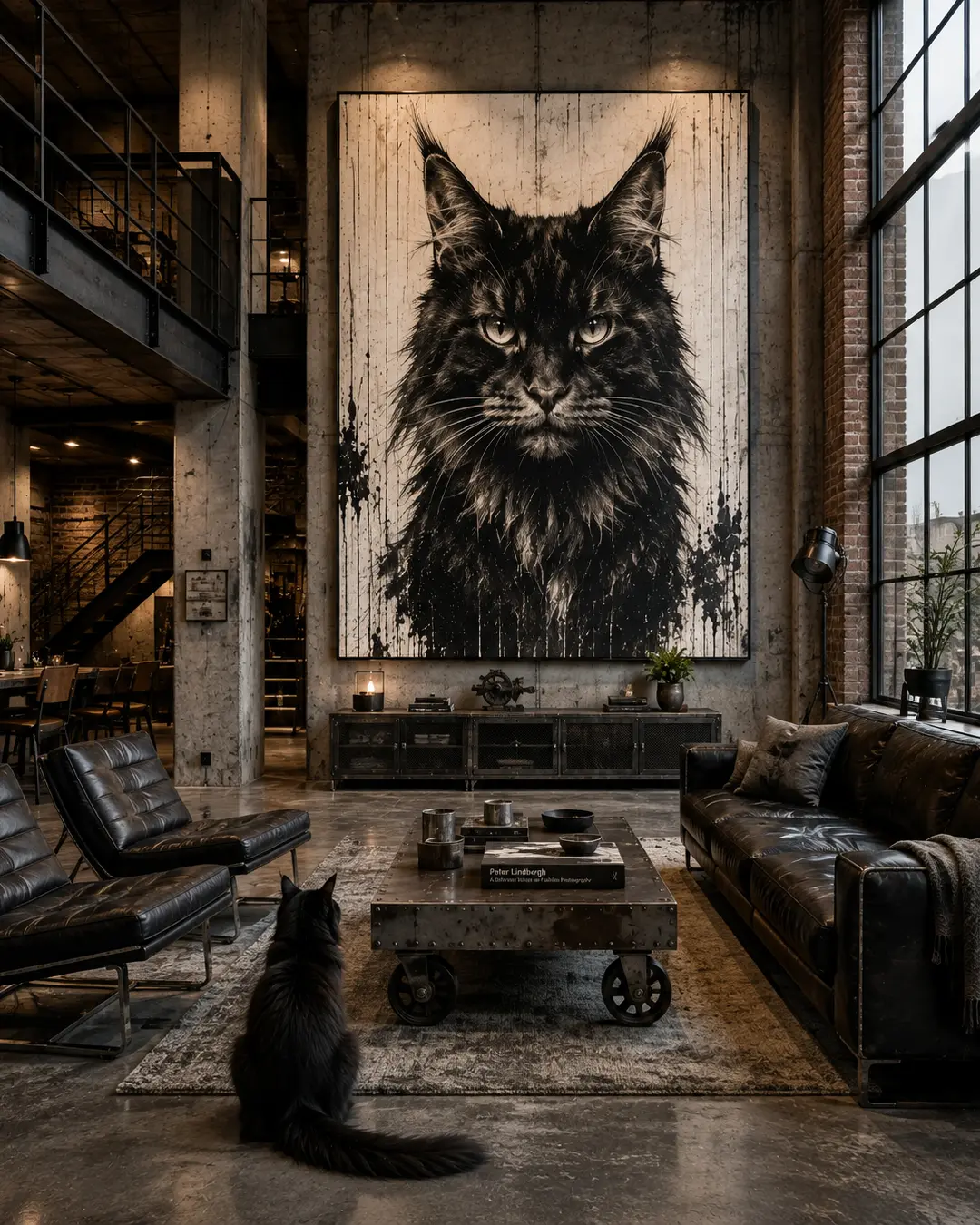
Some artwork doesn’t need colour to dominate a room.
An enormous black-and-white portrait of a Maine Coon becomes the focal point of an industrial loft, its scale almost architectural against the brick, steel and concrete surrounding it.
The furniture is substantial enough to compete—a beautiful sofa, sculptural lighting and pieces that feel carefully collected rather than purchased as a matching set—but nothing steals attention from the cat.
It is technically a portrait of an animal.
It feels more like a statement about the entire room.
The White Cat in Charcoal
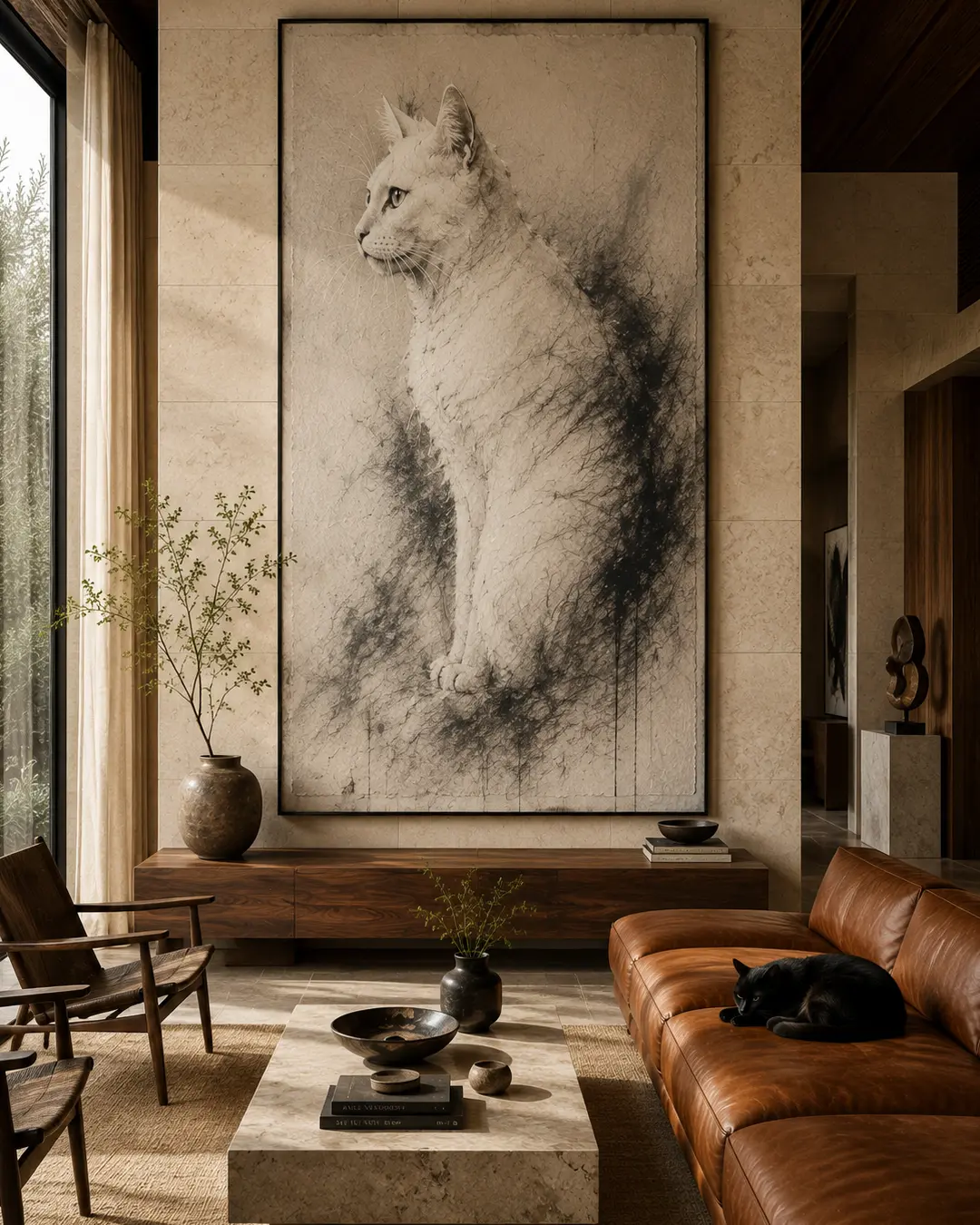
A warm limestone-and-walnut living room calls for something quieter, but quiet doesn’t have to mean forgettable.
An enormous charcoal drawing of a white cat floats against the stone wall, rendered on heavily textured paper with parts of the animal almost disappearing into charcoal dust and negative space.
The restraint is what gives it power.
Against the limestone, walnut and cognac leather, the black charcoal feels dramatic without making the room feel dark.
Meanwhile, a real black cat has claimed the sofa.
Apparently nobody explained which cat was supposed to be the important one.
The Siamese in Blue
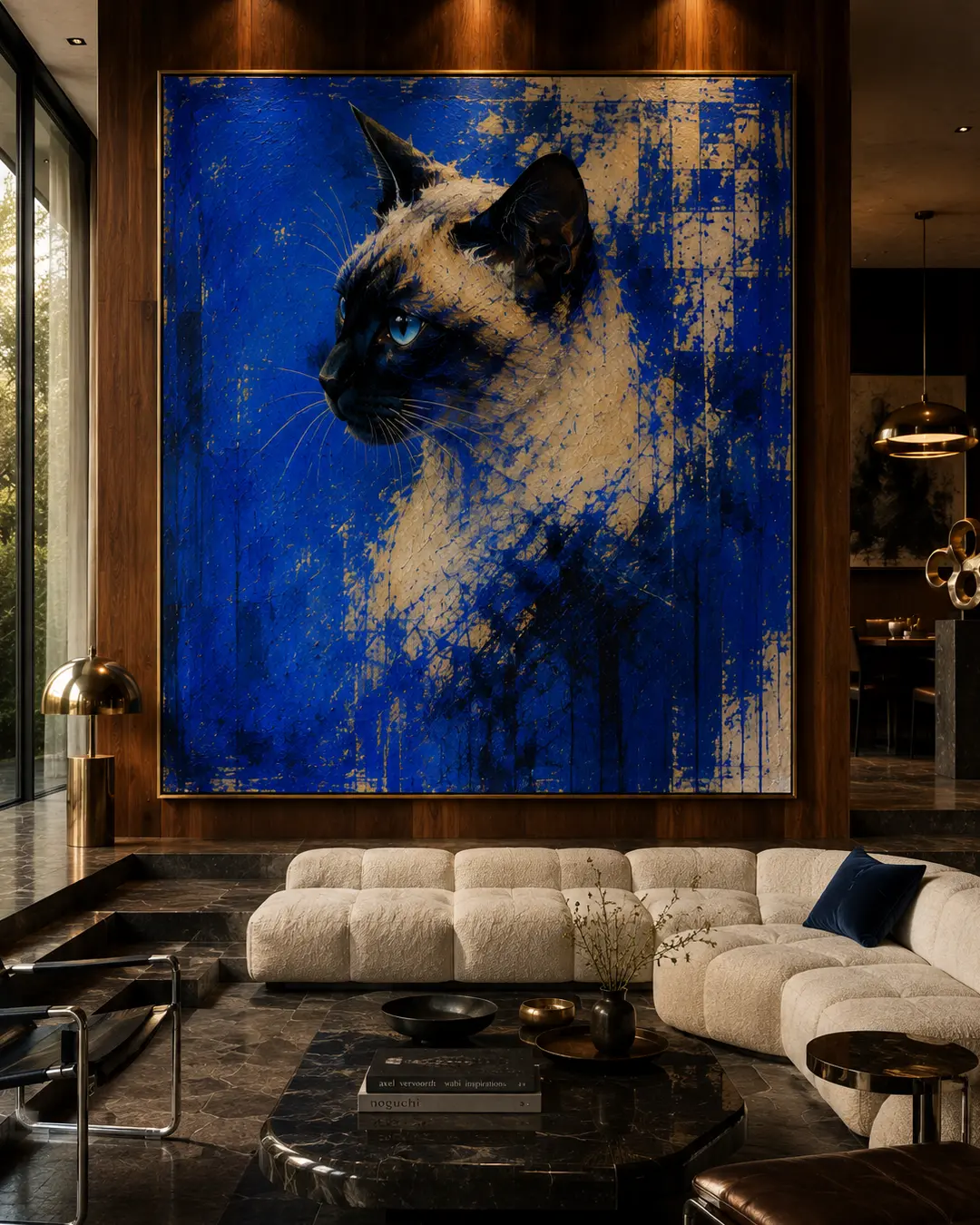
This is where colour earns its place.
In a sophisticated room built around walnut, stone and beautifully restrained furniture, a large contemporary painting of a Siamese cat introduces an extraordinary field of saturated blue.
Not a realistic pet portrait. Not a cartoon.
The familiar angular face and dark points of the Siamese emerge through expressive paint, confident brushwork and areas where the image nearly dissolves into colour.
One remarkable piece can change the temperature of an entire room.
Nothing else needs to compete with it.
The Tabby Photograph
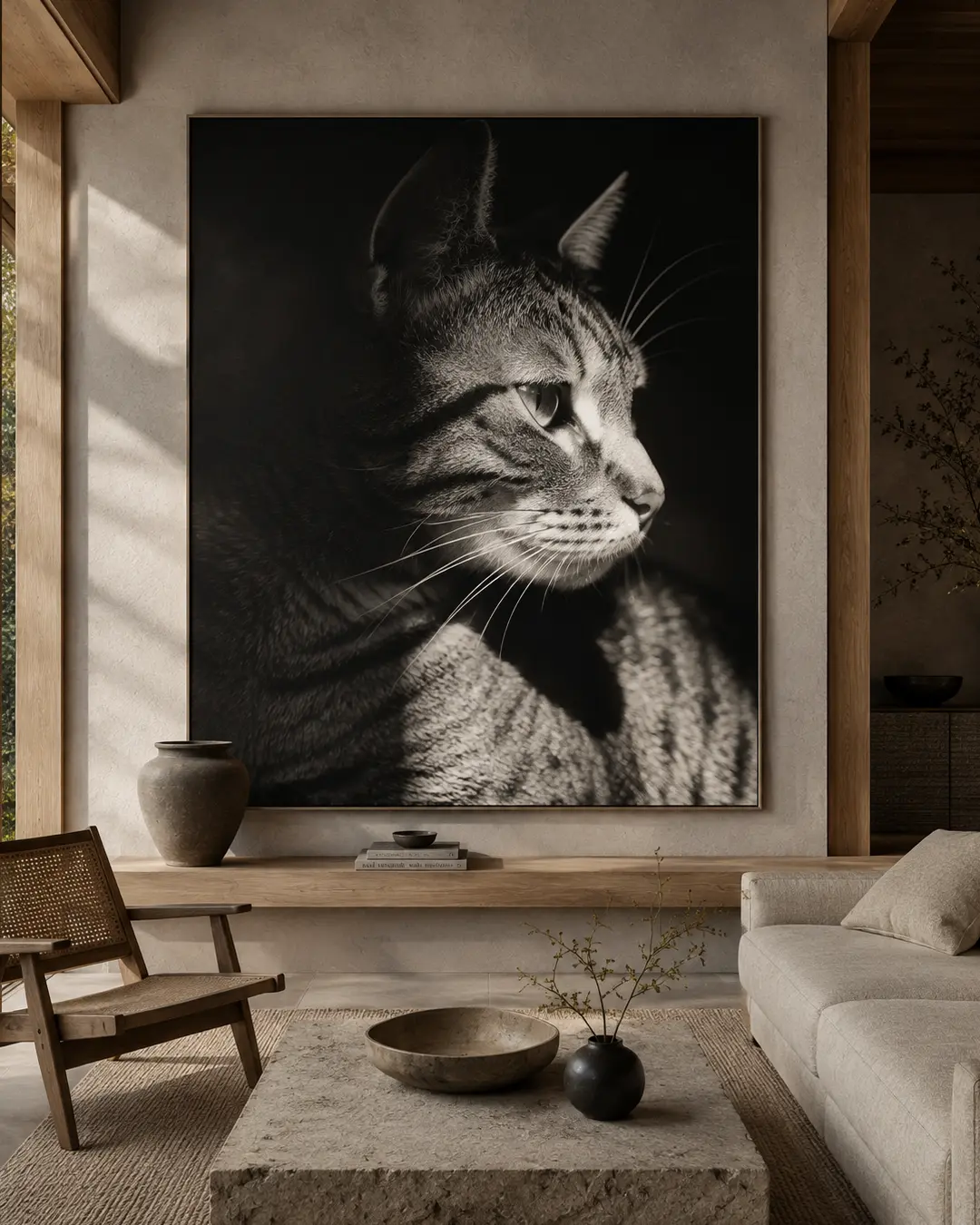
An ordinary tabby can become extraordinary when someone knows where to point a camera.
A monumental fine-art photograph captures the cat in profile, perhaps sitting in a shaft of window light with every whisker, stripe and imperfection rendered at enormous scale.
Displayed in a restrained plaster-and-oak interior, the photograph feels closer to contemporary portrait photography than traditional animal art.
That’s part of what makes it interesting.
The subject doesn’t need to be exotic.
The artist simply needs to make us look at something familiar differently.
The Cat Woven Into the Wall
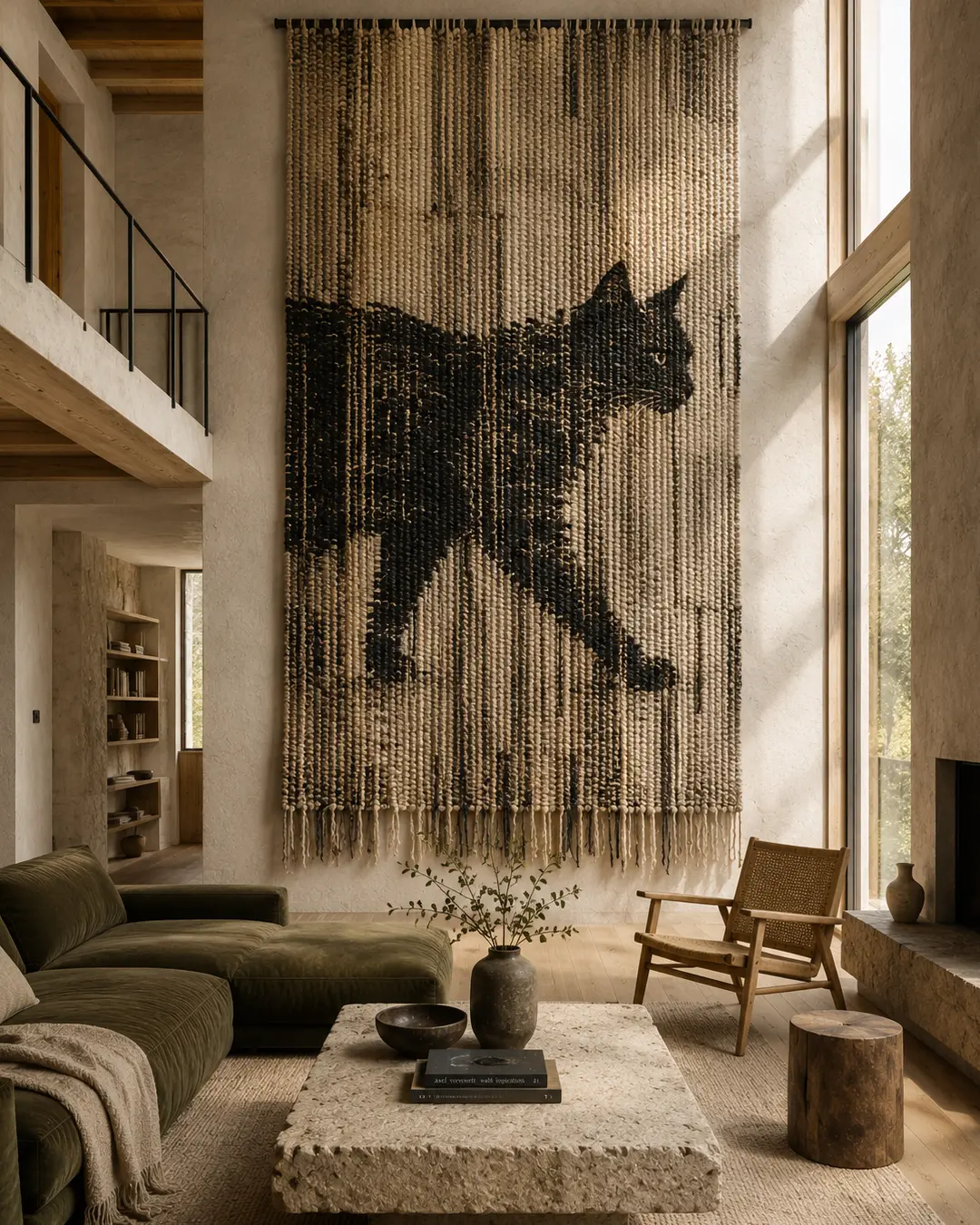
Not every important piece of art needs a frame.
A large handwoven textile hangs from a double-height wall, its irregular fibres, knots and changes in density gradually revealing the form of a black cat.
From across the room, you see the composition.
Move closer and the material itself becomes the story.
The surrounding home is tactile too—limewashed plaster, pale oak, wool upholstery and stone—allowing the textile to feel completely at home without disappearing into the architecture.
Cat art suddenly has very little to do with cat pictures.
The Red Cat
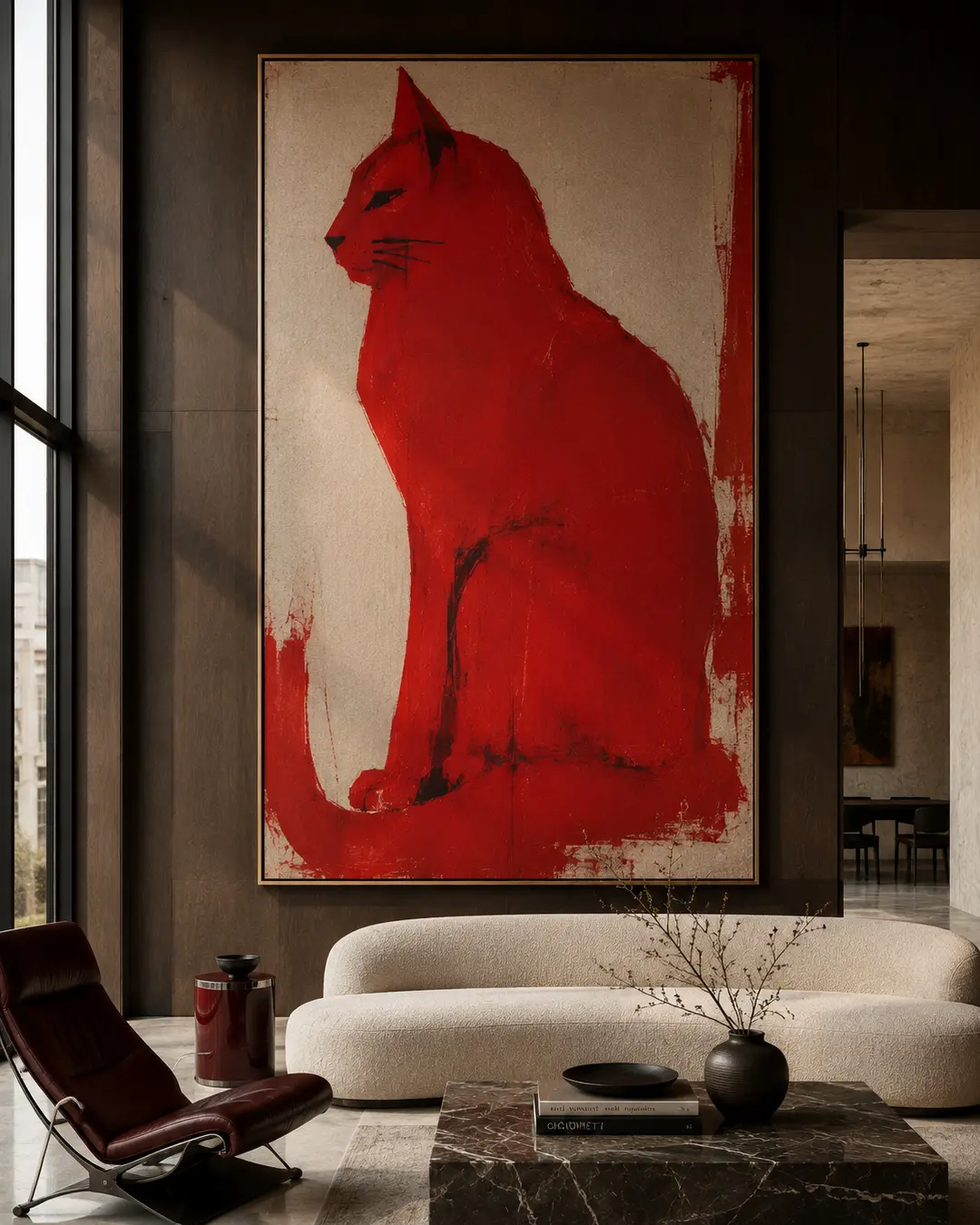
If you’re going to use colour, occasionally you should really use it.
A monumental red painting of a sitting cat occupies an otherwise sophisticated, relatively restrained room.
The cat itself might be reduced to only a few powerful shapes. There is enough information to recognize the animal, but no attempt to make it sweet, realistic or conventionally pretty.
The scale does the rest.
A room filled with colourful objects would dilute it.
One enormous red cat against beautiful stone, timber and exceptional furniture doesn’t need assistance.
The Cat Made From Steel
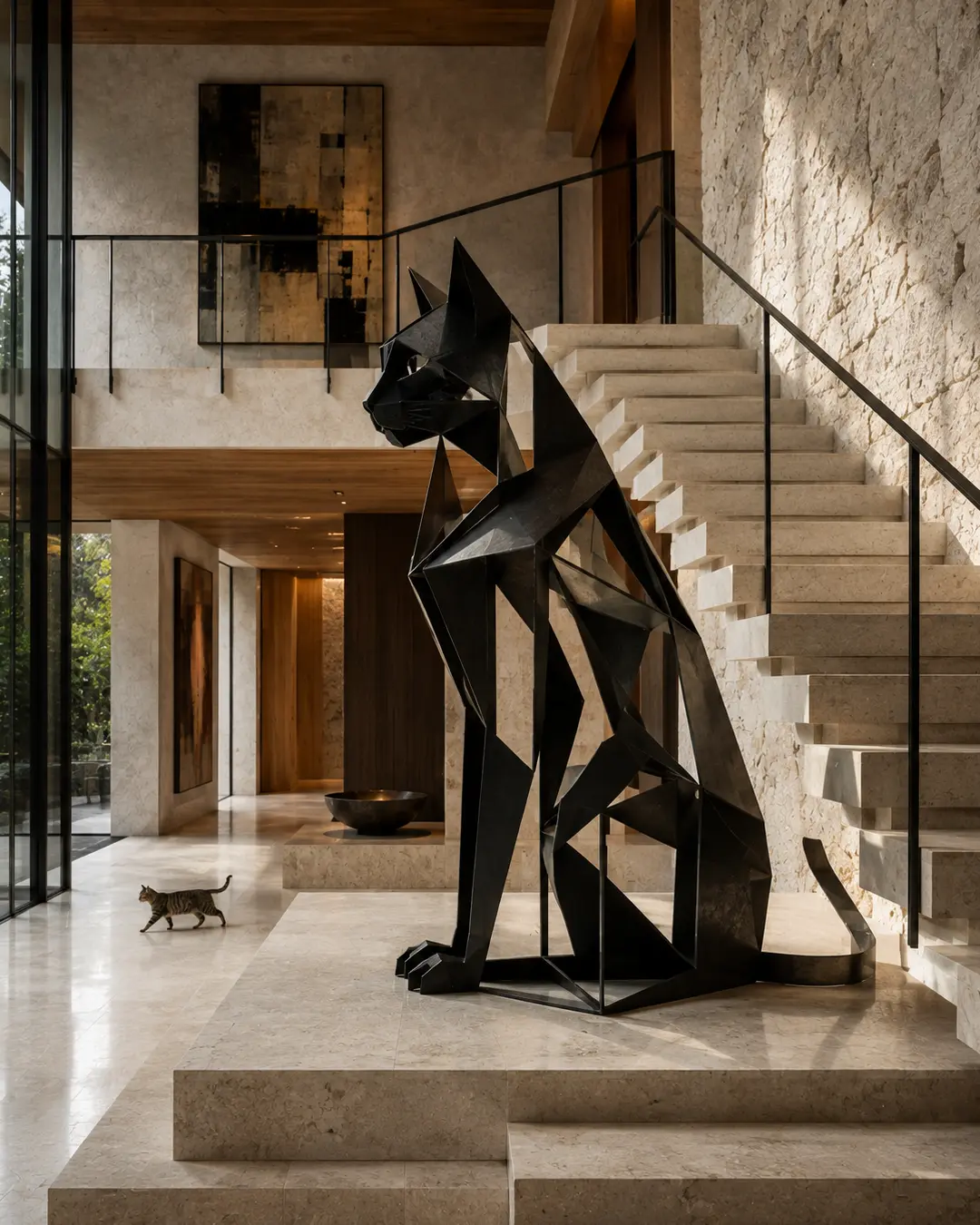
A sculpture changes the relationship between art and room because you can’t simply hang it and forget about it.
A large blackened-steel cat sculpture occupies a dramatic position near a limestone wall or at the edge of an open staircase.
It isn’t a literal reproduction. The body may be constructed from planes, voids and intersecting pieces of metal, allowing the architecture behind it to become part of the work.
As you move through the room, the cat changes.
From one angle it is unmistakable.
From another, it nearly becomes abstraction.
The real cat wandering through the background is considerably less interested in the artistic achievement.
The Cat in Pieces
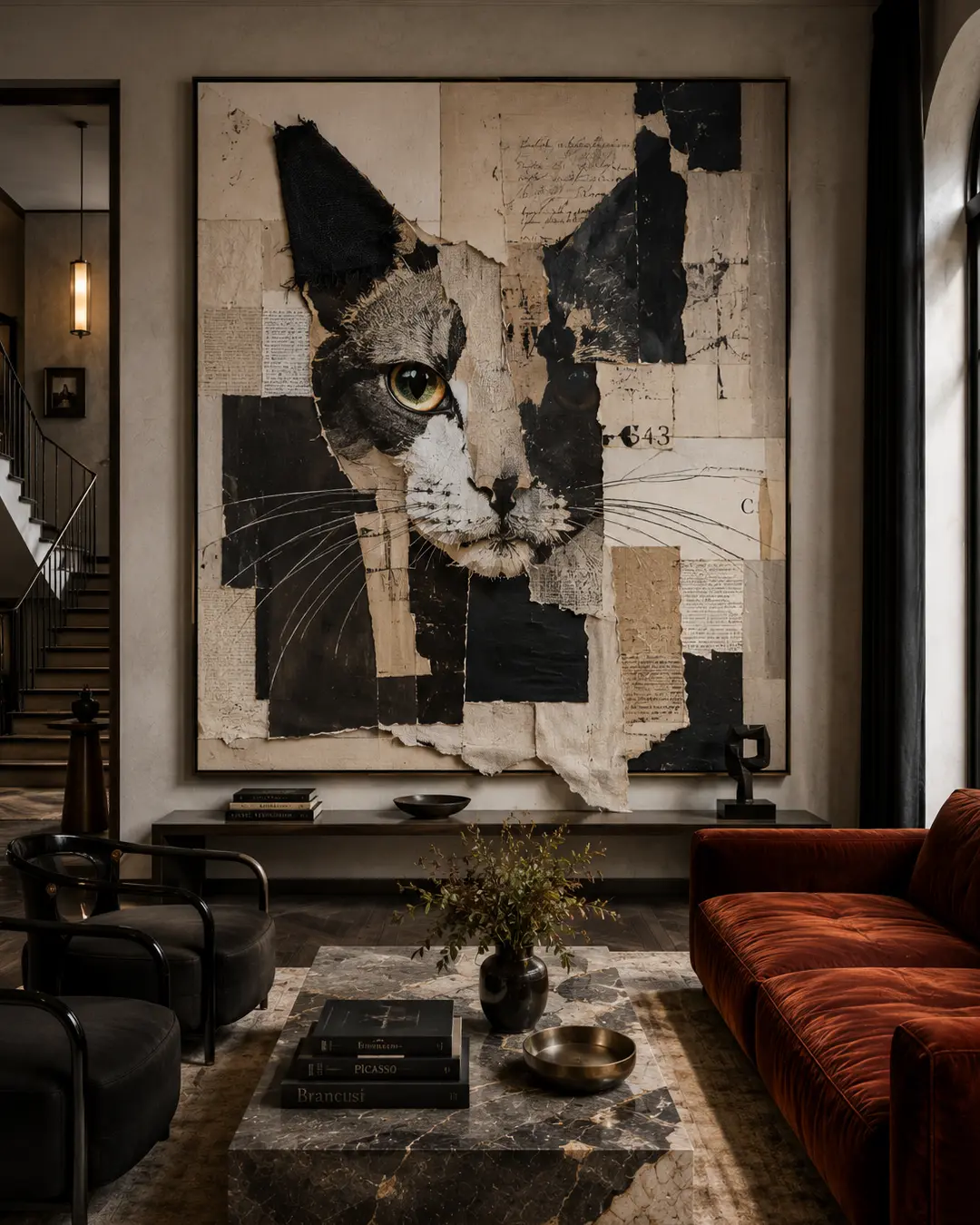
Mixed media gives us permission to make things slightly strange.
Fragments of photography, painted surfaces, torn paper, graphite and perhaps even pieces of fabric combine to create the suggestion of a cat rather than a straightforward portrait.
One eye may be photographic.
The body might disappear into layers of paper and paint.
A whisker could be nothing more than a graphite line extending into untouched canvas.
Placed in a refined contemporary room, the piece introduces just enough disorder to make everything around it feel even more deliberate.
The Cat You Almost Miss
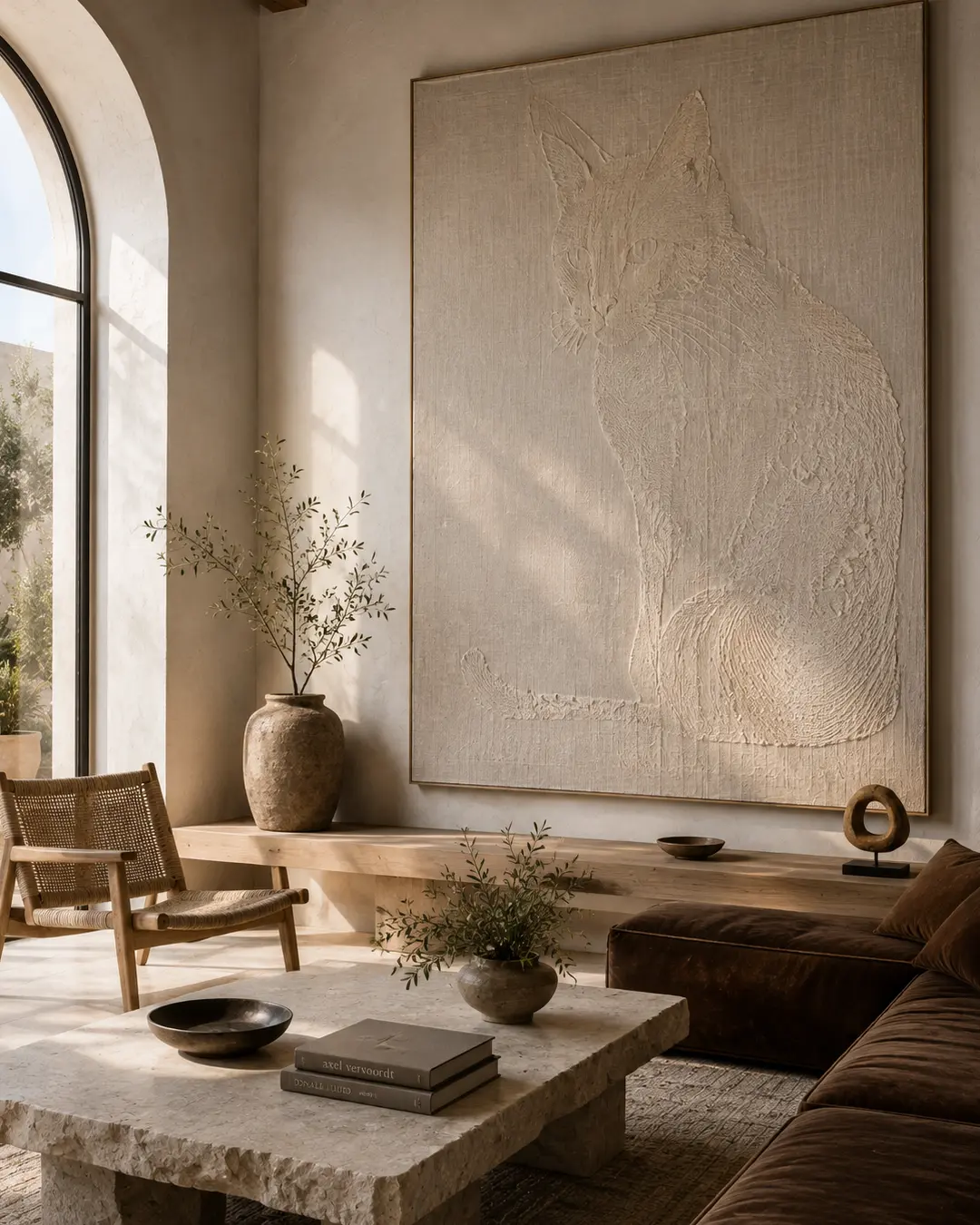
Not all statement art needs to announce itself immediately.
Imagine an enormous pale work on raw linen: a white cat rendered in subtle stitching, chalk, pigment and raised texture.
From across the room it initially appears almost minimal.
Then the light catches the surface.
The ears emerge. A shoulder. The faint curve of a tail. Tiny shadows created by thread and texture reveal an image that wasn’t obvious seconds earlier.
It rewards the person who actually looks.
In a world where so much interior design is built to photograph instantly, there is something wonderful about art that takes a little longer.
The Black Cat at the End of the Hall
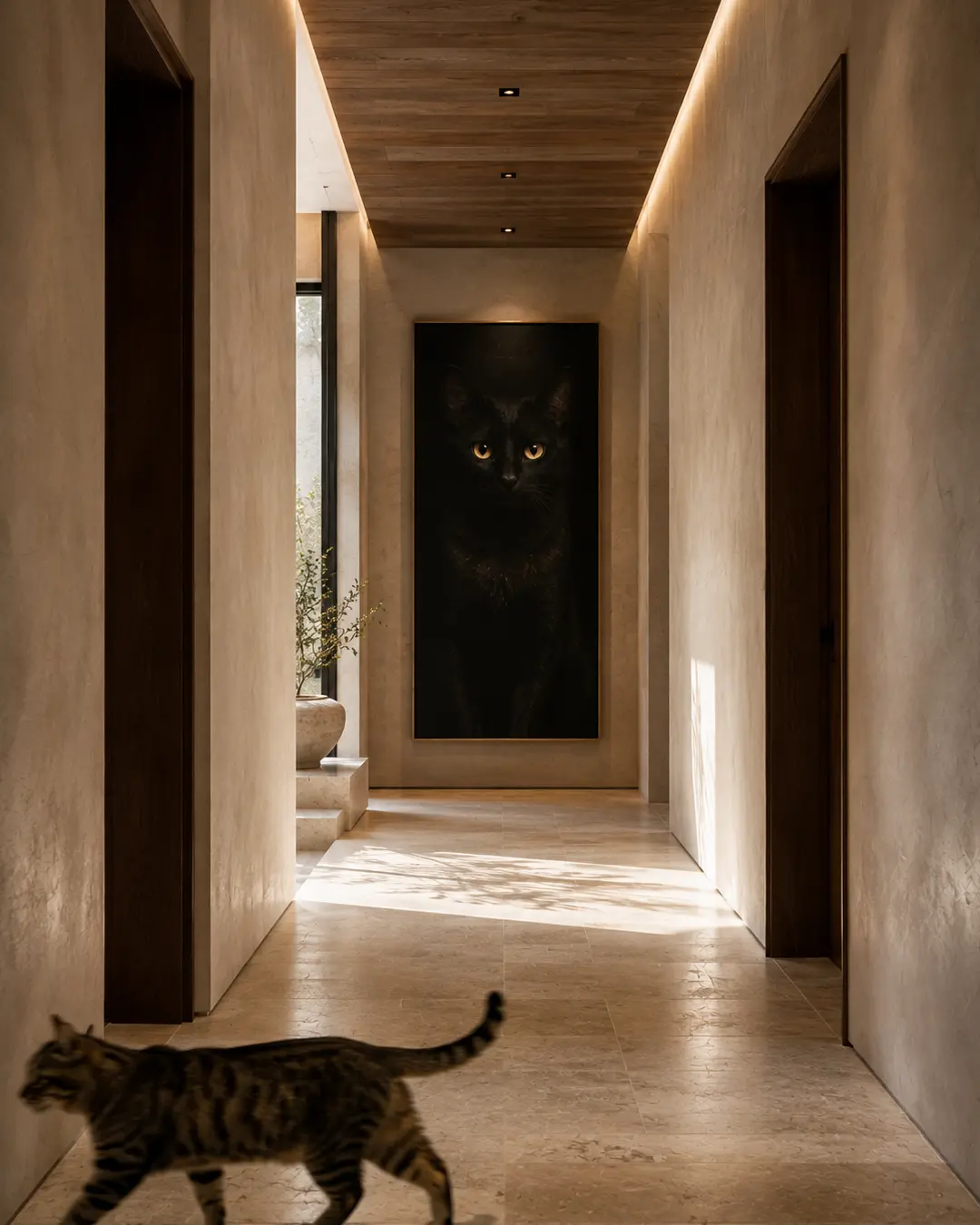
The final piece doesn’t need to be the loudest.
It needs to be unforgettable.
At the end of a long architectural hallway, framed by warm plaster walls and a beautiful stone floor, hangs a nearly life-sized portrait of a black cat against an extraordinarily deep, dark background.
At first, you notice the eyes.
Then the faint edge of an ear.
Then subtle variations in black begin revealing the rest of the animal.
The placement makes the piece impossible to avoid. Every sightline through the home eventually leads toward it.
And perhaps, somewhere much closer to the camera, a completely unrelated tabby crosses the hallway without the slightest concern for composition.
Cat Art Doesn’t Have to Look Like Cat Decor
The most interesting thing about these rooms isn’t that someone who lives there probably likes cats.
It’s that they like art.
A cat can be photographed, painted, sculpted, woven, drawn, fragmented or reduced to little more than a shadow. The subject doesn’t dictate whether something belongs in a sophisticated home.
The execution does.
Choose something because it stops you.
Give it enough room to matter.
Let the furniture, architecture and materials around it be equally considered.
And if a real cat happens to wander through the room?
Even better.
Great art. Great room. The odd real cat.
More Pet Art for Beautiful Homes
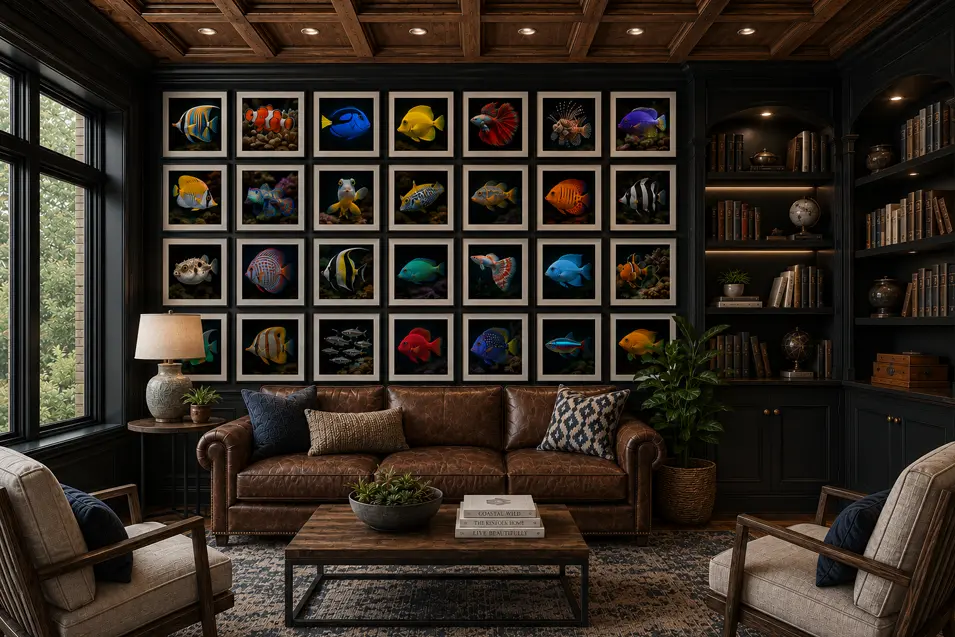
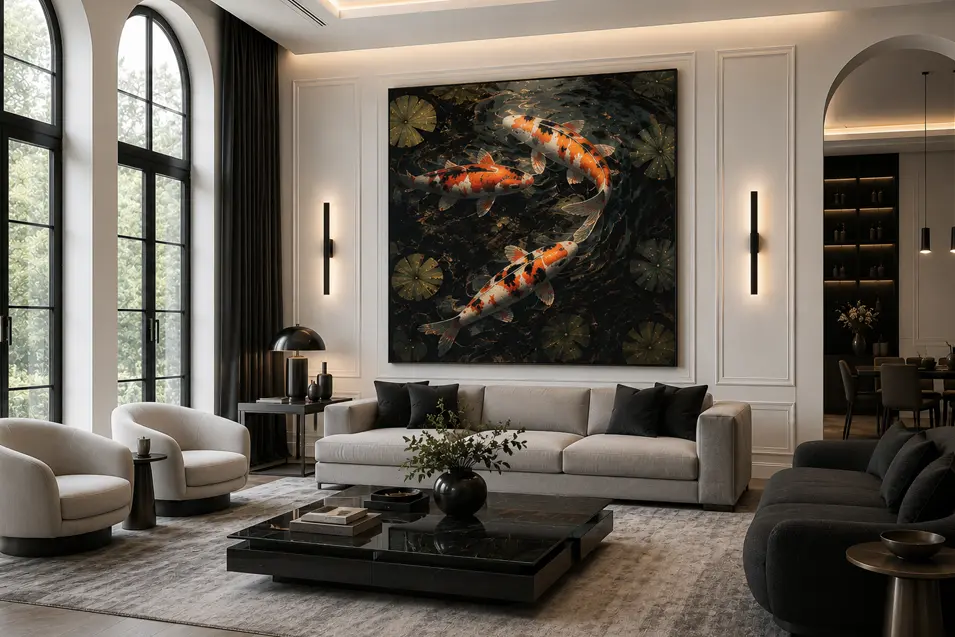
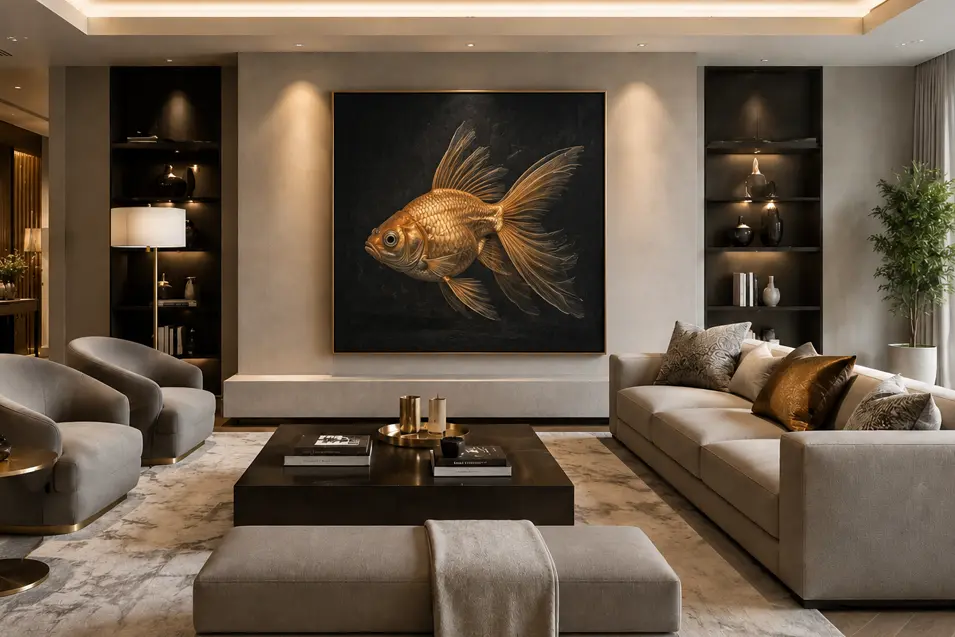
Cats don’t have to be the end of the collection. From wonderfully atmospheric Halloween cat art to unexpected fish-inspired pieces that can completely transform a room, we’re continuing to explore what happens when pets become the subject of genuinely interesting art.
If you’re looking for more inspiration, discover our Halloween Cat Art or take a completely different direction with AI Fish Art.