Canada is a very big place.
Drive west from the Atlantic and colourful fishing villages eventually give way to forests, farmland, enormous prairie skies, foothills, mountains and the rainforests of the Pacific Coast.
Head north and the landscape changes again.
The trees become smaller.
Then disappear.
The distances become enormous.
And eventually there is tundra, rock, ice and Arctic sky.
Architecture changes along the way too.
Homes are shaped by the materials people have available, the weather they live with, the landscapes surrounding them and generations of local building traditions.
So we wondered:
What would happen if dog houses did the same thing?
Not novelty dog houses decorated with provincial flags.
Not thirteen miniature luxury homes.
And definitely not thirteen versions of the same wooden dog house photographed in different places.
Instead, we imagined one dog house for every Canadian province and territory — each belonging completely to the place where it stands.
Some are beautiful pieces of architecture.
Some are practical shelters.
Some look like they were built by craftspeople.
And a few look like Dad built them twenty years ago, repaired them twice and sees absolutely no reason to replace something that still works perfectly well.
Because a good home doesn’t have to be expensive to belong somewhere.
Sometimes it simply needs to feel like home.
Here is our journey across Canada.
British Columbia — Beneath the Cedars
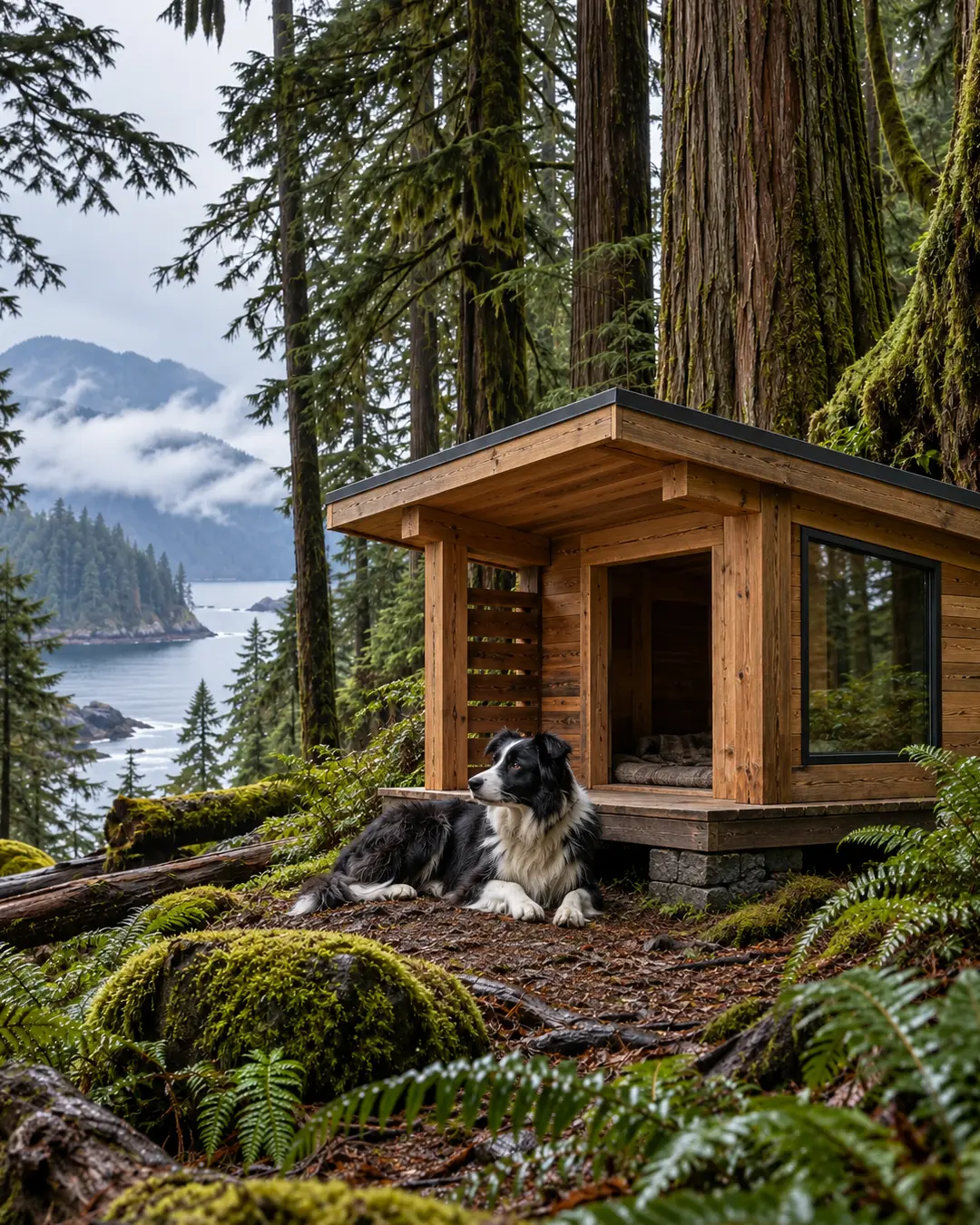
There are places on Canada’s West Coast where the forest seems determined to reclaim everything.
Moss covers fallen logs.
Ferns crowd the forest floor.
Rain darkens the cedar.
And enormous trees make almost everything humans build beneath them seem temporary.
Our British Columbia dog house belongs here.
Built from warm West Coast cedar, it has a simple contemporary shape, generous roof overhangs and a sheltered entrance designed for wet weather.
It is beautifully made, but deliberately restrained.
Because the architecture shouldn’t compete with the forest.
The dog sits outside among ferns and moss while enormous cedar trunks disappear upward beyond the photograph.
Somewhere through the trees there might be the faintest glimpse of water.
The dog house is lovely.
But British Columbia is the real architecture.
Alberta — The Foothills Ranch
There is a moment driving west across Alberta when the horizon changes.
For hours there have been fields.
Then foothills begin rolling across the landscape.
And eventually the Rockies appear.
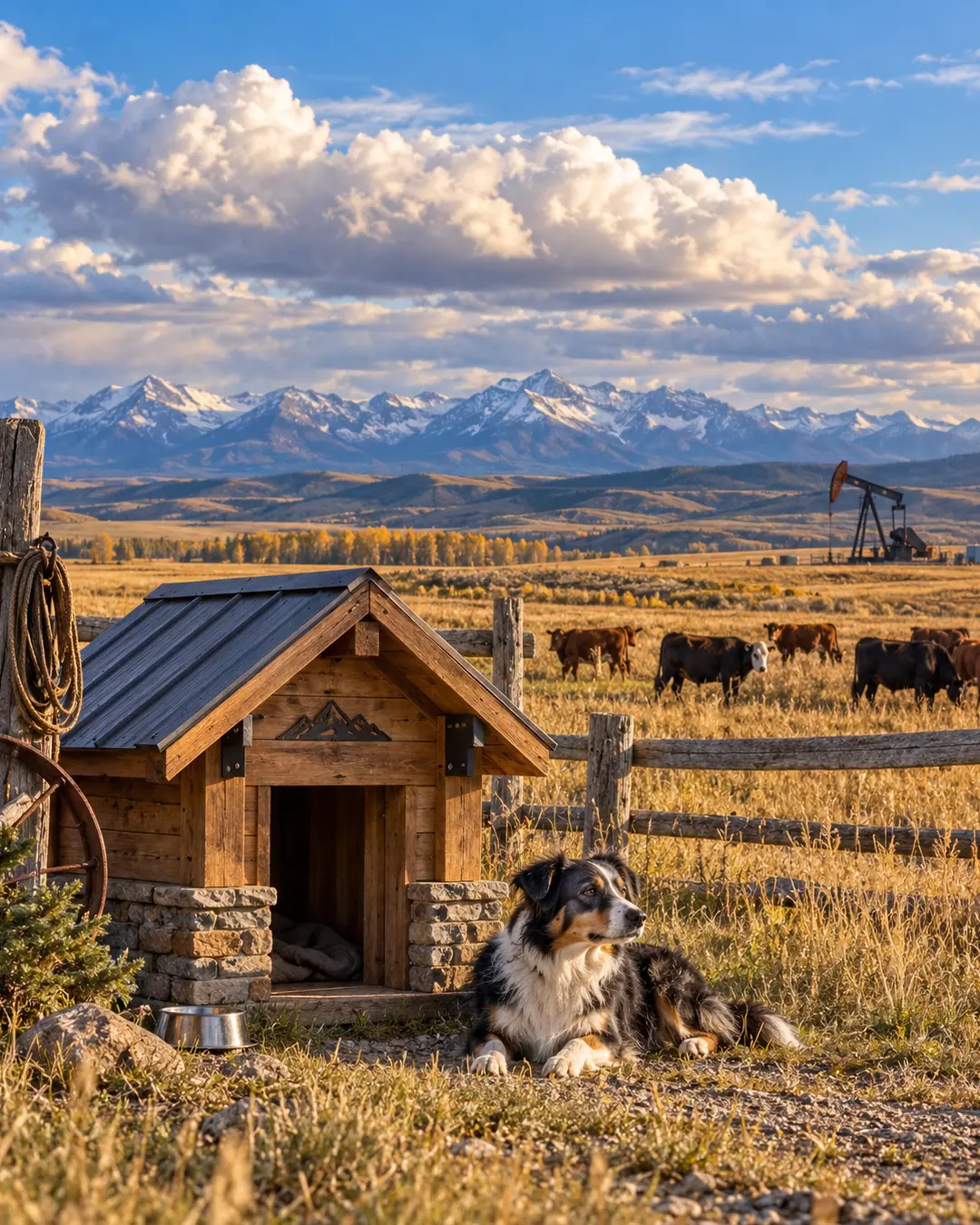
Our Alberta dog house sits somewhere in that transition.
It is built like something a rancher who happens to be an excellent carpenter might make on a winter afternoon: heavy timber, sturdy construction, a little local stone and a metal roof capable of handling whatever the weather decides to do next.
Nothing is overly polished.
Nothing needs to be.
Behind it are grasslands, fencing and the distant Rocky Mountains.
A ranch dog rests beside the entrance.
This isn’t a miniature mountain resort.
It’s a good little building made properly.
And in Alberta, that feels about right.
Saskatchewan — Under an Enormous Sky
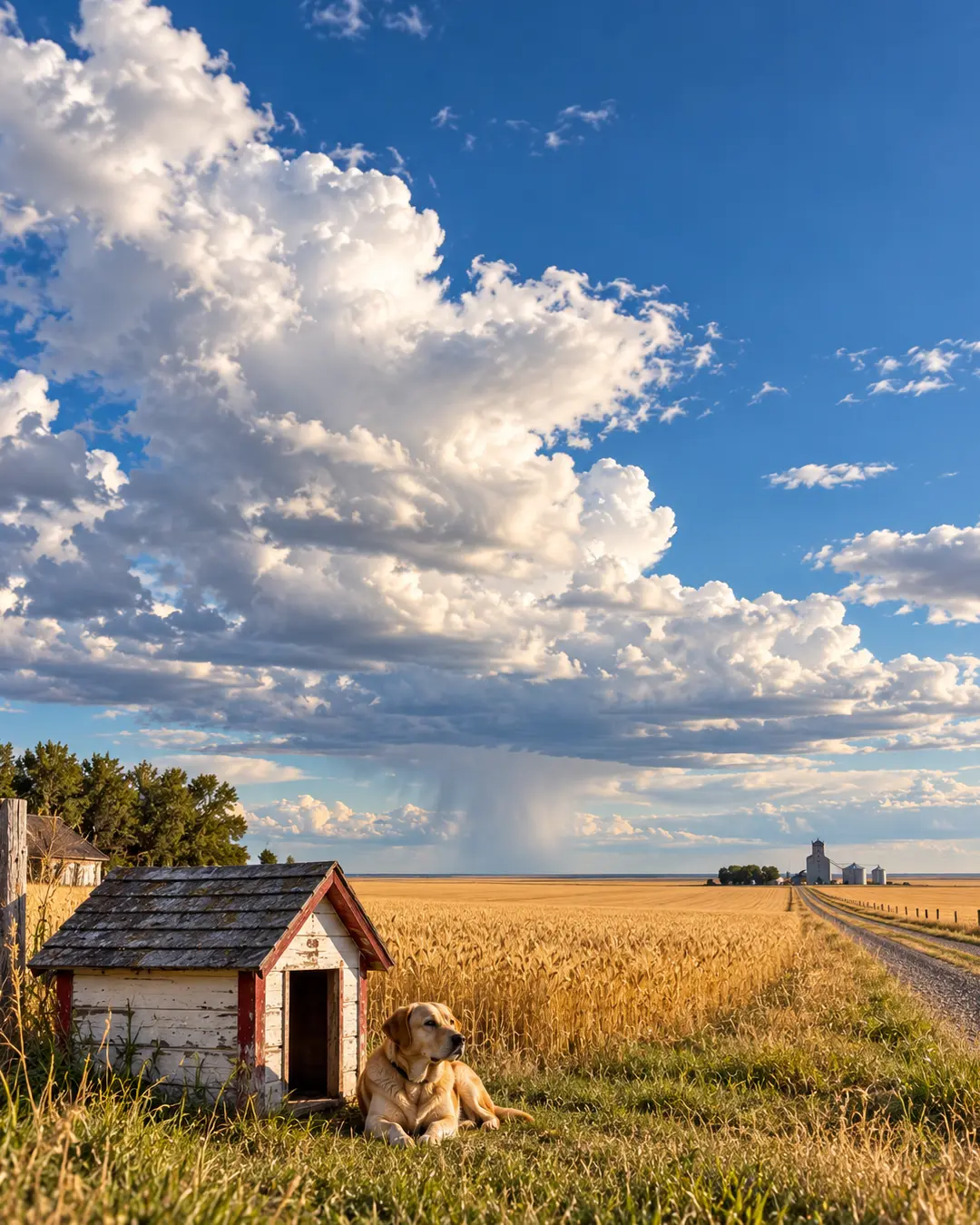
The smallest dog house in this series might belong beneath the biggest sky.
Saskatchewan doesn’t need elaborate architecture to tell its story.
It needs space.
A simple wooden dog house sits beside a farmhouse or shelterbelt at the edge of an enormous field.
Maybe it was built from leftover lumber.
Maybe someone painted it years ago.
Maybe the roof has been replaced once.
None of that matters very much.
Because behind it, the prairie runs almost uninterrupted toward the horizon.
Above it, clouds fill an extraordinary Saskatchewan sky.
The dog is small.
The house is smaller.
And the sky owns the photograph.
Manitoba — The Lake Cabin
Manitoba sometimes gets visually reduced to prairie.
That would be a mistake here.
Instead, we’re heading into lake country.
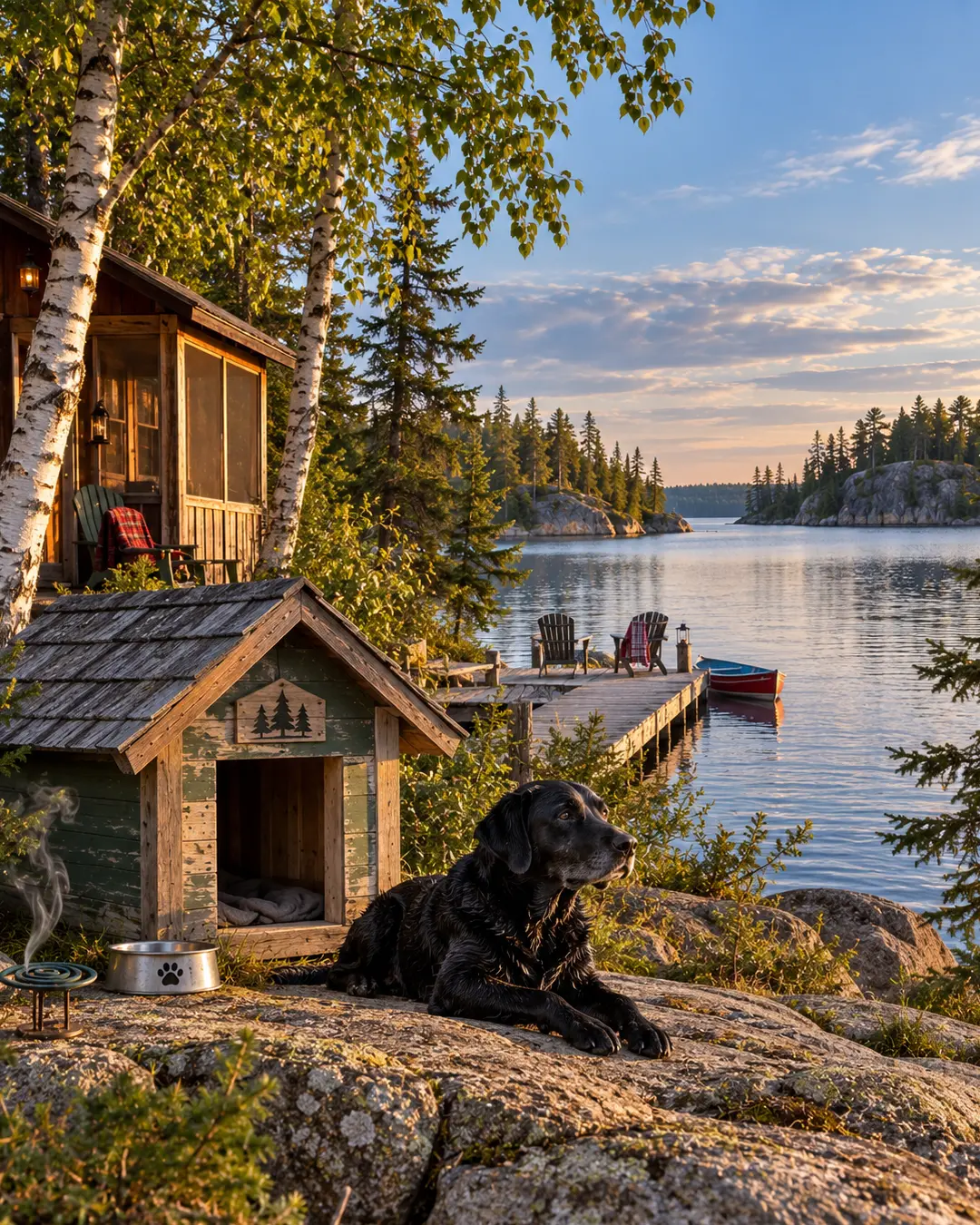
Birch trees lean toward dark water. Spruce grows between exposed rock. A little dock reaches into a quiet northern lake.
Nearby sits a dog house that looks suspiciously like the family cabin.
Not because anyone intentionally matched them.
It simply happened over time.
The little timber house has faded paint, a repaired corner and perhaps a roof made from leftover cabin shingles.
It has survived rainstorms, mosquitoes, snow, muddy paws and more summers than anyone remembers.
The dog lies nearby watching the lake.
Nothing here is trying particularly hard to be beautiful.
Which is probably why it is.
Ontario — The Muskoka Cottage
Ontario gets to show off a little.
Because somewhere on a granite shoreline in Muskoka, somebody absolutely would build this.
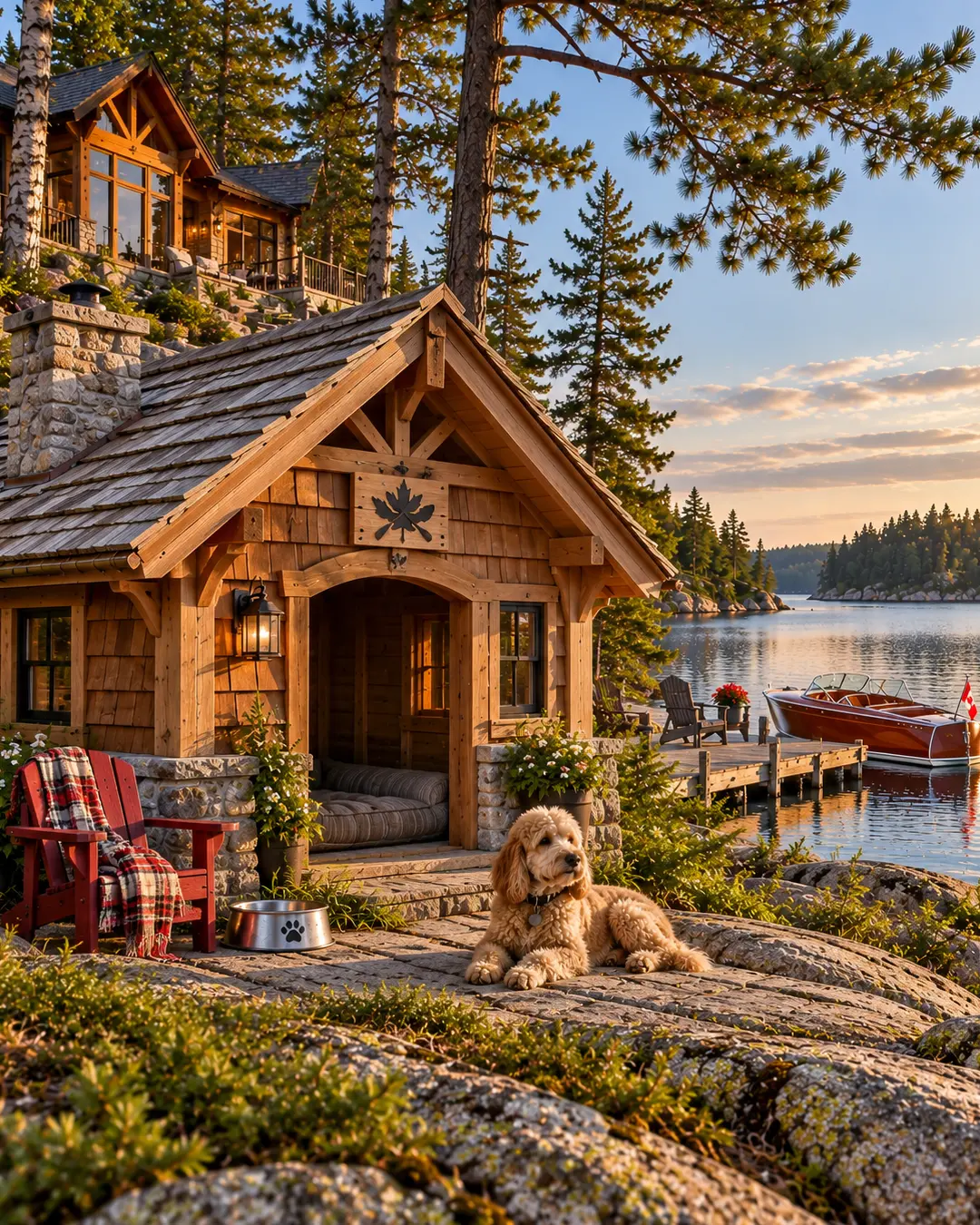
The dog house is essentially a miniature Canadian cottage: cedar siding, substantial timber details, Canadian Shield granite and craftsmanship considerably beyond anything a dog technically requires.
There is even a tiny Muskoka chair outside.
Of course there is.
But the setting matters just as much.
Tall pines frame the scene.
Granite slopes toward clear lake water.
A dock reaches from the shoreline.
Perhaps a canoe waits nearby.
The dog sits outside its ridiculous little cottage looking entirely unimpressed by the real-estate value.
This is cottage country distilled into several very unnecessary square feet.
And we love it.
Quebec — The Laurentian House
Quebec gives us an opportunity to make the architecture itself part of the regional story.
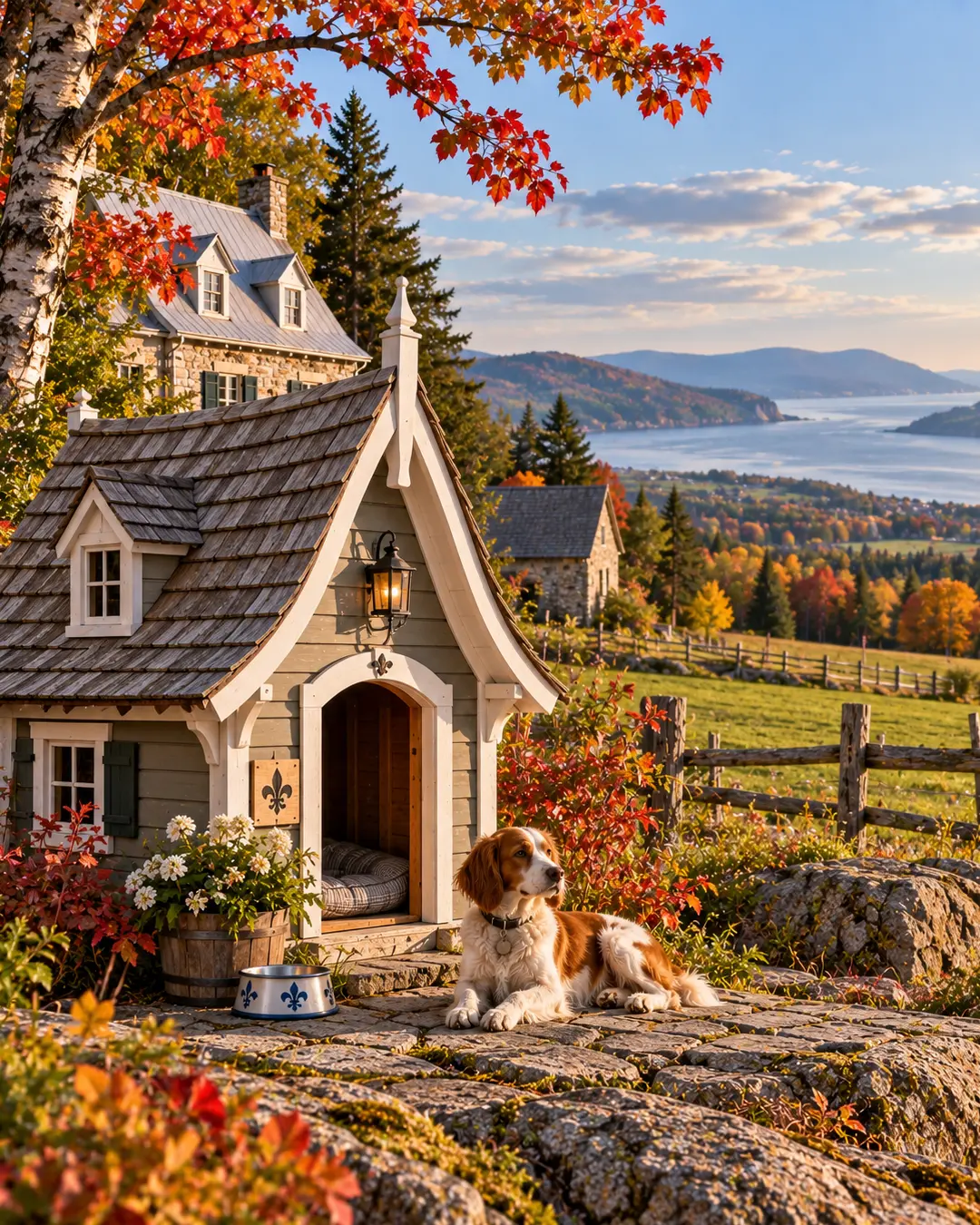
Set among the rolling landscape of the Laurentians or Charlevoix, our little house borrows from traditional Quebec architecture without becoming a caricature.
The roof is steep.
The proportions are elegant.
Cedar shingles and carefully considered trim make it feel as though someone genuinely thought about what this tiny building should look like.
Behind it, mature trees frame a landscape of hills, fields and distant forest.
The dog rests near the doorway.
There is history in the shape of the house.
But there is nothing museum-like about it.
It simply feels as though it belongs exactly where it was built.
New Brunswick — By the Bay
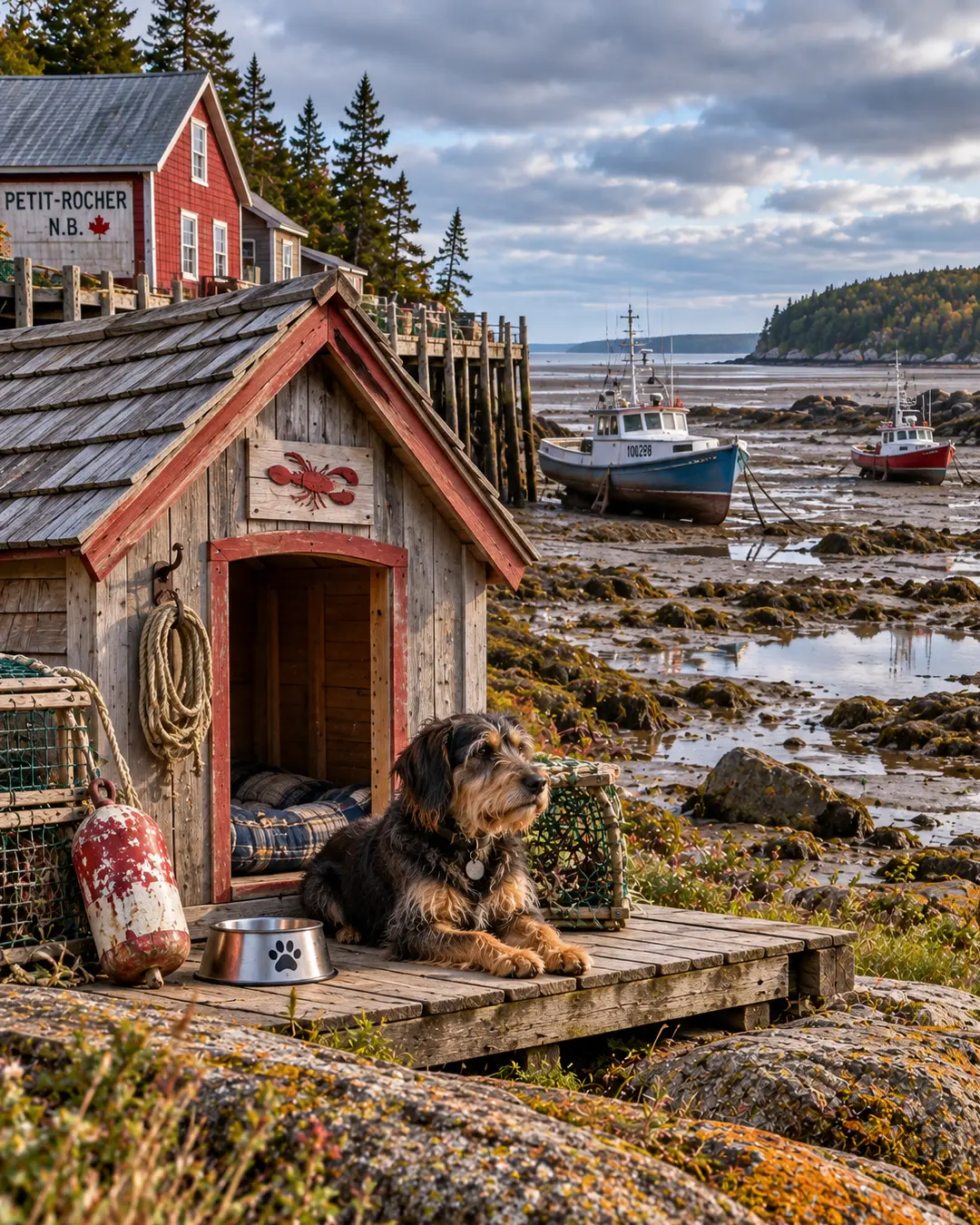
New Brunswick’s dog house belongs near water.
Not manicured waterfront.
Working waterfront.
The Bay of Fundy brings some of the world’s most dramatic tides, and communities along the coast have spent generations building around water, weather and work.
Our dog house borrows a little from a boathouse and a little from a Maritime workshop.
Weathered boards.
Simple construction.
A sturdy roof.
Perhaps a small hook near the entrance where absolutely nothing useful to a dog is hanging.
Behind it are spruce trees, rock, mudflats or distant water.
The tide may be out.
The dog doesn’t care.
It knows it will come back.
Nova Scotia — The Lunenburg Dog House
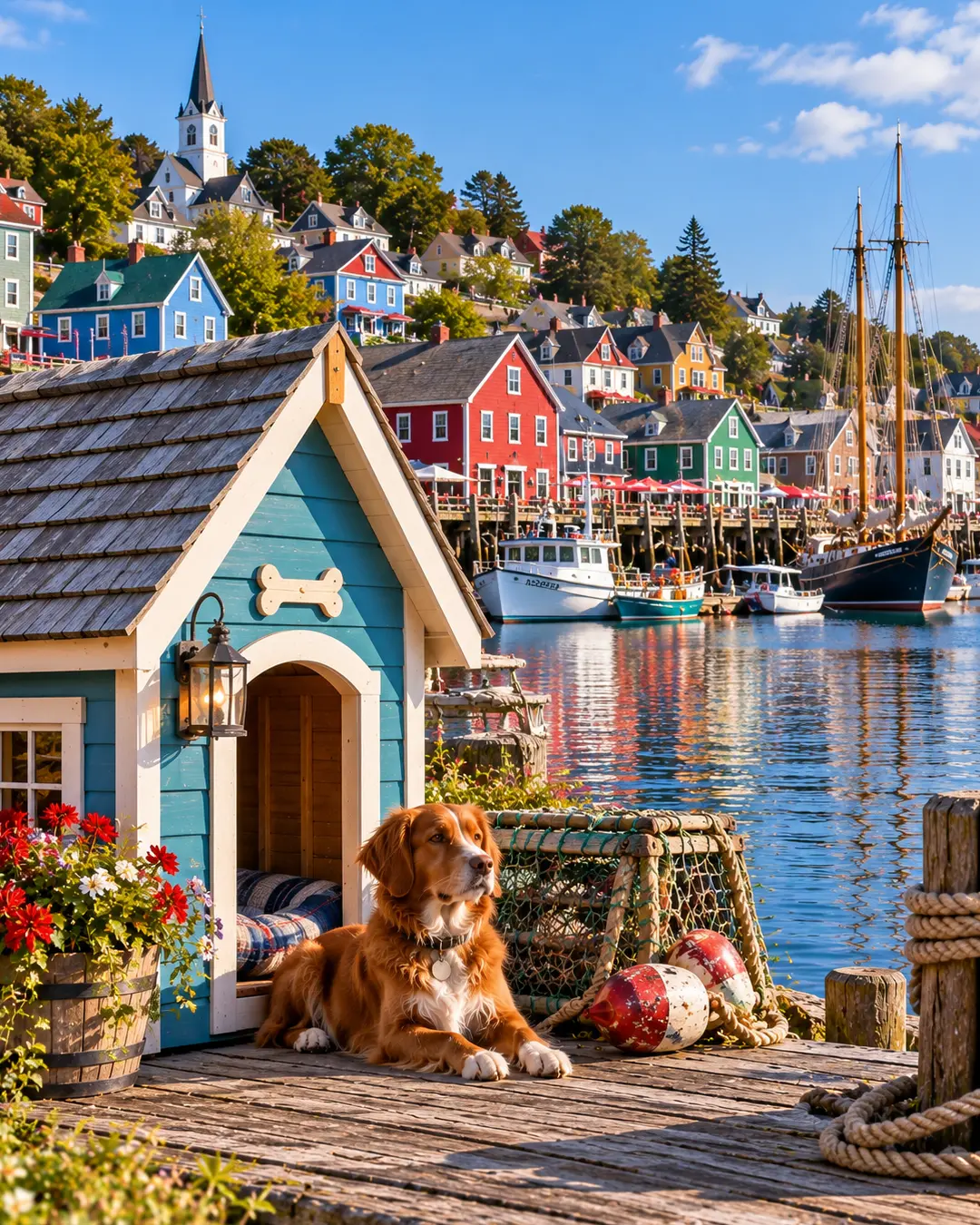
Some Canadian towns seem almost impossible to photograph badly.
Lunenburg is one of them.
Colour climbs the hillside.
Red, blue, yellow and green buildings overlook the harbour while boats, wharves and the Atlantic complete a scene that could hardly belong anywhere else.
So our Nova Scotia dog house joins in.
Clapboard siding gives it the character of the town’s architecture, with crisp trim and a colour chosen with considerably more confidence than most people use when painting their own homes.
But we don’t isolate it.
The harbour matters.
The boats matter.
The hillside matters.
The colourful buildings matter.
The dog house occupies only part of a photograph that is fundamentally about a remarkable Nova Scotia place.
A dog sits outside watching activity along the waterfront.
Maybe it is waiting for someone.
Maybe it just likes boats.
Either explanation works.
Prince Edward Island — Red Earth
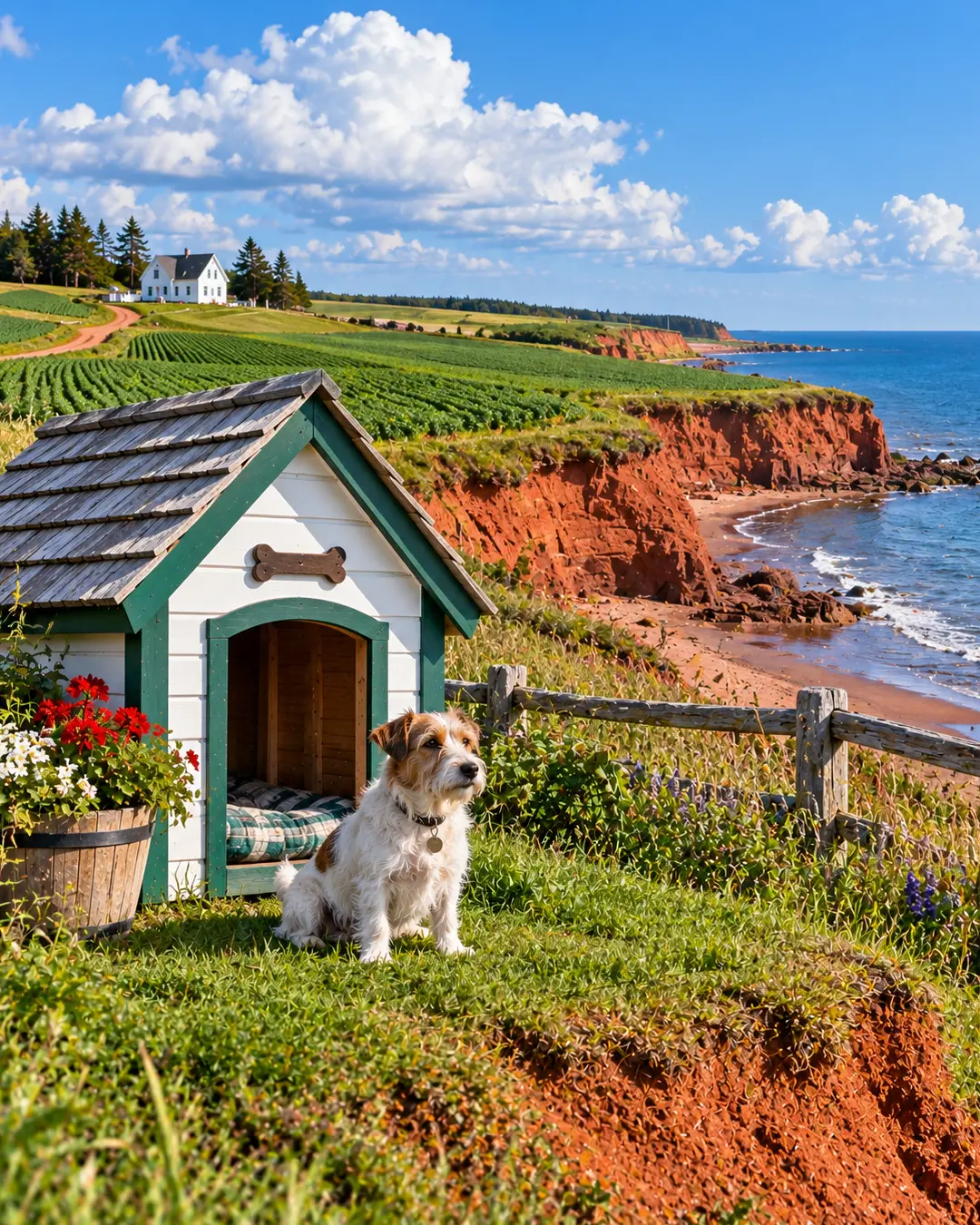
PEI gives us one of Canada’s simplest colour palettes.
Red.
Green.
Blue.
White.
Red soil and sandstone cliffs.
Green fields.
Blue water.
White houses and clouds.
It doesn’t need much more.
Our Prince Edward Island dog house is correspondingly simple: clapboard siding, clean trim and a traditional pitched roof.
Perhaps it is white.
Perhaps it carries one of the island’s cheerful coastal colours.
Either way, it sits against grass so green it almost looks exaggerated, while PEI’s unmistakable red earth appears beneath it.
Beyond that is the coast.
The little house doesn’t create the photograph.
The island does.
Newfoundland & Labrador — Built to Last
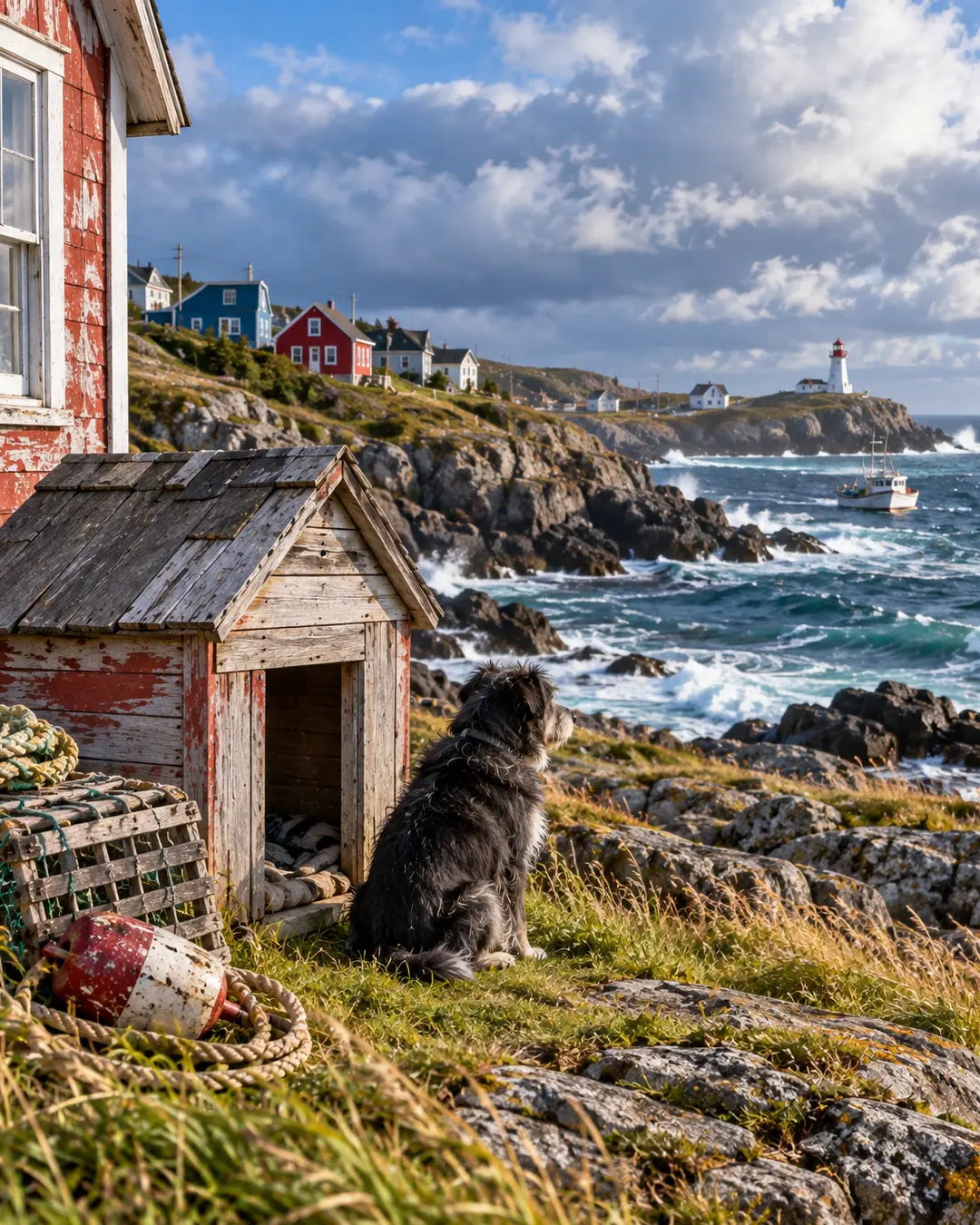
This one isn’t new.
Not remotely.
Someone built it years ago.
The boards have weathered silver.
One wall carries traces of faded paint.
The roof was patched at least once, and there is a very good chance some of the material came from another project.
Nobody remembers exactly when it was built.
Nobody particularly cares.
It works.
The little dog house sits beside a coastal home overlooking the North Atlantic.
Rock pushes through the ground.
Grass bends in the wind.
Fishing gear, rope or an old wooden box suggests that life here has always been connected to the water.
The dog sits outside facing the ocean.
There are more expensive dog houses in this series.
There are more architecturally impressive ones.
There may not be one with more soul.
Yukon — The Little Cabin
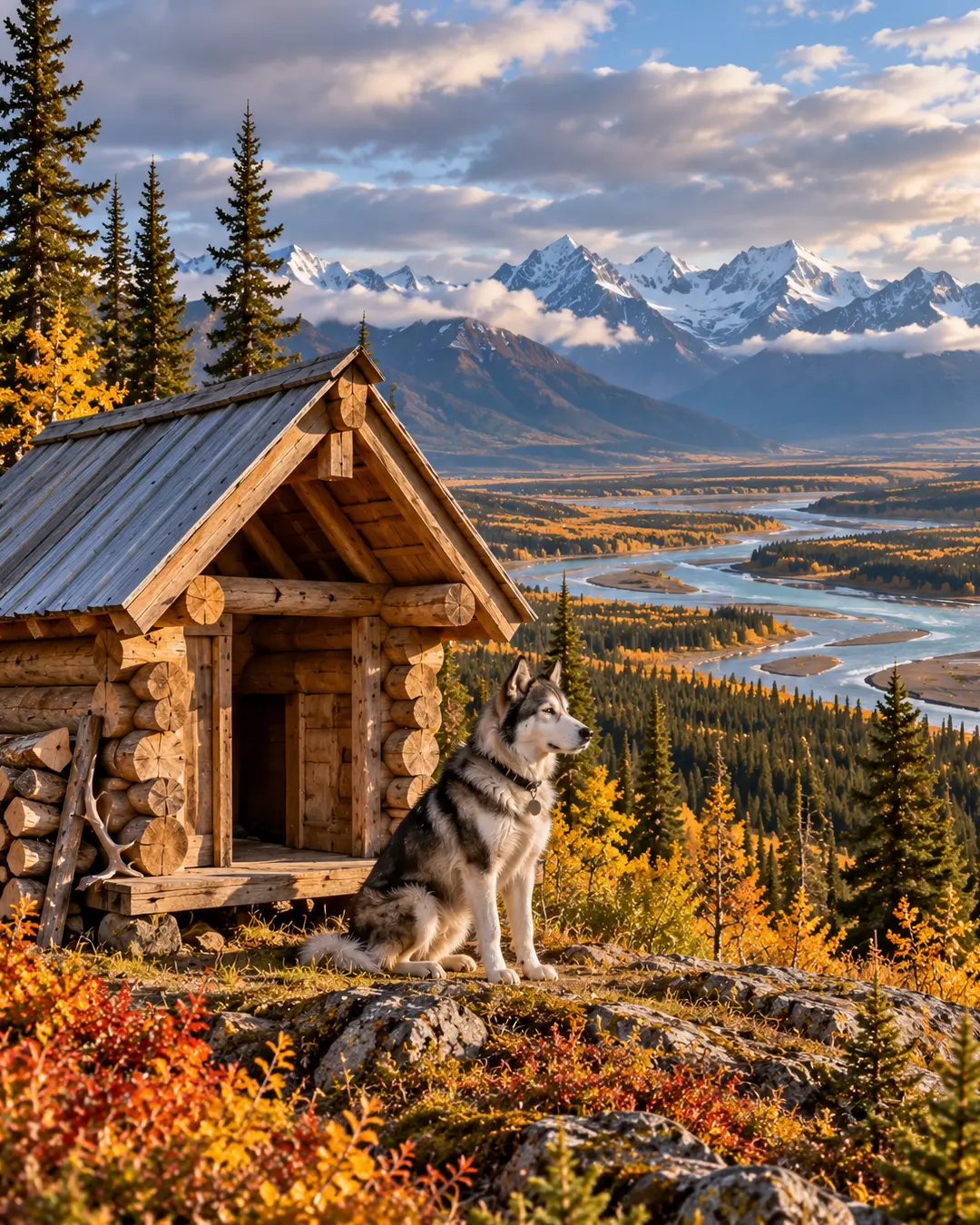
The Yukon has a way of making buildings look small.
Mountains rise behind river valleys.
Spruce forests stretch toward horizons that seem much farther away than expected.
Our dog house embraces that scale rather than fighting it.
It looks like a tiny wilderness cabin.
Heavy timber.
A steep roof.
A sheltered entrance.
Construction intended to survive real winters rather than simply photograph nicely.
Perhaps it was built by someone who also built the woodshed, repaired the porch and knows precisely which pile of lumber behind the garage contains the useful pieces.
A northern dog sits beside it.
Behind both of them is an enormous Yukon landscape.
The little cabin provides shelter.
The wilderness provides everything else.
Northwest Territories — At the Edge of the Trees
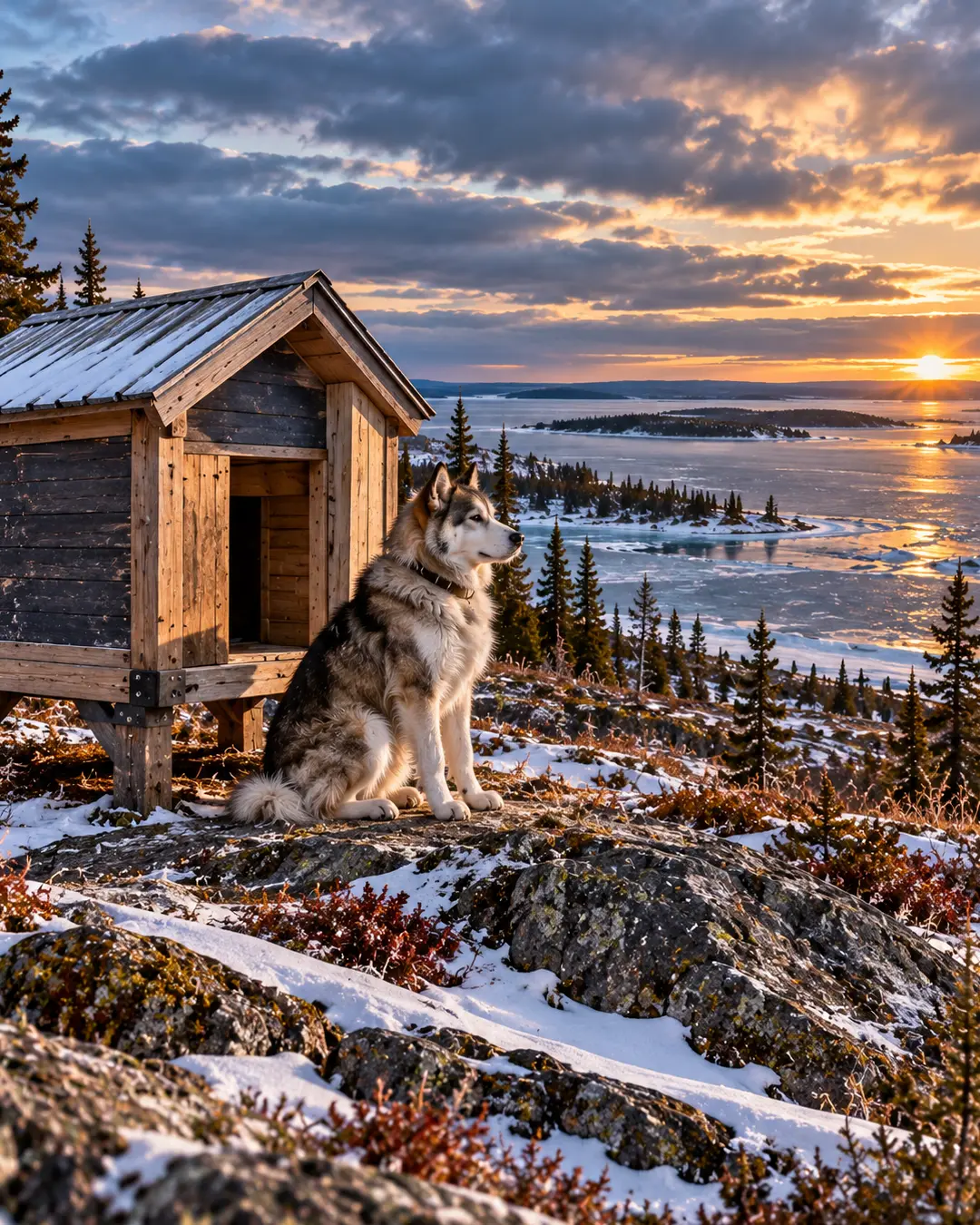
Farther north, architecture becomes increasingly about solving problems.
Cold.
Wind.
Snow.
Frozen ground.
Distance.
Our Northwest Territories dog house reflects that.
The structure is compact and slightly raised, with excellent insulation, a protected entrance and almost nothing included merely for decoration.
It might sit near a northern community with an enormous lake or river beyond it.
Low spruce and exposed rock stretch into the distance.
The sky feels disproportionately large.
There is beauty here, but the dog house doesn’t romanticize northern life.
It is simply a well-designed shelter doing exactly what a shelter is supposed to do.
Keep its occupant warm.
Keep the weather out.
Last.
Nunavut — Shelter
By the time we reach Nunavut, the trees are gone.
And suddenly scale means something different.
Rock.
Tundra.
Water.
Snow.
Sky.
Distances that make a tiny building seem almost impossibly small.
Our Nunavut dog house is the most function-driven design in the entire journey.
It is raised from the ground, heavily insulated and shaped to provide protection from wind. Openings are limited. The entrance is carefully sheltered.
There is no decorative attempt to make it look stereotypically “Arctic.”
No miniature igloo.
No novelty northern theme.
Instead, the architecture responds intelligently to the environment around it.
A dog stands nearby against an extraordinary sweep of tundra and sky.
The shelter occupies only a small portion of the scene.
It has to.
Because up here, the landscape reminds everything humans build just how small it really is.
Thirteen Houses. One Very Big Country.
Put all thirteen dog houses beside one another and they don’t match.
That’s the point.
One is made from beautiful cedar.
Another has peeling paint.
One has stonework and a tiny Muskoka chair.
Another looks like it was assembled from whatever useful lumber happened to be available.
Some were imagined by architects.
Some by craftspeople.
Some could have been built by families.
And in the North, decoration increasingly gives way to the basic intelligence of creating shelter in a difficult climate.
What connects them isn’t a particular architectural style.
It isn’t price.
It isn’t size.
And it certainly isn’t luxury.
It’s something much simpler.
Every one belongs where it is.
Because Canada isn’t one landscape.
It isn’t one climate, one architectural tradition or one way of living.
It is rainforest and prairie.
Granite and red earth.
Fishing villages and ranch country.
Cottage lakes and northern rivers.
Mountains, forests, tundra and three enormous oceans.
And perhaps the best way to build a Canadian dog house isn’t to cover it in maple leaves.
Perhaps you simply look around.
See where you are.
And build something that belongs there.
More Canadian Inspiration
Our journey doesn’t have to end in Nunavut.
Canada’s landscapes, architecture and regional character have inspired quite a few of our more unusual ideas.
Take a road trip with us in Crossing Canada With Your Dog, wander through the historic towns of the Prairies with 20 Luxury Cat Trees Inspired by the Historic Prairie Towns of Western Canada, head back to the Atlantic with our Maritime Collection: Luxury Cat Trees Inspired by Canada’s Atlantic Coast, or travel west for 20 Luxury Cat Trees Inspired by the Indigenous Art of British Columbia.
Different pets. Different designs. Different corners of the country.
Same extraordinary Canada.