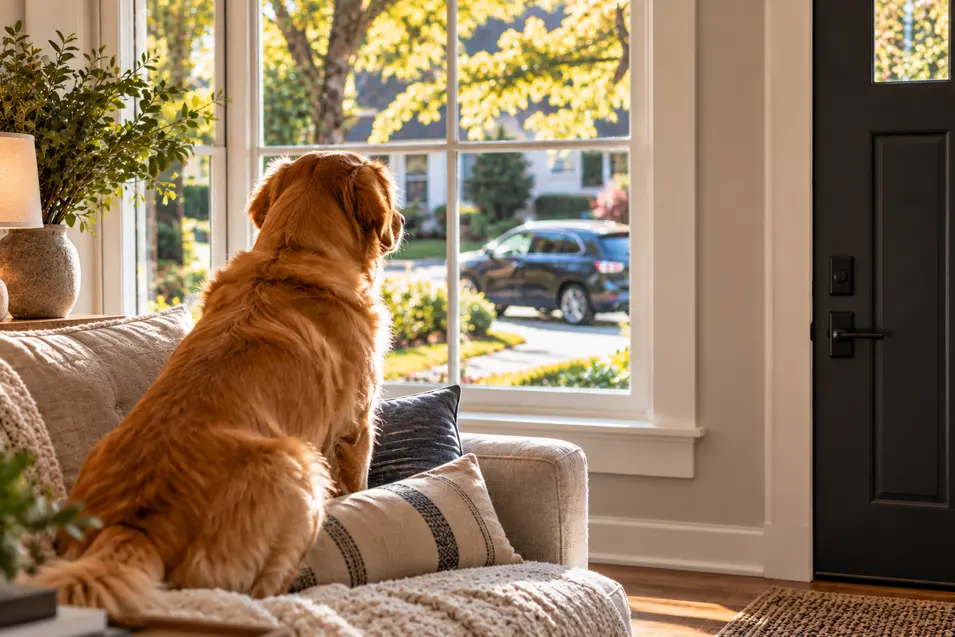
There is a dog sitting by the front window.
It is 4:47 in the afternoon.
Nothing particularly interesting is happening outside.
No squirrels.
No delivery driver.
No suspicious neighbour committing the unforgivable crime of walking past the house.
But the dog is watching.
Waiting.
Then, a few minutes later, a familiar car turns onto the street.
The tail starts.
The dog runs to the door.
And by the time you put your key in the lock, there is an enthusiastic welcoming committee on the other side.
Which raises an interesting question.
Did your dog actually know you were coming home?
Probably.
Just perhaps not in quite the way you think.
Dogs Are Very Good at Learning Our Routines
Dogs may not understand that you normally arrive home at 5:15 p.m., but they are extraordinarily good at noticing patterns.
Your household is full of them.
The kids arrive home from school.
The afternoon light changes.
Someone starts preparing dinner.
A neighbour comes home and closes their garage door.
Traffic gets heavier outside.
The house becomes quieter — or busier.
All of these things can become little pieces of information that tell your dog what usually happens next.
If you leave and return at roughly the same times every weekday, your dog doesn’t need to read a clock.
The entire day becomes its clock.
Your Dog’s Internal Clock May Help Too
Animals have biological rhythms that help regulate sleep, activity, hunger and other behaviours across the day.
Dogs are no exception.
That doesn’t mean your dog understands 4:47 p.m. in the human sense.
But a dog that lives according to a fairly predictable schedule can learn that certain events tend to occur after a particular amount of the day has passed.
Breakfast happens.
You leave.
There is a long quiet period.
Afternoon arrives.
And eventually, you come home.
Repeat that hundreds of times and it isn’t particularly surprising that your dog becomes very good at anticipating the final step.
The House Is Giving Your Dog Clues
We tend to think nothing happens in our homes while we’re gone.
Your dog would probably disagree.
A house changes throughout the day.
Sunlight moves across the floor.
The furnace or air conditioner cycles.
Regular delivery vehicles arrive.
Neighbours leave and return.
Other household members follow their own schedules.
Even the sounds outside can change as morning becomes afternoon.
Your dog has spent considerably more time studying these things than you have.
Mostly because you have a job.
The dog has surveillance.
Your Dog May Hear You Before You Arrive
Then there are the clues that are actually coming from you.
Dogs have excellent hearing and may recognize familiar sounds long before we would notice them.
That could include your car.
Not simply a car.
Your car.
The sound of the engine, the way it approaches, the garage door opening or even the particular sequence of noises that usually precedes you walking through the door can become part of the dog’s recognition process.
To you, your arrival begins when you walk inside.
To your dog, it may have begun considerably earlier.
What About Smell?
This is where things become particularly interesting.
Dogs experience the world through scent at a level we simply don’t.
Researchers have even explored whether changing concentrations of an owner’s scent in a home could provide dogs with information about how long that person has been gone.
It’s an intriguing possibility: your scent is strongest after you leave and gradually changes or diminishes as time passes.
Could a dog learn that when your scent reaches a certain level, you usually return?
Perhaps.
But we shouldn’t leap from an interesting hypothesis to saying dogs literally smell the time.
The more likely explanation for that dog waiting by the window is a combination of scent, biological rhythms, environmental cues and an enormous amount of experience with your routine.
Which, frankly, is impressive enough.
But What If I Come Home at Random Times?
This is where things get fun.
If you normally arrive at 5:00 but unexpectedly come home at noon, some dogs look genuinely surprised.
Others somehow still seem to know you’re approaching.
In those situations, predictable daily routines become a weaker explanation.
The dog might hear your vehicle.
It might recognize footsteps in the hallway of an apartment building.
Perhaps another person in the house behaves differently when you’re expected.
Or there may be some tiny cue you’ve never noticed.
Dogs spend their lives watching us.
We spend considerably less time watching ourselves.
Can Dogs Tell How Long You’ve Been Gone?
Not the way we can.
There is no good reason to think your dog is lying on the sofa thinking:
David has been gone for precisely three hours and seventeen minutes.
But dogs can distinguish between different experiences of being alone, and research suggests their behaviour when reunited with an owner can vary depending on how long the separation lasted.
That doesn’t necessarily mean they possess a human-like concept of elapsed time.
It does suggest that one hour and several hours may not feel identical to a dog.
How they make that distinction is the interesting part.
It could involve biological changes, hunger, sleep cycles, environmental cues, scent or some combination of them.
Why Is My Dog Waiting at the Door Before I Get Home?
Because your dog has become an expert on your life.
Think about how many times the sequence has been repeated.
You leave.
The day unfolds.
Certain things happen.
Then you return.
Dogs are exceptionally good at learning associations. Eventually, the events that happen shortly before your arrival can themselves become signals.
Your dog may start becoming alert before you arrive.
Then move toward the window.
Then wait near the door.
From our perspective, it can look almost psychic.
From the dog’s perspective, there may simply be an enormous collection of clues saying:
You’re almost home.
Does My Dog Know It’s Me?
Very likely.
Your dog doesn’t merely know that someone has arrived.
Dogs can recognize familiar people using scent, sound and visual information.
That familiar engine outside followed by familiar footsteps, a familiar key in the lock and your familiar smell creates a pretty unmistakable package.
Which explains why the response to you coming home may be considerably different from the response to the delivery driver.
Although admittedly, some dogs consider both events equally historic.
What If My Dog Doesn’t Meet Me at the Door?
Don’t take it personally.
Not every dog performs the dramatic homecoming.
Older dogs may be sleeping.
Independent dogs may notice your arrival and decide you’ll eventually find them.
Dogs with hearing loss may simply not realize you’re home yet.
And some dogs apparently reach a stage in the relationship where getting off the sofa seems unnecessary.
You know where they are.
You may come to them.
A quiet greeting doesn’t necessarily mean your dog missed you any less.
Dogs have personalities, and they don’t all express anticipation or excitement in the same way.
Is Waiting for Me a Sign of Separation Anxiety?
Not by itself.
A dog watching from the window or waiting near the door around the time you usually return can simply be normal anticipation.
Separation anxiety is different.
Dogs experiencing significant distress when left alone may show behaviours such as persistent vocalizing, destructive behaviour around exits, attempts to escape, inappropriate elimination, excessive panting or drooling, or an inability to settle.
The important distinction is waiting versus distress.
A dog snoozing all afternoon and wandering over to the window before you arrive is very different from a dog spending hours in a state of panic.
If your dog appears genuinely distressed whenever left alone, that’s something worth discussing with your veterinarian or a qualified behaviour professional.
So, Does Your Dog Really Know You’re Coming Home?
In a sense, yes.
Your dog probably isn’t predicting the future.
It isn’t secretly checking your location on an iPhone.
And despite what that person on the internet insists, we don’t need to invoke canine telepathy.
Something much more interesting is happening.
Your dog has learned you.
Your routines.
Your sounds.
Your scent.
The rhythm of your household.
The countless little things that happen before you walk through the door.
We live with dogs and assume we’re the ones studying them.
Meanwhile, they’ve spent years quietly studying us.
So tomorrow afternoon, if your dog suddenly gets off the sofa and walks toward the window a few minutes before you arrive home, don’t be too surprised.
The dog doesn’t need a watch.
It knows the most important part of the schedule.
You’re coming home.