
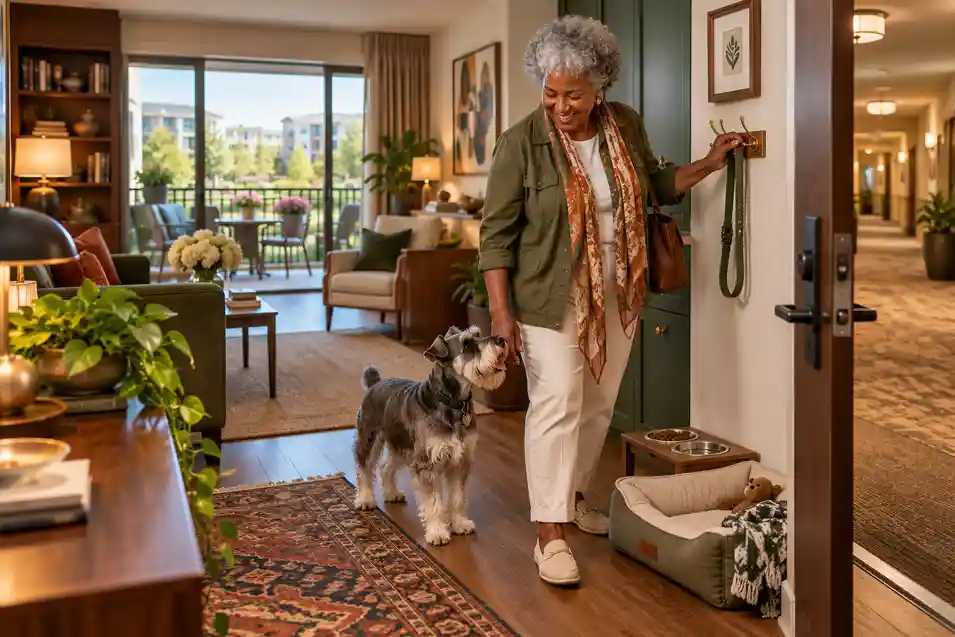
For many people, moving into a retirement community isn’t simply a housing decision.
There’s another member of the household to consider.
The dog who has slept beside your bed for nine years.
The cat who has moved with you three times.
The little terrier who gets you outside every morning.
So one of the first questions may be:
Can my pet come with me?
In the United States, the answer is often maybe.
Some senior living communities welcome residents’ dogs and cats. Others place limits on the number, size or type of pets allowed. Some may permit pets in independent living but have different rules in assisted living, memory care or skilled nursing.
And there isn’t one nationwide pet policy covering senior housing.
Even the term assisted living does not have one standardized definition across the country. States regulate residential care differently, and similar communities may be called assisted living facilities, residential care communities, personal care homes, board-and-care homes or other names depending on where you live.
That makes one rule particularly important:
Don’t wait until you’ve chosen the retirement community to ask about the dog. Make the pet part of choosing the community.
“Senior Living” Can Mean Very Different Things
A major source of confusion is that terms such as retirement community, independent living, assisted living, memory care and nursing home are sometimes used as though they’re different versions of the same thing.
They’re not.
The services provided, residents’ needs, regulatory structure and degree of independence can be very different.
That matters when you have a pet.
As a general framework, it helps to understand the major types of senior living you may encounter.
Independent Living
Independent living is generally the closest to living in a conventional apartment, condominium or residential community.
Residents typically manage their own daily lives while gaining access to conveniences that may include meals, housekeeping, recreation, transportation, maintenance and security.
For someone who can independently feed, exercise, groom and manage an animal, this may offer the greatest flexibility for continuing to live with a pet.
But don’t assume that an independent living community automatically accepts animals.
It may have its own pet rules, fees and restrictions.
Ask before applying or paying a deposit.
Assisted Living
Assisted living generally provides housing along with help with some activities of daily living.
Exactly what services are offered — and what the residence is called — varies by state and facility.
One community may provide relatively light assistance. Another may serve residents with considerably greater care needs.
This is why simply asking whether a place is an “assisted living facility” doesn’t tell you whether your dog or cat can live there.
You need the policy of the actual community you’re considering.
Memory Care
Memory care may operate as its own community or as a specialized area within a larger senior living campus.
Pet ownership can become more complicated because the residence must consider the safety and care needs of the resident, the animal and other people in the community.
That doesn’t mean animals have no place in memory care. Some communities incorporate visiting or resident animals into daily life.
But having animals around is not the same as allowing every resident to keep a personal pet.
If you’re considering memory care for yourself or a family member who has a beloved animal, ask specifically whether personally owned pets can move in and who is expected to provide their daily care.
Nursing Homes and Skilled Nursing Facilities
Nursing homes provide a much higher level of medical and personal care than independent or assisted living.
Residents of Medicare- or Medicaid-certified nursing homes also have federal protections in addition to applicable state laws, including rights involving dignity, participation in care and a safe, comfortable, homelike environment.
But those protections should not be interpreted as a blanket federal right to keep a personal pet.
Whether an individual dog, cat or other animal can live in a particular nursing home needs to be confirmed with that facility.
At this level of care, the practical question becomes especially important:
Who is actually going to care for the animal every day?
Continuing Care Retirement Communities Can Add Another Layer
Some communities offer several levels of housing and care on one campus.
These are commonly known as Continuing Care Retirement Communities, or CCRCs, and may also be described as Life Plan Communities.
A resident might begin in independent living and later move into assisted living or nursing care without leaving the larger community.
That can be attractive to pet owners — but there’s an important question to ask before moving in:
Does the pet policy follow you when your level of care changes?
A dog that is permitted in your independent living apartment may not necessarily be permitted in every other part of the community.
Find that out before you need to make the transition.
Pet-Friendly Doesn’t Always Mean Your Pet Can Move In
This distinction matters enormously.
A senior living community may describe itself as pet-friendly because it offers:
- Therapy-dog visits
- Animal-assisted activities
- A community dog or cat
- Aquariums or birds
- Outdoor animal events
- Pet visitation programs
Those can all be wonderful.
They don’t necessarily mean you can move into your apartment with your own Labrador.
Instead of asking:
“Are you pet-friendly?”
ask:
“Can I move into this community with my own pet?”
Then tell them exactly what you have.
A quiet 11-year-old indoor cat and an energetic 70-pound dog may be treated very differently under the same policy.
Ask About Your Specific Pet
If residents can have pets, find out exactly what the policy allows.
Ask whether there are restrictions involving:
- Dogs
- Cats
- Birds
- Small animals
- Number of pets
- Dog size or weight
- Particular animals
- Behavior
- Vaccinations
- Licensing
- Spaying or neutering
Don’t rely on what happened when somebody else’s father moved into the building five years ago.
Policies change.
Get the current rules from the community you’re actually considering.
Who Is Responsible for Caring for the Pet?
This may be the most important question in the entire discussion.
Suppose your dog is welcome.
Who feeds her?
Who walks her?
Who cleans up after her?
Who takes her to the veterinarian?
Who cleans the cat’s litter box?
Who gives pet medications?
Who handles grooming?
Who takes the dog outside first thing in the morning and again before bed?
Do not assume employees will perform these jobs simply because staff members assist residents with other daily activities.
Pet care may not be included in the services they provide.
Ask specifically what staff will and will not do.
Can You Hire a Dog Walker or Pet Sitter?
This can turn an arrangement that wouldn’t otherwise work into one that does.
Perhaps you can comfortably feed your dog, enjoy having him in your apartment and take him outside for short bathroom breaks, but a two-mile walk is no longer realistic.
Can a professional dog walker come every morning?
Can your daughter collect the dog?
Can a pet sitter access your apartment when you’re away?
Can someone come in to clean the litter box?
Are outside service providers permitted, and what security or sign-in procedures do they need to follow?
Needing help with one part of pet care doesn’t automatically mean you can’t continue living with your animal.
But the community has to permit the solution.
Look at the Community Through Your Dog’s Eyes
Permission is only the beginning.
Suppose the community says your dog can come.
Now ask whether the property actually works for the dog.
How far is your apartment from the nearest exterior door?
Is there an elevator?
Where can the dog relieve himself?
Is there grass nearby?
Is there a fenced dog area?
Are pets allowed in elevators?
Which common areas are off limits?
Can you easily get outside several times every day?
A fourth-floor apartment at the opposite end of a huge building may be perfectly manageable for someone with a cat and surprisingly inconvenient for someone with a dog that needs frequent bathroom breaks.
Climate Matters More Than the Brochure Suggests
Touring a beautiful community on a sunny April afternoon doesn’t tell you what pet ownership will be like year-round.
If you’re in Minnesota, what is the route outside like after a snowstorm?
If you’re in Arizona, where can the dog safely walk during extreme summer heat?
If you’re in Florida, is there covered outdoor access during heavy rain?
If you’re in a region prone to hurricanes, wildfires or other emergencies, how are pets handled during evacuation or sheltering?
Look at the entire route from your apartment to the place where your dog will exercise and relieve himself.
Then imagine doing it on the worst weather day of the year.
Cats Have Different Challenges
Cats eliminate the need for several outdoor trips every day, but that doesn’t mean the arrangement requires no planning.
Where will the litter box go?
Can you comfortably clean it?
Where will bags of litter be stored?
Can litter be delivered?
Where is waste disposed of?
Could someone help clean the box if that eventually becomes difficult?
What happens if the cat scratches doors or flooring?
How will you prevent an indoor cat from escaping when staff enter the apartment?
A calm older cat may adapt beautifully to a smaller home.
The details still matter.
Ask About Deposits, Fees and Damage
Pets may add to the cost of senior living.
Ask whether the community charges:
- A pet deposit
- An additional security or damage deposit
- A one-time pet fee
- Monthly pet rent or fees
- Additional cleaning charges
Also find out what you’re responsible for if your animal damages flooring, doors or other property.
If the community offers pet-related services, ask whether they’re included in the regular monthly cost or charged separately.
Get important financial terms in writing.
Ask Where Your Pet Is Allowed
Permission to keep a dog in your apartment doesn’t necessarily mean the dog can accompany you everywhere.
Ask about:
- Dining rooms
- Lounges
- Activity spaces
- Elevators
- Gardens
- Patios
- Hallways
- Outdoor common areas
- Community transportation
A residence also has to consider people with allergies, fears and other health or safety concerns.
A sensible pet policy has to work for pet owners and their neighbors.
What Happens If Your Pet Becomes a Problem?
Nobody likes imagining their sweet dog becoming the subject of a complaint.
Ask anyway.
What happens after repeated barking?
What if the animal begins having accidents?
What if a dog becomes aggressive?
What about persistent odor?
Damage?
A pet repeatedly getting loose?
An owner becoming unable to provide appropriate care?
Ask what process the community follows and whether residents have an opportunity to correct a problem before an animal has to leave.
You want to understand that policy before moving in, not after a conflict occurs.
What Happens If You Go to the Hospital?
This is where your pet plan and housing plan meet.
If you’re unexpectedly hospitalized for four days, your dog is still in your apartment.
Who takes care of her?
Will staff provide any temporary help?
Can your son enter the apartment?
Can your regular dog walker continue coming?
Does the animal need to leave the community temporarily?
Every pet owner moving into senior housing should have an emergency caregiver who understands the community’s rules.
The same applies if you spend several weeks in rehabilitation or experience another sudden health change.
What Happens If Your Care Needs Increase?
You could move into independent living perfectly capable of caring for your dog.
Five years later, your circumstances may change.
Maybe walking becomes difficult.
Perhaps you require assisted living.
Maybe you eventually need skilled nursing care.
If your community offers multiple levels of care, ask what happens to the pet at each level.
Can the dog move with you?
Does the pet policy change?
Could the dog remain with you if a family member or paid caregiver assumes responsibility for daily pet care?
If the answer eventually becomes no, what would happen to the animal?
These aren’t reasons not to move.
They’re reasons to understand the entire plan before you do.
State Rules and Terminology Differ
Senior housing regulation in the United States isn’t uniform.
A type of residence called “assisted living” in one state may be licensed or categorized differently somewhere else.
The federal Administration for Community Living notes that residential care communities may operate under names including assisted living facilities, board-and-care homes, congregate care, enriched housing and personal care homes, among others.
That means advice written for one state shouldn’t automatically be treated as the rule everywhere.
When researching a community, check the appropriate state agency and the residence itself.
The federal Eldercare Locator can also connect older adults and families with local aging resources and State Units on Aging.
Nursing Homes Are Different Again
Medicare’s Care Compare tool provides information about Medicare- and Medicaid-certified nursing homes, including inspections and other quality information.
It can be useful when researching nursing facilities, but it doesn’t replace a direct conversation about your animal.
If keeping a pet is important, ask the nursing home directly and request its current written policy.
Don’t assume a listing, review or marketing page answers the question.
Service Animals Are a Separate Issue
A trained service animal should not simply be lumped together with an ordinary household pet.
Different legal protections and requirements may apply depending on the type of housing or facility and the circumstances.
Likewise, an emotional support animal is not automatically treated the same as a service animal in every setting.
If your animal assists you because of a disability, don’t rely solely on the facility’s ordinary “pet policy.”
Ask how the community handles service or assistance animals and, if necessary, seek current guidance applicable to your housing situation and state.
Questions to Ask Before Choosing a Community
When touring an independent living, assisted living or other senior community, bring a pet checklist.
Ask:
- Can I bring my existing dog or cat?
- Are there size, species or number restrictions?
- Are there vaccination or licensing requirements?
- Is there a pet deposit or monthly fee?
- Where is my pet allowed in the building?
- Where is the nearest outdoor relief area?
- Is there secure outdoor space?
- Can an outside dog walker or pet sitter enter the community?
- Can family members access my apartment to care for the pet?
- Will staff provide any pet care?
- What happens to my pet if I’m hospitalized?
- What happens if I temporarily cannot walk or feed the animal?
- What behavior could cause my pet to be removed?
- What happens if I need a higher level of care?
- Does the pet policy change elsewhere on the campus?
- What happens during an emergency or evacuation?
- Can I see the complete pet policy in writing?
Then ask yourself one more question:
Would this home still work for both of us on a difficult day?
Don’t Hide the Pet
If a community doesn’t permit your animal, trying to quietly move the pet in is a terrible long-term plan.
You don’t want your housing security — or your pet’s future — dependent on nobody noticing.
Be upfront.
Describe the animal accurately.
Ask questions.
Get the policy in writing.
If the answer doesn’t work for you, explore other communities while you still have the ability to choose.
Start Looking Earlier Than You Think You Need To
This may be the most useful advice in the entire article.
If staying with your pet matters deeply to you, don’t wait until you’re being discharged from a hospital and your family suddenly has a few days to find appropriate housing.
At that point, your choices may be limited.
Research communities while moving is still optional.
Tour them.
Ask about pets.
Compare outdoor access.
Find out what happens if your care needs increase.
Understand the costs.
Meet the staff.
Read the pet policy.
The more important keeping your animal is to you, the earlier that requirement should become part of your housing plan.
Sometimes Your Pet Should Influence Where You Move
And that’s perfectly reasonable.
People choose retirement communities because they want a larger apartment.
They choose them because they’re near their children.
They choose them because they like the food, gardens, activities, location or level of care.
Wanting a home where your dog or cat can continue living with you is another legitimate housing requirement.
For many people, it’s considerably more important than whether the apartment has granite countertops.
The animal may be their closest daily companion.
Have a Backup Plan Even in a Pet-Friendly Community
Finding a residence that welcomes your pet doesn’t eliminate the need for a backup caregiver.
Someone should know:
- Where your pet’s supplies are
- What the animal eats
- Which medications they take
- Who the veterinarian is
- How to access your apartment
- What the community requires
- Where the animal can stay temporarily
- Whether they would take the pet permanently if necessary
A pet-friendly building solves one part of the problem.
It doesn’t solve every future care problem.
The Goal Is to Stay Together — Realistically
Moving into assisted living or a retirement community doesn’t automatically mean saying goodbye to your dog or cat.
For some people, bringing a pet will be entirely possible.
For others, a particular residence, level of care, animal or individual circumstance may make it difficult.
That’s why this question belongs near the beginning of your housing search, not at the end.
Understand what kind of community you’re considering.
Ask for its current pet policy.
Think honestly about who will provide the daily care.
Plan for hospitalization and changing needs.
Look at the property from your pet’s perspective as well as your own.
And if keeping your animal is one of the most important things to you, say so.
Because when you’ve shared your home with an animal for years, choosing your next home isn’t simply about finding somewhere that will accept you.
It’s about finding somewhere that, whenever realistically possible, can still be home to both of you.