You might think you’re visiting a friend’s house alone, but their cat may have a very different opinion. As far as that cat is concerned, you’ve brought a couple of unfamiliar felines along for the visit. They just happen to be invisible.
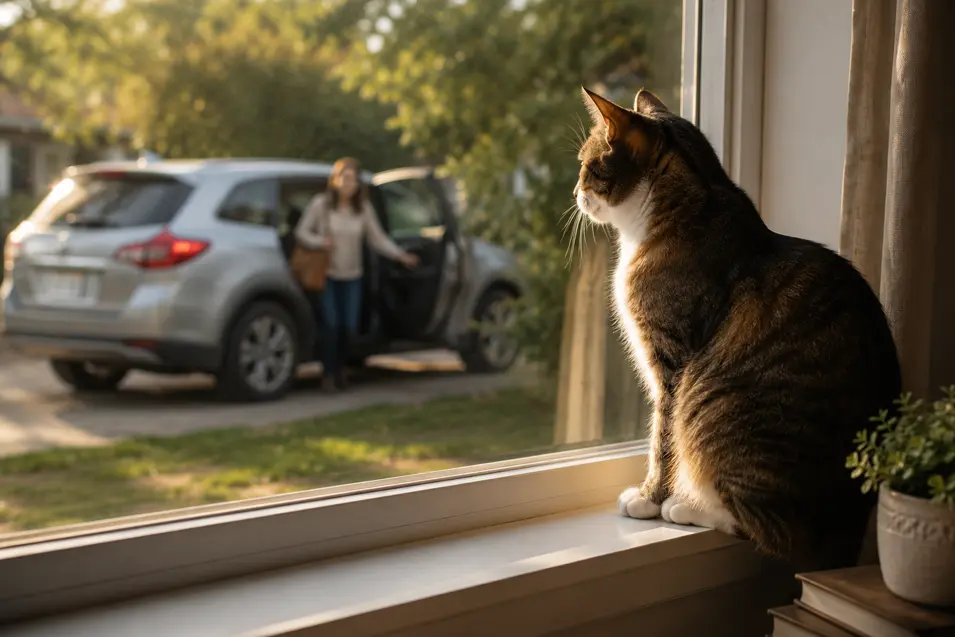
Recently, while I was away, a friend named Amy stopped by to check on my cat, Simba. Amy knows Simba, and under normal circumstances, there’s no reason to expect an unfriendly reception. But this time, Simba hissed at her.
That was unusual. Simba rarely hisses at people. In fact, the only time I normally hear her hiss is when she spots another cat outside the window.
When Amy told me what happened, I immediately wondered whether the explanation was something she couldn’t see. Amy has cats of her own, and Simba may have picked up their scent on her clothing.
Could that really be enough to make a normally friendly cat hiss at someone she already knows?
Absolutely. Cats can detect the scent of other cats on your clothing, shoes, hands, and personal belongings. And depending on the cat, those unfamiliar smells can trigger anything from intense curiosity to territorial behaviour.
How Can Cats Smell Other Cats on Your Clothes?
A cat’s sense of smell is considerably more sensitive than a human’s. While we tend to recognize people primarily by their faces and voices, cats rely heavily on scent to understand their surroundings.
Every cat carries a distinctive combination of odours produced by skin glands, saliva, urine, and other bodily secretions. These scents can transfer onto the surfaces they touch.
If you have cats at home, their scent is probably on more of your belongings than you realize.
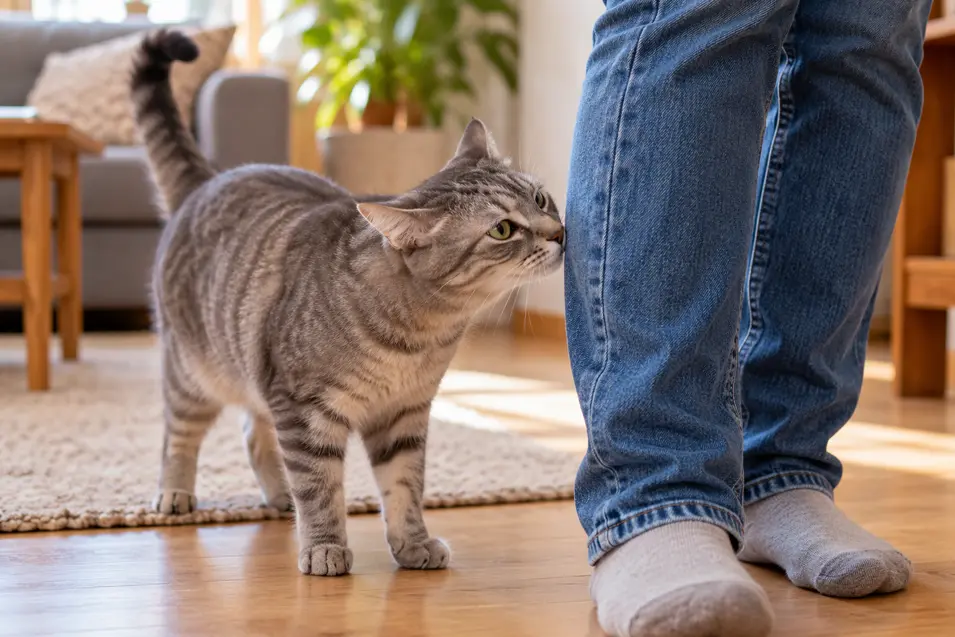
When your cat rubs against your legs, curls up on your sweater, sleeps on your jacket, or brushes against your shoes, scent molecules can be transferred to the fabric.
You might leave the house wearing freshly washed clothes, but after spending a few minutes cuddling your cat, you’ve potentially picked up a scent that another cat can recognize.
And while you won’t notice anything unusual, a cat you visit may find those smells immediately interesting.
Cats also have a specialized sensory structure called the vomeronasal organ, sometimes referred to as Jacobson’s organ. It helps them investigate certain chemical signals, particularly those involved in social and reproductive communication.
You may have seen a cat pause with its mouth slightly open after sniffing something interesting. This behaviour, known as the flehmen response, helps deliver chemical information to that sensory system.
To your nose, your sweater smells like laundry detergent.
To a cat, it may contain an entire collection of clues about where you’ve been and which animals you’ve encountered.
Why Would a Cat Hiss at Someone Who Smells Like Another Cat?
Hissing is generally a defensive warning. It’s a cat’s way of communicating discomfort, fear, or a desire for distance.
It doesn’t necessarily mean the cat is aggressive or intends to attack.
Imagine being comfortable in your home when someone walks through the door carrying the scent of an unfamiliar animal.
You recognize the visitor. You’ve met them before. But there’s something different about them.
For a territorial or cautious cat, that unfamiliar scent may create uncertainty.
Is another cat nearby? Has an unfamiliar animal entered the territory? Is there a potential threat?
The cat doesn’t necessarily understand that the smell came from a perfectly harmless house cat sitting on somebody else’s couch several kilometres away.
It simply detects chemical information associated with another animal.
Some cats will investigate the visitor’s shoes or pant legs. Others may retreat, become unusually alert, or hiss.
A cat can recognize a familiar person and still react defensively to an unfamiliar animal scent that person is carrying.
That distinction helps explain why a cat that normally welcomes visitors might behave differently on a particular day.
Do Cats Know How Many Other Cats You’ve Been Around?
Cats can detect and distinguish many different odours, including those associated with individual animals.
However, that doesn’t mean a cat can reliably determine that you’ve visited exactly two cats, three cats, or an entire household of them.
Scent information is complicated. Odours overlap, change over time, and mix with other environmental smells.
A cat may recognize that another feline has been in contact with your clothing, but we shouldn’t assume it can reconstruct your afternoon with the precision of a detective.
Still, if you’ve been handling several cats, you may carry a mixture of unfamiliar feline scents.
For a sensitive cat, that’s potentially a lot of new information to process.
Are Unspayed or Unneutered Cats More Sensitive to Other Cats’ Smells?
Reproductive hormones can influence feline behaviour, particularly when it comes to mating, territorial activity, and responses to other cats.
Unneutered male cats, for example, may show increased roaming, urine marking, and territorial conflict. Unspayed females may respond differently to scent cues during their reproductive cycles.
However, being unspayed or unneutered doesn’t automatically mean a cat will hiss at visitors who smell like other cats.
Spayed and neutered cats can also be highly territorial, cautious, or sensitive to unfamiliar smells.
Personality, previous experiences, socialization, stress, and the circumstances of the encounter all matter.
In Simba’s case, she isn’t spayed, so hormones are one possible factor to consider. But there’s no way to know whether that influenced her reaction to Amy.
The unfamiliar scent itself may have been enough.
Why Do Some Cats React While Others Don’t?
Anyone who has lived with more than one cat knows that feline personalities can be remarkably different.
One cat might enthusiastically sniff a visitor’s shoes after detecting another cat’s scent.
Another might ignore the smell completely.
A third might decide the visitor has committed an unforgivable offence and retreat beneath the bed.
Several factors can influence the reaction.
Territorial confidence
Cats that feel secure in their surroundings may be more willing to investigate unfamiliar smells without becoming defensive.
Others are more protective of their personal space.
Previous experiences with other cats
A cat that has had frightening or unpleasant encounters with unfamiliar cats may respond more cautiously to feline odours.
Conversely, cats accustomed to living peacefully with other cats may be less troubled by unfamiliar scents, although that isn’t guaranteed.
Stress and changes in routine
Cats often appreciate predictable routines.
If their owner is away, feeding times change, or an unfamiliar person is handling their care, they may already be feeling unsettled.
An unexpected animal scent could add another source of uncertainty.
Individual personality
Some cats are naturally curious and outgoing. Others are cautious and prefer to observe new situations from a distance.
Neither response necessarily indicates a behavioural problem.
Can Your Cat Smell Another Cat After You’ve Washed Your Hands?
Possibly.
Washing your hands with soap and water can remove much of the scent and physical residue transferred through direct contact with another cat.
But washing your hands doesn’t remove odours from your sweater, pants, jacket, shoes, or bag.
If another cat has been rubbing against your legs, the scent may remain on your clothing even after you’ve thoroughly washed your hands.
How long it remains detectable depends on the material, the amount of scent transferred, washing, ventilation, and other conditions.
There isn’t a reliable universal rule saying another cat’s scent disappears from clothing after a specific number of hours.
And remember, cats can detect odours that humans cannot.
Just because your clothes smell perfectly normal to you doesn’t mean they smell familiar to a cat.
How to Visit Someone’s Cat When You Have Cats at Home
If you’re visiting a friend who has a particularly territorial or nervous cat, a few simple precautions may help make the encounter more comfortable.
Wash your hands before visiting. This is especially useful if you’ve recently been petting or handling your own cats.
Consider changing your clothing. If your cats have been sleeping on your sweater or rubbing against your pants, wearing freshly laundered clothing may reduce the amount of unfamiliar scent you bring.
Pay attention to your shoes and belongings. Cats often investigate shoes, bags, and jackets because they carry interesting outdoor and household smells.
Let the resident cat approach you. Avoid immediately reaching down to pet a cat that seems uncertain or uncomfortable.
Don’t force an introduction. If the cat hisses, backs away, or hides, give it space.
Allow time for investigation. A curious cat may simply need a few minutes to sniff and decide that everything is fine.
Most importantly, don’t punish a cat for hissing.
Hissing is communication. Punishing the behaviour can increase fear or stress without addressing whatever made the cat uncomfortable in the first place.
And if you’ve been around a cat that is sick or may have a contagious infection, take appropriate hygiene precautions. Changing clothes and washing your hands can help reduce the risk of carrying infectious material between households, although the precautions needed depend on the illness.
What If Your Cat Suddenly Starts Hissing at Everyone?
An occasional hiss at a visitor carrying an unfamiliar scent is not necessarily cause for alarm.
But sudden or persistent behavioural changes deserve attention.
If your normally friendly cat begins hissing frequently, hiding, refusing interaction, or reacting aggressively to familiar people, don’t automatically assume another animal’s scent is responsible.
Pain, illness, sensory changes, and other medical problems can also cause cats to become unusually defensive.
Pay particular attention to changes in appetite, litter box habits, mobility, grooming, or activity.
If the behaviour is new, persistent, or accompanied by other symptoms, arrange a veterinary examination.
Cats are very good at hiding discomfort, and a change in temperament can sometimes be one of the first noticeable signs that something is wrong.
So, Did Simba Really Smell Amy’s Cats?
We can’t know for certain.
Amy has cats of her own. Simba normally recognizes her and doesn’t hiss at her. And Simba has a history of reacting defensively when she sees unfamiliar cats outside.
That makes scent a plausible explanation.
Perhaps Amy had been cuddling one of her cats before coming over. Maybe a cat had rubbed against her pants, or she’d picked up scent on her shoes.
Simba may have detected something that simply didn’t belong in her familiar environment.
Of course, there are other possibilities. My being away, a change in routine, or something else about the visit could have contributed.
But the experience illustrates something fascinating about living with cats.
We experience the world largely through what we see. Cats experience an enormous amount of it through what they smell.
So the next time you visit a friend and their normally affectionate cat suddenly gives you a suspicious stare, don’t take it personally.
You might be perfectly welcome.
It’s the invisible cats you brought with you that are causing the trouble.