
That charming little pet boutique might not be what it appears to be. Here’s how to investigate an unfamiliar online retailer, recognize warning signs and protect your money.
Online shopping has made life wonderfully convenient for pet owners. Need a new dog bed? A scratching post? A fancy collar? A ridiculous little sweater your dog will probably hate? A few clicks and it’s on its way.
But there’s another side to online shopping that’s becoming increasingly difficult to ignore.
Some websites present themselves as established, family-owned neighbourhood businesses, complete with beautiful storefront photographs, touching stories about their founders and glowing customer testimonials.
The problem?
Sometimes the story is much easier to find than the actual business.
And with modern website-building tools, stock photography and artificial intelligence, creating the appearance of a trustworthy retailer has never been easier.
So how do you know whether you’re dealing with a genuine pet shop, an ordinary online reseller or a business deliberately misrepresenting itself?
As it turns out, I recently spent an extraordinary amount of time trying to answer that very question.
And it all started with a laundry basket.
Why Am I Writing This Article? It Started With a Dog Laundry Basket
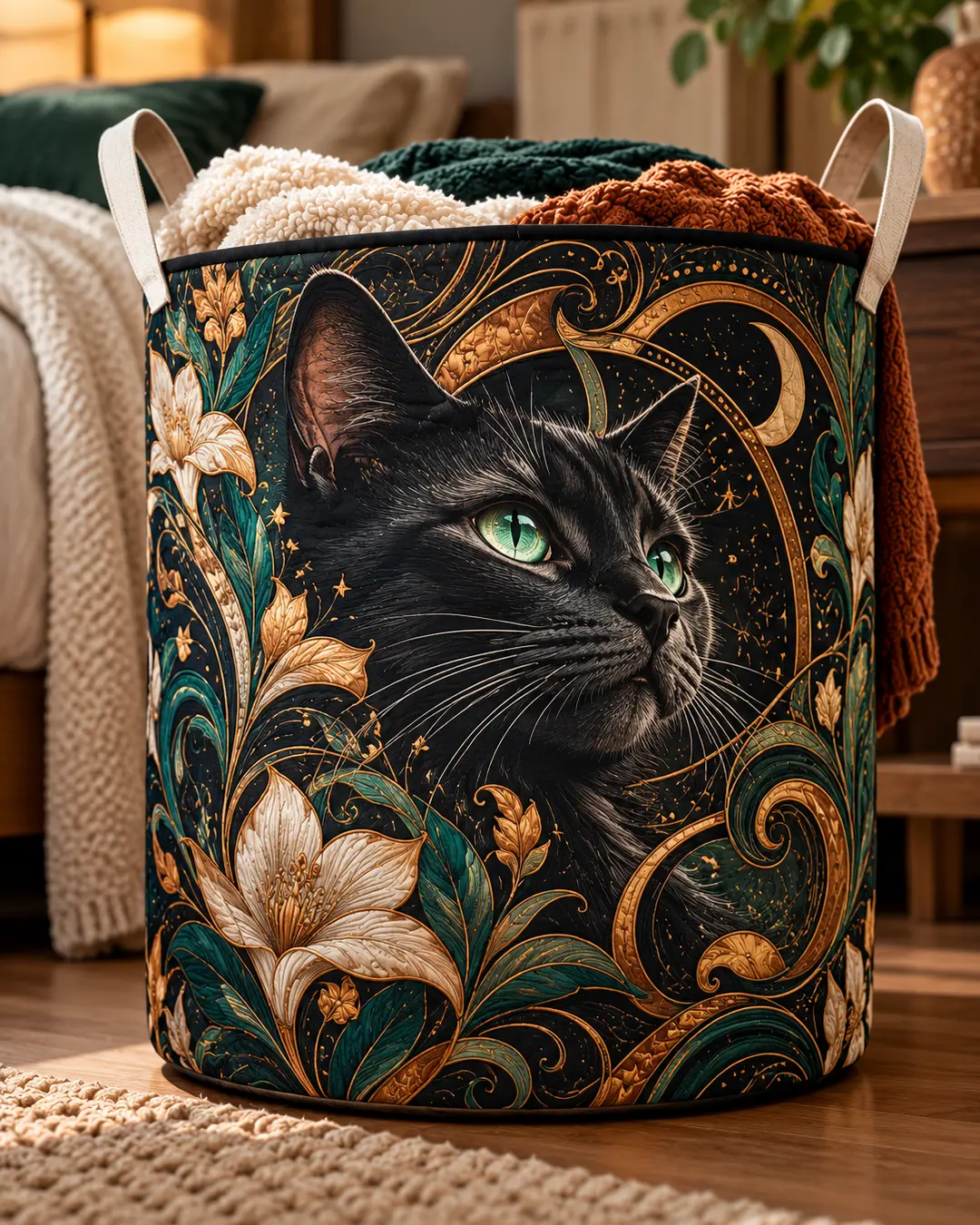
This basket is fake. We created this entire image using artificial intelligence in just seconds. The basket has never been manufactured, photographed, or offered for sale. Yet it looks like a genuine product in a beautiful home. That’s the point: a convincing product photo doesn’t prove the product actually exists.
I wasn’t investigating online shopping scams.
I wasn’t researching consumer protection or planning an article about questionable retailers.
I simply saw a really cool laundry basket featuring dogs.
I liked it.
The product appeared on a website presenting itself as a local boutique in Calgary, Alberta, where I live.
Naturally, I was curious. I like supporting local businesses, and I wanted to know a little more about the company.
According to its website, the business had been around for nine years.
Wonderful. An established local retailer.
Except something didn’t feel quite right.
I couldn’t find a physical address. I couldn’t find an established social media presence. I couldn’t find much independent evidence that the business had ever operated in Calgary.
So I checked the website’s domain registration.
The domain had been registered approximately four months earlier.
Now, that alone doesn’t prove anything. An established retailer might launch a new website or change its domain name.
But a company claiming nine years in business should generally have some kind of history beyond the claims on its own website.
I kept digging.
The more I investigated, the more questions I had. I found other online boutiques with similarly polished presentations, impressive claims about their histories and surprisingly little independent evidence to support them.
I also discovered that the same products appeared across websites presenting themselves as unrelated businesses.
That doesn’t automatically mean they’re fraudulent. Retailers frequently sell products from the same wholesalers.
But when identical merchandise, remarkably similar business stories, questionable testimonials and unverifiable storefronts start appearing together, it’s worth asking more questions.
I’m a web developer. I understand search engines, digital marketing and artificial intelligence. I also have access to tools that help me investigate website histories and online business claims.
Most people don’t approach shopping that way.
They see something they like, read a few reassuring reviews and pull out their credit card.
And why shouldn’t they?
Buying a laundry basket shouldn’t require becoming a private investigator.
Our findings have raised enough concerns that we intend to report the relevant websites to Shopify and share the documented evidence with local news organizations.
In the meantime, I thought it might be more useful to explain how ordinary shoppers can recognize the warning signs themselves.
1. The Beautiful Boutique That Might Not Exist
You’ve probably seen these websites.
There’s a gorgeous storefront with warm lighting, expensive displays and perhaps a beautiful city landmark visible through the window.
The company has a charming name. The owners are smiling. Everything looks welcoming, established and trustworthy.
Sometimes there’s a mother and daughter who supposedly built the business together. Sometimes it’s a husband and wife retiring after 25 wonderful years. Other times it’s a family boutique closing its doors with a heartbreaking farewell sale.
The photographs look like something from an interior design magazine.
But where is the store?
If a website claims to operate a physical boutique, look for its street address.
Not just “Calgary, Canada” or “Proudly serving Toronto.”
An actual address.
Then check Google Maps and Street View.
Does the building exist? Does the storefront match the photographs? Is the address a shopping district, a residential house, an office building or something else entirely?
A genuine home-based pet business may have excellent reasons not to publish its residential address. That’s very different from a company displaying photographs of an elaborate retail storefront while refusing to identify where that storefront is located.
And if every supposedly independent little boutique seems to have a spectacular view of the Calgary Tower, the CN Tower or the Sydney Opera House, perhaps it’s time to question the real estate.
A beautiful photograph is not proof that a business exists at that location.
2. The About Us Page: A Wonderful Story, But Is It True?
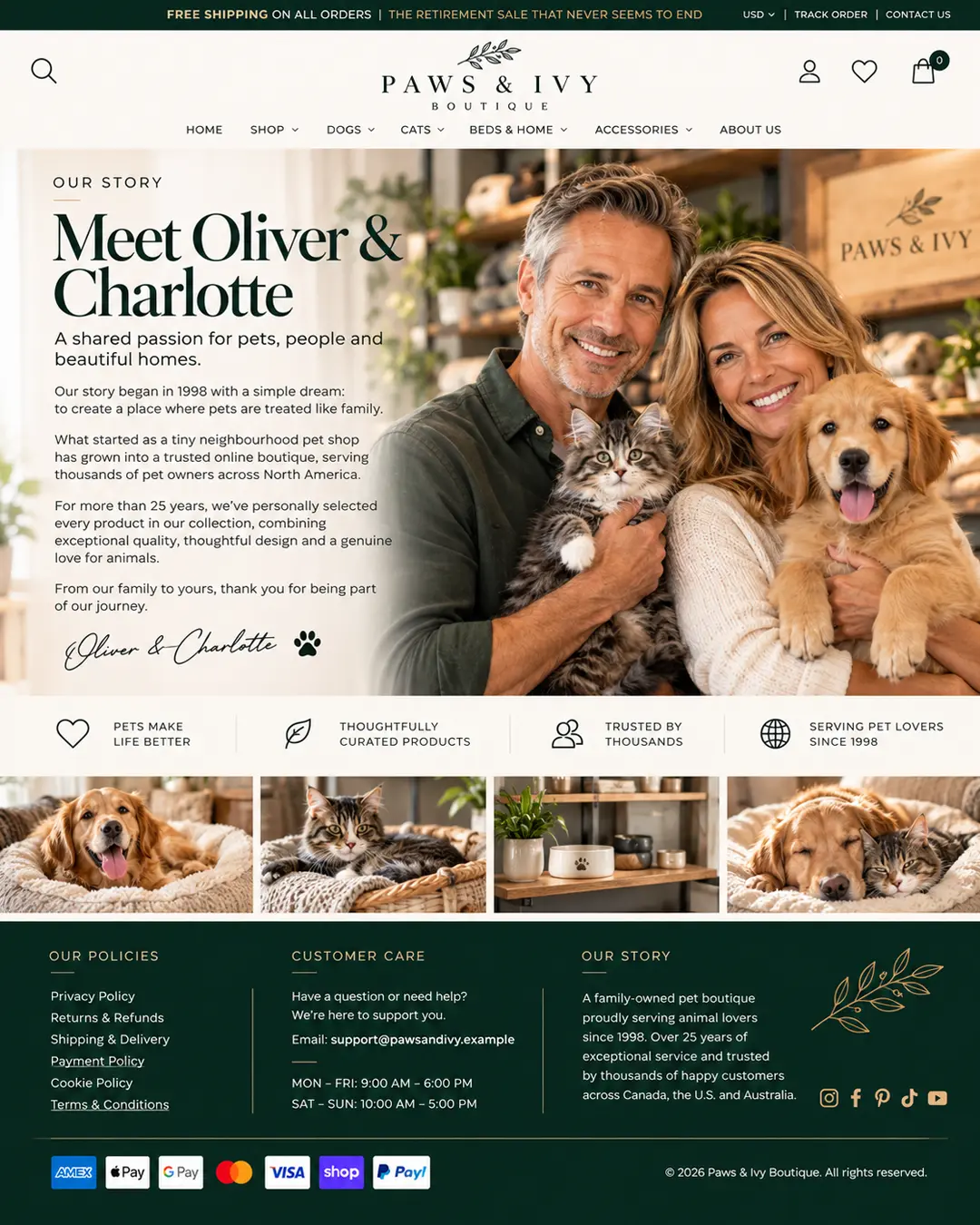
I love a good family-business story.
A couple starts selling handmade pet accessories from their garage. Their children help package orders after school. Twenty years later, they’re operating a successful shop.
Wonderful.
But if a company claims decades of history, there should usually be some evidence of it.
Look for old customer reviews, newspaper mentions, business listings, community events, archived websites or an established social media presence.
You can also investigate when the website’s domain was registered using a service such as WHOIS.
Remember, a newly registered domain doesn’t automatically mean a new business. But it gives you another piece of information to compare against the company’s story.
For example, a business claiming to have operated since 2005 might reasonably have launched a new website in 2026.
But if there’s no evidence of the business before 2026, that’s a question worth asking.
The Wayback Machine is another useful resource. It stores historical snapshots of many websites, allowing you to see how a site appeared in previous years.
Not every website is archived, so an absence of records isn’t proof of wrongdoing.
But sometimes an archived page reveals a very different story from the one being told today.
If the story is so good you wish it were your own, enjoy reading it. Just don’t assume it’s true without checking.
3. Are Those Customer Reviews Real?
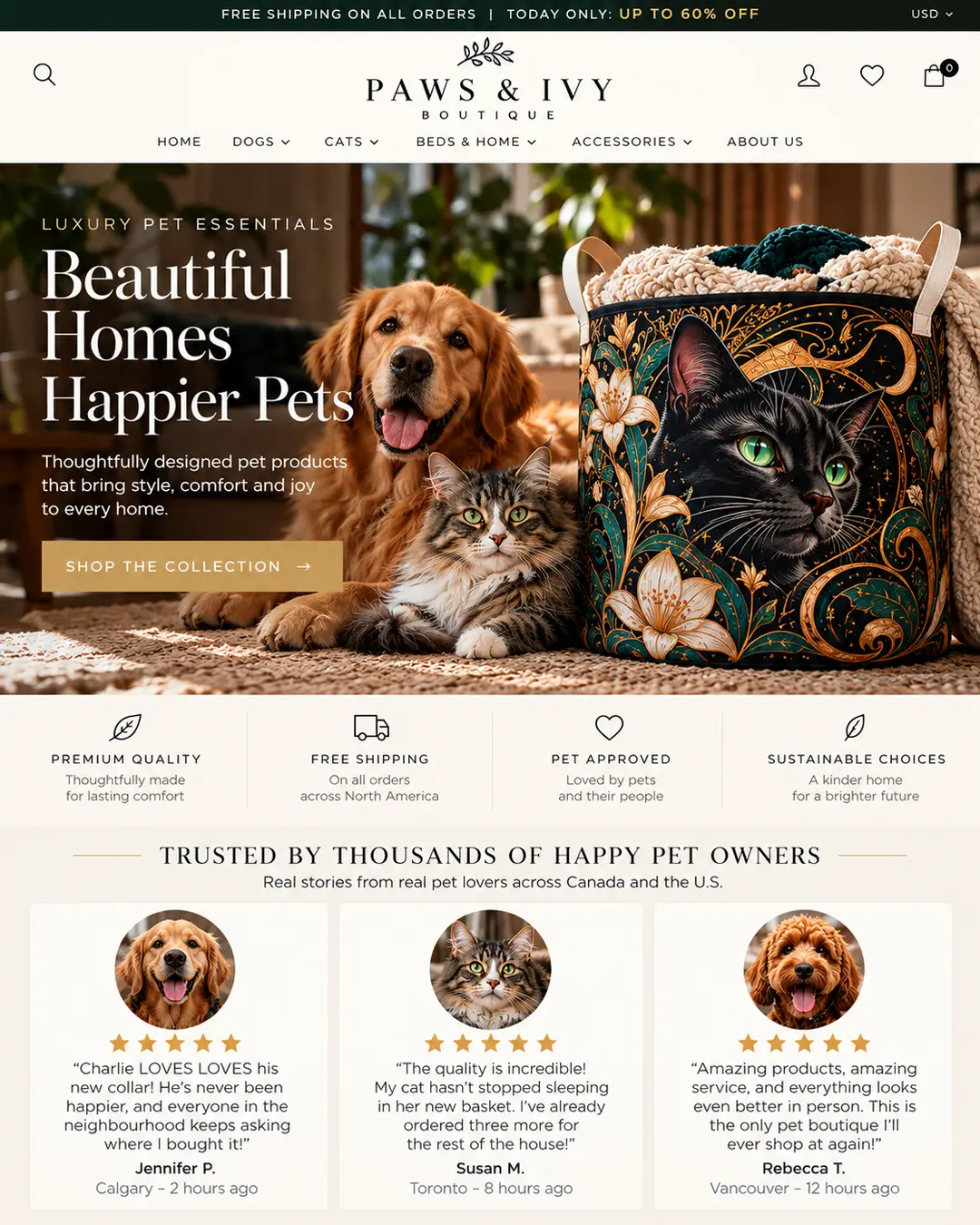
These customer testimonials are fake. We created the five-star reviews, customer names, pet photos, and glowing recommendations using artificial intelligence in minutes. Charlie never received a new collar, and Jennifer, Susan, and Rebecca aren’t real customers. That’s the point: convincing testimonials and happy customer photos don’t prove anyone actually purchased a product.
Customer testimonials are one of the easiest ways to make a website appear trustworthy.
You’ll see statements such as:
“Absolutely wonderful service!”
“My favourite boutique!”
“Beautiful products and incredibly fast shipping!”
And perhaps a photograph of a smiling customer.
But who wrote those reviews?
Are they independently verifiable?
During my investigation, I encountered websites displaying testimonials with labels suggesting they had been posted just a few hours earlier.
The interesting part was that some of those labels were part of static graphics rather than functioning, independently updated review systems.
A review that says “2 hours ago” isn’t particularly convincing if it’s still saying “2 hours ago” next week.
Start with Trustpilot and search for the company’s name and website address.
Don’t rely solely on a Trustpilot logo or a claimed five-star rating displayed on the retailer’s own website. Visit Trustpilot itself.
Look at the actual reviews. Pay attention to repeated complaints about product quality, delivery times, refund difficulties and customer service.
The Better Business Bureau is another place to check for business information and complaints, particularly in Canada and the United States.
Google reviews can also be helpful, especially for businesses claiming to have physical storefronts.
No reviews doesn’t automatically mean a company is dishonest. Every legitimate new business starts somewhere.
But a website claiming 20,000 delighted customers while having virtually no independent customer feedback deserves closer examination.
4. Where’s the Phone Number? Can You Speak to a Real Person?
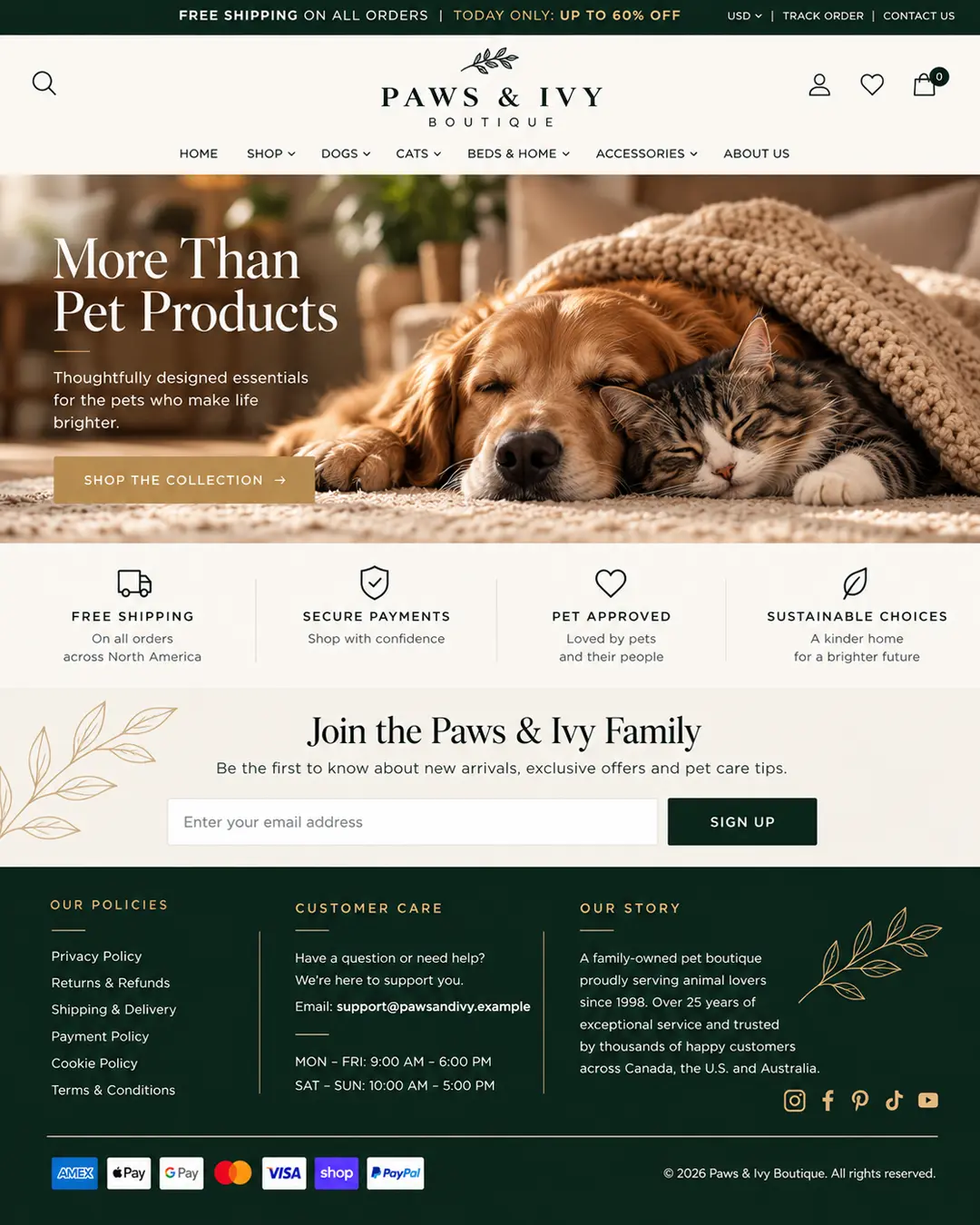
Looks legitimate, doesn’t it? This entire website is fictional. We invented the company, its history, customer testimonials and contact information. The professional-looking footer, reassuring policies and claims of decades in business were all created in minutes. None of these details independently proves a business is genuine.
Here’s a simple question.
If a company claims to have operated a family-owned pet store for 15 years, why can’t you find a telephone number?
Many questionable online retailers provide nothing more than an email address or contact form.
You can send a message, but there’s no obvious way to speak directly with anyone.
Now, someone making handmade dog collars from their kitchen table might not want strangers calling during dinner. That’s perfectly reasonable.
But a supposedly established retail store with thousands of happy customers?
You should reasonably expect some way to speak with a representative.
If there’s no telephone number, email the company and ask for one. Explain that you’d like to speak with someone before placing an order.
If they provide a number, call it.
Ask about the products, the company’s location, its shipping arrangements and whether you can visit the store.
Reaching an outsourced call centre isn’t automatically suspicious. Many legitimate companies use overseas customer support.
But if the representative cannot answer basic questions about the supposedly family-owned boutique, doesn’t know where the store is or cannot explain the return policy, that’s another reason to investigate.
If a company is eager to take your money but unwilling to let you speak to a human being, perhaps your credit card should stay in your wallet.
5. Search the Product Photograph Before You Buy
Here’s a particularly useful trick.
Find the photograph of the product you’re considering and search for it using Google Lens.
You may discover that the supposedly exclusive handmade dog bed is available from several other retailers.
Perhaps the same photograph appears on a wholesale marketplace.
Maybe the $89 pet accessory is being sold elsewhere for $19.
This doesn’t automatically mean the retailer is doing anything dishonest. Reselling products is a perfectly legitimate business model.
But there’s a difference between selling a product sourced from a manufacturer and claiming that your family lovingly handcrafts every item in a workshop behind the store.
If the product is advertised as handmade, exclusive or locally manufactured, the retailer should be able to explain where and how it’s made.
And don’t forget to compare the actual specifications. Products that look identical in photographs aren’t necessarily identical in quality.
6. Look Beyond the Pretty Pictures
Artificial intelligence can now produce remarkably convincing photographs.
A fictional boutique can have a beautiful interior, perfectly arranged shelves, smiling owners and even a sentimental slogan painted on the wall.
You may see phrases like “Good Style, Brighter Days” decorating a supposedly charming neighbourhood store.
None of that proves a photograph was AI-generated.
But it raises a useful question:
Can you find independent evidence that the people and places in those photographs are real?
Look for pictures of actual events, tagged customer photographs, community involvement and a history of social media posts.
Does the business participate in local markets?
Has it sponsored an animal shelter fundraiser?
Are there photographs of customers visiting the store?
Do other local organizations mention it?
A business doesn’t need to have a massive online following to be legitimate.
But a retailer claiming decades of community involvement should generally have something more than a handful of glamorous promotional photographs.
7. Check Social Media — and How Far Back It Goes
A Facebook or Instagram icon at the bottom of a website means very little by itself.
Click it.
Does the link work?
Does the business have an active account?
How old are the posts?
Are customers commenting and interacting?
Are there genuine photographs of the store, staff and products?
A new social media account doesn’t prove a company is new. Plenty of established businesses joined social media late.
But if a company claims to have been a beloved neighbourhood institution for 30 years and its entire online presence appeared three weeks ago, that’s worth investigating.
And if the social media links don’t work at all, don’t simply ignore it.
Ask why.
8. Search for Identical Wording on Other Websites
This was one of the most revealing techniques during my own investigation.
Instead of searching only for the company’s name, I started searching for unusual phrases from its website.
An oddly worded sentence in the footer.
A distinctive statement about customer service.
A particular passage from the About Us page.
Put the exact phrase in quotation marks when searching Google.
You might discover that the same wording appears on numerous apparently unrelated websites.
Now, many legitimate businesses use common ecommerce templates and standard policy language. Identical wording alone doesn’t establish that sites share an owner or are dishonest.
But when several supposedly independent family boutiques use the same unusual descriptions, similar retirement stories and matching marketing language, the pattern becomes interesting.
It can also help you discover other websites worth investigating.
Sometimes the most revealing part of a beautiful website is the tiny print at the bottom.
9. The Retirement Sale That Never Seems to End
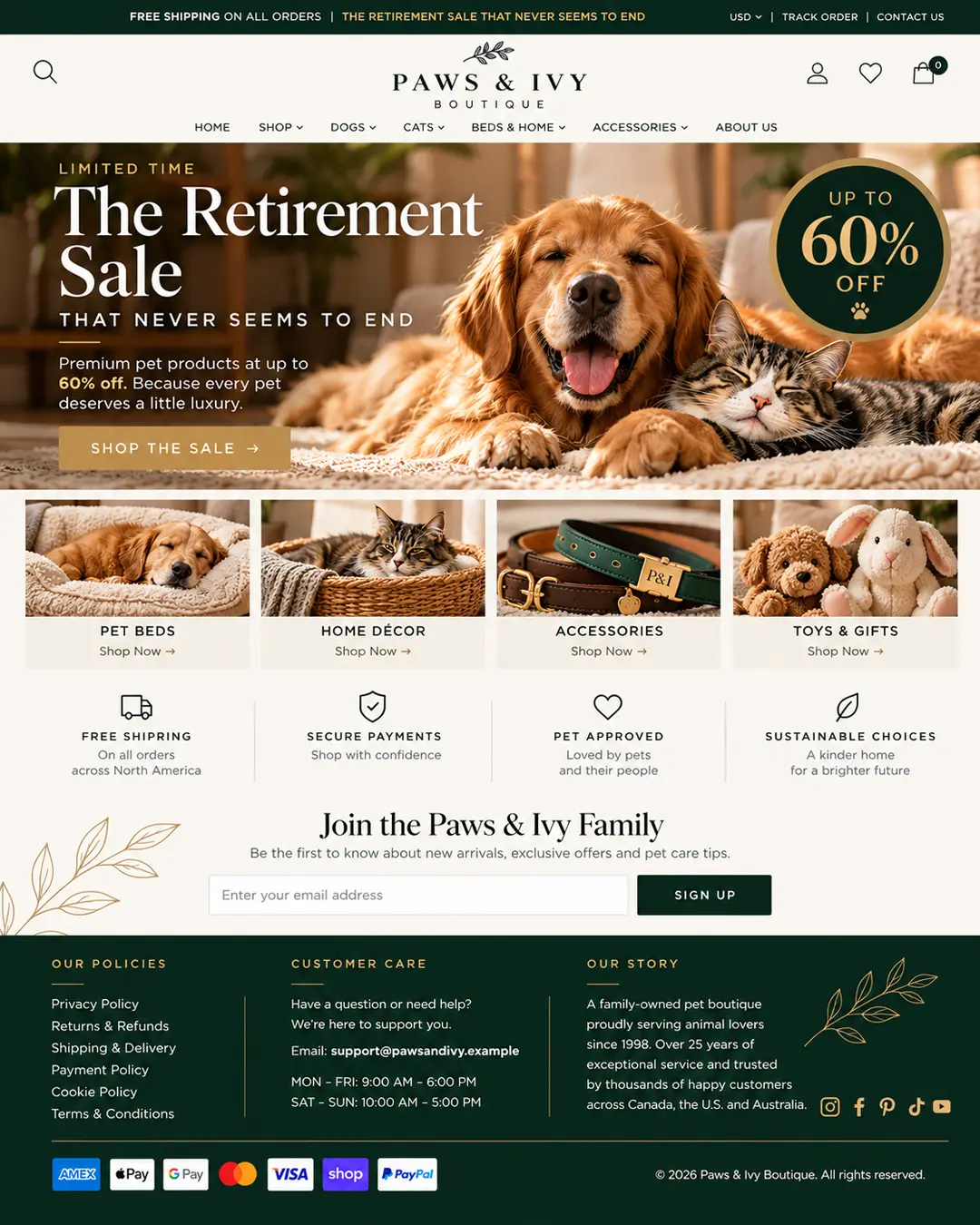
Who doesn’t love a sale?
Especially when the owners are supposedly retiring after decades of serving the community.
Everything must go!
Seventy percent off!
Last chance!
The problem is that emotional stories and urgent discounts can discourage shoppers from asking sensible questions.
Before rushing to buy, check whether the company has an independently verifiable history.
Is the closing sale mentioned by local news outlets or community organizations?
Does the business have a physical location?
Are the prices genuinely discounted, or is the original price simply an inflated number?
And if the countdown clock resets every time you revisit the website, that should tell you something about the urgency.
A genuine retirement sale can be a wonderful opportunity to support a longtime retailer.
A manufactured retirement story is something else entirely.
10. Where Is Your Order Actually Coming From?
A website might have a Canadian city in its name and display Canadian flags, familiar landmarks or references to local service.
That doesn’t necessarily mean its products are stocked or shipped from Canada.
Before ordering, find out where the merchandise is coming from.
Look at the shipping policy.
Does it explain processing times, estimated delivery dates and potential customs charges?
Does the company identify whether products ship domestically or internationally?
Long shipping times aren’t automatically suspicious. Many legitimate small retailers make products to order or source merchandise internationally.
But customers deserve accurate information about what they’re buying and when they can reasonably expect to receive it.
A company shouldn’t create the impression that you’re buying something from a local shop if the actual fulfilment arrangements are materially different and undisclosed.
11. The 10% Refund Game: When Returning an Item Becomes Another Gamble
This is where online shopping can become particularly frustrating.
You order something from what appears to be a local boutique.
The item finally arrives.
Unfortunately, it looks nothing like the photograph, the quality is disappointing or the size is completely wrong.
You contact customer service and ask for a refund.
They respond with an offer.
How about a 10% refund if you keep the product?
You decline.
Perhaps they offer 20%.
You still want your money back.
Then you discover that you must pay to ship the item back, potentially to another country.
Now you’re looking at another $20 or $30 in shipping costs.
And you start wondering:
What if I send it back and they say it never arrived?
What if they refuse the refund?
Am I about to lose even more money trying to recover what I’ve already spent?
Those alarm bells are going off for a reason.
You’re no longer deciding whether you like the product.
You’re deciding whether to gamble more money on getting your original payment returned.
That’s why it’s important to read the return policy before buying.
Find out who pays return shipping, where returns must be sent, whether restocking fees apply and what conditions must be met for a refund.
If the product was misrepresented or never delivered as promised, contact your credit card issuer to ask about dispute or chargeback options before spending more money on a return. Keep photographs, receipts, order confirmations and correspondence.
A return policy that technically offers refunds isn’t much comfort if exercising that right is impractical or prohibitively expensive.
And if you ultimately end up with a useless product and no refund, you might as well have donated the money to your local animal shelter.
At least somebody deserving would have benefited.
12. What About Website Traffic and Search History?
For people who want to investigate a little further, tools such as Ahrefs and Semrush can provide estimates of a website’s organic search traffic.
These tools aren’t necessary for ordinary shoppers, and their estimates have limitations.
They generally do not show all website visitors, including every person arriving through advertisements, social media or direct links.
But they can sometimes help put extraordinary marketing claims into perspective.
If a website claims enormous popularity yet has virtually no visible search history, very few independent mentions and no meaningful online footprint, it’s reasonable to ask how those claims can be verified.
Again, no single metric proves dishonesty.
It’s the combination of warning signs that matters.
13. Don’t Forget About the Small, Honest Businesses
Before anyone starts assuming that every online pet retailer without a storefront is suspicious, there’s something important to remember.
Many wonderful pet businesses operate from people’s homes.
Someone might make beautiful dog collars in a spare bedroom, bake specialty pet treats in an approved kitchen or sell handmade cat toys at weekend markets.
They might have a basic website, a modest social media following and no public telephone number.
There’s nothing inherently wrong with any of that.
In fact, these are exactly the sorts of small businesses worth supporting.
The distinction is honesty.
A person who says, “I make these collars at home and ship them myself,” is telling you what the business actually is.
A website claiming to be a 25-year-old luxury boutique with a magnificent downtown storefront should be able to support that story.
Being small isn’t suspicious. Pretending to be something you’re not is the problem.
14. What Should You Do If You’ve Already Ordered?
If you’ve purchased from an unfamiliar retailer and now have concerns, don’t panic, but don’t ignore the problem either.
Start by saving your documentation.
Take screenshots of the product listing, advertised claims, return policy and order confirmation. Keep emails, tracking information and photographs of anything delivered.
Contact the merchant in writing and clearly explain the problem and the resolution you’re requesting.
If the item never arrives, is materially different from its description or the company refuses to address the issue, contact your payment provider promptly to ask about buyer protection and dispute deadlines.
You can also report potentially deceptive business practices to the appropriate consumer protection authorities.
In Canada, the Canadian Anti-Fraud Centre accepts fraud reports, while provincial consumer protection agencies may handle misleading business practices.
In the United States, consumers can report suspected fraud to the Federal Trade Commission.
If the merchant operates on Shopify, you can also use Shopify’s reporting channels to flag concerns about the store.
Remember that reporting a business doesn’t automatically establish that it has committed fraud. Provide accurate, documented information and let the appropriate organizations investigate.
15. A Five-Minute Check Before You Pull Out Your Credit Card
You don’t need to be a web developer to do a little investigating.
Before ordering from an unfamiliar pet retailer, spend a few minutes checking the basics.
- Search the business name and website address. Look for independent reviews, complaints and customer experiences.
- Check the address. If the company claims to have a physical store, can you verify its location?
- Look for a telephone number. If none is listed, ask whether you can speak with someone before ordering.
- Check the business history. Do its claims about years in operation match what you can independently find?
- Use Google Lens. See whether identical product photographs appear elsewhere.
- Read the shipping and return policies. Find out where the product ships from and where it must be returned.
- Check social media. Look beyond the follower count for genuine history and interaction.
- Be wary of emotional urgency. A touching retirement story and a massive discount shouldn’t prevent you from asking questions.
And perhaps most importantly, pay attention when something doesn’t feel right.
Your instincts aren’t evidence that a company is dishonest.
But they’re a perfectly good reason to investigate before spending your money.
16. Maybe Shopping Local Isn’t Such a Bad Idea After All
There’s something to be said for walking into a real store, meeting the people behind the counter and actually seeing what you’re buying.
You might discover that Agnes has been running the neighbourhood pet shop for nearly 50 years.
Her son is a doctor.
In fact, he saw your mother just last week.
That’s the wonderful thing about shopping local.
Sometimes you walk in looking for a dog collar and leave knowing a little more about the people who make your community special.
These are businesses built on relationships, reputations and decades of serving their neighbours.
Their histories aren’t invented for an About Us page. They’re written in the memories of customers who’ve walked through their doors.
Local businesses employ people, contribute to their communities, support events and build relationships that can last generations.
And when something goes wrong, there’s often a real person you can speak with.
Now, I’m not suggesting you should stop shopping online.
There are thousands of excellent online retailers, including small home-based businesses doing wonderful work.
But the next time you’re tempted by a beautiful website claiming to be a charming boutique in your hometown, consider visiting an actual local shop instead.
You might pay a few dollars more.
You might also receive better advice, meet some interesting people and discover that Agnes knows half your family.
And speaking of Agnes, I want to end with a personal note.
To Agnes at Grande Prairie Pet Shop:
I bought my first fish, my first hamster and my first guinea pig from you when I was growing up.
My mother has been shopping with you for more than 50 years. And even recently, my niece was buying frozen mice from your store for her son’s corn snake.
Nearly half a century after I bought that first fish, I had the pleasure of stopping by and seeing you on your very last day in business.
Thank you for all those wonderful years.
Enjoy your retirement, Agnes!
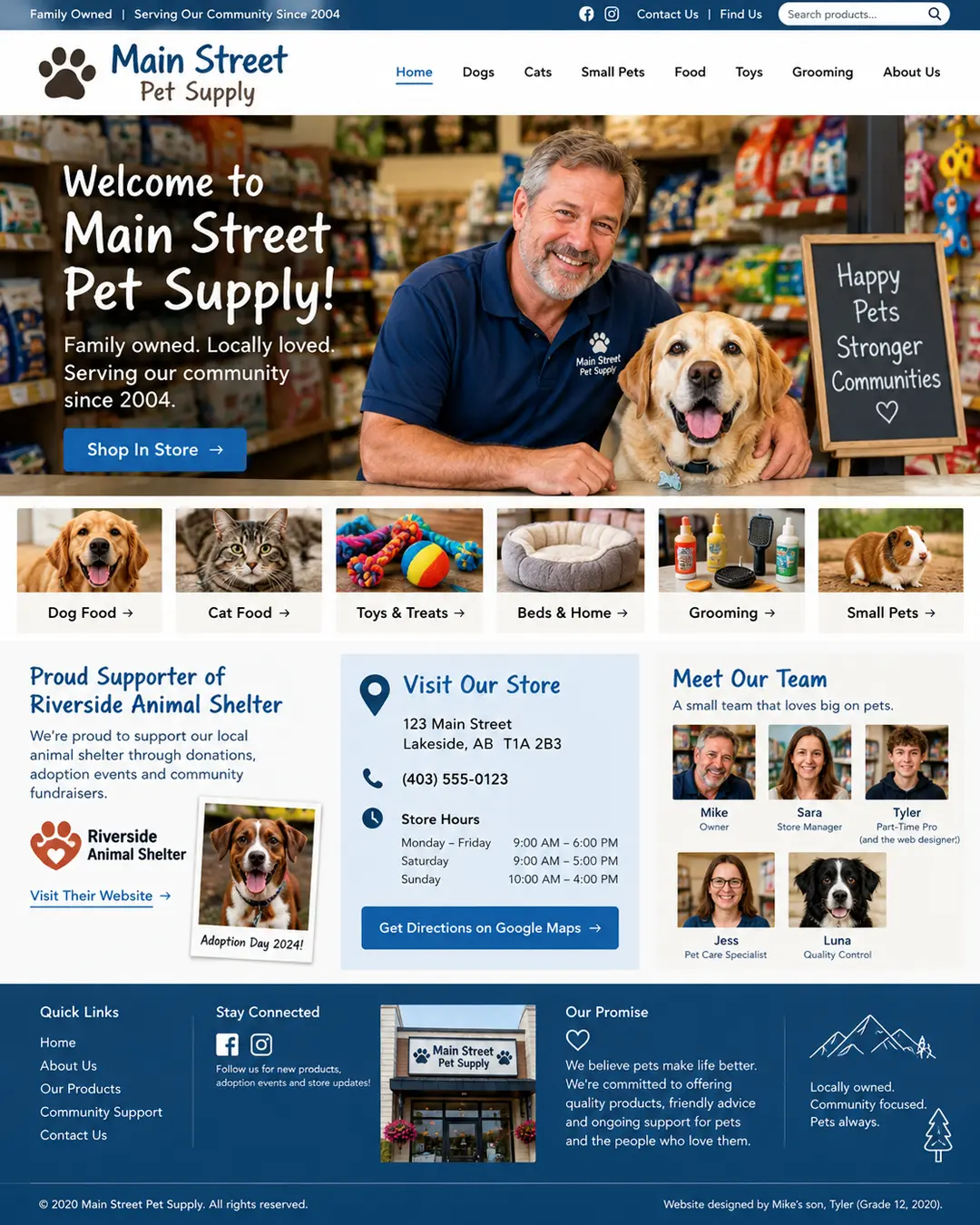
The internet has given us access to an incredible variety of pet products and independent retailers.
That’s something worth celebrating.
But it’s also made it possible to create the appearance of a longstanding, beloved neighbourhood business in a remarkably short period of time.
A beautiful website can be built in days.
A convincing family history can be written in minutes.
A storefront photograph can be generated almost instantly.
But a genuine reputation takes time.
Real businesses often have stories they’re proud to tell, customers who remember them and communities that know who they are.
That’s not something you can manufacture simply by adding a photograph and a few glowing testimonials to a website.
So enjoy shopping online. Discover new products. Support independent makers. Find that ridiculous dog-themed laundry basket you never knew you needed.
Just remember to ask a few questions before handing over your credit card.
Because pretty pictures can sell you a product.
They shouldn’t be the only thing selling you a company’s credibility.