For many people, aging in place means staying in the home they know for as long as possible. When you share that home with a dog or cat, however, there is another part of the equation: the house needs to continue working for your pet, too.
The interesting thing is that many of the changes that make a home easier and safer for an older adult also make it better for an aging pet.
Slippery floors can become difficult for both of you. Stairs that once required no thought can become challenging. Bending down to fill a water bowl or clean a litter box may become uncomfortable. Bathing a large dog can become physically demanding. Even a poorly placed pet bed can turn into a nighttime trip hazard.
A genuinely pet-friendly aging-in-place home isn’t filled with special equipment. It is simply designed around how you and your pet actually live — and how those needs may change.
Start With the Way You Move Through the House
Before buying anything, walk through your normal day.
Where does your dog sleep? Where are the food and water bowls? Which door do you use for bathroom breaks? Do you have to go downstairs to clean the litter box? Where are leashes, food, medications and grooming supplies stored?
Then consider what happens if either of you becomes less mobile.
A good aging-in-place plan reduces unnecessary bending, lifting, carrying, climbing and navigating around obstacles. It also makes the important parts of your pet’s routine easier to reach.
The goal isn’t to design around the worst possible future. It is to remove small frustrations before they become large ones.
Choose Flooring That Gives Everyone Traction
Beautiful polished floors can become surprisingly difficult as people and pets age.
Older dogs may struggle to get their feet underneath them on slick hardwood, laminate or tile. Cats can also become less confident jumping down onto slippery surfaces.
For people, the same flooring can increase the consequences of a stumble or fall.
Replacing every floor usually isn’t necessary. Instead, identify the routes everyone uses most frequently.
A secure runner through a hallway or between your dog’s bed and the back door can provide traction without covering the entire house. Area rugs can help in living rooms and bedrooms.
The important word is secure.
Loose rugs, curling corners and lightweight mats can solve a traction problem for your dog while creating a trip hazard for you. Use appropriate non-slip backing and keep transitions as flat as possible.
If you’re renovating anyway, consider flooring with good traction that is also durable, easy to clean and comfortable underfoot.
Think Carefully About Stairs
Stairs are one of the biggest shared challenges in an aging household.
Your dog may have difficulty with them before you do — particularly larger dogs, dogs with arthritis or breeds prone to joint and spinal problems.
Look at whether essential parts of daily life can eventually happen on one level.
Could your dog’s sleeping area move downstairs if necessary? Is there a way outside that doesn’t require a flight of stairs? Could a litter box be placed on the main floor instead of in the basement?
For a few steps, a properly designed ramp may help some dogs. For longer staircases, gates can prevent an older pet from attempting stairs unsupervised.
Don’t wait until somebody can no longer use the stairs to figure out the alternative.
Make Feeding Easier Without Creating an Obstacle
Pet feeding stations are often designed primarily around appearance. Aging in place requires thinking about the person using them.
If bending becomes uncomfortable, constantly picking bowls up from the floor can become surprisingly annoying.
Store food close to the feeding area and at an accessible height. Avoid keeping a 30-pound bag of dog food in the basement or on a high shelf if you use it every day.
A scoop and smaller sealed container can be easier to manage than lifting a large bag.
Some dogs benefit from elevated bowls, but bowl height should be chosen for the individual dog rather than automatically raising them because the dog is older.
Most importantly, keep the feeding station out of the main walking path.
A beautiful feeding station that forces you to step around bowls several times a day is badly designed.
Make Outdoor Access Simple
For a dog owner, one of the most important aging-in-place questions may be remarkably simple:
How easy is it to let the dog outside?
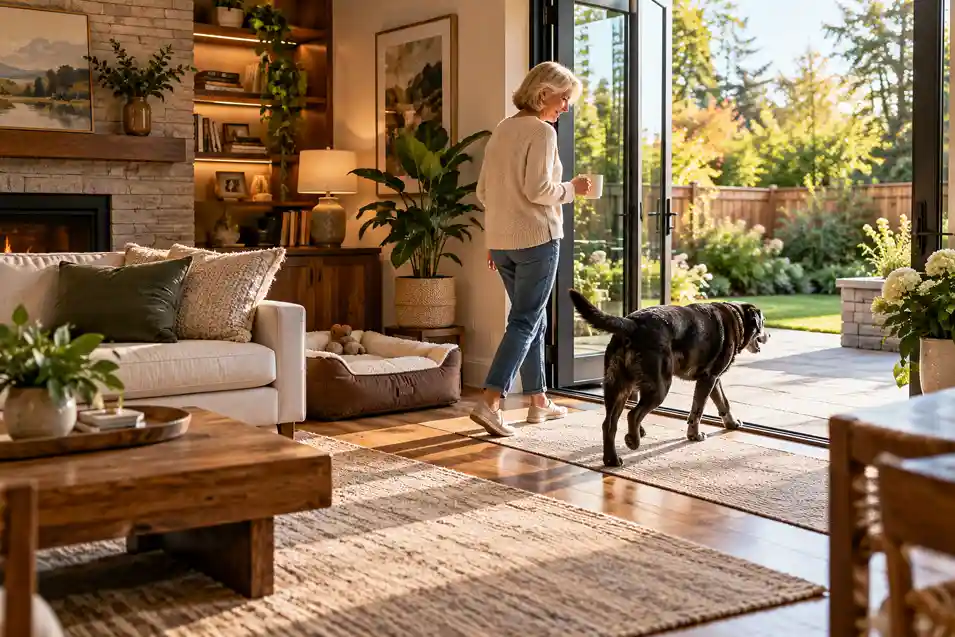
A door directly into a secure fenced area can make an enormous difference.
This becomes particularly valuable during bad weather, at night or if mobility changes. Walking down steps, across an icy driveway and around the side of the house every time the dog needs out may be manageable today and miserable later.
If appropriate for the home and dog, a well-designed dog door can provide additional independence. Security, climate, wildlife and the dog’s size and behaviour all need to be considered.
In cold climates, an insulated pet door or small enclosed transition area may make far more sense than a simple flap through an exterior wall.
Pay attention to the threshold as well. A high step through a doorway can eventually become difficult for both humans and pets.
Create a Small, Secure Potty Area
A huge backyard isn’t necessarily the most useful backyard for an older dog owner.
A smaller fenced area immediately outside the house can be much more practical.
It should be easy to see from indoors, accessible without difficult steps and simple to maintain. Good drainage matters, as does a surface that remains usable in rain or snow.
Lighting is important too.
At 11 p.m., you shouldn’t need to cross a dark yard to figure out where the dog went.
Improve Lighting Before You Think You Need It
Lighting is one of the simplest improvements you can make.
Hallways, stairs, entrances and the route between the bedroom and bathroom deserve particular attention.
So does the route to the back door.
Low-level night lighting or motion-activated lights can help you navigate without turning on every overhead fixture.
This has an additional pet-friendly benefit: you are much less likely to step on a sleeping cat or trip over a dog lying somewhere unexpected.
Contrast can help too. A pet with declining vision may have difficulty distinguishing steps or changes in floor level, particularly when surfaces are similar in colour.
Design Around Trip Hazards — Including the Pet
Pets themselves are sometimes the trip hazard.
Small dogs and cats have an extraordinary ability to appear directly behind someone’s feet. Larger dogs can block circulation simply by choosing the wrong place for a nap.
Furniture placement can help.
Give pets comfortable resting places near the family without putting beds in major walking routes. A dog bed tucked beside a sofa or against a wall is usually safer than one floating in the middle of the room.
Keep toys contained when they’re not being used, particularly balls and hard chew toys that can roll underfoot.
Cords, feeding bowls, scratching posts and pet stairs should also have deliberate locations rather than slowly migrating into circulation paths.
Rethink the Litter Box
The traditional litter box in the basement may become a terrible arrangement as both cat and owner age.
For the person, it means carrying litter up and down stairs and repeatedly bending to clean the box.
For an older cat, those same stairs may eventually discourage litter box use altogether.
Consider placing at least one litter box on the main living level.
Choose a location that gives the cat privacy and easy access while remaining convenient to clean. Large walk-in or low-entry boxes can be easier for cats with reduced mobility.
The owner’s accessibility matters just as much.
A litter setup that requires crawling into a cabinet or pulling a heavy box from underneath furniture isn’t particularly clever if it becomes painful to use.
Store litter, liners and cleaning supplies nearby so the job doesn’t involve carrying things across the house.
Make Grooming and Bathing Safer
Bathing an 80-pound dog in a conventional bathtub is difficult at almost any age.
It becomes considerably harder when lifting, balance or back strength changes.
If you’re renovating a mudroom, laundry room or utility area, a step-in dog wash can be a worthwhile addition. The dog should be able to walk into it rather than being lifted over a high wall.
A handheld sprayer, non-slip surface and conveniently placed shampoo storage make the process easier.
Think about where you stand, too. The setup shouldn’t require prolonged kneeling or awkward reaching.
For smaller pets, a stable grooming surface at a comfortable working height can reduce bending.
And sometimes the best aging-in-place modification isn’t architectural at all: paying a groomer to handle a physically difficult job can be a very sensible solution.
Pay Attention to Furniture Height
Very low sofas and chairs can become harder to get out of with age.
They can also be difficult for older pets to climb onto.
That doesn’t necessarily mean buying specialized furniture. It may simply mean choosing seating with a comfortable height, supportive cushions and enough clearance around it to stand safely.
If your dog is allowed on the sofa or bed but can no longer jump safely, pet steps or a ramp may help.
They need to be stable and placed where they don’t create another obstacle.
For large dogs, consider whether repeatedly jumping from a high bed is still sensible. Sometimes a comfortable dog bed beside the human bed is the safer long-term arrangement.
Put Everyday Pet Supplies Where You Can Reach Them
Aging-in-place design is often about eliminating unnecessary effort.
Keep the things you use every day between comfortable reaching heights whenever possible.
Leashes can hang beside the door. Food can live near the feeding station. Towels can be stored beside the dog wash. Grooming tools can stay where grooming actually happens.
Avoid making yourself climb a step stool for something you use every morning.
Likewise, don’t store heavy pet supplies on the floor if lifting them requires an awkward bend.
Small changes in storage can eliminate hundreds of unnecessary movements over the course of a year.
Organize Medications for Both of You
As people and pets age, medications can become part of the daily routine.
Keep human and animal medications clearly separated and labelled.
A dedicated pet medication area can hold prescriptions, supplements, flea and tick treatments and veterinary information. If medication needs refrigeration, consider using a clearly labelled container inside the refrigerator.
It is also useful to keep an up-to-date list of your pet’s medications and veterinarian information somewhere another person could easily find it.
That becomes especially important if somebody else suddenly needs to care for your pet.
Plan for Winter, Rain and Bad Days
A home shouldn’t only work on sunny Tuesday afternoons.
Think about January.
If there’s snow outside, can you safely reach the dog’s potty area? Where will wet paws be cleaned? Is there somewhere to sit while putting on boots or attaching a leash?
Now think about a week when you aren’t feeling well.
Could someone else easily find the dog’s food, leash and medication? Could a neighbour let the dog into the yard without walking through the entire house?
Good aging-in-place design builds resilience into ordinary routines.
Design for the Bad Week, Not Just the Good Day
One of the most useful questions you can ask is:
Would this house still work if I temporarily couldn’t do what I normally do?
You don’t need to imagine permanent disability.
Imagine recovering from knee surgery. A sprained ankle. A bad back. Six weeks using a walker. A period when you aren’t allowed to lift more than ten pounds.
Then do the same exercise for your pet.
What happens if your 80-pound dog suddenly can’t climb the stairs?
Can the dog sleep, eat and reach the yard without being carried?
Could you manage a dog with limited mobility without lifting them into a bathtub or vehicle several times a week?
A house that works during the difficult weeks will usually be wonderfully easy to live in during the good ones.
Think About the Route to the Car
Getting a pet from the house to the vehicle is easy to overlook until it isn’t.
For large dogs in particular, eventually there may come a day when jumping into an SUV is no longer possible.
A portable ramp can help, but make sure you can comfortably lift, unfold and store it yourself.
Consider the entire route: door thresholds, exterior steps, icy surfaces, gates and the height of the vehicle.
This matters most during veterinary emergencies, when neither you nor the dog needs another obstacle.
Make It Easy for Someone Else to Step In
Aging in place doesn’t mean doing everything yourself forever.
Design the home and your routines so another person can help easily.
Keep veterinary information accessible. Make sure somebody you trust knows how to enter the house. Label food and medications clearly. Have a carrier that is actually accessible rather than buried behind twenty years of Christmas decorations.
Write down the basics of your pet’s routine.
Where do they eat? How much? When do they receive medication? Which veterinarian do they see? Is there anything a temporary caregiver needs to know?
These aren’t dramatic preparations. They’re practical ones.
You Don’t Have to Renovate Everything at Once
Aging-in-place design is often presented as a major renovation project.
It doesn’t have to be.
Start with the obvious friction points.
Secure the rug that slides.
Move the litter box upstairs.
Put the dog food somewhere easier to reach.
Add a light near the back door.
Move the dog bed out of the hallway.
Install a handrail.
Create a fenced area close to the house.
Then, when you eventually replace flooring, renovate a bathroom or rebuild a deck, think about how that project could make life easier ten years from now.
The best time to incorporate accessibility is often when you’re already changing something.
A Pet-Friendly Home Should Grow Older Gracefully Too
Aging in place isn’t about turning your home into a medical facility.
It’s about removing the little barriers that gradually make everyday life harder.
For pet owners, that means looking at the house from two perspectives.
Can you safely move through it?
Can your pet?
Can you comfortably care for them?
Can they reach the places they need without unnecessary difficulty?
And if one of you has a bad week, does everything suddenly fall apart?
The best pet-friendly homes aren’t designed only for the energetic puppy, the agile cat or the healthy 50-year-old owner.
They’re designed for the entire life you hope to share together.
A few thoughtful changes today can make it much easier for both of you to stay comfortable, independent and — most importantly — together in the home you love for as long as possible.