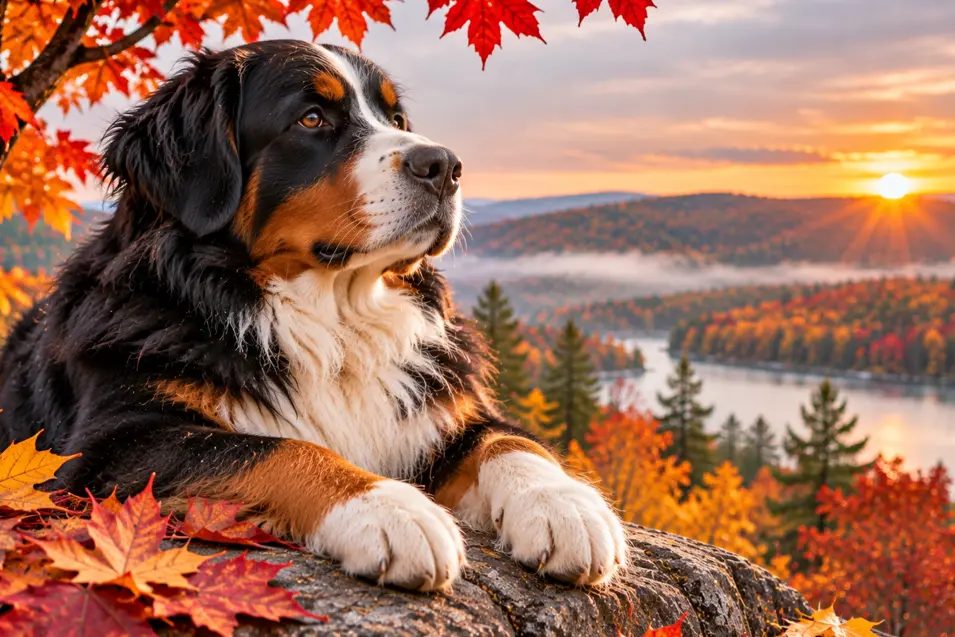
Autumn is one of the most beautiful seasons to photograph your dog. The changing leaves, golden sunlight, misty mornings, and rich seasonal colours create natural backdrops that are difficult to reproduce at any other time of year. Whether your dog is racing through a pile of fallen leaves or sitting quietly beneath a canopy of colourful trees, fall offers countless opportunities to capture memorable photographs.
You don’t need to be a professional photographer or own expensive equipment to take wonderful pictures of your dog. A modern smartphone can produce beautiful results, while a DSLR or mirrorless camera offers additional control over lighting, focus, and movement.
The secret to great autumn dog photography is understanding how to use natural light, choosing interesting locations, getting your camera settings right, and, perhaps most importantly, allowing your dog’s personality to shine through.
Here are some practical photography tips to help you make the most of this colourful season.
Take Advantage of Autumn’s Golden Hour
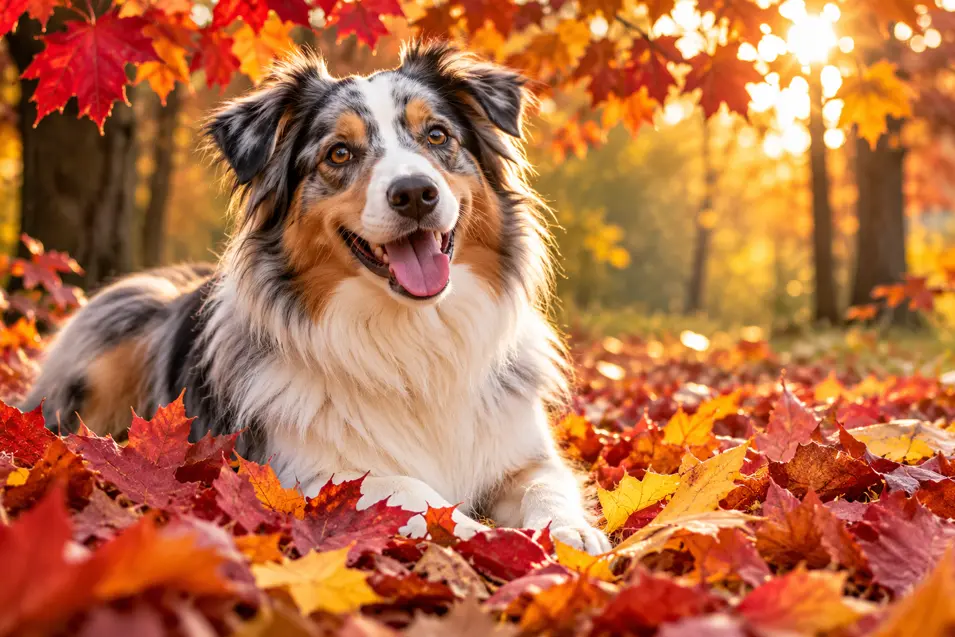
One of the easiest ways to improve your dog photography is to pay attention to the time of day.
Photographers often refer to the hour shortly after sunrise and the hour before sunset as golden hour. During these periods, sunlight travels through more of the atmosphere, producing warmer colours, longer shadows, and softer illumination than the harsh midday sun.
Autumn makes this lighting particularly beautiful. Golden sunlight filtering through yellow and red leaves can create a wonderful glow around your dog’s fur.
Try positioning your dog so the sunlight comes from the side or slightly behind them. Backlighting can produce a delicate rim of light around their ears, tail, and coat, particularly with long-haired breeds.
If you’re photographing a dark-coloured dog, make sure enough light reaches their face. A beautiful background won’t help much if your dog’s eyes disappear into shadow.
Don’t overlook cloudy days, either. An overcast autumn afternoon acts like a giant natural softbox, producing even lighting that’s especially flattering for close-up portraits.
Photography tip: If your camera allows manual exposure adjustments, try slightly underexposing bright autumn backgrounds to preserve detail in colourful leaves. Check that your dog’s face remains properly exposed.
Choose a Background That Complements Your Dog
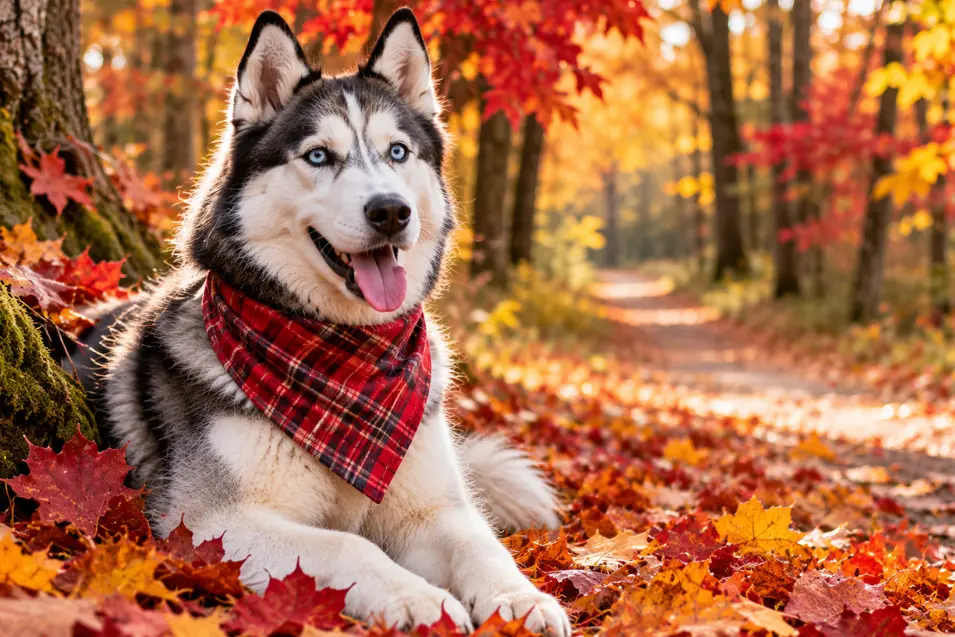
Autumn provides an extraordinary variety of natural backgrounds, but the most colourful location isn’t necessarily the best place for a photograph.
A forest filled with red and yellow leaves might look spectacular in person, yet produce a cluttered photograph if branches, tree trunks, and distracting objects compete with your dog.
Look for locations where your dog can stand out clearly.
A quiet woodland trail, a carpet of fallen leaves, a rustic wooden fence, or a single colourful tree can make a stronger photograph than a busy landscape.
Consider your dog’s coat colour when choosing a background. Black dogs can look striking against golden leaves, while white or cream-coloured dogs often photograph beautifully against deep reds and dark green foliage.
Brown and reddish dogs may blend into autumn scenery, so look for contrasting backgrounds that help define their outline.
You can also create depth by positioning your dog several feet in front of the background. This separation becomes especially effective when using a wide aperture or your smartphone’s portrait mode.
Photography tip: Before taking the picture, look carefully around your dog’s head. Reposition yourself if a tree trunk, branch, or fence post appears to be growing out of their ears.
Get Down to Your Dog’s Eye Level
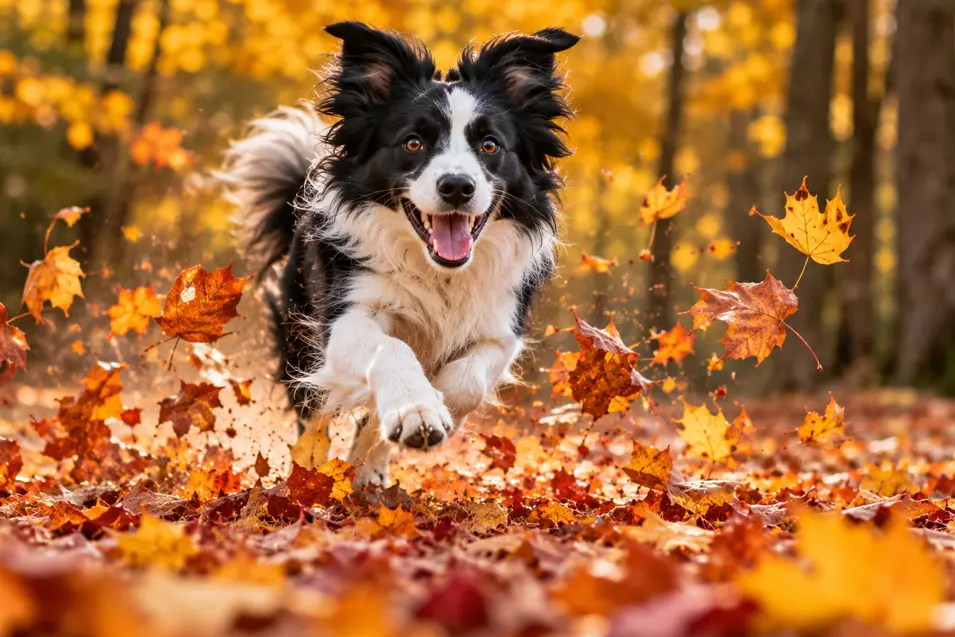
One of the simplest ways to transform an ordinary dog photograph into a beautiful portrait is to change your perspective.
Most people photograph their dogs while standing. Although this works for some situations, shooting downward can make your dog appear smaller and less connected to the viewer.
Instead, crouch or kneel until your camera is approximately level with your dog’s eyes.
This perspective creates a more intimate photograph and allows you to capture expressions that might otherwise be missed.
Getting even lower can produce dramatic results, particularly when your dog is standing among fallen leaves. The leaves in the foreground may become softly blurred, creating a natural frame around your subject.
Experiment with different angles. A photograph taken from slightly below eye level can emphasize a dog’s proud posture, while a close-up taken directly at eye level can capture a wonderfully personal expression.
For small dogs, you may need to sit or lie on the ground to achieve the right perspective.
Photography tip: Focus on the eye closest to the camera. Sharp eyes are often the difference between an average portrait and a photograph that immediately draws attention.
Understand Your Camera Settings: ISO, Shutter Speed, and Aperture
You don’t need to master every camera setting to take beautiful autumn photographs, but understanding three basic controls can make an enormous difference.
ISO: Controlling Light Sensitivity
ISO determines how much your camera amplifies the light captured by its sensor.
In bright daylight, an ISO setting of 100–200 is a good starting point. On cloudy afternoons or beneath a dense canopy of autumn trees, you may need ISO 400–800 or higher.
Higher ISO settings help you maintain a fast shutter speed when light is limited, although they can introduce grain or digital noise.
Modern cameras handle higher ISO settings surprisingly well, so don’t be afraid to increase it when necessary. A slightly grainy photograph with sharp eyes is usually better than a blurry one.
Shutter Speed: Freezing Movement
Dogs rarely stay perfectly still, especially when they’re enjoying an autumn adventure.
For a dog sitting calmly, a shutter speed around 1/250 second is a useful starting point.
For walking dogs, try approximately 1/500 second.
If your dog is running, jumping, or chasing leaves, start around 1/1000 second or faster.
These are guidelines rather than fixed rules. Fast-moving dogs, long lenses, and unpredictable movement may require even quicker shutter speeds.
Aperture: Creating Beautiful Background Blur
Aperture controls the size of the opening through which light enters your camera. It also affects how much of the scene appears in focus.
A wide aperture, such as f/1.8 or f/2.8, can create a beautifully blurred background that separates your dog from the autumn scenery.
For portraits, f/2.8 to f/4 is often a practical starting point, depending on your lens and distance from the dog.
If you’re photographing two dogs together or want more of the landscape in focus, try f/5.6 or f/8.
With very wide apertures, be careful that your dog’s nose is sharp while their eyes are out of focus.
Suggested Camera Settings
| Photography situation | Shutter speed | Aperture | ISO |
|---|---|---|---|
| Sitting dog in daylight | 1/250 sec | f/2.8–f/4 | 100–400 |
| Dog walking along a trail | 1/500 sec | f/4 | 200–800 |
| Dog running through leaves | 1/1000–1/2000 sec | f/2.8–f/5.6 | Auto ISO |
| Portrait on an overcast day | 1/250 sec | f/2.8–f/4 | 400–800 |
| Dog in a woodland setting | 1/500 sec | f/4–f/5.6 | Auto ISO |
These settings are starting points. Adjust them to match the available light, your equipment, and how quickly your dog is moving.
If your camera offers continuous autofocus or animal-eye detection, enable it when photographing active dogs.
Capture Your Dog Running Through Fallen Leaves
Few autumn photographs capture the season quite like a dog enthusiastically running through a carpet of colourful leaves.
These images can be wonderfully expressive, with flying leaves, bouncing ears, and joyful movement.
However, action photography requires a little planning.
Choose an open area with good natural light and a relatively uncluttered background. Position yourself where your dog will run toward you or across your field of view.
Ask a friend or family member to call your dog from a safe distance, or encourage your dog to retrieve a favourite toy.
Use a fast shutter speed, continuous autofocus, and your camera’s burst mode to capture several frames in quick succession.
If you’re photographing your dog running directly toward the camera, focus tracking is particularly helpful because the distance between you and your dog changes rapidly.
Don’t worry if every photograph isn’t perfect. Some of the most entertaining pictures happen when ears fly in unexpected directions or a dog emerges from a pile of leaves with a ridiculous expression.
Photography tip: Avoid throwing large piles of leaves directly into your dog’s face. Instead, photograph natural movement through clean, dry leaves, and check the area for sharp objects, hidden debris, or other hazards.
Use Autumn Accessories Without Overdoing It
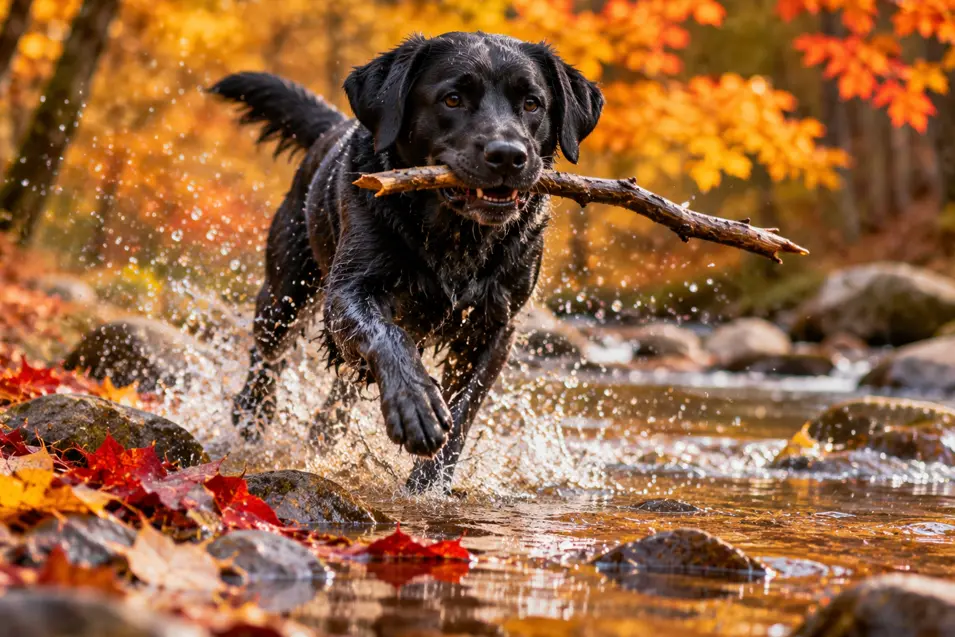
A simple seasonal accessory can add personality and colour to your photographs.
A plaid bandana, a knitted sweater, or a lightweight autumn-coloured scarf can complement the surroundings without distracting from your dog.
Choose colours that work with both your dog’s coat and the background. Deep burgundy, forest green, cream, mustard yellow, and muted navy often look especially attractive against fall foliage.
For dogs that enjoy wearing clothing, a comfortable sweater can create a cozy autumn portrait.
However, accessories should never interfere with movement, breathing, vision, or comfort.
Avoid tight scarves, dangling decorations, or anything your dog might chew or swallow.
Not every dog enjoys dressing up, and that’s perfectly fine. A beautiful autumn portrait doesn’t require accessories at all.
Sometimes a dog sitting naturally beneath a colourful tree is far more compelling than an elaborate staged photograph.
Photography tip: Keep accessories simple. One well-chosen bandana usually photographs better than a collection of hats, scarves, and seasonal props competing for attention.
Photograph Your Dog on Misty Autumn Mornings
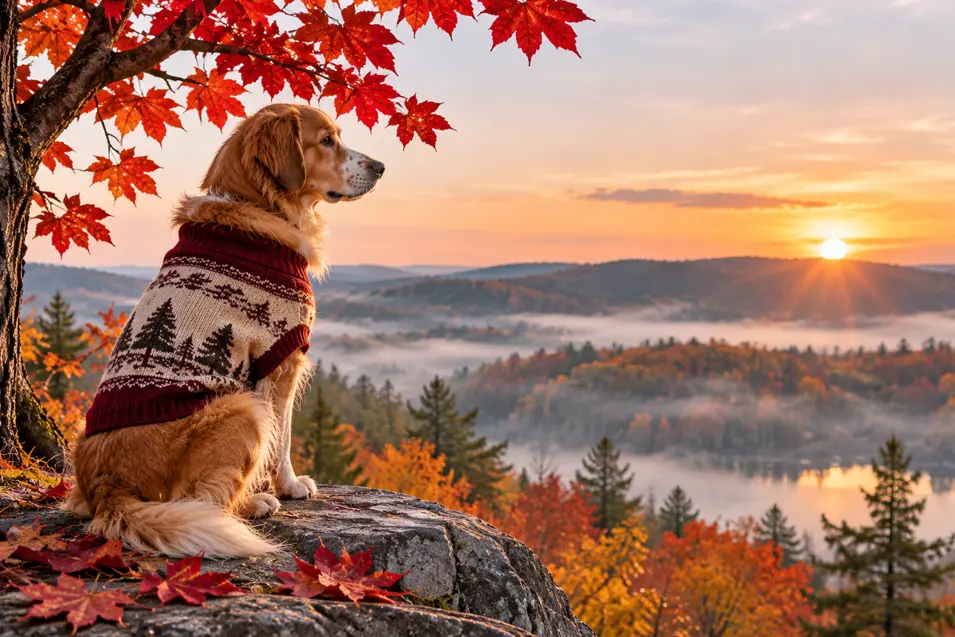
Autumn mist can transform an ordinary walking trail into an extraordinary photography location.
Fog softens distant backgrounds, reduces visual clutter, and creates a peaceful atmosphere that’s especially beautiful in woodland settings.
Early mornings near lakes, rivers, and open fields can be particularly photogenic when cool overnight temperatures encourage mist to form.
For a dramatic composition, photograph your dog standing or sitting along a trail that gradually disappears into the fog.
You can also position your dog against a softly illuminated background, allowing their silhouette to stand out.
Misty scenes often work beautifully with muted colours rather than the saturated oranges and reds typically associated with autumn.
Keep your exposure under control, especially when photographing against bright fog, and make sure your dog’s face remains visible unless you’re deliberately creating a silhouette.
Photography tip: Include a recognizable foreground element, such as a fallen log or a few colourful leaves, to give your photograph a sense of depth.
Create Beautiful Close-Up Portraits
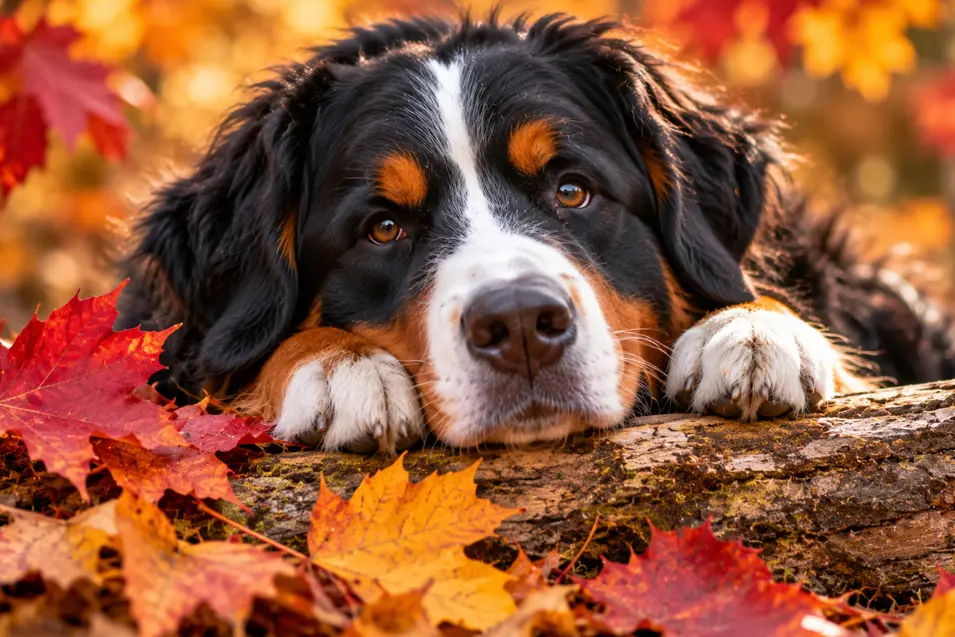
Not every autumn photograph needs to show an entire landscape.
Close-up portraits can capture the small details that make your dog unique: expressive eyes, whiskers, floppy ears, or the texture of their fur.
Autumn leaves can provide beautiful natural framing for these photographs.
Try photographing your dog resting beside a cluster of colourful leaves, looking through low branches, or sitting against a softly blurred background.
For a close-up portrait, focus carefully on your dog’s eyes and avoid placing the camera so close that their nose becomes disproportionately large, unless you’re deliberately creating a playful effect.
A longer portrait lens, such as an 85mm lens, can produce flattering results. A zoom lens set to a moderate telephoto focal length can also work beautifully.
With smartphones, try stepping back slightly and using an appropriate optical zoom setting rather than moving the phone inches from your dog’s face.
Photography tip: A small catchlight, or reflection of light in your dog’s eyes, can make a portrait feel more lively. Open shade or soft window light often produces attractive catchlights.
Take Beautiful Autumn Dog Photos With Your Smartphone
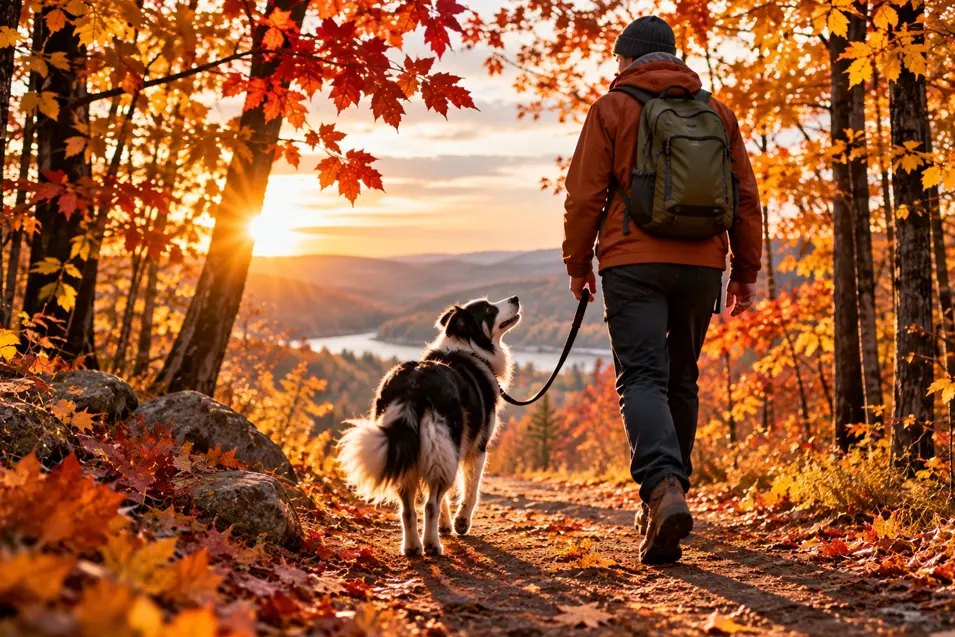
You don’t need an expensive camera to create impressive autumn dog photographs.
Modern smartphones offer excellent image quality, automatic exposure, portrait modes, and sophisticated autofocus systems.
The most important improvements usually come from better lighting and composition rather than equipment.
Start by cleaning your phone’s camera lens. Fingerprints and smudges can reduce sharpness and create unwanted haze, particularly when photographing toward sunlight.
Tap your dog’s face on the screen to set focus and exposure. If the background is very bright, adjust the exposure so your dog isn’t lost in shadow.
Use portrait mode for calm, relatively stationary subjects, but check the results carefully. Smartphone software sometimes struggles to separate fine fur, whiskers, and ears from the background.
For action photographs, use your phone’s burst or continuous shooting feature where available.
Avoid relying heavily on digital zoom, which can reduce image quality. Instead, move closer when it’s safe and practical, or use your phone’s optical telephoto camera if it has one.
And remember to shoot both vertically and horizontally. Vertical photographs are ideal for Pinterest and social media, while horizontal compositions work beautifully for websites, prints, and photo albums.
Let Your Dog Be a Dog
Some of the best dog photographs are completely unplanned.
Your dog might pause to investigate an interesting scent, tilt their head at a distant sound, or settle comfortably in a patch of autumn sunshine.
These natural moments often reveal more personality than a perfectly staged portrait.
Rather than repeatedly asking your dog to sit and stay, give them opportunities to explore their surroundings safely.
Keep your camera ready and watch for interesting expressions or behaviour.
If your dog becomes restless or distracted, take a break. A short walk or a little playtime can restore their enthusiasm.
Treats and favourite toys can help attract attention, but use them sparingly and reward your dog for participating.
Never force a nervous dog into an unfamiliar environment or expect them to remain still for long periods.
Photography tip: Try holding a favourite toy close to the camera lens to encourage your dog to look toward you. A helper can make this much easier.
Edit Your Autumn Photographs Without Losing Their Natural Beauty
Autumn photographs often benefit from a little editing, but it’s easy to go too far.
The goal should be to enhance the atmosphere you experienced rather than create colours that never existed.
Begin with basic adjustments to exposure, contrast, highlights, and shadows.
If your dog’s face appears too dark, gently lift the shadows without washing out the entire photograph.
A modest increase in warmth can enhance golden-hour lighting, while careful adjustments to vibrance can bring out the colours of autumn leaves.
Be cautious with saturation. Excessive editing can turn beautiful natural foliage into unrealistic shades of orange and red.
For portraits, subtle sharpening around the eyes can help draw attention to your dog.
You can also crop the photograph to improve composition or remove distracting objects near the edges.
Popular editing tools include Adobe Lightroom, Snapseed, and the editing features already built into many smartphones.
Photography tip: Compare your edited image with the original before saving it. If the leaves look unnaturally bright or your dog’s coat has changed colour, reduce the adjustments.
Keep Your Dog Safe and Comfortable During Fall Photography Sessions
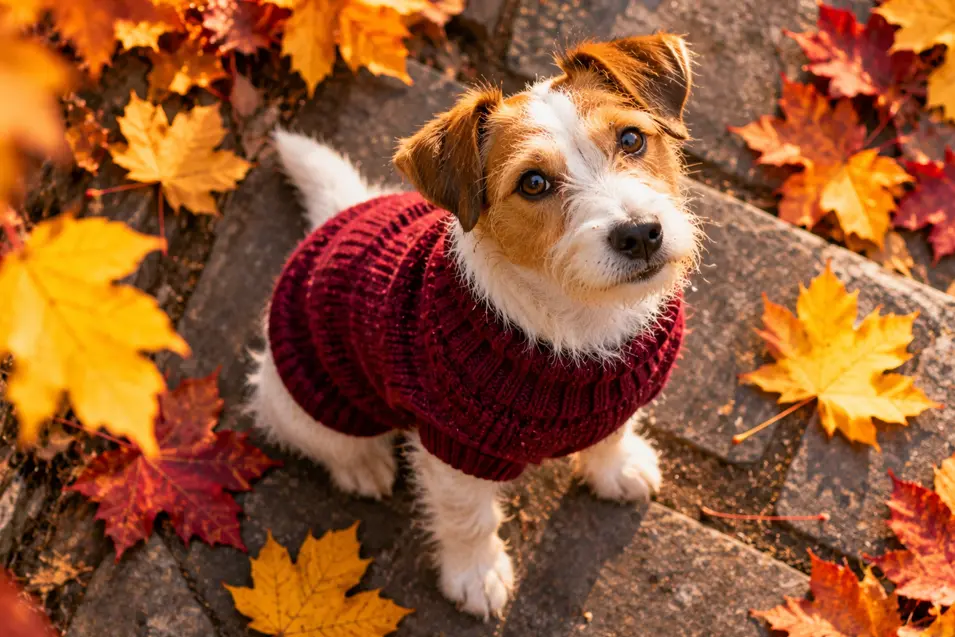
Beautiful photographs should never come at the expense of your dog’s comfort or safety.
Autumn weather can change quickly, particularly in wooded areas or during early morning outings.
Bring fresh drinking water, keep your dog appropriately warm, and watch for signs of fatigue or discomfort.
Be cautious around slippery leaves, muddy slopes, and unfamiliar trails.
Avoid placing your dog on unstable logs, high rocks, or other elevated surfaces simply to create a dramatic photograph.
Check outdoor locations for mushrooms, sharp debris, and potentially harmful plants. Some wild mushrooms are highly toxic to dogs, so don’t allow your dog to investigate or eat them.
If you’re photographing near roads, livestock, or wildlife, keep your dog securely leashed. A long line can provide some freedom of movement in appropriate areas without sacrificing safety.
After a woodland photography session, check your dog’s coat and paws for ticks, burrs, and other debris.
Most importantly, keep sessions enjoyable. A relaxed, happy dog will almost always produce better photographs than one that’s tired, uncomfortable, or frustrated.
Make the Most of Autumn’s Short Photography Season
One of the wonderful things about autumn photography is that the scenery changes almost daily.
A favourite trail might be filled with brilliant yellow leaves one weekend and covered with a thick carpet of fallen foliage the next.
Don’t wait for the perfect day or the perfect camera.
Take your dog for a walk, explore somewhere new, and experiment with different lighting, angles, and compositions.
Some photographs will be technically better than others, but the most meaningful images often capture something much simpler: your dog’s personality and the pleasure of spending time together.
Years from now, you probably won’t remember which ISO setting you used or whether every leaf was perfectly in focus.
You’ll remember the crisp autumn air, the sound of leaves beneath your feet, and the dog who made those ordinary moments special.
More Reading: Pet Photography and Memories
Beautiful photographs do more than capture your dog’s appearance. They preserve special moments, celebrate your pet’s personality, and can even become meaningful pieces of art in your home. Explore these related articles for more inspiration.
How Photography Changed the Way We Remember Our Pets — Discover how photographs help preserve the memories and emotional connections we share with our animals.
The Art of Pet Photography — Explore the creative side of photographing pets and capturing their unique personalities.
Pet Photography as Home Decor — Learn how to turn your favourite pet photographs into beautiful, personal artwork for your home.