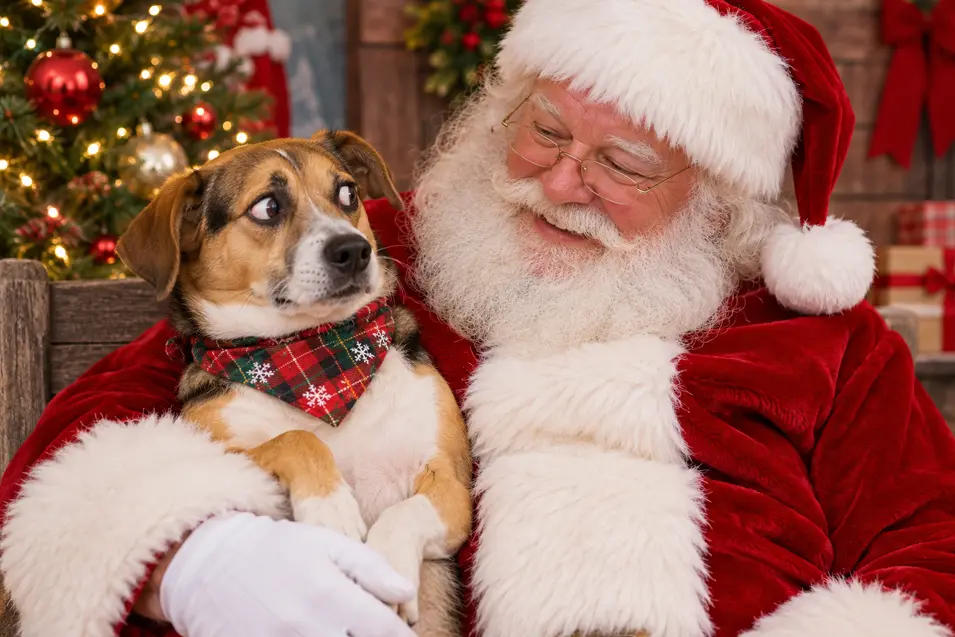
To children, Santa Claus is a magical figure who brings presents, spreads Christmas cheer, and somehow manages to visit millions of homes in a single night. To some dogs, however, Santa is a large, unfamiliar stranger with a booming voice, an enormous white beard, and a suspiciously bright red outfit.
Add a crowded shopping mall, flashing cameras, excited children, and someone expecting your dog to sit beside this mysterious character, and suddenly that adorable Christmas photo doesn’t seem quite so adorable.
While plenty of dogs happily pose with Santa, others become nervous, frightened, or downright determined to escape. And when you consider how dogs experience the world, their reactions make perfect sense.
So why are some dogs afraid of Santa Claus, and what can you do to make the experience less stressful?
Santa Doesn’t Look Like Anyone Your Dog Knows
Dogs become familiar with people through a combination of appearance, scent, movement, voice, and previous experiences. Santa Claus presents a rather unusual collection of these characteristics.
Think about it from your dog’s perspective. Here’s a stranger wearing an oversized red suit, heavy black boots, a floppy hat, and a massive white beard that conceals much of his face.
Even dogs that are normally friendly with strangers may hesitate when someone looks dramatically different from the people they encounter every day.
Dogs can also react differently to people wearing costumes, helmets, sunglasses, or bulky winter clothing. These accessories change the familiar outline of a human body and can make it more difficult for a dog to interpret someone’s intentions.
Santa just happens to combine several of these unusual features into one very festive package.
That Big White Beard Can Be Confusing
Humans recognize Santa’s beard as part of his cheerful appearance. Dogs may find it considerably less reassuring.
Although dogs rely heavily on scent and body language, they also use visual information to understand the people around them. Facial expressions, head movements, posture, and other familiar cues help them interpret social situations.
A thick beard covering much of someone’s face can make those cues less obvious.
For dogs that have rarely encountered people with large beards, Santa’s appearance may simply be unfamiliar.
This doesn’t mean dogs are naturally afraid of beards. Many live happily with bearded owners and wouldn’t think twice about them. The issue is unfamiliarity, particularly when combined with an unusual costume and an unfamiliar environment.
A dog that has never seen someone dressed like Santa may need time to figure out exactly what he’s looking at.
Santa’s Booming Voice Might Be Part of the Problem
“Ho, ho, ho!”
For humans, Santa’s famous laugh is a cheerful Christmas tradition. For a nervous dog, a sudden burst of deep, enthusiastic laughter might be startling.
Dogs are sensitive to vocal tone, volume, and changes in sound. Some become uncomfortable when unfamiliar people speak loudly, laugh unexpectedly, or make exaggerated noises.
A Santa performer may also greet dogs with enthusiastic calls, excited gestures, and attempts to get their attention.
While these actions are generally well-intentioned, they can be overwhelming for dogs that prefer quiet, predictable interactions.
A soft-spoken Santa who allows dogs to approach at their own pace may have considerably more success than one who enthusiastically announces their arrival to everyone in the room.
The Christmas Photo Experience Can Be Overwhelming
Sometimes Santa isn’t really the problem.
The environment surrounding a Santa photo session can be just as frightening as the man in the red suit.
Pet-friendly Christmas photo events often take place in shopping centres, pet stores, community halls, or other busy locations. These environments may contain unfamiliar smells, barking dogs, excited children, loud music, and people moving in every direction.
For a sensitive dog, that’s a lot to process.
Now imagine being guided through this unfamiliar environment, approaching a strangely dressed person, and suddenly being expected to sit still while someone points a camera at you.
Even a dog that might happily greet Santa in a quiet backyard could struggle with the same encounter in a crowded shopping mall.
The experience can become particularly stressful when owners are focused on getting the perfect photograph rather than watching their dog’s behaviour.
What looks like a harmless Christmas tradition to us may feel like an uncomfortable situation with no obvious escape route to our pets.
Why Some Dogs Are More Nervous Than Others
Not every dog reacts to Santa Claus in the same way.
Some dogs enthusiastically approach anyone willing to offer attention. Others are naturally cautious around unfamiliar people, particularly when those people look or behave differently from what they’re accustomed to.
Several factors can influence a dog’s reaction.
Early socialization: Dogs that have enjoyed positive experiences with a wide variety of people, appearances, and environments may be more comfortable encountering someone dressed as Santa.
Individual temperament: Some dogs are naturally outgoing, while others prefer to observe unfamiliar situations from a safe distance.
Previous experiences: A dog that has been frightened by costumes, loud voices, or unwanted handling may react cautiously to similar situations.
Age and health: Puppies are still learning about the world, while older dogs experiencing changes in hearing, vision, mobility, or comfort may find unfamiliar encounters more challenging.
Sensitivity to busy environments: Dogs that struggle with crowds, noise, or unfamiliar locations may find Christmas photo sessions particularly stressful.
A dog’s size or breed doesn’t automatically determine whether Santa will frighten them. A large, confident-looking dog can be just as uncomfortable as a tiny companion dog.
And a dog that happily posed with Santa last Christmas might react differently this year.
Signs Your Dog Is Uncomfortable Around Santa
One of the most important things owners can do is recognize when their dog is becoming uncomfortable.
Dogs don’t always express fear by barking, growling, or trying to run away. Many communicate their discomfort through much subtler behaviours.
Watch for signs such as:
- Turning the head or body away from Santa
- Repeatedly licking the lips or nose
- Yawning when not tired
- Holding the ears back
- Tucking the tail between the legs
- Trembling or shaking
- Avoiding eye contact
- Showing the whites of the eyes
- Freezing or becoming unusually still
- Panting when not hot
- Attempting to hide behind their owner
- Pulling away or trying to escape
Some of these behaviours can occur in perfectly ordinary situations. It’s their combination, frequency, and surrounding circumstances that help reveal whether a dog is stressed.
A particularly important sign is freezing.
A dog that sits completely motionless on Santa’s lap isn’t necessarily enjoying the experience. Some frightened dogs become still when they feel unable to escape.
If your dog appears uncomfortable, the best response is to calmly create distance and allow them to recover.
A Christmas photograph is never worth frightening your dog.
Should You Make Your Dog Sit on Santa’s Lap?
The short answer is no.
If your dog is reluctant to approach Santa, forcing them into his lap or holding them in place for a photograph can make the experience worse.
Being physically restrained near something frightening may increase anxiety and can sometimes lead to defensive behaviour.
Even normally gentle dogs may growl, snap, or attempt to bite when they feel trapped.
It’s also worth remembering that Santa performers may not be experienced dog handlers. They might be wonderful with children but less familiar with canine body language.
A better approach is to let your dog choose whether to interact.
If your dog seems relaxed, they may be perfectly happy sitting beside Santa or posing near his chair. There’s no requirement for them to be picked up, hugged, or placed on someone’s lap.
And if your dog would rather admire Santa from across the room, that’s perfectly acceptable too.
How to Help Your Dog Feel More Comfortable Around Santa
If you’d like to include your dog in a Christmas photo tradition, there are several ways to make the experience more enjoyable.
Start at a Comfortable Distance
Allow your dog to observe Santa from far enough away that they remain relaxed.
Don’t immediately approach the chair or encourage physical contact.
Give your dog time to watch, sniff the surroundings, and decide whether they want to move closer.
Bring Their Favourite Treats
High-value treats can help create positive associations with an unfamiliar situation.
Reward calm behaviour and allow your dog to explore at their own pace.
However, treats shouldn’t be used to lure a frightened dog into an interaction they’re trying to avoid.
The goal is to help your dog feel comfortable, not persuade them to tolerate something overwhelming.
Choose a Quiet Photo Session
Whenever possible, look for pet-specific Santa events with scheduled appointments, limited crowds, and experienced handlers.
A quieter setting can make a tremendous difference for nervous dogs.
Let Santa Ignore Your Dog at First
It may sound strange, but one of the best ways for Santa to make friends with a cautious dog is to do very little.
Rather than reaching toward the dog, leaning over them, or making direct eye contact, Santa can remain seated and allow the dog to investigate voluntarily.
Some dogs feel much more comfortable when unfamiliar people don’t immediately demand their attention.
Keep the Visit Short
There’s no reason to turn a Christmas photo session into a lengthy social event.
If your dog is comfortable, take a few photographs and finish while things are still going well.
If they become uncomfortable, leave.
Ending an experience before it becomes stressful is far better than waiting until your dog is visibly frightened.
Alternatives to Traditional Santa Photos
Fortunately, Santa doesn’t need to be sitting beside your dog for you to capture a memorable Christmas photograph.
There are plenty of festive alternatives that don’t involve an unfamiliar man in a red suit.
A Christmas tree portrait: Photograph your dog relaxing near a decorated Christmas tree, keeping electrical cords, breakable ornaments, and other hazards safely out of reach.
A cozy Christmas morning: Capture your dog resting on their favourite blanket beside a few wrapped presents.
An outdoor winter photograph: Snow-covered trees, a festive scarf, and natural light can create a beautiful seasonal portrait.
A Christmas stocking photograph: Position a decorative stocking near your dog while they relax in a familiar setting.
A family Christmas portrait: Sometimes the best holiday photograph is simply your dog sitting comfortably with the people they already know and trust.
You can even photograph your dog with Santa standing several feet away, provided your dog is genuinely comfortable with the arrangement.
The most memorable Christmas pictures often happen when dogs are simply being themselves.
When It’s Better to Skip Santa Altogether
Some dogs genuinely dislike unfamiliar people, costumes, crowds, or being handled by strangers.
For these dogs, a Santa photo session may offer little benefit and considerable stress.
Dogs with significant fear or anxiety shouldn’t be pushed into these situations simply because it’s a holiday tradition.
If your dog has previously panicked around strangers, reacted defensively when frightened, or struggled with busy public environments, skipping the event may be the kindest choice.
For dogs whose fear affects everyday life, a qualified reward-based trainer or veterinary behaviour professional can help develop a gradual behaviour modification plan.
But there’s no reason to make meeting Santa a training goal unless it serves a meaningful purpose for your dog.
After all, your dog doesn’t know it’s Christmas.
They don’t understand the significance of the red suit, the white beard, or the photographs that will eventually appear on your refrigerator.
They simply know whether they feel safe.
Your Dog Doesn’t Have to Love Santa to Love Christmas
Christmas is supposed to be a season of happiness, comfort, and spending time with those we love. That should include our dogs.
Some dogs will happily jump into Santa’s lap, wag their tails, and pose like seasoned Christmas professionals.
Others will take one look at the enormous white beard and decide they’ve seen quite enough.
Both reactions are perfectly normal.
The important thing is respecting your dog’s comfort, recognizing their signals, and remembering that a successful Christmas experience doesn’t require a perfect photograph.
And if your dog would rather spend Christmas curled up on the couch, enjoying a favourite toy while the rest of the family celebrates, that’s perfectly fine.
Santa might bring the presents, but your dog already knows who really makes Christmas special.
More Christmas Reading for Dog Lovers
Christmas Stockings for Dogs: Fun Ideas for Your Furry Friend – From tasty treats to favourite toys, discover ways to fill your dog’s Christmas stocking with surprises they’ll actually enjoy.
If Dogs Were Santa Claus: 10 Very Different Ways to Run Christmas – Forget the naughty and nice list. Imagine what Christmas would look like if dogs were running the North Pole.
Dogs in Santa Hats: A Little Christmas Cheer – Enjoy a festive collection of dogs dressed for the holidays, proving that sometimes all you need is a Santa hat and a little personality.