Christmas is a wonderful time of year, filled with family gatherings, festive decorations, delicious food, and plenty of excitement. But while we’re enjoying the celebrations, our dogs may be wondering what on earth has happened to their normally predictable world.
Suddenly, the living room is filled with decorations. Strangers are arriving at the door. Children are running around, music is playing, and familiar routines seem to have disappeared.
Some dogs thrive on all the extra attention. Others find the holidays overwhelming.
Even a normally relaxed dog can become anxious when too many unfamiliar things happen at once.
Fortunately, there are plenty of simple ways to help your dog feel comfortable and secure throughout the holiday season. From maintaining familiar routines to creating a peaceful retreat, a little preparation can make Christmas more enjoyable for everyone.
Why Christmas Can Be Stressful for Dogs
Dogs are creatures of habit. They become comfortable with familiar surroundings, predictable schedules, and the people they know.
Christmas often changes all three.
Furniture may be rearranged to accommodate a Christmas tree. Decorations appear in familiar spaces. Visitors arrive at unusual hours, and the household becomes considerably noisier.
For dogs that are sensitive to change, these disruptions can be unsettling.
Common sources of Christmas stress include:
- Large family gatherings and unfamiliar visitors
- Excited children and increased household noise
- Changes to feeding, walking, and sleeping schedules
- Christmas music, doorbells, and noisy toys
- Unfamiliar decorations and rearranged furniture
- Visiting dogs or other pets
- Being left alone more frequently during holiday outings
- Reduced opportunities for quiet rest
The combination of several small changes can be more stressful than any one event.
A dog that comfortably tolerates two visitors may struggle when ten people arrive, especially if the gathering continues for several hours.
Understanding your dog’s individual comfort level is the first step toward a calmer Christmas.
Recognize the Signs of Stress in Your Dog
Dogs don’t always communicate anxiety in obvious ways.
While some may bark, whine, or hide, others display subtle changes in body language that are easy to overlook during a busy celebration.
Watch for signs such as:
- Repeated yawning when your dog isn’t tired
- Lip licking without food being present
- Panting when the room isn’t hot
- Pacing or an inability to settle
- Trembling or shaking
- Ears held back or a lowered body posture
- Avoiding eye contact or turning away
- Hiding behind furniture or seeking isolation
- Excessive barking or whining
- Refusing treats they would normally enjoy
- Growling when approached or handled
These behaviours should be interpreted in context. A single yawn doesn’t necessarily indicate anxiety, but several stress signals appearing together may suggest your dog is uncomfortable.
One particularly important sign is a dog repeatedly attempting to move away from people.
If your dog retreats from an interaction, allow them to leave.
Forcing a nervous dog to remain in an uncomfortable situation can increase anxiety and the risk of defensive behaviour.
1. Maintain Your Dog’s Normal Routine
One of the easiest ways to reduce holiday stress is to keep your dog’s daily schedule as familiar as possible.
Christmas preparations can quickly take over the household, but your dog still benefits from regular meals, walks, exercise, and rest.
Try to maintain:
- Consistent feeding times
- Regular bathroom breaks
- Familiar walking routes
- Normal bedtime routines
- Daily playtime and attention
- Access to favourite resting places
You don’t need to follow an exact schedule down to the minute.
The goal is simply to preserve enough familiar activities that your dog feels secure.
If you’re hosting Christmas dinner, consider taking your dog for their usual walk before guests arrive.
A relaxed walk with opportunities to sniff and explore can provide mental stimulation and help your dog settle afterward.
Avoid exhausting your dog with unusually intense exercise in the hope that they’ll sleep through the festivities. Overtired dogs can sometimes become more irritable or restless.
2. Create a Quiet Christmas Retreat
Every dog should have somewhere peaceful to escape when the celebrations become overwhelming.
This might be a bedroom, a quiet corner of the house, or a familiar crate if your dog already enjoys using one.
The ideal retreat should be away from busy doorways, loud conversations, and excited children.
Include familiar comforts such as:
- Your dog’s regular bed or blanket
- Fresh drinking water
- A favourite toy
- Comfortable room temperature
- Soft background noise, if your dog finds it relaxing
If your dog is accustomed to resting in a crate, you can make it available as a familiar refuge.
However, Christmas Day isn’t the time to introduce crate confinement to a dog that has never been comfortable with it.
Make sure your dog can rest without being disturbed.
Explain to visitors, particularly children, that the retreat is a private space.
A dog choosing to sleep quietly in another room isn’t missing Christmas. They’re simply enjoying it in their own way.
3. Prepare Your Dog for Christmas Visitors
For some dogs, the most stressful part of Christmas is the constant arrival of unfamiliar people.
The doorbell rings, people enter carrying bags and presents, and everyone seems eager to greet the dog.
If your dog becomes excited or anxious when visitors arrive, prepare before the first guest reaches the door.
You might keep your dog in a quiet room during arrivals, then allow introductions once everyone has settled.
For dogs that enjoy meeting people, calm greetings can be encouraged by asking visitors to avoid excessive excitement.
If your dog is nervous around strangers, don’t insist that they greet everyone.
Allow them to observe from a comfortable distance or remain in their quiet space.
Give Your Guests a Few Simple Rules
Visitors may not realize that certain behaviours make dogs uncomfortable.
Before the gathering begins, explain that they should:
- Allow the dog to approach rather than reaching toward them.
- Avoid hugging, restraining, or picking up the dog.
- Never disturb a sleeping or resting dog.
- Avoid feeding treats or table scraps without permission.
- Respect the dog’s decision to move away.
- Keep doors and gates secure.
These small considerations can prevent many stressful interactions.
4. Supervise Children Around Dogs
Christmas is especially exciting for children.
Unfortunately, running, shouting, squealing, and unexpected physical contact can be overwhelming for some dogs.
Even dogs that are normally comfortable with children may struggle when the household becomes unusually busy.
Always supervise interactions between dogs and young children.
Teach children not to pull ears or tails, chase dogs, climb on them, or interrupt them while eating or sleeping.
Children should also understand that a dog hiding under furniture or resting in another room needs to be left alone.
Never assume a dog will tolerate unwanted attention simply because they’ve been patient in the past.
If your dog appears uncomfortable, calmly separate them from the activity.
Giving a dog space is far more effective than expecting them to endure an overwhelming situation.
5. Provide Calming Activities and Mental Enrichment
Keeping your dog occupied with appropriate activities can help them settle during holiday gatherings.
Food puzzles, stuffed enrichment toys, and familiar chew toys can provide a positive focus away from the excitement.
A licking mat may also be useful for dogs that enjoy one.
Choose treats and fillings that are safe for your dog, and account for the extra calories in their daily food allowance.
Always supervise activities involving toys or chews that could break into pieces or become choking hazards.
For dogs that enjoy scent-based games, try hiding a few treats around a quiet room and allowing them to search.
Sniffing and problem-solving can provide satisfying mental stimulation without requiring high-energy play.
The goal isn’t to distract a frightened dog from something terrifying. It’s to offer enjoyable activities in an environment where they already feel reasonably safe.
If your dog is too anxious to eat or engage with a favourite toy, they may need more distance from the festivities.
6. Keep Christmas Noise Under Control
Christmas can be surprisingly loud.
Music, laughter, excited conversations, noisy toys, and repeated doorbells may create an uncomfortable environment for noise-sensitive dogs.
If your dog is easily startled, consider lowering the music volume and avoiding sudden bursts of noise near their resting area.
A television, fan, or white-noise machine may help soften unpredictable household sounds for some dogs.
Keep the volume moderate, and only use background noise if your dog appears comfortable with it.
If your household includes musical decorations or animated Christmas displays, place them away from areas where your dog normally rests.
Watch your dog’s reaction to new sounds.
Some dogs are completely unfazed by a singing Santa decoration. Others may find it deeply suspicious.
7. Introduce Christmas Decorations Gradually
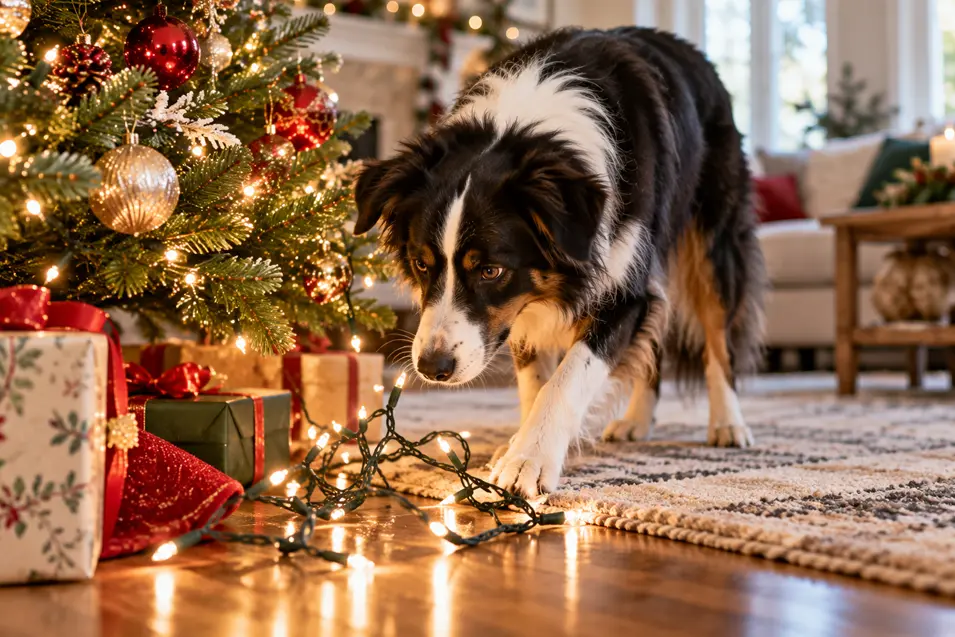
A decorated Christmas tree may look beautiful to us, but to a dog, it represents a large, unfamiliar object that has suddenly appeared in the living room.
Some dogs investigate immediately.
Others may bark, retreat, or approach cautiously.
If your dog is sensitive to unfamiliar objects, introduce decorations gradually rather than transforming the entire room at once.
Allow your dog to observe the undecorated tree before adding lights and ornaments.
Reward calm behaviour when your dog chooses to investigate appropriately or relax nearby.
Avoid forcing your dog to approach decorations that make them uncomfortable.
It’s also important to keep potentially dangerous items out of reach, including electrical cords, loose tinsel, fragile ornaments, and edible decorations.
A dog that feels secure around the decorations is less likely to become distressed by their presence.
8. Be Careful When Other Dogs Come to Visit
Christmas gatherings sometimes include visiting dogs.
While it can be tempting to imagine all the family pets happily playing together, not every dog enjoys sharing their home with unfamiliar animals.
Even dogs that have met before may behave differently in a crowded, noisy environment.
If another dog will be visiting, consider arranging a calm introduction outdoors or in a neutral location before bringing them inside.
Remove high-value toys, food bowls, and chews that could trigger competition.
Provide separate resting spaces and supervise interactions.
Never force dogs to share beds, toys, or attention.
If either dog becomes uncomfortable, separate them before tensions escalate.
For dogs that are fearful, reactive, or uncomfortable around other animals, arranging separate areas may be the safest and least stressful option.
9. Avoid Overwhelming Your Dog With Attention
Christmas often brings relatives who haven’t seen your dog in months.
Naturally, everyone wants to say hello.
But constant attention can become exhausting, particularly for older dogs, shy dogs, or those who simply prefer a quieter lifestyle.
Pay attention to whether your dog is actively seeking interaction or merely tolerating it.
A dog that approaches with relaxed body language may enjoy a gentle greeting.
A dog that repeatedly turns away, moves off, or becomes tense is asking for space.
Let your dog decide how much social interaction they want.
There’s no requirement for them to participate in every family photograph, greeting, or holiday activity.
10. Plan Ahead if You’re Leaving Your Dog Alone
Christmas often involves shopping trips, family visits, religious services, and other activities away from home.
If your dog will be spending time alone, try to keep their environment familiar.
Provide a comfortable resting area, fresh water, and appropriate enrichment.
Avoid leaving your dog unattended with accessible electrical decorations, fragile ornaments, or wrapped presents containing food.
If your dog already experiences separation anxiety, holiday changes may make the problem more difficult.
Arrange suitable care when necessary, and avoid assuming that leaving a television or radio playing will resolve significant distress.
Dogs with separation-related anxiety may benefit from a structured behaviour plan developed with veterinary guidance.
11. Consider Calming Products Carefully
Pet stores offer a variety of products marketed to help anxious dogs.
These may include pheromone diffusers, calming wraps, supplements, and specially designed enrichment products.
Some dogs appear to benefit from certain products, but results vary, and scientific evidence for many options remains limited.
A calming wrap may help one dog while making another uncomfortable.
Pheromone products may be useful as part of a broader management plan, but they aren’t guaranteed to work.
Always introduce wearable products gradually and check that your dog is comfortable using them.
Speak with your veterinarian before giving calming supplements or medications, especially if your dog has an existing medical condition or takes prescription medication.
Never give your dog human sedatives or anti-anxiety medication without veterinary direction.
For dogs with severe anxiety, a veterinarian may recommend appropriate medication alongside behavioural strategies.
12. Know When Your Dog Needs a Break
Sometimes the best way to keep a dog calm is simply to remove them from the situation.
If your dog begins pacing, trembling, hiding, growling, or repeatedly trying to escape, the festivities may have become too much.
Don’t wait for the behaviour to escalate.
Calmly guide your dog to a quieter area, or allow them to retreat on their own.
Give them time to settle without demanding interaction.
If your dog remains distressed, consider ending their participation in the gathering.
There’s nothing wrong with a dog spending Christmas afternoon resting comfortably in a peaceful bedroom.
Their wellbeing matters more than being present for every moment of the celebration.
13. Give Older Dogs and Puppies Extra Consideration
Puppies and senior dogs may have different needs during the holidays.
Puppies
Young puppies are still learning how to cope with unfamiliar experiences.
Too many visitors, loud noises, and constant handling can quickly become overwhelming.
Provide frequent rest periods, maintain regular bathroom breaks, and supervise all interactions.
Introduce new experiences gently, allowing your puppy to approach at their own pace.
Senior Dogs
Older dogs may have reduced hearing or vision, mobility difficulties, or discomfort from age-related conditions.
Changes in furniture placement can make navigating the home more challenging.
Keep pathways clear and avoid moving familiar beds or water bowls unnecessarily.
Make sure your senior dog has a comfortable place to rest away from busy household activity.
If an older dog suddenly becomes unusually anxious, restless, or irritable, consult your veterinarian. Pain or underlying health problems may be contributing to the behaviour.
When Should You Speak to Your Veterinarian About Christmas Anxiety?
Mild excitement or temporary nervousness during a busy gathering isn’t unusual.
However, persistent or intense anxiety deserves professional attention.
Contact your veterinarian if your dog experiences:
- Severe trembling or panic
- Repeated attempts to escape
- Destructive behaviour associated with distress
- Persistent refusal to eat or drink
- Extreme fear of visitors or household sounds
- Aggressive behaviour linked to fear
- Anxiety that continues after the festivities end
A veterinarian can assess whether pain, illness, or behavioural factors are contributing to the problem.
They may recommend a qualified behaviour professional, environmental changes, or appropriate medication.
If your dog has a history of serious anxiety, don’t wait until Christmas Eve to seek help.
Planning ahead allows time to introduce effective strategies before the busiest celebrations begin.
Frequently Asked Questions About Keeping Dogs Calm at Christmas
Why does my dog get anxious at Christmas?
Christmas introduces changes in routine, unfamiliar visitors, decorations, and increased noise. Dogs that prefer predictable environments may find these changes stressful.
Should I let my dog hide during Christmas gatherings?
Yes. If your dog chooses to retreat to a safe, quiet area, allow them to do so. Hiding can be a way of coping with an overwhelming situation. Make sure they have access to water and aren’t being disturbed.
How can I calm my dog when guests arrive?
Prepare a quiet area before visitors arrive, keep greetings low-key, and allow your dog to approach people at their own pace. For anxious dogs, remaining separated from the gathering may be preferable.
Can Christmas music calm dogs?
Some dogs appear to relax with gentle background music, but individual responses vary. Keep the volume comfortable and watch your dog’s behaviour to determine whether it helps.
Are calming treats safe for dogs?
Safety depends on the ingredients, dosage, and your dog’s individual health. Some supplements may interact with medications or be unsuitable for certain dogs. Ask your veterinarian before introducing a calming supplement.
Should I take my dog to a large family Christmas gathering?
That depends on your dog’s temperament, health, and comfort around unfamiliar people and environments. Some dogs enjoy social outings, while others are happier staying home with suitable care.
Can dogs become stressed after Christmas?
Yes. Changes in sleep, routine, and activity can affect dogs during and after busy celebrations. Returning to familiar schedules and providing adequate rest can help them settle.
A Calm Christmas Is a Happy Christmas
Christmas doesn’t have to be stressful for dogs.
While we may enjoy busy gatherings, lively conversations, and a house full of activity, our dogs often appreciate something much simpler: familiar routines, comfortable surroundings, and the freedom to relax.
By recognizing signs of stress, providing quiet spaces, and allowing your dog to participate at their own pace, you can make the holidays more enjoyable for everyone.
Remember that every dog is different.
One may happily greet every visitor at the door, while another would much rather spend the afternoon curled up in a favourite bed.
Neither dog is celebrating Christmas the wrong way.
The best gift you can give your dog this holiday season may be something that doesn’t come wrapped in paper at all: a safe, peaceful home where they feel comfortable, understood, and loved.
More Reading: Helping Your Dog Enjoy a Stress-Free Christmas
The holiday season can be overwhelming for dogs, especially with unfamiliar visitors, noisy celebrations, and changes to their daily routines. These articles offer more ways to keep your dog comfortable and relaxed throughout Christmas.
- Preparing Your Dog for Christmas Visitors and Crowds – Learn how to help your dog handle holiday guests, busy gatherings, and unfamiliar faces without becoming overwhelmed.
- Why Some Dogs Are Afraid of Santa Claus – Discover why Santa’s costume, beard, and unusual appearance can frighten some dogs, and how to make holiday encounters less stressful.
- Can Your Dog Tell If You Are Stressed Out? – Dogs are surprisingly sensitive to human emotions. Find out how your own holiday stress may affect your dog and why staying calm can make a difference.