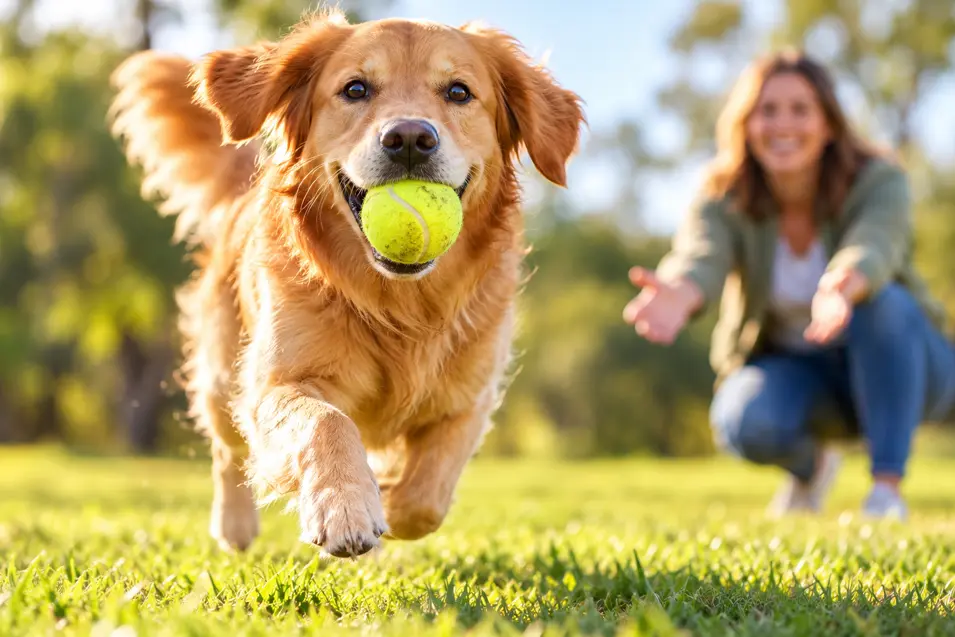
Playing fetch seems like one of the simplest things you can do with a dog. You throw a ball, your dog chases it, brings it back, and you throw it again. Everybody has fun, the dog gets some exercise, and eventually you both head inside feeling like you’ve accomplished something.
At least, that’s how it’s supposed to work.
In reality, plenty of dogs have their own interpretation of fetch. Some chase the ball enthusiastically, then stand 30 feet away looking at you. Others retrieve it but refuse to let go. A few grab the ball and disappear behind the sofa, apparently believing you’ve just given them a wonderful new possession.
And then there are the dogs who watch you throw the ball, look back at you, and seem genuinely confused about why you would deliberately discard something you obviously wanted.
The good news? Most dogs can learn the basics of fetch with patience, positive reinforcement, and a little understanding of how dogs learn.
Whether you’re teaching a puppy, working with an adult dog, or trying to convince your four-legged companion that returning the ball is actually part of the game, here’s how to make fetch enjoyable for both of you.
Do Dogs Naturally Know How to Play Fetch?
Not necessarily.
While chasing moving objects comes naturally to many dogs, playing fetch involves several separate behaviours.
Your dog needs to become interested in the toy, chase it, pick it up, carry it back toward you, release it, and wait for the next throw.
That’s quite a sequence when you think about it.
Some dogs perform most of these behaviours instinctively. Labrador Retrievers and Golden Retrievers, for example, were selectively bred to retrieve objects, so carrying something back to a person may come more naturally to them.
Other dogs may enthusiastically chase a ball but have little interest in returning it.
A terrier might grab the toy and shake it. A herding dog might chase it and stop it from moving. A scent hound might abandon the entire exercise after discovering something fascinating beneath a nearby bush.
None of these dogs is being deliberately difficult.
They’re simply responding to different instincts, preferences, and experiences.
The trick is teaching your dog that bringing the toy back is just as rewarding as chasing it.
What You’ll Need to Teach Your Dog Fetch
You don’t need expensive equipment or a large backyard to begin.
In fact, starting indoors is often easier because there are fewer distractions.
A few basic items will help:
- A favourite toy: Choose something your dog enjoys picking up and carrying, such as a soft ball, plush toy, or lightweight retrieving toy.
- Small training treats: Use rewards your dog finds particularly appealing.
- A quiet space: A hallway or small room works beautifully for early training.
- Two similar toys: These can be helpful when teaching your dog to return and release an object.
- Patience: Probably the most important item on the list.
Choose toys that are appropriately sized for your dog and unlikely to break apart during play.
If you’re using tennis balls, remember that ordinary tennis balls aren’t designed specifically for dogs. Their abrasive felt and potential choking hazards make appropriately sized, purpose-made dog balls worth considering.
We explore this in more detail in Why Are Dogs So Obsessed With Tennis Balls?, including why dogs love chasing them and what owners should know about their safety.
Editor’s note: Replace the link above with the published tennis ball article URL.
Step 1: Get Your Dog Interested in the Toy
Before teaching your dog to retrieve anything, you need to establish that the toy is worth pursuing.
Sit on the floor with your dog and introduce the ball or retrieving toy.
Move it gently across the floor, roll it a short distance, or encourage your dog to investigate it.
When your dog shows interest, offer praise or a small treat.
You can reward simple behaviours such as looking at the toy, touching it with their nose, or picking it up.
For dogs that already love toys, this stage may take approximately three seconds.
For others, it could require several short sessions.
Avoid forcing the toy into your dog’s mouth or repeatedly pushing it toward them. You want your dog to develop a positive association with the object.
If your dog seems completely uninterested, try a different toy.
Some dogs prefer soft toys they can carry comfortably. Others enjoy rubber balls, squeaky toys, or lightweight fabric retrieving toys.
The best fetch toy isn’t necessarily the one you think looks most exciting.
It’s the one your dog actually wants.
Step 2: Teach Your Dog to Pick Up the Toy
Once your dog is interested, encourage them to pick it up.
Place the toy on the floor directly in front of your dog.
If they touch it with their nose, mark the behaviour with a cheerful “yes” or a clicker and reward them.
Gradually wait for a little more interaction before rewarding.
First, your dog might touch the toy. Then they may open their mouth around it. Eventually, they’ll pick it up.
Reward each meaningful step toward the behaviour you want.
If your dog already picks up toys naturally, you can skip much of this stage.
Once your dog reliably picks up the toy, introduce a cue such as “take it.”
Say the cue just before your dog performs the action, then reward them.
With repetition, your dog can learn to associate the words with picking up the object.
Keep sessions short and positive.
Five minutes of enthusiastic learning is generally more productive than 30 minutes of frustration.
Step 3: Teach Your Dog to Bring the Toy Toward You
This is where many games of fetch begin falling apart.
Your dog happily chases the toy, picks it up, and then decides to enjoy it somewhere else.
The solution is to make returning to you rewarding.
Start by tossing the toy only a few feet away.
When your dog picks it up, crouch down, use an encouraging voice, and invite them toward you.
You can take a few steps backward to make following you more appealing.
As soon as your dog moves toward you with the toy, praise them enthusiastically.
If they reach you while still holding it, reward that success.
Don’t worry about perfect positioning or dropping the toy into your hand just yet.
Right now, the goal is simple: your dog learns that coming back to you is a good thing.
What If Your Dog Runs Away With the Ball?
First, resist the temptation to chase them.
From your dog’s perspective, having you run after them might be the most entertaining part of the entire game.
Congratulations. You’ve accidentally invented reverse fetch.
Instead, remain inviting and encourage your dog to approach.
You can try moving away from your dog, crouching down, or offering a reward when they return.
For dogs that repeatedly run off, practising in a hallway or small enclosed area can help prevent the game from turning into an unwanted chase.
The important thing is to avoid turning retrieval into a confrontation.
You want your dog to think, “Bringing the ball back makes good things happen.”
Not, “If I approach that person, they’re going to steal my treasure.”
Step 4: Teach Your Dog to Drop the Ball
For many dogs, retrieving the ball isn’t the problem.
Giving it back is.
They’ll happily carry it to your feet, look directly into your eyes, and then clamp their jaws shut with the determination of a bank vault.
This is where teaching a reliable “drop it” cue becomes essential.
Start with a toy your dog enjoys but isn’t excessively possessive about.
Offer a small, high-value treat near your dog’s nose.
When they release the toy to take the treat, mark the moment with “yes” and reward them.
Then give the toy back.
Repeat this several times.
Once your dog begins anticipating the release, introduce the cue “drop it” just before they let go.
Gradually practise with different toys and in different locations.
The key is teaching your dog that releasing an object doesn’t always mean losing it forever.
Sometimes dropping the ball earns a treat.
Sometimes it earns another throw.
And sometimes it means you get to spend another five minutes throwing the same object across the backyard.
Your dog will probably consider that a reasonable arrangement.
Never Turn Fetch Into a Tug-of-War Over Possession
If your dog refuses to release the toy, avoid forcibly pulling it from their mouth.
This can create frustration, encourage unwanted tugging, or increase guarding behaviour in some dogs.
Instead, return to practising trades with rewards.
If your dog stiffens, growls, snaps, or shows other signs of resource guarding, stop the exercise and seek guidance from a qualified reward-based trainer or veterinary behaviour professional.
Fetch should be enjoyable, not a battle over ownership.
Step 5: Put the Whole Game Together
Once your dog can chase the toy, pick it up, return to you, and release it, you’re ready to combine the behaviours.
Begin with a very short throw.
Encourage your dog to chase the toy.
When they pick it up, invite them back.
Praise them for returning.
Ask them to drop the toy.
Then reward them with another throw.
For dogs that love chasing, the next throw may become the most valuable reward of all.
Start with just a few successful repetitions.
As your dog becomes more confident, gradually increase the throwing distance.
You can also practise in different environments, beginning with quiet spaces before progressing to the backyard or a park.
Remember that dogs don’t automatically understand that a behaviour learned in the living room also applies in a distracting outdoor environment.
A dog who retrieves perfectly in your hallway may suddenly forget everything when confronted with squirrels, interesting smells, and the neighbour’s cat.
That’s normal.
Make the exercise easier again, reward success, and gradually rebuild the behaviour in the new location.
Step 6: Try the Two-Toy Method
For dogs who love chasing but aren’t particularly interested in returning, the two-toy method can be useful.
You’ll need two similar toys that your dog finds equally appealing.
Start by throwing the first toy a short distance.
When your dog picks it up, show them the second toy and encourage them to return.
Once they come back and release the first toy, reward them by throwing the second.
While they retrieve the second toy, pick up the first.
Repeat the process.
The idea is to teach your dog that returning and releasing a toy makes the next exciting chase possible.
However, don’t throw the second toy while your dog is still running away with the first. Otherwise, you may accidentally teach them that abandoning the original toy is part of the game.
Wait for the behaviour you want before providing the next reward.
With practice, many dogs begin returning more consistently because they understand how the game works.
Why Does My Dog Fetch the Ball but Drop It Halfway Back?
This is a common problem, particularly with dogs that enjoy chasing more than carrying.
Your dog may retrieve the ball enthusiastically, run halfway toward you, and then drop it before continuing.
There are several possible explanations.
They may not understand that carrying the ball all the way back is expected. They may be anticipating another throw. Or they may simply find carrying the toy less rewarding than chasing it.
To improve the behaviour, shorten the retrieving distance.
Reward your dog for carrying the toy even a few steps toward you.
Gradually increase the distance before offering the reward.
If your dog drops the ball early, avoid scolding them.
Simply make the next attempt easier.
Over time, you can build toward a complete retrieve.
And if your dog consistently drops the ball six feet away and looks at you expectantly, remember that you’ve probably been trained to retrieve it yourself.
Dogs are remarkably good at teaching humans routines.
Why Won’t My Dog Bring the Ball Back?
Some dogs seem to understand fetch perfectly but refuse to participate according to the rules.
They chase the ball, pick it up, and then lie down to chew it.
Others run in circles with the ball, apparently delighted by their own athletic abilities.
Some bring it back once and then decide they’ve fulfilled their contractual obligations for the day.
These behaviours can happen for several reasons.
Your dog may enjoy chasing but not retrieving. They may prefer possessing the toy. They may not understand the complete sequence, or they may have learned that keeping the ball produces more attention.
The solution depends on the underlying behaviour.
For dogs that don’t understand returning, practise short-distance recalls while carrying a toy.
For dogs that won’t release the ball, work on positive trades.
For dogs that become distracted, train in quieter environments.
And for dogs that simply don’t enjoy fetch, consider whether another activity might be more appropriate.
Not every dog needs to become a championship retriever.
We’ll explore those differences further in our companion article, Why Won’t My Dog Play Fetch?
Can You Teach an Older Dog to Play Fetch?
Absolutely.
Although puppies often learn new games quickly, adult and senior dogs can learn fetch too.
The training principles remain largely the same: start with simple behaviours, reward success, and gradually build the complete sequence.
Older dogs may need shorter sessions, gentler throws, and toys that are easier to pick up.
For dogs with arthritis, reduced mobility, or other health concerns, high-speed chasing and sudden turns may not be appropriate.
You can still teach a modified version of fetch by rolling a soft toy a short distance across the floor.
Some senior dogs enjoy retrieving at a leisurely pace.
Others prefer carrying a toy back to their bed and calling it a day.
The objective isn’t athletic performance.
It’s providing an enjoyable activity suited to your dog’s abilities.
How Long Does It Take to Teach a Dog Fetch?
There’s no universal timeline.
Some dogs begin retrieving within a single training session. Others may need days or weeks to learn the complete sequence.
A dog that naturally loves carrying toys may progress quickly.
A dog that has never shown interest in retrieving may need more time to develop the necessary behaviours.
Training consistency matters more than rushing.
A few short sessions each day can be more effective than one exhausting session.
Try to end each practice while your dog is still engaged and enjoying the activity.
And remember that progress isn’t always perfectly linear.
Your dog might retrieve beautifully on Tuesday, forget everything on Wednesday, and suddenly perform like a professional on Thursday.
Welcome to dog training.
How to Play Fetch Safely
Fetch is a wonderful source of exercise and enrichment, but it’s important to keep the game appropriate for your dog’s health and physical abilities.
Repeated sprinting, jumping, twisting, and sudden stops can place stress on muscles and joints.
Choose a safe playing surface with enough room to move without obstacles.
Avoid throwing balls near roads, steep slopes, icy areas, or other hazards.
During warm weather, keep sessions short, provide water, and watch for signs of overheating.
Puppies whose bodies are still developing shouldn’t be pushed into repetitive high-impact exercise.
Senior dogs and those with joint problems may benefit from gentler activities.
Also, avoid throwing balls high into the air if your dog tends to leap awkwardly to catch them. Rolling or throwing toys low across the ground may reduce some risks, although fast turns and stops can still cause injuries.
Choose appropriately sized toys, supervise play, and replace damaged balls.
Most importantly, don’t assume your dog will stop when they’re tired.
Some highly motivated dogs will continue chasing a ball long after they should be resting.
It’s your responsibility to recognize when playtime needs to end.
What If Your Dog Doesn’t Like Fetch?
Here’s something worth remembering: playing fetch is not a requirement for being a happy, healthy dog.
Some dogs absolutely adore it.
Others would rather spend 20 minutes investigating a single patch of grass.
And that’s perfectly fine.
Dogs have different personalities, instincts, physical abilities, and preferences.
If your dog shows little interest in chasing or retrieving toys, don’t force the issue.
Try other activities such as scent games, food puzzles, gentle tug, hide-and-seek, or trick training.
A dog who doesn’t enjoy fetch isn’t necessarily lazy, stubborn, or poorly trained.
They may simply have different ideas about entertainment.
And frankly, if someone kept throwing your favourite possession across the yard and expecting you to retrieve it, you might eventually question their judgment too.
The Secret to Teaching Fetch? Make Coming Back the Best Part
At its heart, successful fetch training isn’t really about throwing a ball.
It’s about teaching your dog that the entire experience is rewarding, including the part where they return to you.
For some dogs, that understanding comes naturally.
For others, it takes patience, practice, and a generous supply of treats.
Keep training positive, celebrate small successes, and remember that the goal is to enjoy spending time together.
Your dog doesn’t need to retrieve perfectly, deliver the ball directly into your hand, or perform like a professional hunting retriever.
If you’re both having fun, you’re already doing something right.
And one day, after weeks of practising, your dog may finally chase the ball, pick it up, run straight back, and drop it neatly at your feet.
You’ll feel an enormous sense of accomplishment.
Your dog will look up at you expectantly.
And you’ll realize you’ve just taught them a game they’re going to want to play approximately 400 times a day.
Congratulations.
You may never sit peacefully in your backyard again.