
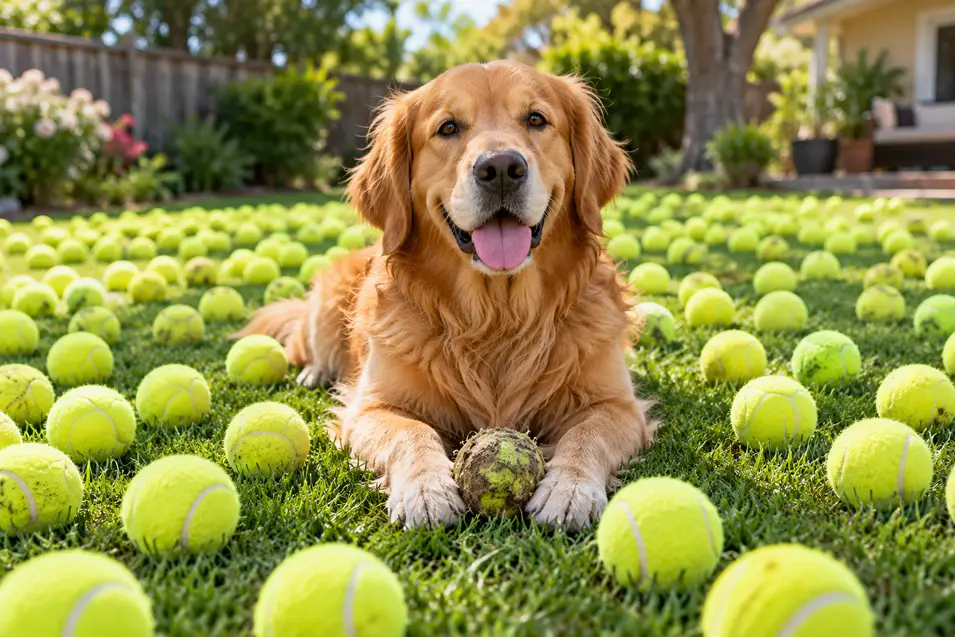
There’s something about a tennis ball that can turn an otherwise sensible dog into a complete lunatic. One minute, your dog is peacefully sleeping on the sofa. The next, you pick up a tennis ball, and suddenly you’re the most important person in the universe.
The tail starts wagging. The eyes widen. The entire body trembles with anticipation. And if you don’t throw that ball within the next three seconds, you’re going to hear about it.
Some dogs will chase a tennis ball until they’re exhausted. Others carry one around the house like a priceless family heirloom. And then there are the dogs with a collection of 15 tennis balls who insist on playing with the same filthy, flattened, barely recognizable specimen they’ve owned for three years.
So what makes tennis balls so irresistible? Is it their colour, their smell, the way they bounce, or something deeper in a dog’s instincts?
As it turns out, there’s some fascinating science behind this seemingly simple obsession.
The Thrill of the Chase: It’s in Their DNA
Long before dogs were sleeping in orthopedic beds and eating premium kibble, their ancestors survived by hunting. Spotting movement, chasing prey and catching it were essential survival skills.
Thousands of years of domestication haven’t completely erased those instincts.
When you throw a tennis ball across the yard, its sudden movement can activate parts of your dog’s natural predatory behaviour. The ball flies through the air, hits the ground, changes direction and rolls away. To a dog with a strong chase instinct, that’s an invitation that’s difficult to ignore.
Of course, not every dog responds the same way.
Border Collies, Australian Shepherds and other herding breeds have been selectively bred to respond to movement. Retrievers were developed to retrieve objects, making a game of fetch particularly appealing. Terriers may enjoy the chase but have entirely different ideas about what should happen once they catch the ball.
And then there’s the Basset Hound, who watches the ball roll across the lawn, considers the situation and decides you can probably retrieve it yourself.
Breed tendencies matter, but individual personality, experience and training play equally important roles.
Why Does the Bouncing Make Such a Difference?
A tennis ball doesn’t travel like a predictable object.
It bounces, changes direction, rolls under furniture and occasionally disappears into places no human hand can comfortably reach.
That unpredictability can make the game particularly engaging.
Dogs are highly responsive to movement, and an object that suddenly changes direction provides fresh opportunities to chase, track and react.
A ball rolling slowly across the floor might attract mild interest. The same ball bouncing unpredictably across the backyard can produce an entirely different response.
This helps explain why some dogs show little interest in stationary toys but become intensely excited the moment someone throws one.
For these dogs, the reward isn’t necessarily owning the ball. It’s the opportunity to chase it.
Do Dogs Actually Like the Colour of Tennis Balls?
Traditional tennis balls are a distinctive fluorescent yellow-green, often called optic yellow.
And while dogs don’t see colours the same way humans do, the colour of a tennis ball may contribute to its appeal.
Humans have three types of colour-sensitive cone cells, allowing us to distinguish a broad range of colours. Dogs have two types, making their colour vision more limited.
Dogs generally distinguish blues and yellows more readily than reds and greens.
That means a bright yellow ball can be easier for a dog to distinguish from certain backgrounds than a red ball, particularly against green grass.
However, colour isn’t the whole story.
Dogs also rely heavily on movement, contrast and scent when locating objects. A blue ball may actually stand out better than a yellow one against some grassy backgrounds.
And if you’ve ever watched a dog locate a muddy tennis ball buried beneath a pile of leaves, you already know that colour isn’t necessarily the deciding factor.
Their noses are doing some of the work, too.
The Smell of a Tennis Ball Matters More Than You Think
To humans, an old tennis ball smells like rubber, dirt and something that probably shouldn’t be brought into the house.
To your dog, that same ball can carry a fascinating collection of familiar scents.
Dogs experience the world largely through smell. Their noses can detect and distinguish odours far beyond human capabilities.
A tennis ball that’s been carried around the backyard, rolled through the grass, handled by its owner and repeatedly retrieved may develop a scent profile that’s particularly familiar.
That doesn’t mean every dog prefers a dirty ball because of its smell. But scent can help explain why an old, well-used toy remains interesting even when a brand-new replacement is sitting nearby.
And yes, this may be why your dog completely ignores the three fresh tennis balls you purchased yesterday while searching desperately for the disgusting one underneath the deck.
Why Do Some Dogs Have a Favourite Tennis Ball?
Anyone who has lived with a ball-obsessed dog knows that not all tennis balls are created equal.
You can purchase an entire bag of identical balls, scatter them across the living room and watch your dog carefully select the same one every time.
Why?
Dogs can develop preferences for particular objects through familiarity, scent, texture and previous experiences.
A favourite ball may be associated with enjoyable games, attention from a beloved person or countless successful retrieving sessions.
Over time, those positive associations can make the object especially rewarding.
Some dogs may also prefer the way an older ball feels in their mouth. Others may simply recognize it more easily because of its distinctive smell or appearance.
There’s no single scientific explanation for every dog’s favourite-ball preference, but learning and familiarity are likely important factors.
Whatever the reason, attempting to replace that treasured possession can be surprisingly difficult.
Apparently, the new ball just doesn’t have the same character.
Why Do Dogs Love Carrying Tennis Balls Around?
Not every tennis-ball enthusiast wants to play fetch.
Some dogs are perfectly content carrying a ball from room to room, placing it beside their bed or holding it gently while relaxing.
For retrievers and other dogs bred to carry objects, this behaviour may be particularly natural.
But carrying a ball can also be a learned habit associated with positive experiences.
A dog might pick up a ball because it has previously attracted attention, initiated a game or earned praise.
For some dogs, carrying a familiar toy may also be part of a comforting routine, although we shouldn’t assume every dog holding a ball is using it for emotional reassurance.
The important distinction is that loving a tennis ball doesn’t always mean loving fetch.
Sometimes the ball itself is the attraction.
And sometimes your dog simply wants everyone in the house to know that the ball belongs to them.
Why Do Some Dogs Become Obsessed With Fetch?
There’s a difference between a dog that enjoys playing fetch and one that seems incapable of thinking about anything else.
For some dogs, the anticipation of the next throw becomes an incredibly powerful motivator.
Fetch combines several rewarding experiences: movement, pursuit, successful retrieval and interaction with a person.
When those experiences happen repeatedly, dogs can learn to associate the sight of a ball with excitement and reward.
This can create a strong behavioural pattern.
The dog sees the ball, becomes excited, demands a throw, chases it and immediately wants the experience repeated.
In some cases, the excitement becomes so intense that the dog struggles to settle down even after the game ends.
You might notice your dog staring at the ball constantly, whining when you stop throwing it, repeatedly dropping it at your feet or ignoring opportunities to rest.
These behaviours don’t automatically indicate a behavioural disorder. Many enthusiastic dogs simply love playing fetch.
However, if ball-related behaviour begins interfering with sleep, relaxation, eating or normal daily activities, it’s worth speaking with your veterinarian or a qualified canine behaviour professional.
A healthy relationship with toys should include the ability to disengage.
Even the world’s most enthusiastic retriever needs an occasional afternoon off.
Does Playing Fetch Strengthen Your Bond With Your Dog?
Absolutely, provided both you and your dog enjoy the activity.
Playing fetch creates opportunities for shared attention, exercise, communication and positive reinforcement.
Your dog learns that interacting with you leads to enjoyable experiences. You learn to recognize your dog’s signals, preferences and energy levels.
The game can also reinforce useful behaviours such as coming when called, dropping objects and waiting for permission before chasing.
But fetch isn’t the only way to build a strong relationship.
Some dogs would rather play tug, explore new smells, learn tricks or simply accompany you on a leisurely walk.
The best activity is one that suits your dog’s personality, physical abilities and interests.
And if your dog retrieves the ball once, drops it halfway back and expects you to finish the job, perhaps you’ve discovered a different kind of teamwork.
Are Tennis Balls Safe for Dogs?
Here’s where the love affair with tennis balls deserves a little caution.
Although tennis balls are inexpensive and widely available, standard balls manufactured for tennis weren’t specifically designed as dog toys.
Depending on your dog’s size, chewing habits and play style, they can present several potential risks.
Tennis Balls Can Wear Down Teeth
The fuzzy felt covering a tennis ball can become abrasive, particularly when it collects sand, dirt and other gritty particles.
Repeated chewing on this material may contribute to tooth wear over time.
Dogs that occasionally retrieve a clean tennis ball may face different risks from dogs that spend hours aggressively chewing one.
If your dog regularly chews tennis balls, a purpose-made dog toy with a less abrasive surface may be a better option.
Tennis Balls Can Become Choking Hazards
Standard tennis balls are approximately 2.7 inches in diameter, but that doesn’t make them safe for every dog.
For some large dogs, a standard tennis ball may be small enough to become lodged in the throat.
Powerful chewers can also break tennis balls into pieces, creating choking or gastrointestinal obstruction hazards if those pieces are swallowed.
Never assume a toy is safe simply because your dog has played with it for years.
Choose balls that are appropriately sized for your dog’s mouth, inspect them regularly and discard damaged toys.
If your dog is choking or having difficulty breathing, seek emergency veterinary care immediately.
Not Every Rubber Ball Is Automatically Safer
Purpose-made rubber dog balls can be excellent alternatives, but material alone doesn’t guarantee safety.
A ball that’s too small can still become a choking hazard. A toy that breaks apart easily can still create an intestinal blockage risk.
Look for durable, appropriately sized toys from reputable manufacturers, and choose products that match your dog’s chewing strength and play habits.
Supervision matters, particularly with dogs that destroy or swallow toys.
Can Dogs Play Too Much Fetch?
It’s possible to have too much of a good thing, especially when the good thing involves sprinting, jumping, twisting and sudden stops.
Repeated high-speed fetch sessions can place considerable demands on a dog’s muscles and joints.
Dogs may also continue chasing balls despite becoming tired, particularly when they’re highly motivated by the game.
Young puppies, senior dogs, overweight dogs and those with existing orthopedic problems may need modified activities.
Hot weather adds another concern because vigorous exercise can increase the risk of overheating.
Rather than throwing a ball repeatedly until your dog collapses in exhaustion, try shorter sessions with breaks.
You can also introduce variety by rolling the ball instead of throwing it high, hiding toys for scent-based games or practising gentle retrieval exercises.
The goal is to provide enjoyable physical and mental stimulation, not to see how many consecutive throws your shoulder can survive.
How to Tell When Your Dog Has Had Enough
Some dogs make it obvious when they’re tired. They slow down, lie in the shade or abandon the ball entirely.
Others need a little help recognizing when playtime should end.
Watch for excessive panting, slowing movements, unusual stiffness, reluctance to continue or difficulty recovering between throws.
In hot conditions, signs such as weakness, disorientation, vomiting or collapse require immediate attention.
For highly enthusiastic dogs, establishing a predictable end-of-game routine can be helpful.
Use a consistent cue such as “all done,” put the ball away and transition to a calmer activity.
Over time, your dog can learn that the end of fetch doesn’t mean the end of all enjoyable things.
There will be another game tomorrow.
Probably at 6:00 a.m., if your dog has anything to say about it.
What Are the Best Alternatives to Tennis Balls?
If your dog loves chasing and retrieving, there’s no shortage of alternatives designed specifically for canine play.
Durable rubber fetch balls, appropriately sized floating toys and other dog-specific retrieving products may offer advantages over standard tennis balls.
The best choice depends on your dog’s size, age, chewing behaviour and preferred activities.
Some dogs enjoy balls that bounce unpredictably. Others prefer softer toys that are easier to carry.
For dogs that enjoy searching more than chasing, hiding a toy in the backyard can provide an entirely different kind of enrichment.
You don’t necessarily have to eliminate tennis balls from your dog’s life. But understanding the potential risks helps you make sensible choices about how and when they’re used.
For Some Dogs, a Tennis Ball Is Practically a Work of Art
After all this discussion about instincts, colour vision, scent, behavioural rewards and safety, one thing remains clear: dogs have an extraordinary ability to find happiness in remarkably simple things.
A tennis ball doesn’t need batteries, an internet connection or a monthly subscription.
It just needs someone willing to throw it.
And for certain dogs, that humble little ball becomes something far more important than a toy. It’s a prized possession, a favourite pastime and occasionally the centre of their entire universe.
In fact, we started wondering what would happen if dogs took their appreciation for tennis balls to the next level.
What if they opened an art museum?
That’s the idea behind The Ball Collection, our imaginary fine-art exhibition celebrating the humble tennis ball in all its glory.
Because if dogs were responsible for curating the world’s great art collections, there’s a very good chance the Mona Lisa would be sharing wall space with a slightly chewed tennis ball.
And judging by how enthusiastically dogs respond to them, we suspect the tennis ball would draw the bigger crowd.