A pet-friendly home changes as we do.
The features that worked perfectly when you were 45 may become annoying at 70 and genuinely difficult at 80. Bending down twice a day to fill water bowls, stepping over a pet gate, carrying a large bag of dog food down basement stairs or kneeling to clean a litter box may not seem like significant problems today.
Eventually, they can be.
That doesn’t mean giving up the dog or cat you love. It means designing the home so everyday pet care remains as easy, safe and independent as possible.
And none of this requires turning a beautiful home into something that looks institutional.
The best aging-in-place design is often the design you barely notice.
Design for the 80-Year-Old You
If you’re renovating or building a home in your 60s or 70s, don’t design exclusively around what you can comfortably do today.
Think about the person who will live there ten or fifteen years from now.
Will you still want to bend to floor level several times a day?
Will stepping over a gate still feel effortless?
Could you manage the dog while opening a heavy exterior door?
Will you want to carry a 30-pound bag of pet food through the house?
Could you clean the litter box without kneeling?
Could you bathe the dog without lifting it into a tub?
You don’t need to predict exactly how your mobility will change. The goal is simply to remove unnecessary physical demands wherever possible.
Good design gives your future self options.
Keep Pet Supplies Within Easy Reach
One of the simplest improvements is reconsidering where everyday pet supplies are stored.
Food, treats, medications, poop bags, grooming supplies and leashes shouldn’t require climbing onto stools, reaching into deep lower cabinets or repeatedly carrying things between floors.
A dedicated pet cabinet or section of a mudroom can keep frequently used supplies between approximately knee and shoulder height.
Large bags of food are another consideration. Instead of repeatedly moving the entire bag, use an easy-to-open storage container positioned close to the feeding area. If possible, have heavy pet supplies delivered directly to the home.
Convenience isn’t laziness.
When you’re designing for aging in place, reducing unnecessary lifting, carrying, reaching and bending is simply good planning.
Rethink the Feeding Station
Pet bowls belong close to the floor because that’s where dogs and cats naturally eat. The solution isn’t automatically putting a dog’s dinner on a countertop simply because bending has become inconvenient.
Instead, design the feeding routine around both the animal and the person.
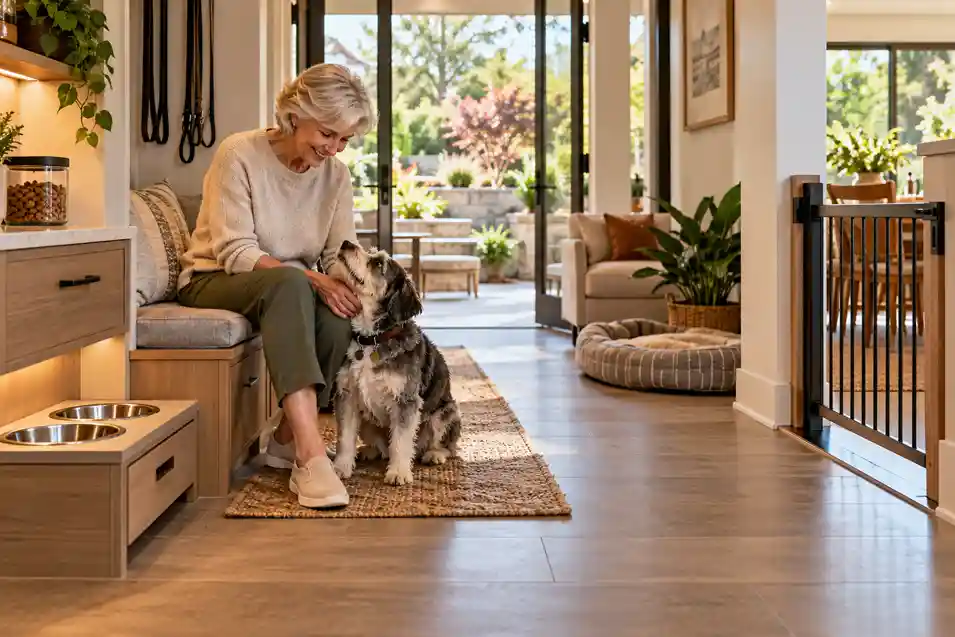
A feeding station can include nearby food storage, a pull-out shelf for preparing meals and an easily accessible water source. Bowls can sit in a stable, contained base that prevents them from sliding across the floor.
For some dogs, an appropriately elevated feeder may also be suitable, although feeding height should be chosen for the individual animal rather than simply for the owner’s convenience.
The important question is:
How much bending, carrying and cleanup does this routine require every single day?
Reducing those movements can make an enormous difference over time.
Don’t Put Pet Beds in Walking Paths
Dogs have an extraordinary ability to choose exactly the spot where humans need to walk.
At 35, stepping around a sleeping dog is irritating.
At 80, it can be dangerous.
Give pet beds deliberate locations rather than allowing them to migrate into circulation areas. A bed beside a sofa, against a bedroom wall or beneath an open console can keep the animal close without creating an obstacle.
The same principle applies at night.
If your dog sleeps in the bedroom, make sure there’s a clear route between the bed, bathroom and doorway. A dark-colored dog sleeping on a dark rug at 2 a.m. is not an ideal aging-in-place feature.
Low-level night lighting or motion-activated lighting can help enormously.
Be Careful With Pet Gates
Pet gates deserve more attention in an aging-in-place home.
Many traditional gates require people to step over a bottom rail. Others have awkward latches or narrow openings.
All of those can become problems as balance and mobility change.
If you need to restrict a pet’s access, look for a gate with a wide walk-through opening and minimal threshold. Wall-mounted or integrated gates can often be safer and more attractive than temporary pressure-mounted barriers.
In some homes, a pocket-style or retractable solution may work even better.
The basic rule is simple:
A safety device for the pet should not become a fall hazard for the person.
Make Outdoor Access Easy
For dog owners, outdoor access can determine how long independent pet ownership remains practical.
A direct route from the main living area or mudroom to a securely fenced yard can eliminate countless leash trips.
Ideally, that route should have minimal or no steps, good lighting, a stable walking surface and a door that’s easy to operate.
Think about bad weather too.
What happens when it’s raining, snowing or icy?
A covered area immediately outside the door gives both owner and dog somewhere protected to stand. Good drainage reduces slippery surfaces. Exterior lighting makes nighttime bathroom trips safer.
A fenced yard can be particularly valuable later in life, allowing a dog to go outside without requiring its owner to walk around the block every time nature calls.
That doesn’t replace exercise.
It simply provides another option.
Think Carefully About Dog Doors
A dog door can provide wonderful independence, but it isn’t automatically right for every household.
Security, wildlife, weather, yard safety and the dog’s behavior all matter.
If you do install one, its location should be easy for the dog to use without creating drafts or forcing the owner into an awkward area when cleaning around it.
Electronic doors that respond to a pet’s collar or microchip can provide greater control than a permanently open flap.
The goal isn’t necessarily unrestricted outdoor access.
It’s reducing unnecessary human effort while keeping the animal safe.
Make Litter Boxes Easier to Live With
Cats create a different aging-in-place challenge.
A litter box traditionally sits on the floor, which means scooping often involves bending or crouching.
Avoid hiding the box inside tiny cabinets that require getting onto your knees simply to reach it.
Instead, choose an accessible location with enough surrounding space to clean comfortably. A long-handled scoop can reduce bending, while a lightweight waste container nearby eliminates unnecessary carrying.
Some owners may benefit from carefully designed raised litter-box furniture, provided the cat can comfortably access it.
And remember that cats age too.
A young cat may happily jump into a high-sided box today but struggle with that same entrance later. A low-entry box can eventually become important for an arthritic or mobility-limited cat.
Aging-in-place design should work for both species.
Choose Flooring for Four Feet and Two
Beautiful flooring can also be practical flooring.
Highly polished surfaces may look spectacular but can become slippery for both older adults and aging animals.
Look for flooring with reasonable traction and easy maintenance. Luxury vinyl, textured tile, engineered wood with an appropriate finish and other durable surfaces can all work depending on the home.
Area rugs require particular attention.
Use proper non-slip backing and avoid curled corners or lightweight rugs that move underfoot.
Washability matters too.
Pets bring mud, water, hair, occasional accidents and whatever mysterious substance they discovered in the backyard into the house.
A home that’s easy to clean is easier to live in.
Build a Better Dog-Washing Area
Lifting a dog into a traditional bathtub isn’t much fun at any age.
Later in life, it may become impossible.
If you’re renovating a mudroom or laundry room, consider a step-in dog wash with a low entrance, handheld sprayer and nearby storage for shampoo and towels.
For larger dogs, avoiding lifting altogether is the priority.
Good drainage and a slip-resistant surface are important for both dog and owner.
And if you don’t want a dedicated dog wash, consider whether your home’s shower could accommodate the occasional muddy dog without requiring awkward lifting or kneeling.
Sometimes the smartest pet-friendly feature isn’t something exclusively designed for the pet.
It’s a human feature that works beautifully for both.
Create a Pet Landing Zone Near the Door
Leashes have a remarkable ability to disappear precisely when you need them.
A small pet station near the primary entrance can simplify daily routines considerably.
Keep leashes, harnesses, waste bags, towels and walking accessories in one easily accessible place.
A nearby bench can also provide somewhere to sit while putting on shoes or attaching a harness.
If your dog tends to rush the door, consider creating a small buffer zone using thoughtful furniture placement, an interior door or a well-designed gate.
Again, the goal is to make everyday routines require fewer complicated movements.
Consider the Size of Your Future Pet
Aging with a beloved 80-pound dog is one thing.
Choosing an 80-pound puppy at age 78 is another.
That doesn’t mean older adults shouldn’t have large dogs. Plenty do successfully.
But your home should reflect the physical realities of the animal.
Could you control the dog at the front door?
Could you help it into a vehicle?
What happens if it becomes injured and cannot walk?
Could you manage bathing and grooming?
The same questions apply to smaller animals in different ways. Tiny dogs can be surprisingly easy to trip over, particularly in low light.
The best pet isn’t determined by age alone.
It depends on the person, the animal, the home and the support available around them.
Technology Can Quietly Help
A few well-chosen technologies can make pet ownership easier without turning the house into a gadget showroom.
Automatic feeders can simplify feeding schedules. Pet water fountains reduce how often bowls need refilling. Cameras can help owners check on animals while away from home. Smart locks can make it easier for trusted dog walkers, family members or pet sitters to enter when needed.
Automatic litter boxes may reduce daily scooping for some cat owners, although they still require regular cleaning and maintenance.
Technology works best when it removes a repetitive physical task rather than creating another complicated system to manage.
Plan for Help Before You Need It
Perhaps the most overlooked part of designing a pet-friendly home for later life isn’t architectural at all.
It’s planning for another person to help.
Could a neighbor easily take the dog outside if you’re sick?
Does a family member know where the pet’s food and medications are kept?
Could a dog walker enter the home without you having to answer the door?
Does someone know your veterinarian’s information?
If you were unexpectedly hospitalized, who would take care of the animals that evening?
Designing for independence doesn’t mean pretending you’ll never need assistance.
Good aging-in-place design makes assistance easier when it becomes necessary.
Accessible Doesn’t Have to Look Accessible
One reason people resist aging-in-place features is that they picture a home filled with grab bars, ramps and equipment that reminds them of a hospital.
It doesn’t have to look anything like that.
A wide doorway can simply look generous.
A step-free patio can feel like beautiful indoor-outdoor architecture.
A built-in pet gate can look like part of the millwork.
A dog bed positioned in an intentional alcove can improve the room aesthetically while keeping circulation clear.
A step-in dog wash can become one of the best-looking features in a mudroom.
A well-designed home doesn’t announce:
An older person lives here.
It simply works exceptionally well.
Your Home Should Make Keeping Your Pet Easier
For many people, pets become even more important later in life.
They provide companionship, routine, movement, affection and a reason to get up and engage with the day.
The goal of pet-friendly aging-in-place design isn’t to eliminate every possible challenge.
It’s to remove the unnecessary ones.
Don’t bend when you don’t need to.
Don’t carry something heavy when it could be stored closer.
Don’t step over something that could have a proper opening.
Don’t put a pet bed where you’re likely to trip over it.
Don’t build a beautiful outdoor space that’s difficult to reach.
And don’t wait until something becomes difficult before thinking about how it could be easier.
Design the home for the person you are today.
But leave a little room for the person—and the pets—you’ll be ten years from now.
Because a truly pet-friendly home shouldn’t just help you live with animals.
It should help you keep living well together.