
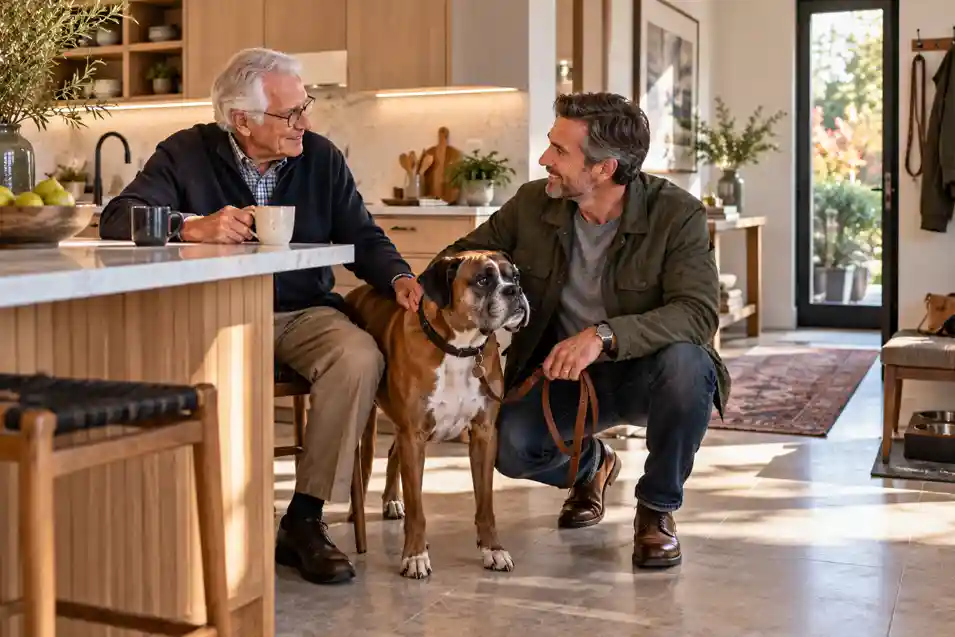
Most pet owners don’t like thinking about the possibility that one day they may not be able to care for their dog or cat.
So they don’t.
Instead, there’s often a vague family assumption:
“If something happens, one of the kids will take him.”
Maybe they will.
But which one?
Have you actually asked them?
Can they have pets where they live?
Does your dog get along with their dog?
Can they afford another animal?
Would they be comfortable managing your dog’s medications?
And what happens if you don’t need someone to take your pet forever — you just need someone to take them tonight?
These aren’t particularly pleasant questions.
They’re much easier to answer around the kitchen table today than from a hospital waiting room tomorrow.
The Worst Time to Make the Plan Is During the Emergency
Imagine someone who lives alone with a dog.
They fall at home and are taken to the hospital.
The dog is still in the house.
Someone needs to feed them, let them outside and probably take them somewhere.
Where is the leash?
What does the dog eat?
Does the dog take medication?
Who has a house key?
Which veterinarian does the dog see?
Can the dog stay with the person’s daughter?
Does the daughter even know she’s supposed to take the dog?
None of these questions is especially difficult when they’re answered ahead of time.
During an emergency, they can become one more source of stress for a family already dealing with enough.
The worst time for your family to decide who will take your pet is the same afternoon they’re trying to decide what happens to you.
Start With Two Different Questions
Pet owners often think only about permanent care:
Who gets my pet if I die?
That’s important.
But there’s another question that’s much more likely to become relevant first:
Who takes care of my pet if I temporarily can’t?
You may be hospitalized for three days.
You might spend six weeks recovering from surgery.
A fall could result in a temporary rehabilitation stay.
You might suddenly need to stay with family while work is being done to your home.
None of those situations necessarily means you’re giving up your pet.
You simply need someone else to handle their care for a while.
Your temporary caregiver and permanent caregiver don’t have to be the same person.
Who Can Take Your Pet Tonight?
This is the most immediate part of the plan.
If you unexpectedly couldn’t return home tonight, who could get to your pet?
Ideally, at least one trusted person should have access to your home or know how to obtain it.
That person should know that they are your emergency pet contact.
They don’t necessarily need to take your pet into their own home. They may simply need to feed the cat, let the dog into the yard or bring the animal to your designated caregiver.
The important thing is that somebody knows they’re responsible for that first step.
Don’t make your family figure it out after the ambulance has left.
Choose a Temporary Caregiver
Next, decide who could realistically care for your pet for several days or weeks.
This might be:
- A family member
- A close friend
- A trusted neighbour
- Your regular pet sitter
- A boarding facility
- Someone associated with your veterinarian
- Another person your pet already knows
Think about what would actually work for your animal.
A cat may be much happier remaining in their own home with someone visiting regularly.
A social dog may adapt easily to staying with family.
A dog with complicated medical or behavioural needs may require someone with specific experience.
The solution doesn’t need to look the same for every pet.
It needs to work for yours.
Then Have the Permanent-Care Conversation
This is the conversation people tend to avoid.
If you permanently became unable to care for your pet — or if you died — who would become responsible for them?
Don’t simply nominate someone privately.
Ask them.
There is a significant difference between:
“My daughter loves Charlie.”
and:
“My daughter and I have talked about it, and she has agreed that Charlie will live with her if I can no longer care for him.”
Loving your pet isn’t the same as agreeing to become their next owner.
Give the person you’re asking permission to say no.
A reluctant yes isn’t much of a plan.
Don’t Take “Of Course I Would” at Face Value
Even an enthusiastic family member needs to think through the practical details.
Where do they live?
Are pets permitted?
Are there breed or size restrictions?
Do they already have animals?
Will those animals get along with yours?
Do they have young children?
How long are they away from home each day?
Can they physically handle your dog?
Can they afford another pet?
If your animal has ongoing medical needs, are they comfortable managing them?
You aren’t interrogating them.
You’re making sure the arrangement you’ve both imagined could actually work.
Your First Choice May Not Be Your Best Choice
The person you’re emotionally closest to isn’t necessarily the best person to take your pet.
Perhaps your son adores your German Shepherd but lives in a downtown apartment and travels for work every week.
Meanwhile, your neighbour has known the dog for eight years, owns a house with a fenced yard and already looks after him when you’re away.
The practical answer may be different from the sentimental one.
The priority should be finding the home where your pet is most likely to remain safe, loved and well cared for.
Have a Second Person
A backup plan needs a backup.
The person who agrees today may not be able to help five years from now.
They could move.
Their housing could change.
They could develop health problems.
They might adopt another pet that isn’t compatible with yours.
Their financial situation could change.
Ask a second trusted person whether they would be willing to step in if your first choice couldn’t.
Then make sure both people know the plan.
Don’t Forget the Pet’s Opinion
Your dog doesn’t get to sign the paperwork, but compatibility matters.
If possible, your future caregiver should already know your pet.
Better still, your pet should be comfortable spending time with them.
If that person may eventually take your dog, let them walk the dog occasionally.
Have the dog visit their home.
If appropriate, let the pet stay overnight while you’re travelling.
This gives everyone useful information.
It also means that if an emergency happens, your pet isn’t suddenly handed to a complete stranger during an already confusing time.
Make Sure Someone Else Can Handle Your Dog
This matters particularly with large, powerful, fearful or reactive dogs.
If you’re the only person who can safely walk your dog, that’s a vulnerability in your care plan.
Your emergency caregiver should understand how the dog behaves on leash, around other animals and when frightened.
They should know what equipment you use and how to use it.
If your dog has behavioural challenges, document them honestly.
Don’t leave a future caregiver to discover that your dog hates other dogs while they’re already halfway down the sidewalk.
Create a Pet Emergency File
You don’t need an elaborate binder.
You need accurate information that another person can find quickly.
Include:
- Your veterinarian’s name and contact information
- Your pet’s name, age and basic identification
- Microchip information, if applicable
- Current medications and instructions
- Medical conditions and allergies
- Food brand and feeding amounts
- Feeding schedule
- Walking and bathroom routine
- Behavioural concerns
- Grooming needs
- Pet insurance information, if applicable
- Emergency contacts
- Temporary caregiver
- Permanent caregiver
- Backup caregiver
- Location of the leash, carrier and other essential supplies
Update the information whenever something important changes.
A perfect plan from six years ago isn’t particularly useful if the phone numbers no longer work.
Put the Emergency Information Somewhere People Can Find It
A beautifully organized folder doesn’t help if nobody knows it exists.
Tell your family or emergency contact where the information is kept.
You might keep a simple emergency card somewhere obvious in the home with the names and phone numbers of the people who should be contacted about your pet.
If you live alone, consider carrying information in your wallet or phone indicating that there is a pet at home and who should be contacted.
The goal is not to advertise personal information unnecessarily.
It’s to make sure your animal isn’t accidentally left alone because nobody realized they were there.
Keep Pet Supplies Easy to Find
If someone suddenly needs to care for your pet, don’t make them search the entire house.
Keep food, medication, leashes, carriers and essential supplies in predictable locations.
Label medications clearly.
If your pet eats a specific prescription food, make sure the caregiver knows that.
For cats, keep enough litter available.
For dogs, make sure harnesses and leashes are accessible and in usable condition.
A little organization can make an emergency handoff dramatically easier.
Think About Veterinary Decisions
If you’re hospitalized and your pet becomes ill, who can authorize treatment?
Who will pay the veterinary bill?
Does your veterinarian have your emergency contact information?
Policies and legal requirements vary, so talk with your veterinary clinic about what information or authorization they recommend having on file.
If someone may need to make decisions for your pet in your absence, make sure they understand your wishes and know how to contact the clinic.
Consider the Financial Side
Taking on another animal costs money.
Food, veterinary care, grooming, medications, boarding and unexpected medical treatment can add up.
If someone has agreed to permanently take your pet, consider whether you’re also able to provide money toward the animal’s future care.
How that should be arranged depends on where you live and your individual circumstances.
If you want to include provisions for a pet in your estate planning, speak with a qualified legal professional about the options available where you live.
Don’t assume that simply mentioning the pet in a casual note will accomplish what you intend.
Your Will Isn’t an Emergency Plan
Estate planning can be an important part of protecting a pet’s future, but it doesn’t solve the immediate problem.
If you’re taken to the hospital tonight, nobody is going to begin by reading your will to figure out who feeds the dog.
You need both.
A practical, immediate care plan tells people what to do now.
Appropriate estate planning can help address what should happen longer term.
One shouldn’t replace the other.
What If Nobody in Your Family Can Take the Pet?
This is a possibility worth confronting before an emergency.
Not everyone has children.
Not everyone’s children can take an animal.
Friends may be unable to make a long-term commitment.
If you don’t have a suitable permanent caregiver, start investigating other options while you’re still able to make the decisions yourself.
Depending on your circumstances, possibilities might include a trusted friend, your pet’s breeder, a breed-specific rescue, a reputable local rescue or another organization willing to discuss future placement.
Don’t assume an organization will automatically take your pet years from now.
Talk to them.
Understand their policies.
Have more than one option whenever possible.
Couples Need a Plan Too
Living with another person doesn’t eliminate the need for planning.
If one partner dies or becomes ill, can the other comfortably care for the pet alone?
Perhaps one person has always walked the 80-pound dog while the other handles feeding.
Would that arrangement still work with only one person?
If not, what help would be needed?
A dog walker, family member or fenced yard may make it entirely manageable.
Again, the goal isn’t to imagine disaster.
It’s to prevent one change from creating five additional problems.
Revisit the Plan When Life Changes
Your pet plan shouldn’t be something you create once and forget.
Review it when:
- You adopt another pet
- A caregiver moves
- Your housing changes
- Your pet develops a medical condition
- Your own health or mobility changes
- A family member’s circumstances change
- Your veterinarian changes
- Important contact information changes
Even reviewing it once a year is better than discovering during an emergency that every assumption is outdated.
Talk About It Before You Have To
Families often avoid conversations about illness, aging and death because they feel uncomfortable.
That’s understandable.
But this conversation doesn’t need to be grim.
It can be as simple as:
“I want to make sure Molly is looked after if I ever end up in the hospital. Could we talk about what we’d do?”
Ten minutes over coffee could prevent an enormous amount of confusion later.
And once the plan exists, you don’t have to keep worrying about it.
Planning Doesn’t Mean You’re Giving Up Your Independence
Creating a backup plan isn’t an admission that you can no longer care for your pet.
Quite the opposite.
It’s part of responsible pet ownership.
You buy pet food before the bag is completely empty.
You keep a leash by the door.
You have a veterinarian before there’s an emergency.
Planning for another person to temporarily or permanently care for your animal follows the same logic.
You hope the plan isn’t needed.
You make it anyway.
Give Your Family One Less Crisis to Solve
If something suddenly happens to you, the people who love you will already have enough to deal with.
Don’t make them simultaneously answer:
“What are we going to do with the dog?”
Tell them.
Choose the people.
Have the conversations.
Write down the routine.
Make veterinary information easy to find.
Keep supplies accessible.
Create a temporary plan and a permanent one.
And revisit both occasionally.
You can’t predict every hospitalization, fall, illness or sudden change in life.
But you can make sure that if one happens, your pet doesn’t become another emergency.
The greatest gift in planning ahead isn’t simply knowing who takes your pet.
It’s knowing that whatever happens to you, someone already knows what happens to them.