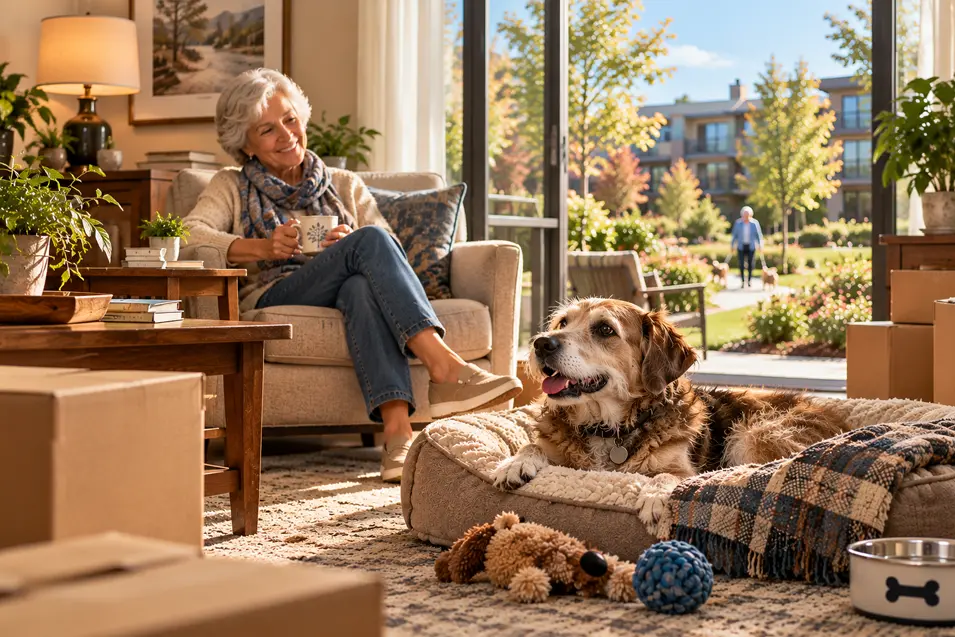
For many dog owners, walking the dog is so deeply woven into everyday life that it’s difficult to imagine not being able to do it.
Then something changes.
Maybe arthritis makes longer walks painful. Balance isn’t what it once was. Winter sidewalks feel less safe. A large dog has become too strong to comfortably handle. An illness or surgery temporarily limits mobility. Or an older couple realizes that the two or three walks they’ve managed for years are becoming increasingly difficult.
That’s often when a frightening question appears:
Does this mean I can’t keep my dog?
Sometimes circumstances genuinely do change enough that another home becomes the best option for a dog. But difficulty walking shouldn’t automatically lead to that conclusion.
Walking is only one part of caring for a dog.
Before changing the relationship, look at whether you can change the routine.
Start With What Your Dog Actually Needs
There isn’t one correct amount or type of exercise for every dog.
A young, energetic Border Collie has very different requirements from an elderly Pug. Breed matters, but so do age, health, temperament and the individual dog.
Some dogs need considerable physical activity. Others benefit just as much from shorter outings combined with sniffing, training, play and mental stimulation.
An older dog may already prefer several short excursions to one long walk.
Before deciding that you can no longer meet your dog’s needs, figure out what those needs actually are.
Your veterinarian can help, particularly if the dog is older, overweight or has health or mobility problems.
The question isn’t:
Can I still walk my dog the way I did five years ago?
It’s:
Can I still create a life that meets my dog’s needs?
Those are very different questions.
Don’t Wait Until Walking Becomes Impossible
One of the biggest mistakes is waiting for a crisis.
If walking is becoming uncomfortable or increasingly difficult, start changing the routine while you can still manage it.
That might mean reducing the length of your own walks while adding help from someone else.
It might mean installing fencing this year rather than after a fall.
It could mean teaching your dog to comfortably leave the house with a family member or professional dog walker.
Dogs thrive on routine, and gradual changes are generally easier than suddenly rebuilding their entire schedule because their owner has been injured or hospitalized.
Think of it as creating redundancy.
You may still do most of the walks today. You’re simply making sure you aren’t the only person or system capable of meeting the dog’s needs.
A Secure Fenced Yard Can Change Everything
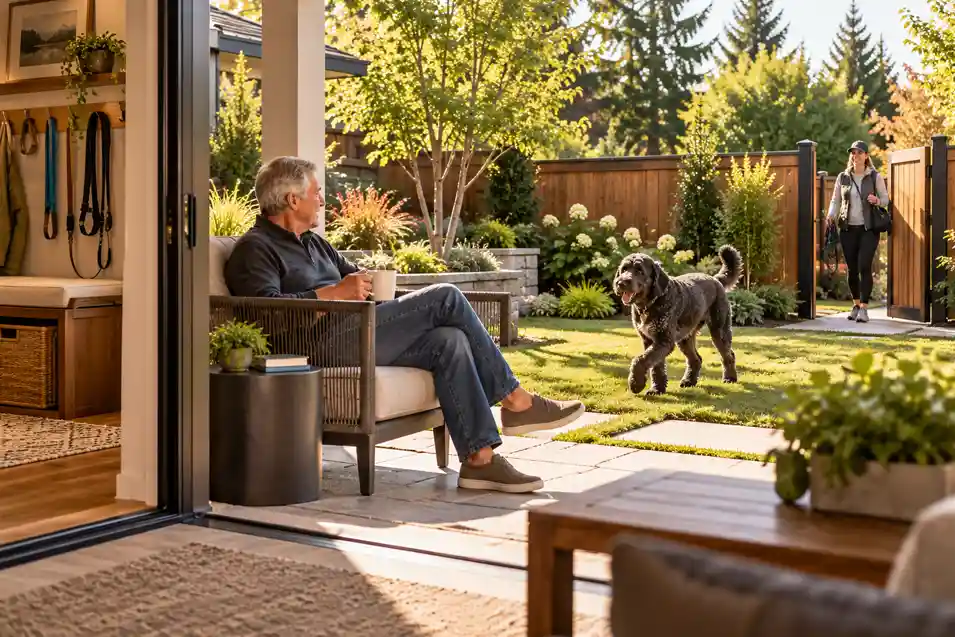
For someone struggling with mobility, direct access to a secure fenced area can dramatically simplify daily life with a dog.
That doesn’t mean opening the door in the morning and leaving the dog outside all day.
A yard isn’t automatically a substitute for walks, exercise, social interaction or enrichment.
What it can do is separate bathroom needs from exercise needs.
If every bathroom break currently requires putting on shoes, attaching a leash and walking around the block, the physical demands add up quickly.
A securely fenced area immediately outside the house means the dog can relieve themselves without requiring a formal walk every time.
Then exercise can be handled separately and more deliberately.
You May Not Need a Huge Yard
A small, well-designed fenced area can be more useful than a large property.
Ideally, it should be directly accessible from the house, visible from indoors and easy to maintain.
Avoid unnecessary stairs if possible.
Good drainage helps keep the area usable after rain. In snowy climates, keeping a short path cleared can be much easier than navigating an entire sidewalk or neighbourhood.
Lighting matters too.
Taking a dog outside at 10 p.m. shouldn’t require walking across a dark, icy yard.
For some households, creating a smaller secure dog area close to the house can be one of the most valuable aging-in-place improvements they make.
Consider a Dog Walker Before You Think You Need One
Hiring a dog walker doesn’t mean you’ve failed to care for your dog.
It means you’ve hired someone to perform a task.
We routinely pay people to cut grass, shovel snow, clean houses, deliver groceries and handle home repairs when those jobs become difficult or inconvenient.
Walking a dog can be approached the same way.
A professional walker could handle one substantial walk each day while you continue doing shorter outings.
For a high-energy dog, a walker might come several times a week for longer adventures.
If cost is a concern, even one or two scheduled walks each week can provide variety and reduce the physical burden.
The important thing is finding someone reliable whom both you and your dog know and trust.
It’s much easier to establish that relationship before you desperately need it.
Let Family Help With a Specific Job
Families sometimes have a vague conversation about helping:
“Call if you need anything.”
That’s well intentioned, but not particularly useful.
Specific arrangements work better.
Maybe a son takes the dog for a long walk every Sunday.
A granddaughter handles Tuesday and Thursday evenings.
A neighbour who already walks their own dog adds yours to the routine three mornings a week.
Someone who visits regularly takes the dog to a nearby trail.
One person doesn’t necessarily need to take over everything.
A few predictable contributions can dramatically reduce the workload while giving the dog additional activity and social interaction.
Look at Your Neighbourhood
Sometimes help is closer than you think.
A trusted neighbour may already walk every morning and enjoy having another dog along.
A responsible teenager may be interested in earning some money walking a familiar neighbourhood dog.
Friends with dogs may be happy to occasionally include yours.
The important part is reliability and suitability.
Not every dog should be handed to an inexperienced person, particularly if the dog is large, reactive, fearful or difficult on leash.
Choose help based on the dog you actually have.
Separate Exercise From Walking
Dogs don’t know that exercise is supposed to happen during a two-mile march around the neighbourhood.
Walking is excellent because it combines movement, sniffing, exploration and interaction with the environment.
But it isn’t the only way to provide those things.
Depending on the dog, alternatives can include retrieving in a fenced yard, scent games, food puzzles, hide-and-seek, training exercises, tug, searching for scattered treats, supervised play with compatible dogs and other forms of enrichment.
Even sitting outside together while a dog explores and sniffs can provide meaningful stimulation.
The goal isn’t merely to exhaust the dog.
It’s to provide an interesting life.
Don’t Underestimate Sniffing
A slow walk isn’t necessarily an inferior walk.
If you can comfortably manage only a short distance, allowing your dog time to sniff can make that outing far more enriching.
Dogs experience an enormous amount of their environment through scent.
Ten or fifteen minutes of relaxed exploration may provide more mental stimulation than hurriedly covering a much greater distance.
For older dogs in particular, a slower “sniff walk” can be wonderfully appropriate.
You don’t need to measure the value of every walk in kilometres.
Use the Backyard Intentionally
A backyard becomes much more useful when it’s treated as part of the dog’s environment rather than simply a patch of grass.
Hide treats for the dog to find.
Practice simple training exercises.
Scatter part of a meal in the grass.
Create different places to sniff and explore.
Play a short retrieving game if that’s appropriate for your dog.
Rotate toys rather than leaving everything outside permanently.
Even five or ten minutes of intentional interaction can turn the yard into something much more stimulating than simply opening the door.
Doggy Daycare Can Help Some Dogs — But Not Every Dog
For the right dog, occasional daycare can provide exercise, interaction and a significant change of scenery.
But daycare isn’t automatically appropriate for every dog.
Some dogs love busy social environments. Others find them overwhelming.
Older dogs may prefer quieter activities. Dogs with health issues may not tolerate prolonged play. Reactive or anxious dogs may need completely different arrangements.
Choose based on temperament rather than assuming every dog wants to spend eight hours in a room full of other dogs.
For some households, a small home-based daycare, trusted sitter or individual outing may be a better fit.
Make the Front Door Easier to Manage
Sometimes the difficult part isn’t actually walking.
It’s getting ready to walk.
Trying to balance while bending over to attach a leash, searching for poop bags, wrestling with boots and controlling an excited dog can turn leaving the house into the hardest part of the outing.
Create a proper dog-walking station near the door.
Keep the leash, harness, waste bags and other supplies together.
Add a stable chair or bench where you can sit while putting on shoes or attaching equipment.
Make sure the floor provides good traction.
Keep the area uncluttered.
Good home design removes unnecessary physical effort from routines you repeat every day.
Teach the Dog to Be Calm at the Door
A dog that explodes through the doorway can become dangerous for someone whose balance or strength has changed.
Training matters.
Teaching the dog to wait calmly while the door opens, stand quietly while a leash is attached and leave without pulling can make walks substantially safer.
A front-clip harness or other appropriate walking equipment may help some dogs, but equipment isn’t a substitute for training.
If handling your dog is becoming difficult, a qualified trainer may be able to help develop calmer routines.
The earlier you address pulling or door excitement, the better.
Think About the Surface Outside Your Door
A beautifully designed interior doesn’t help much if reaching the sidewalk requires navigating three icy steps.
Look at the entire route from inside the house to wherever the dog goes.
Are there stairs?
Is there a handrail?
Does water freeze near the entrance?
Is the walkway uneven?
Is exterior lighting adequate?
Would a ramp or different route make sense?
Could the dog access the fenced yard through another door with fewer obstacles?
Sometimes the problem attributed to “walking the dog” is actually a badly designed transition between the house and outdoors.
A Dog Door May Provide More Independence
For some dogs and homes, a pet door can reduce the number of times someone needs to physically escort the dog outside.
It isn’t appropriate everywhere.
Climate, wildlife, home security, the dog’s size and behaviour, and the security of the yard all matter.
In colder regions, insulated doors or enclosed transitions can help reduce drafts.
The most important requirement is that the dog door lead somewhere genuinely secure.
A pet door shouldn’t simply trade one problem for another.
Plan for Winter Differently
A routine that works beautifully in July may become dangerous in January.
Snow, darkness and ice can completely change the calculation for an older dog owner.
If winter walking becomes difficult, this may be the season when a dog walker takes on more of the exercise.
A secure yard can handle bathroom breaks.
Indoor enrichment can increase.
Walks may become shorter and happen during daylight rather than early morning or late evening.
There is nothing wrong with having different seasonal routines.
Safety matters more than maintaining an arbitrary walking schedule twelve months of the year.
Think About the Dog You Choose Next
This can be a difficult subject, but it’s an important one.
If you’re getting older and eventually considering another dog, think carefully about the life you realistically expect to have throughout that dog’s lifetime.
That doesn’t mean older adults shouldn’t adopt puppies or active breeds.
It means planning honestly.
A very large, powerful dog may become difficult to handle if strength or balance changes.
A highly energetic working breed may require more exercise than you’re likely to comfortably provide.
A tiny dog can be physically easier to manage but may also be easier to trip over.
Age, temperament, training, grooming requirements and exercise needs can matter as much as size.
Choose the dog that fits the life you’re likely to live — not simply the life you have today.
Build a Backup Plan Before You Need One
Every pet owner should have a backup care plan, regardless of age.
Who can take the dog for three days if you’re hospitalized?
Who has a key?
Who knows the feeding routine?
Where are the medications?
Who is the veterinarian?
Can somebody else safely handle the dog?
If your regular dog walker is unavailable, is there another option?
Having answers to those