
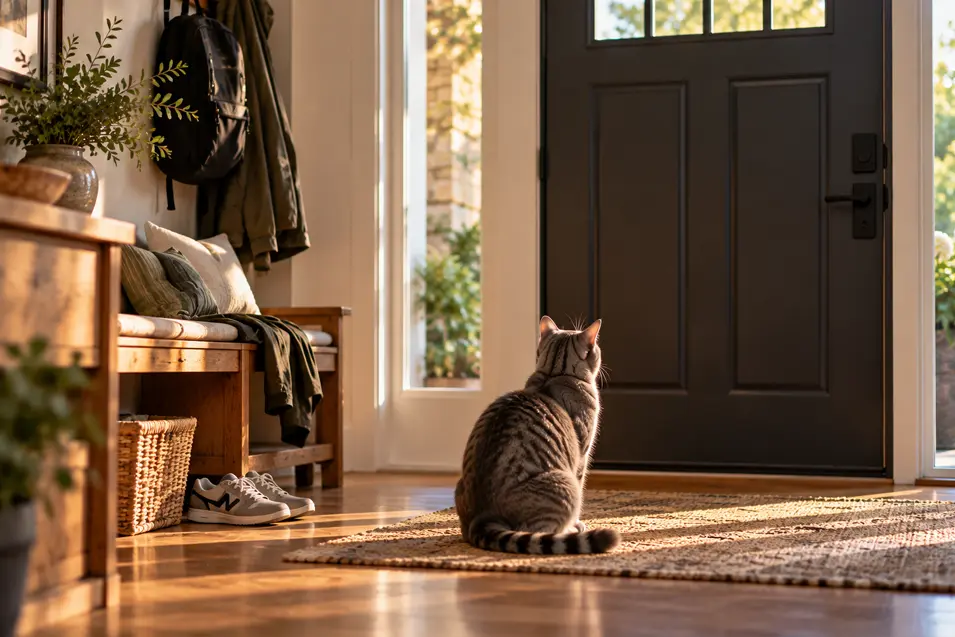
When someone leaves home, we tend to think about the people involved.
The child heading to university is thinking about classes, roommates and whether everything they own will fit into a dorm room. Someone leaving to travel for a year is thinking about flights, visas and whatever waits for them on the other side of the world. Parents are dealing with a quieter house and the strange realization that the person who used to be upstairs every night suddenly isn’t.
But there may be another member of the family trying to make sense of the change.
The dog who waited beside the door every afternoon.
The cat who slept on the end of their bed.
The animal who heard the same voice, smelled the same clothes and participated in the same little household rituals every day.
One morning that person leaves.
And unlike everyone else in the family, nobody can sit the dog down and explain that Emma has gone to university but will be home at Thanksgiving.
When my son Owen leaves for New Zealand, his cat Simba will stay with me. She’ll remain in the same house, eat the same food and have the same person filling her bowl and cleaning her litter box that she’s had for years.
From our perspective, very little about Simba’s life will change.
Except one of her people will be gone.
So what does that mean to her?
## Pets Notice When the Household Changes
We can’t know exactly how a cat or dog understands someone moving away, and we should be careful about turning animal behaviour into a human story simply because it feels right to us.
What we do know is that companion animals form social relationships and learn the rhythms of the households in which they live.
They know who feeds them. They recognize familiar voices and scents. They anticipate walks, play sessions and bedtime routines. They learn when people normally leave and when they usually come home.
Veterinary behaviour specialists describe separation-related distress as distress associated with the absence of an attachment figure. Changes in household membership—including someone moving away—are among the changes associated with separation problems in dogs.
That doesn’t mean every pet becomes distressed when a child moves out.
Many won’t.
Some animals will adjust remarkably quickly, particularly if most of their familiar environment and routine remain intact. Others may notice the absence without showing any obvious behavioural change.
For some, however, the difference can be significant.
## They Don’t Have to Understand Where You Went to Notice You’re Gone
One of the tempting questions is whether a dog or cat understands that someone has *moved away*.
That’s probably asking the wrong question.
Your dog doesn’t need to understand university, international travel or apartment leases to recognize that the person who normally comes downstairs every morning hasn’t appeared for several days.
Your cat doesn’t need a concept of New Zealand to notice that a familiar bedroom is empty every night.
What they experience is an altered pattern.
A familiar person isn’t appearing. Their scent gradually changes around the house. Certain interactions no longer happen. Perhaps breakfast arrives from somebody else, an evening walk disappears or the bedroom door that was normally open is now closed.
VCA notes that the absence of a human companion can affect both the social interaction an animal receives and the routines associated with that person.
For the pet, those everyday details may matter considerably more than the geographical explanation.
## Your Pet May Look for the Person Who Left
Some pets may investigate the places associated with the missing person.
A dog might spend more time near their bedroom or watch the front door around the time they used to arrive home. A cat may sleep on their bed or spend more time around belongings carrying their scent.
Other animals won’t appear to search at all.
Neither reaction tells us exactly what they’re thinking.
That’s important because humans are exceptionally good at constructing stories around our animals. A cat sleeping on a teenager’s abandoned hoodie might be seeking a familiar scent—or it might simply be a cat who has discovered an exceptionally comfortable hoodie.
We don’t need to decide which one it is.
Instead, watch for **changes from that particular animal’s normal behaviour**.
That’s far more useful than trying to determine whether they “miss” someone in precisely the way we do.
## Sometimes the Change Is Subtle
Not every response looks dramatic.
A pet might simply become a little more attached to another person in the household.
They may follow you more often, choose to sleep closer to you or begin appearing during parts of the day when they previously kept to themselves.
I noticed something similar with Simba after our dog Ollie died.
She became more affectionate.
I can’t tell you that Simba consciously decided she had lost one relationship and needed to strengthen another. That would be putting a human explanation onto behaviour whose motivation I can’t know.
But the household changed, and Simba’s behaviour changed with it.
Animal-welfare guidance similarly notes that after the loss of a companion, some dogs and cats become more withdrawn while others follow their remaining person more frequently. Changes in eating, sleeping, play and grooming can also occur.
A person moving away isn’t the same as another animal dying, of course. But both examples remind us that changes in the social makeup of a home can coincide with changes in an animal’s behaviour.
Sometimes those changes are surprisingly quiet.