There is a strange assumption that once you bring a dog or cat into your home, beautiful furniture is no longer a sensible idea.
Buy the cheap sofa.
Skip the nice rug.
Forget about the cream chair.
Cover everything with blankets.
And perhaps wait fifteen years before decorating properly.
We disagree.
A pet-friendly living room does not need to look like it was designed around the dog.
It simply needs to be designed with the dog — or cat — in mind.
That means choosing furniture that can handle real life.
Thinking about where your pets actually sleep.
Selecting fabrics that don’t panic at the sight of muddy paws.
Providing places for animals to settle without filling the room with unattractive pet products.
And, perhaps most importantly, accepting how your household really works.
Because there isn’t much point designing a pristine living room around the idea that the dog isn’t allowed on the sofa when the dog has been sleeping on the sofa every afternoon for the past six years.
The best pet-friendly rooms don’t fight the animals who live in them.
They accommodate them beautifully.
Here’s how.
Start With How Your Pet Actually Lives
Before choosing a sofa, rug or coffee table, spend a little time thinking about what really happens in your living room.
Not what you wish happened.
What actually happens.
Where does your dog sleep during the evening?
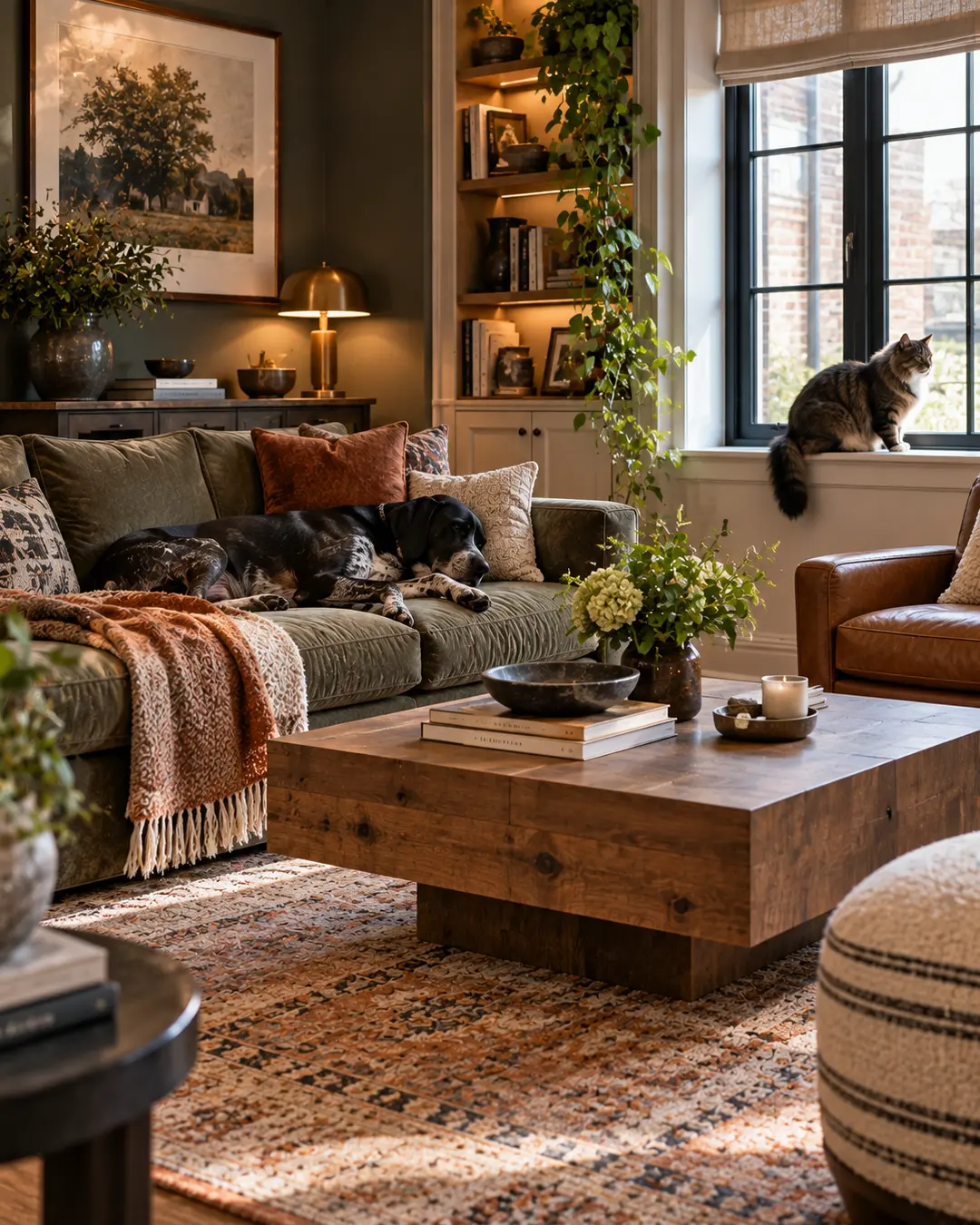
Does your cat spend every afternoon in the window?
Does the dog jump onto the sofa the moment you leave the room?
Is there a favourite chair that technically belongs to you but hasn’t been available since 2022?
Where does everyone enter the room?
Where are the busiest pathways?
Where do toys accumulate?
Where does the dog go after coming inside with wet paws?
These little behaviours matter because good interior design is partly about understanding how a room is used.
Pets are simply another part of that equation.
A Great Dane and two adults living in a small living room require different furniture than a ten-pound terrier living with someone who rarely uses the sofa.
A house with three cats may need scratching surfaces and vertical territory that a house with a Labrador doesn’t.
Start with the household.
Then design the room.
Choose the Sofa First
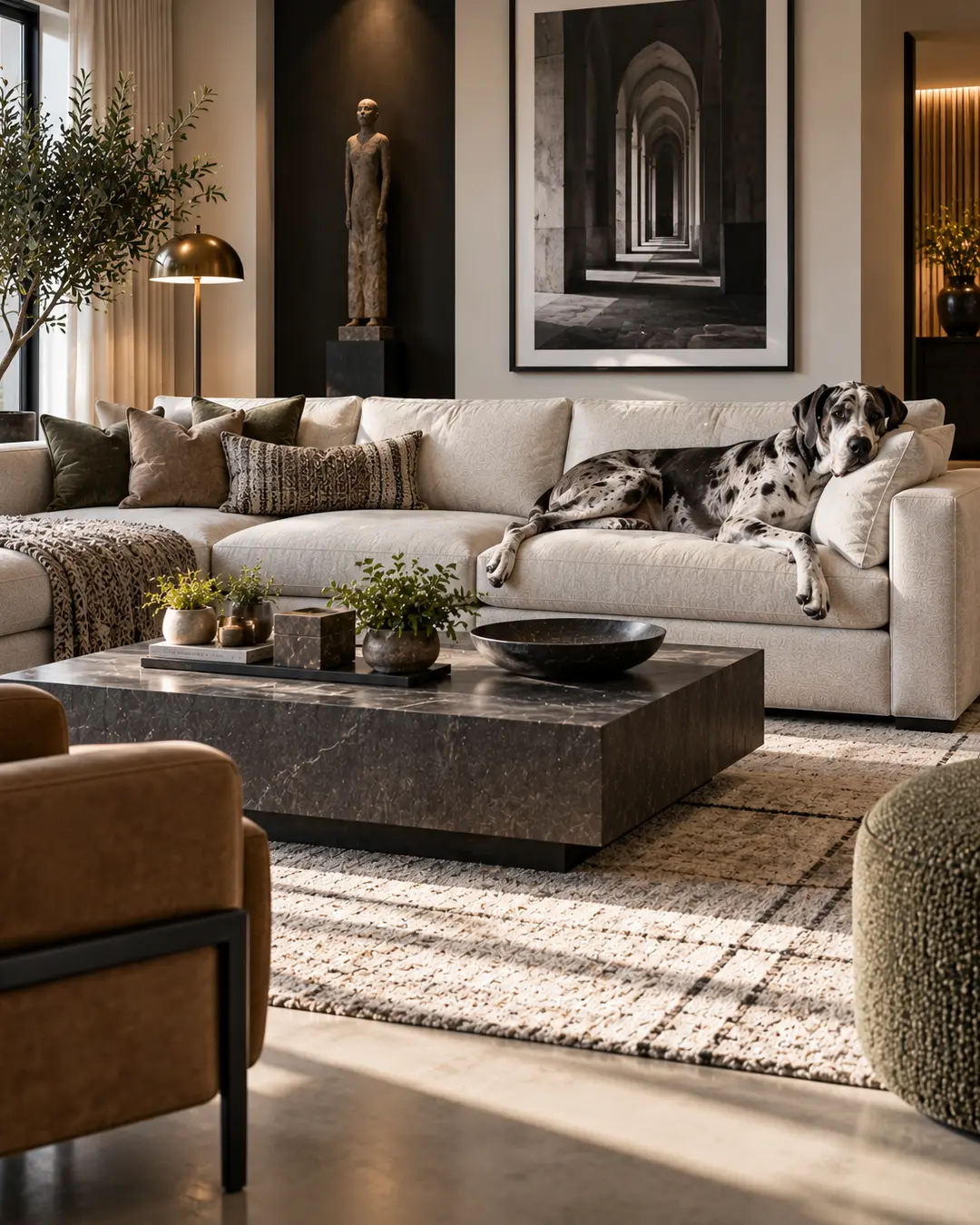
In most living rooms, the sofa is the largest piece of furniture.
It is often one of the most expensive.
And if you have a dog, there is a reasonably good chance the dog considers it communal property.
That makes the sofa one of the most important decisions in a pet-friendly living room.
Start with construction.
A well-built frame, durable suspension and good-quality cushions matter in any home, but they become particularly important when the furniture receives more use.
Then think about upholstery.
Performance fabrics have changed considerably over the years. Many now feel and look like beautiful residential upholstery while offering significantly better resistance to stains and everyday wear.
Tightly woven fabrics generally make more sense around claws than loose, heavily textured weaves.
Leather can also work extremely well in homes with pets, although it develops character differently. Claws may leave marks, particularly on softer leathers, so anyone expecting leather to remain absolutely pristine may be disappointed.
Some people love the patina.
Others don’t.
Know which person you are before buying it.
Colour matters too, but not in the way people sometimes think.
You do not automatically need a brown sofa because you own a dog.
Instead, consider the colour of the pet hair you’re actually dealing with, how frequently you’re willing to vacuum and whether a subtle texture or pattern might disguise the occasional hair between cleanings.
And if your dog sleeps on the sofa every night?
Admit it now.
Choose accordingly.
There are dozens of beautiful sofa styles available, from Chesterfields and English roll-arm sofas to contemporary modular sectionals. Pet ownership doesn’t eliminate those choices.
It simply adds another consideration to them.
Accent Chairs Still Get to Be Beautiful
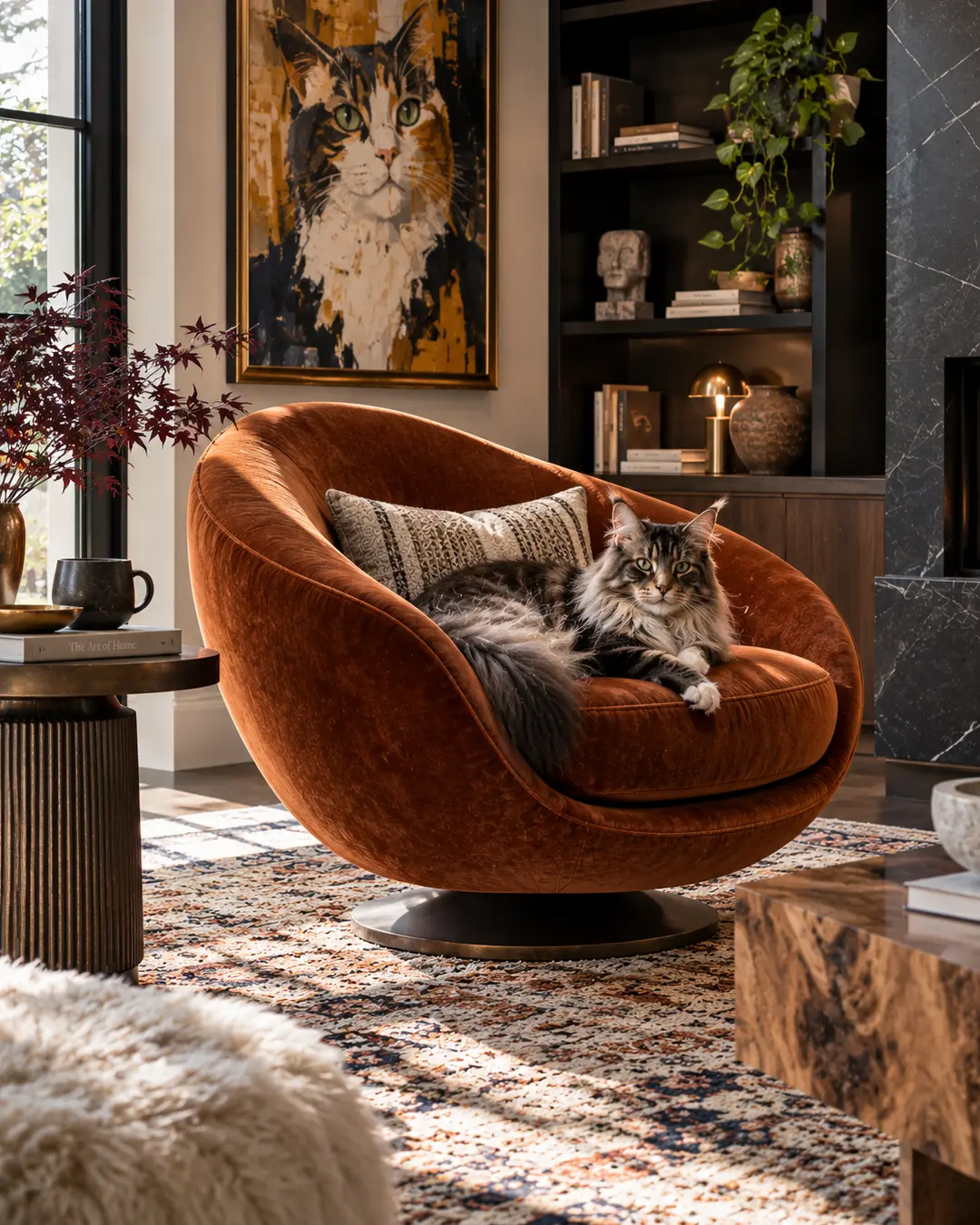
Accent chairs are where a room gets interesting.
The sofa often has to perform several jobs at once.
An accent chair can be different.
A beautiful shape.
An unexpected material.
A richer colour.
Something sculptural.
Something that makes the room feel finished.
Pets don’t change that.
But they may influence which chair works best.
If your cat scratches upholstered furniture, a delicate open weave may not be the smartest choice.
If your 90-pound dog routinely launches himself into every available chair, a tiny chair on delicate legs probably isn’t going to enjoy its new life.
If the chair will rarely be touched by the pet, however, there is no reason it can’t be the most luxurious piece in the room.
Placement matters as well.
Cats frequently choose chairs because of where they are, not because of what they are.
Put the world’s most beautiful chair beside a sunny window and you may have inadvertently purchased a very expensive cat bed.
Dogs aren’t much better.
We’ve paired enough beautiful accent chairs with dogs — and cats — to know how quickly ownership can become disputed.
Choose something you love.
Just understand that you may eventually have to negotiate for it.
Think About the Coffee Table Differently
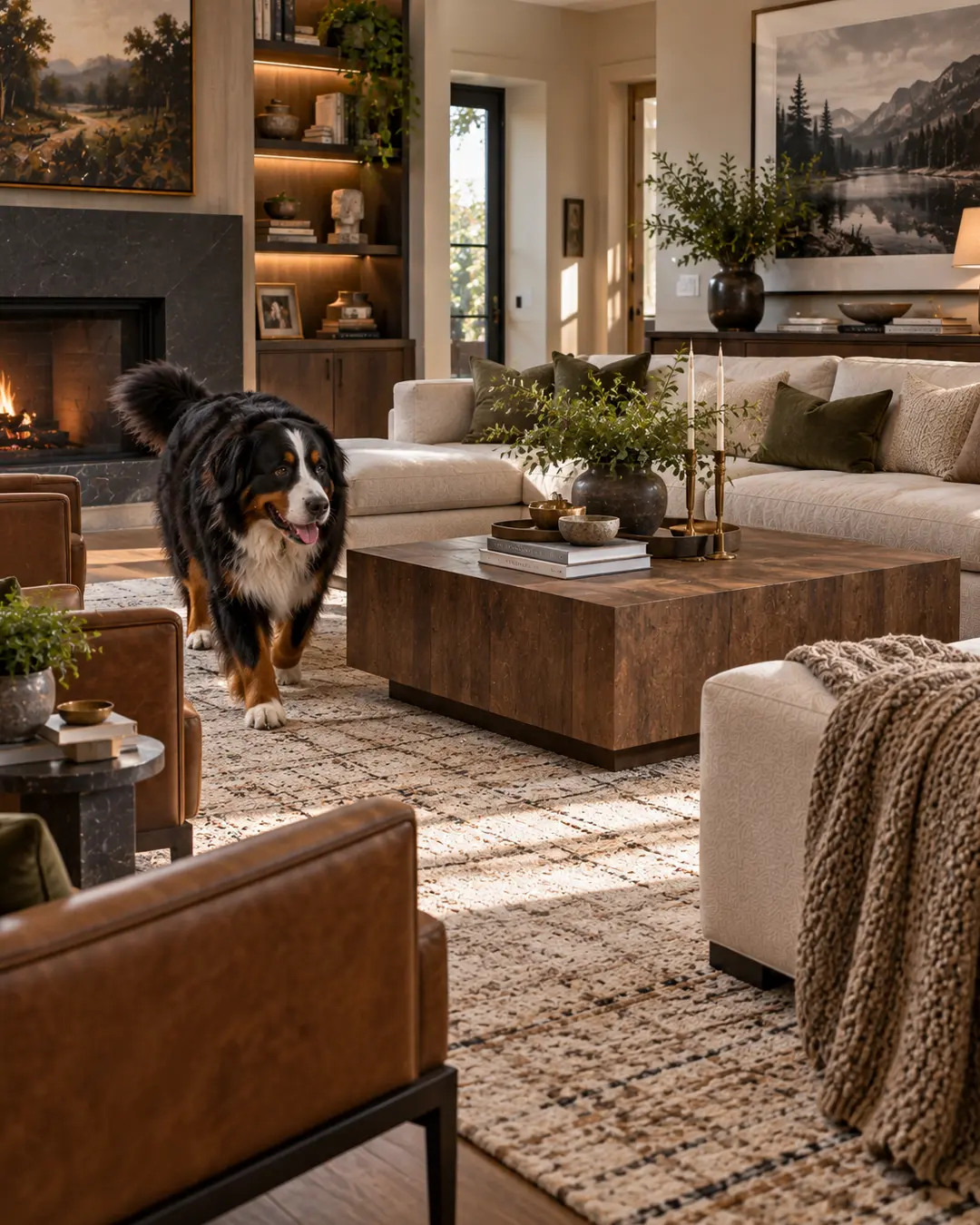
Coffee tables receive surprisingly little attention in conversations about pet-friendly design.
They should receive more.
Large dogs and delicate objects at tail height are an ambitious combination.
Small dogs racing through a room can turn sharply projected corners into hazards.
And lightweight tables positioned in major traffic routes may spend their lives being bumped.
None of this means you need a boring coffee table.
It means proportion, stability and placement matter.
A substantial wood table can work beautifully.
Stone can be exceptionally durable.
Glass can visually lighten a smaller room, although fingerprints, nose prints and enthusiastic tails may make it a higher-maintenance choice.
Rounded corners can make sense in busy rooms, particularly with larger dogs, although a well-positioned rectangular or square table can work perfectly well too.
Most importantly, leave enough room around it.
Your living room needs circulation space for people.
Your pets need it too.
The Rug Is Going to Live a Hard Life
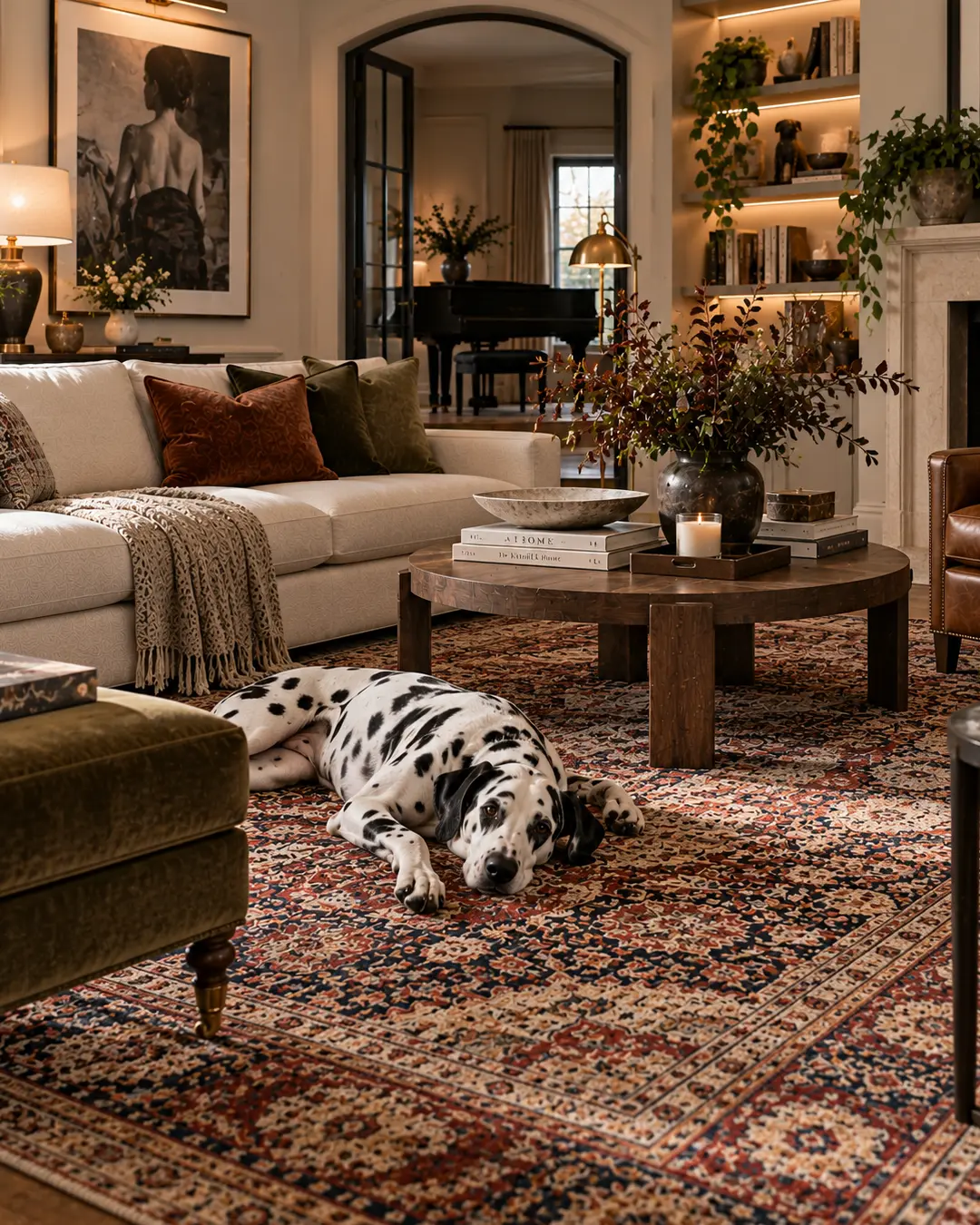
Few things transform a living room as quickly as a good rug.
It can define the seating area, introduce colour, soften acoustics and make an otherwise disconnected collection of furniture feel intentional.
It can also collect an astonishing amount of dog hair.
Pet-friendly rug selection comes down to balancing appearance with reality.
Low- and medium-pile rugs are generally easier to vacuum than very deep piles.
Dense construction tends to be easier to live with than loose loops that can catch claws.
Pattern can be enormously forgiving.
So can colour variation.
Washable rugs are useful in some households, particularly where accidents or muddy paws are frequent, but they aren’t the only answer.
A well-made conventional rug in the right material can perform beautifully for years.
The mistake is assuming that because you have a pet, the rug doesn’t matter.
It does.
A tiny inexpensive rug floating beneath the coffee table can make an otherwise beautiful room feel unfinished.
Buy the appropriate size for the room.
Then choose a construction you can realistically maintain.
Flooring Matters More Than Almost Anything
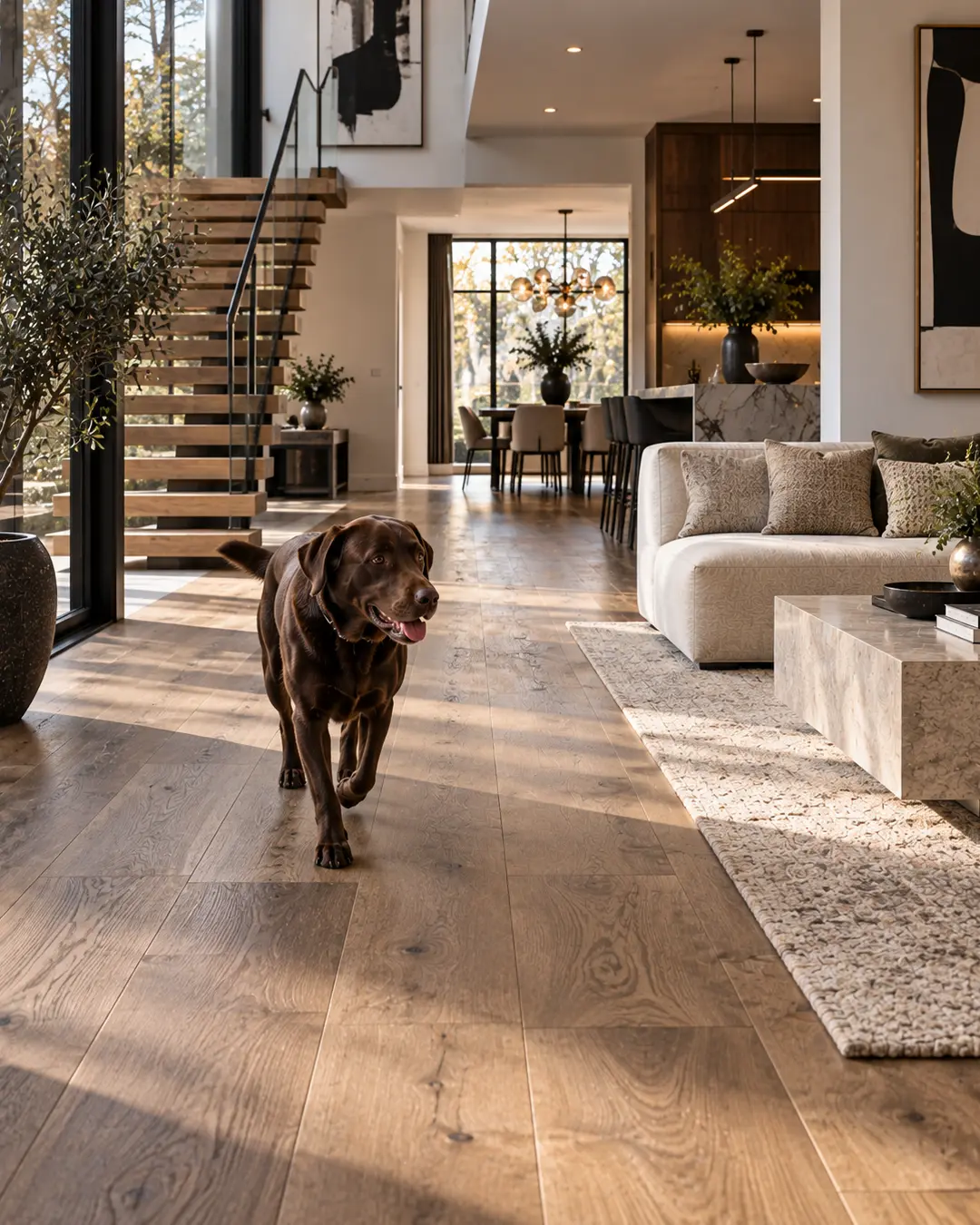
The floor is the one surface your pet uses constantly.
That makes flooring one of the biggest decisions in a pet-friendly home.
Dogs need traction.
Owners need durability.
Everyone would prefer something that still looks good after years of use.
Hardwood is beautiful, but species, finish and sheen can dramatically affect how visible scratches become.
Engineered wood can provide many of the visual benefits of hardwood with different performance characteristics depending on the product.
Luxury vinyl has become popular partly because of its resistance to moisture and everyday wear.
Tile can be exceptionally durable, although it may be cold and slippery for some animals.
Laminate quality varies considerably, but many modern products offer excellent durability.
There isn’t one universally perfect pet-friendly floor.
A quiet household with a twelve-pound dog has very different requirements from a home with two 100-pound dogs running through the living room after playing outside.
Consider traction, scratch resistance, moisture resistance, maintenance and how the material will age.
Then consider appearance.
You still have to live there too.
Give the Dog Somewhere Better Than the Middle of the Floor
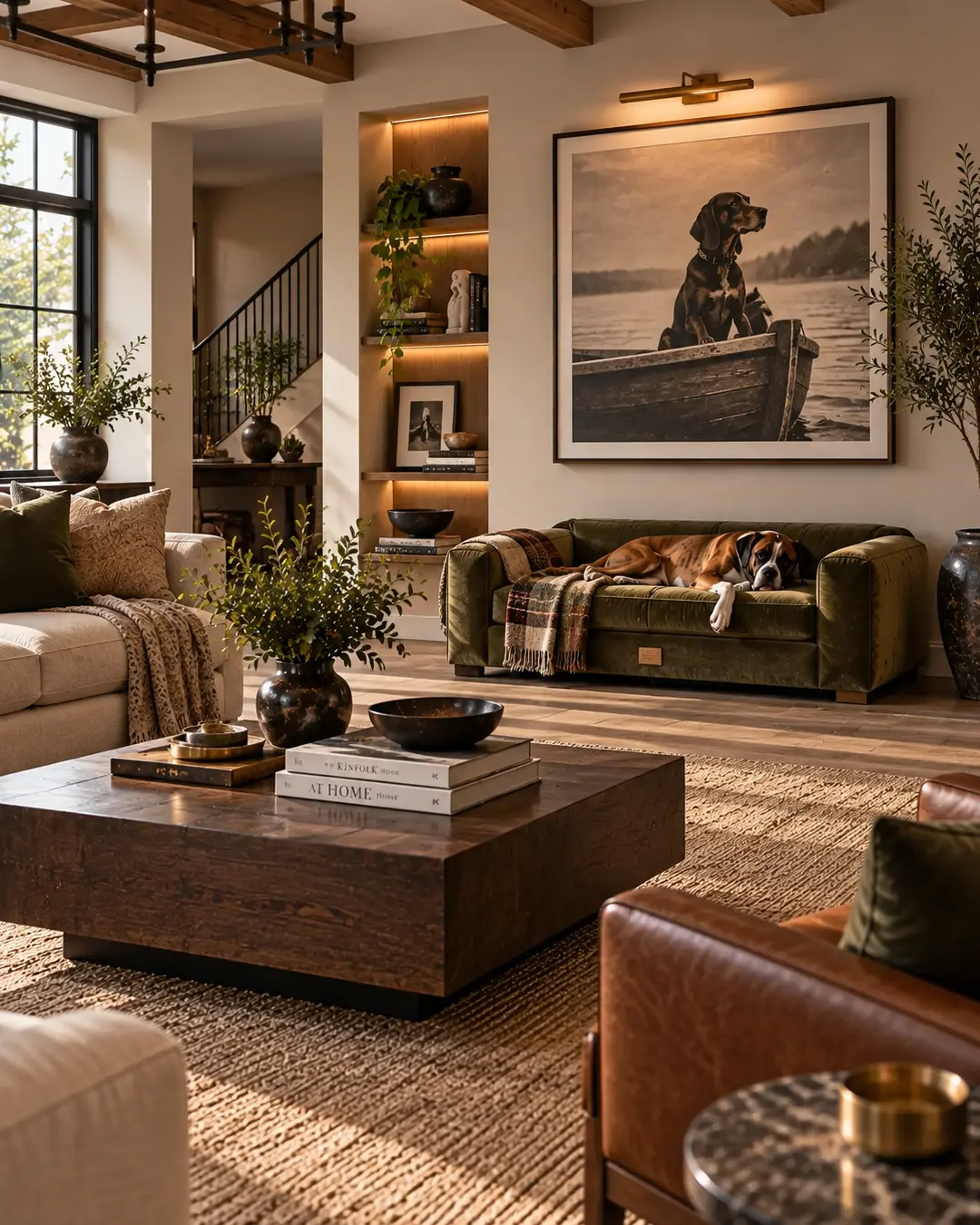
Dog beds have historically been treated as pet supplies rather than furniture.
That is changing.
And it should.
If you’ve spent thousands of dollars furnishing a beautiful living room, dropping an unattractive dog bed into the middle of it shouldn’t be the final step.
Treat the dog’s sleeping area as part of the furniture plan.
Think about scale.
A bed should be large enough for the dog to sleep comfortably without dominating the room unnecessarily.
Think about placement.
Most dogs don’t want to be banished to an unused corner.
They want to be near you.
A dog bed positioned near the seating area allows the dog to remain part of the household without sitting directly in the traffic path.
And think about design.
There are beautiful upholstered dog beds, furniture-style dog sofas and custom options that can coordinate with the rest of the room.
You can even use complementary upholstery rather than attempting to match everything exactly.
The goal isn’t to disguise the fact that a dog lives there.
It’s to make the dog’s belongings feel like they belong there too.
Cats Need More Than Floor Space
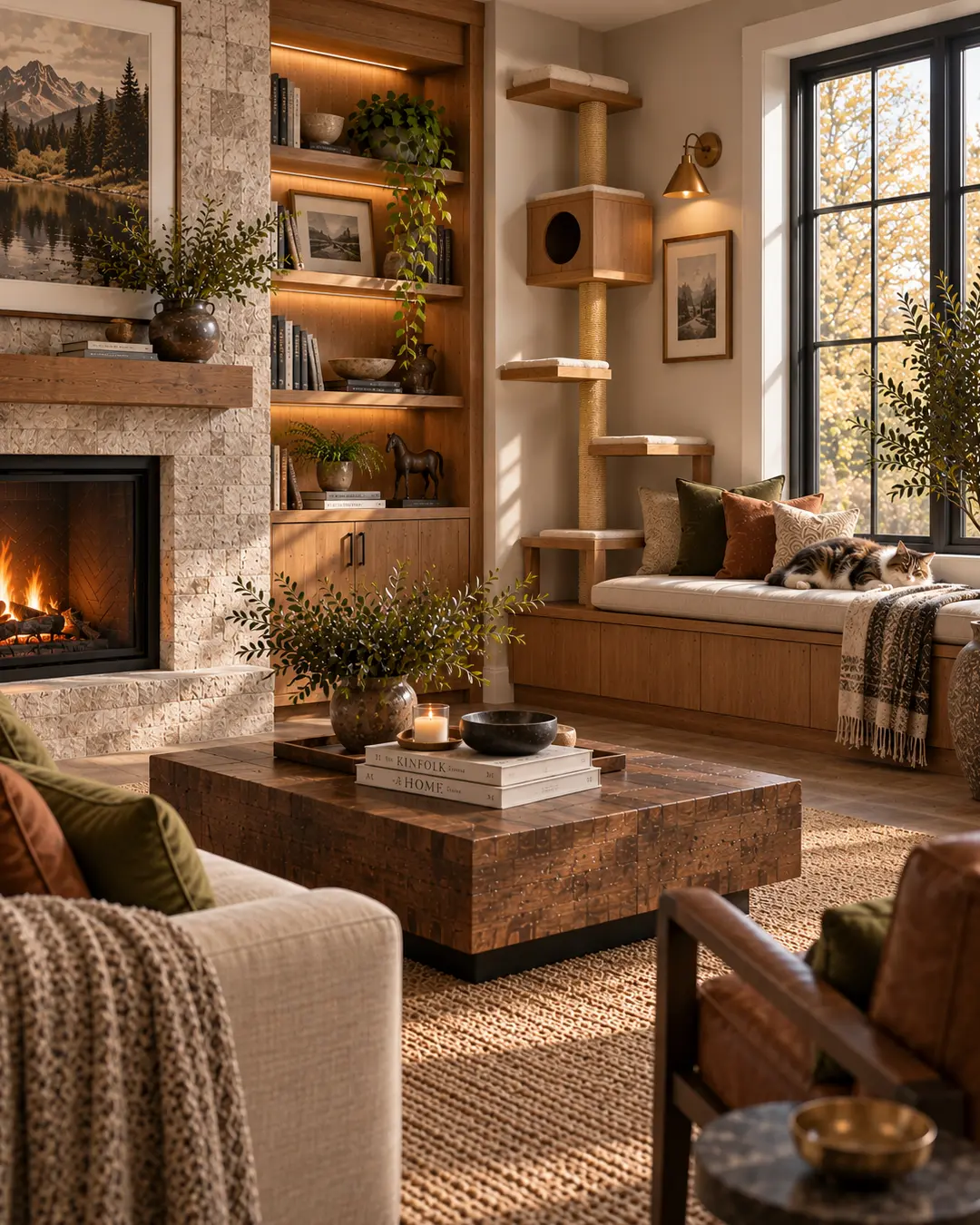
Dogs tend to occupy rooms horizontally.
Cats add another dimension.
They look up.
Window ledges.
Bookcases.
Shelves.
Chair backs.
Cabinet tops.
The mysterious six-inch space above something you were certain no animal could possibly reach.
A cat-friendly living room should acknowledge this without turning the room into an indoor amusement park.
Sometimes furniture placement is enough.
A chair or bench near a window may provide exactly the perch a cat wants.
A substantial scratching post positioned intelligently can protect other furniture while giving the cat somewhere appropriate to stretch.
Built-in shelving can sometimes provide vertical territory without looking remotely like cat furniture.
The best solutions often disappear into the design.
The cat knows they’re there.
Visitors simply see a beautiful room.
Design Around Traffic Flow
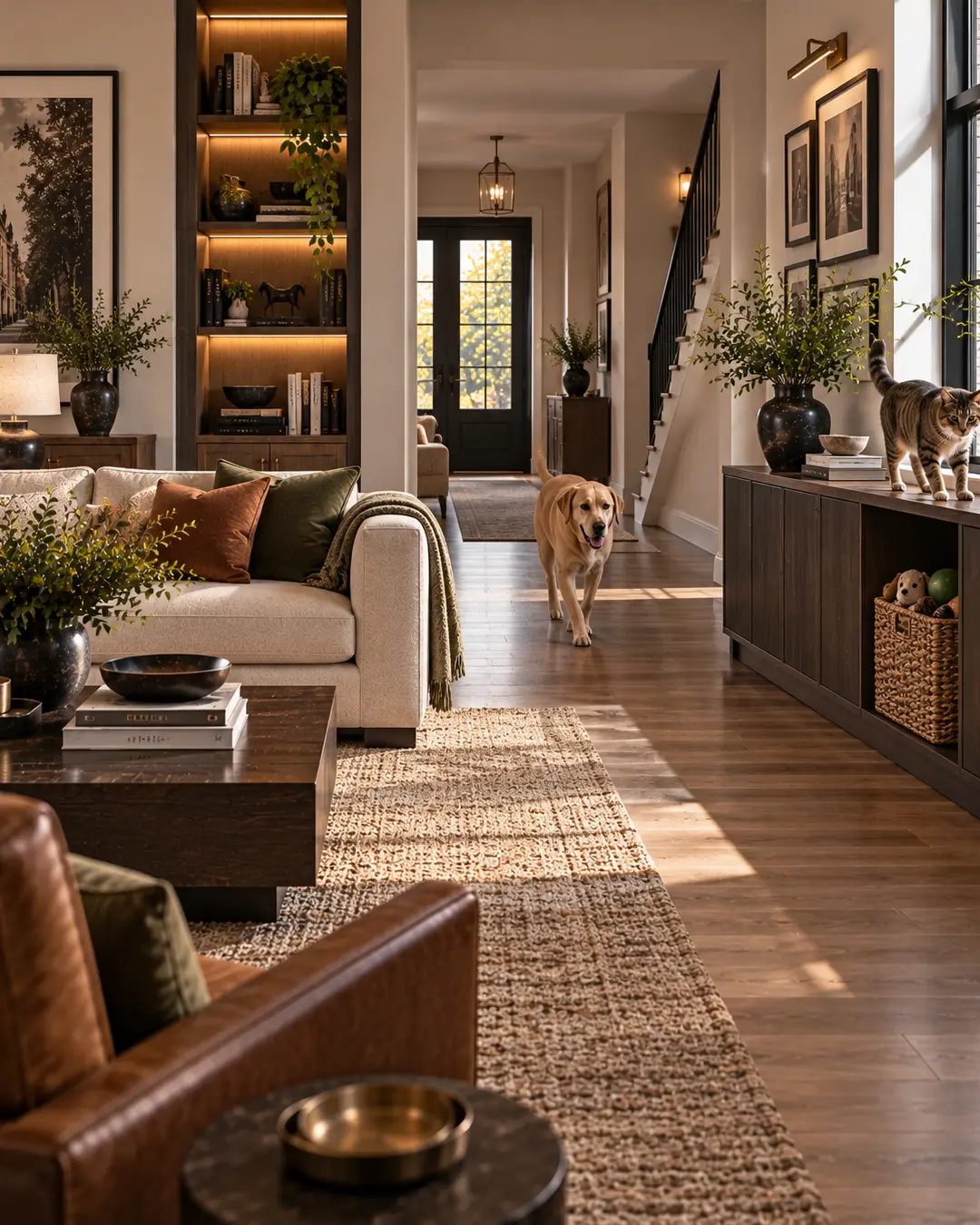
Every household develops invisible pathways.
People walk from the hallway to the sofa.
The dog walks from the sofa to the front window.
The cat jumps from the chair to the console to the windowsill despite having perfectly good access to the floor.
Pay attention to those routes.
Furniture placed directly in an established pathway will constantly be bumped, walked around or jumped over.
Fragile accessories become particularly vulnerable.
Instead of fighting the movement, design around it.
Leave clear paths between doorways.
Give larger dogs enough room to turn comfortably.
Avoid squeezing furniture into every available space.
A room with slightly less furniture and better circulation often feels larger, calmer and more expensive anyway.
Pet-friendly design sometimes turns out to simply be good design.
Make the Pet Stuff Disappear
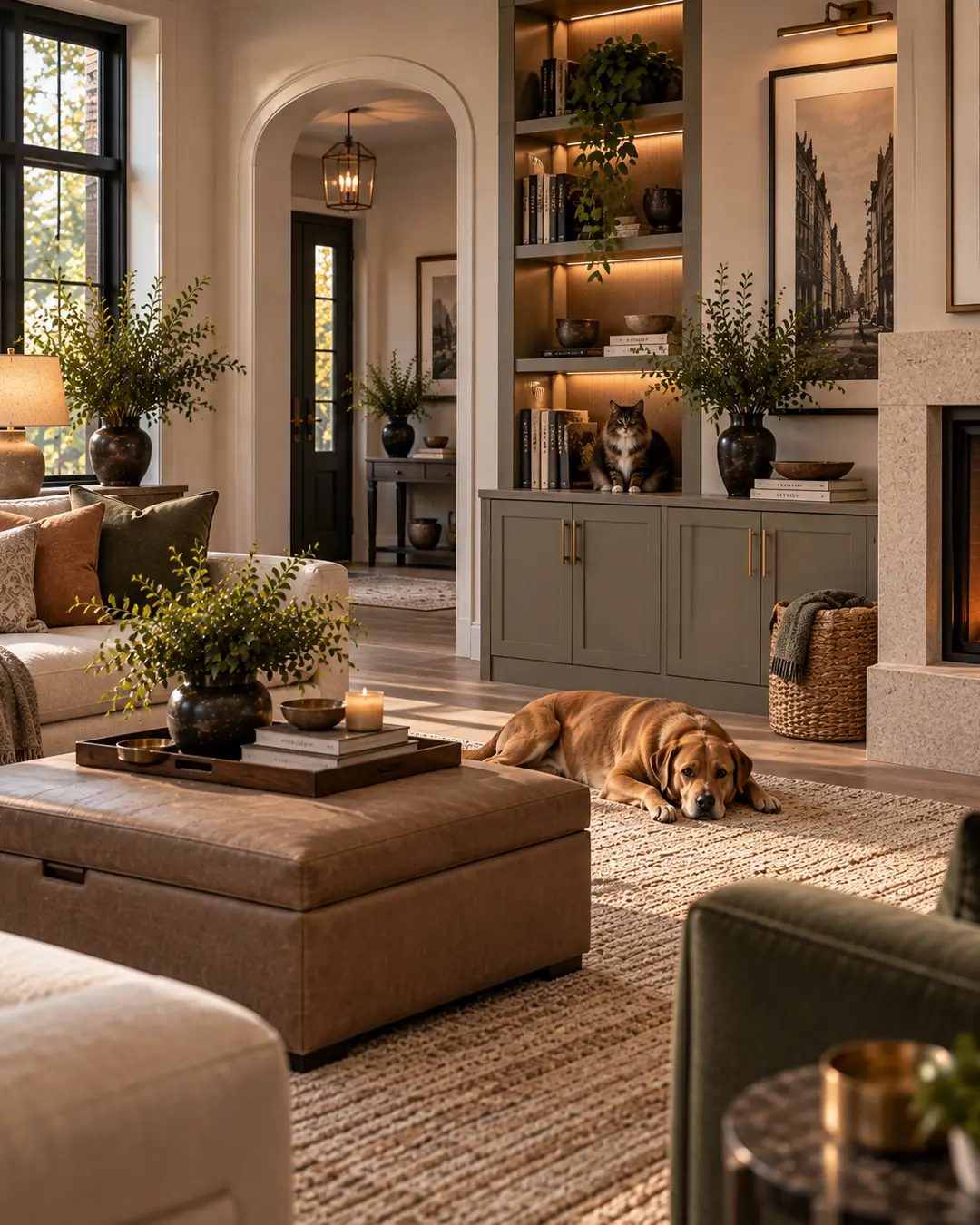
Dogs and cats accumulate possessions.
Toys.
Leashes.
Brushes.
Blankets.
Treats.
Waste bags.
Grooming supplies.
And, somehow, seventeen versions of essentially the same ball.
You don’t need to see all of it.
A beautiful basket can hold the toys that are used every day.
Closed cabinetry can hide everything else.
A console with drawers can become the place for leashes and walking supplies.
An ottoman with storage can hold blankets.
If the living room is close to the main entrance, a dedicated drawer or cabinet for pet essentials can make everyday routines considerably easier.
The goal isn’t to pretend you don’t own a pet.
It’s to prevent the pet’s belongings from becoming the visual focus of the room.
Be Smarter About Art and Accessories
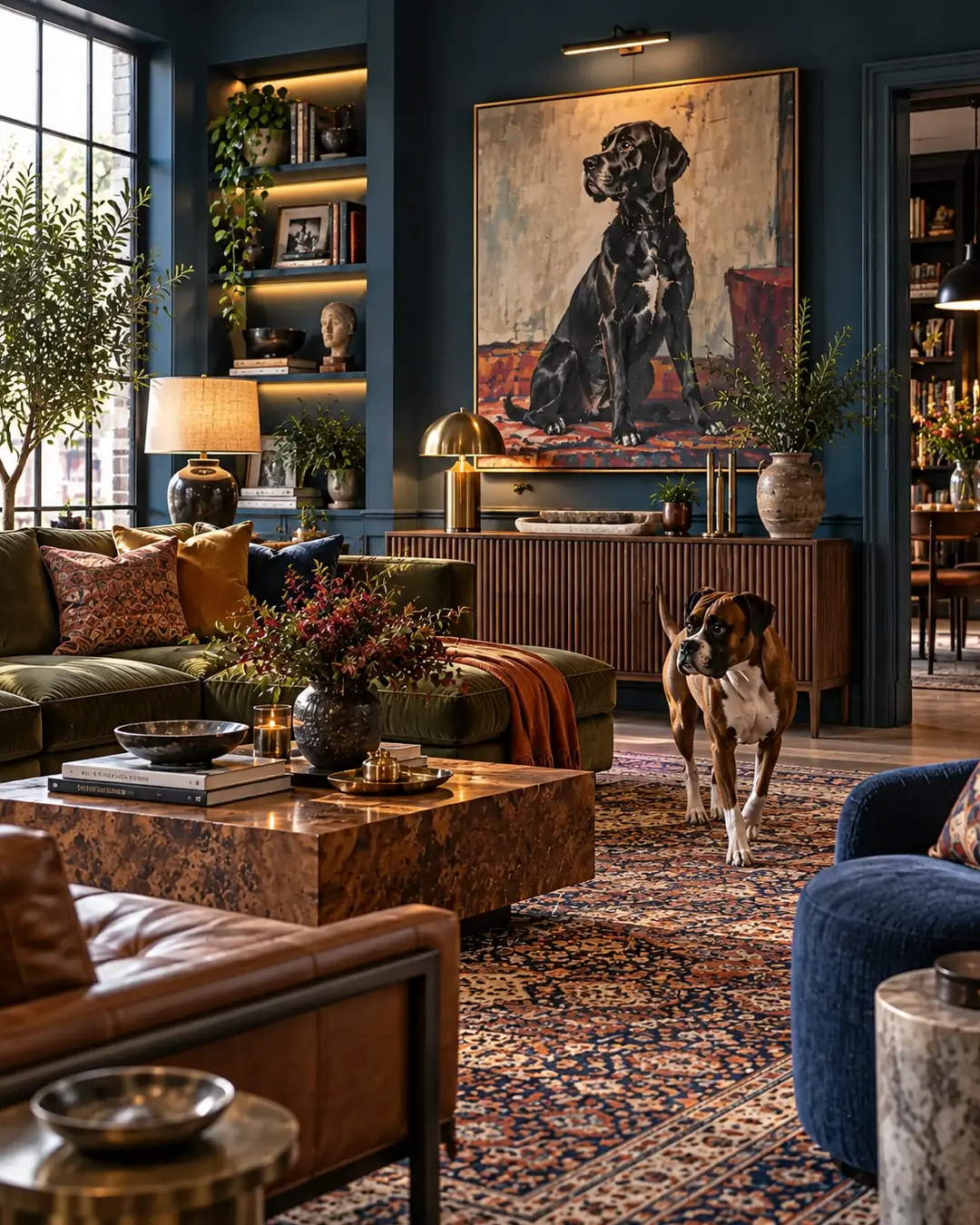
You should still decorate.
Please.
Owning a Labrador does not mean every surface in the house must remain empty for the next twelve years.
But consider where things are placed.
A collection of fragile objects on a low table directly beside the route your dog uses to race toward the front door probably isn’t going to end well.
Tall, lightweight floor lamps may not be ideal beside enthusiastic large dogs.
Anything positioned at tail height deserves a moment of consideration.
Use walls.
Art adds personality without occupying valuable floor space.
Choose substantial lamps.
Use trays to organize smaller objects on tables.
Place fragile pieces where they aren’t directly exposed to everyday chaos.
And don’t remove every interesting thing from the room in the name of practicality.
A pet-friendly room should still look like people live there.
Don’t Buy Everything in the Colour of Your Dog
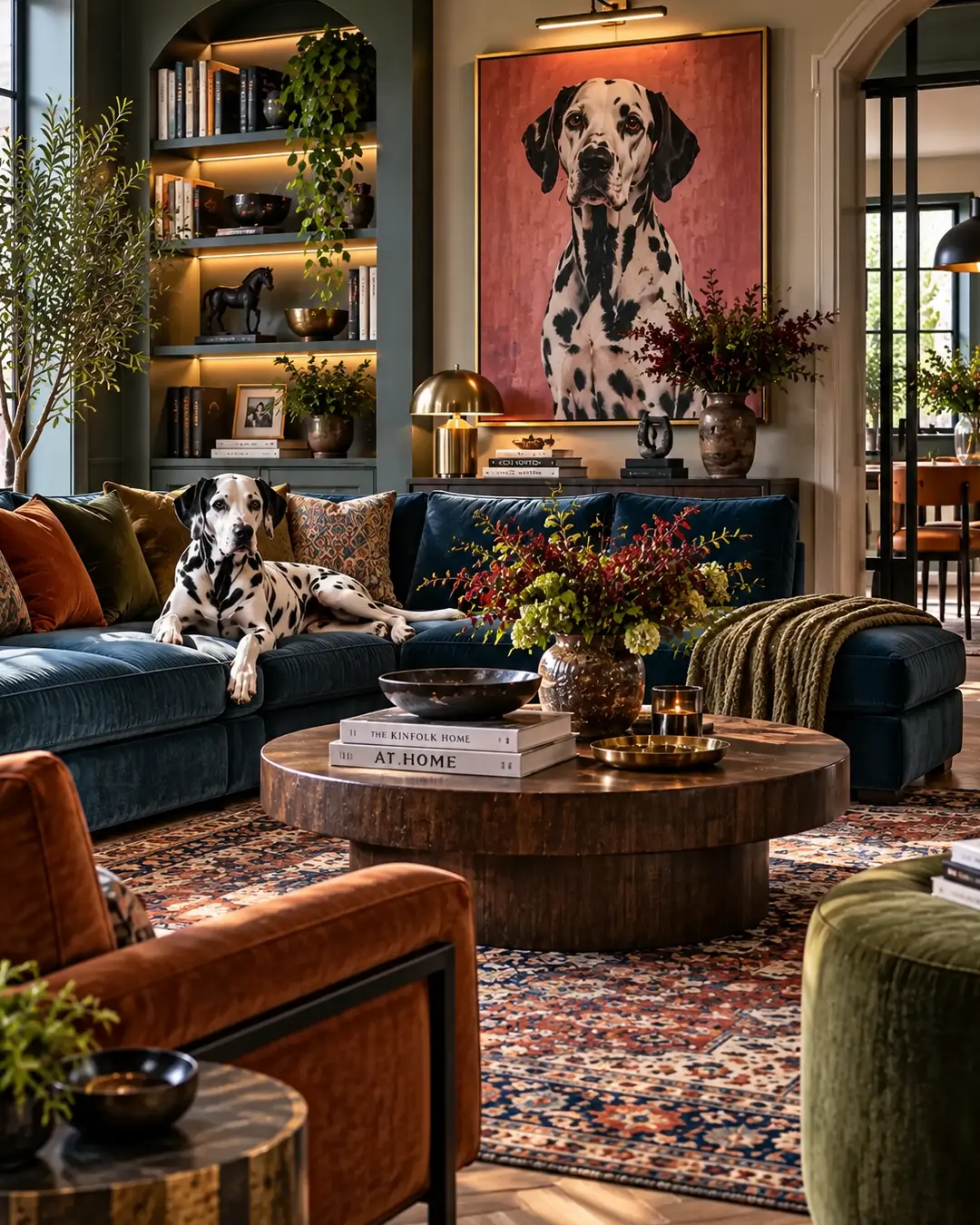
This advice appears surprisingly often.
Own a black dog?
Buy a dark sofa.
Own a white dog?
Buy a light one.
There is some logic here.
Pet hair is less visible against similar colours.
But your entire decorating scheme does not need to be determined by the Labrador.
There are other ways to handle hair.
Texture.
Pattern.
Regular vacuuming.
Washable throws in the places where your pet actually sleeps.
Good upholstery.
A cordless vacuum that you don’t hate using.
Choose colours that work with your home.
If they also happen to disguise dog hair, excellent.
But don’t spend the next decade living in a beige room because someone told you it matched the Golden Retriever.
Don’t Design the Entire Living Room Around the Pet
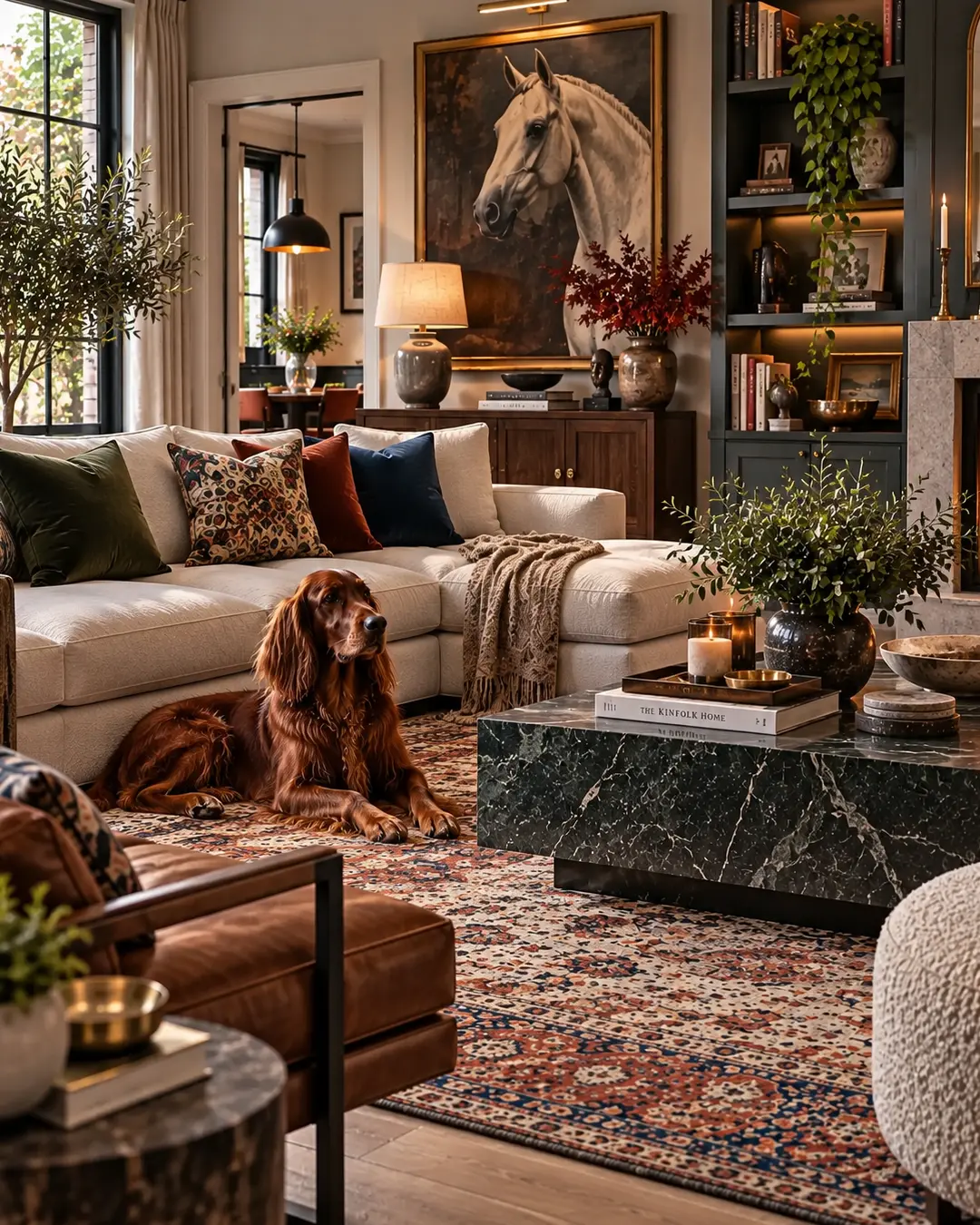
This may be the most important rule.
Pet-friendly design is not pet-first design.
You are allowed to own nice things.
You are allowed to have a white chair.
You are allowed to buy the sofa you’ve wanted for years.
You are allowed to own a beautiful rug.
You are even allowed to have decorative objects sitting on tables.
The objective is not to create a room that your dog cannot possibly damage.
Such a room probably doesn’t exist.
The objective is to make intelligent decisions about the things that matter most.
Use durable materials where they receive heavy wear.
Choose appropriate upholstery for furniture the pets actually use.
Provide attractive alternatives.
Think about traffic.
Plan storage.
Accept a little imperfection.
Then decorate the room you actually want.
Because a house shouldn’t become less beautiful simply because an animal lives there.
If anything, pets are part of what turns a beautifully decorated house into a home.
The Best Pet-Friendly Living Rooms Don’t Look Pet-Friendly
Walk into a truly successful pet-friendly living room and you shouldn’t immediately notice all the compromises.
You should notice a beautiful sofa.
A great chair.
A properly sized rug.
Interesting art.
Good lighting.
Furniture arranged in a way that makes the room comfortable and inviting.
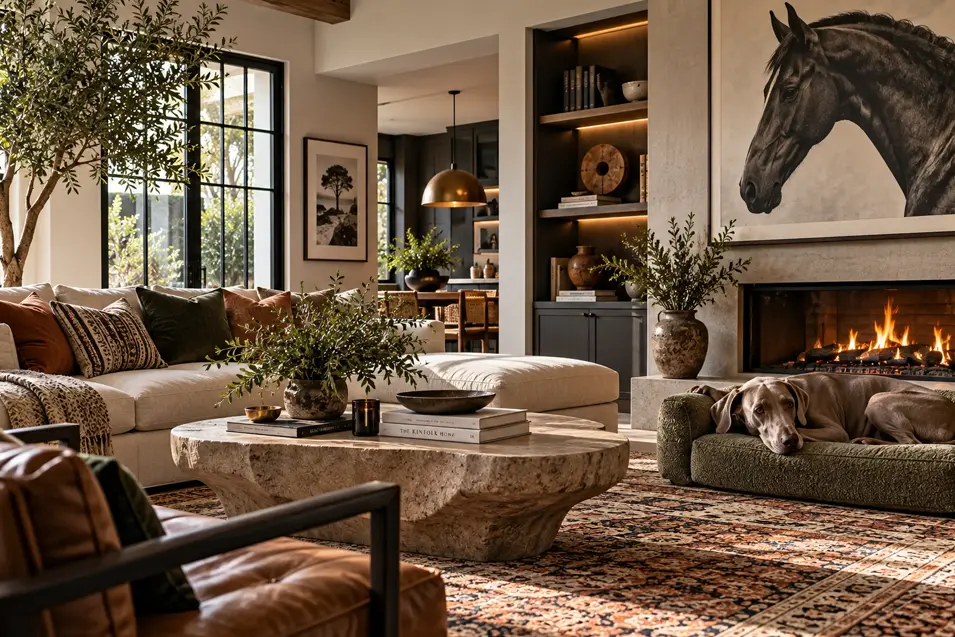
Then perhaps you’ll notice the dog asleep on an upholstered bed beside the sofa.
Or the cat stretched across the chair near the window.
That’s the goal.
Not a living room designed for pets.
Not a living room designed despite them.
Just a genuinely beautiful room designed for everyone who lives there.
Including the ones who leave hair on the sofa.
More Beautiful Furniture for Dog-Friendly Homes
A pet-friendly living room doesn’t mean settling for boring furniture.
If the sofa is still the star of your room, explore our guide to sofa styles and designs — or take things one step further and see why your sofa should be nicer than your dog’s, where beautiful dog-sized furniture becomes part of the room rather than something you try to hide.