Architecture can make a remarkable photograph all by itself.
Give us soaring ceilings, impossible geometry, an abandoned building, a perfect reflection or a shaft of light falling exactly where it should, and we’re quite happy.
So for this collection, we tried something different.
We put a dog in the photograph — and then deliberately refused to make the dog the subject.
Sometimes he’s barely there. A tiny figure crossing an enormous cathedral. Standing at the far end of a silent swimming pool. Waiting alone in an empty train station. Wandering through a building everyone else seems to have forgotten.
The architecture still gets top billing.
But something strange happens when you add the dog.
The building stops being empty.
Suddenly there’s scale. Movement. Curiosity. And, occasionally, a question you weren’t expecting to ask.
Where is he going?
What is he waiting for?
And how exactly did that dog get in there?
These aren’t really photographs of dogs.
At least, that’s what we keep telling ourselves.
The Factory That Forgot Its Purpose
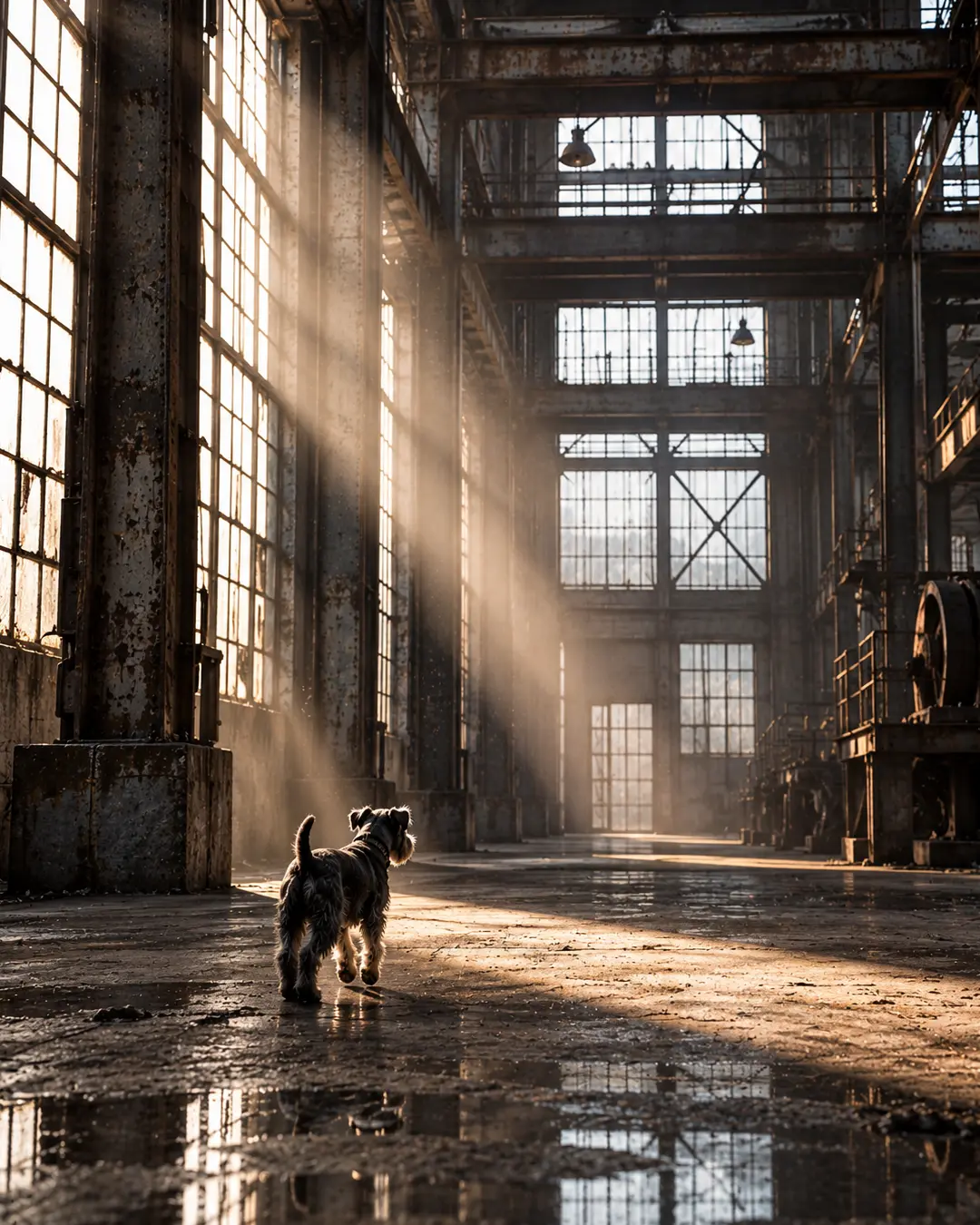
The first thing you notice is the scale.
Steel columns rise several storeys. Enormous factory windows repeat into the distance. Old machinery still occupies the edges of a building that once existed for noise, movement and work.
Now there is none.
Just rust, dust and late-afternoon sunlight cutting through the windows.
Then a small dog walks into the frame.
He doesn’t make the building feel smaller.
He makes you realize just how enormous it is.
And because he’s moving deeper into the factory rather than toward us, the photograph suddenly has a story.
You want to follow him.
Which is strange, because a moment ago you were perfectly happy just looking at the architecture.
Architecture Drawn With Light
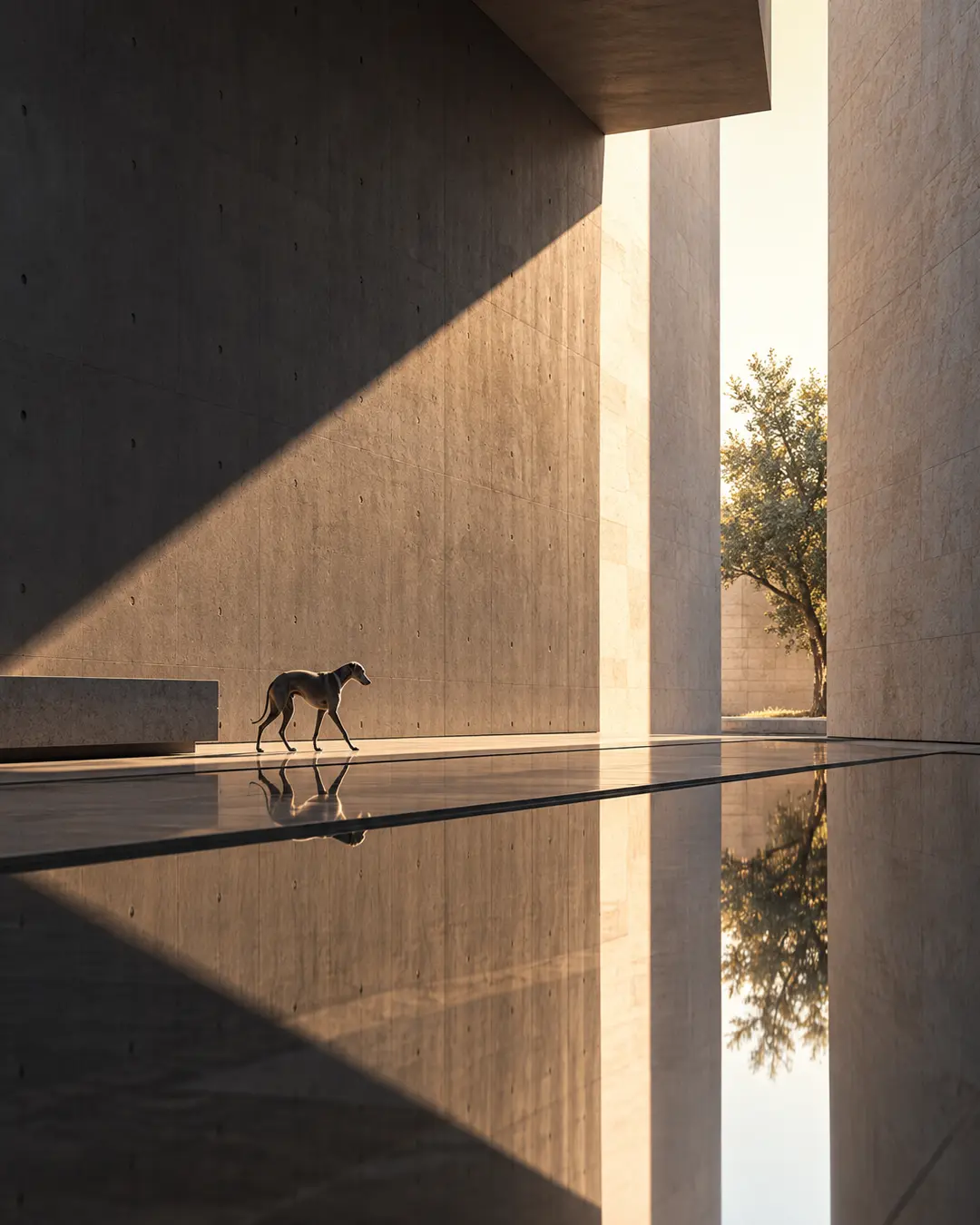
There is almost nothing here that doesn’t feel deliberate.
The enormous concrete planes. The narrow opening to the sky. The single tree perfectly framed beyond the stone walls.
And then there is the light.
It cuts diagonally across the concrete, continues across the floor and appears again in the reflection below. The architecture has essentially become a study in geometry.
The dog just happens to be walking through it.
Except his long, slender silhouette is so perfectly suited to the space that he begins to look like another line in the composition.
For a moment, the architecture and the dog seem to be speaking the same language.
Where the Light Lands
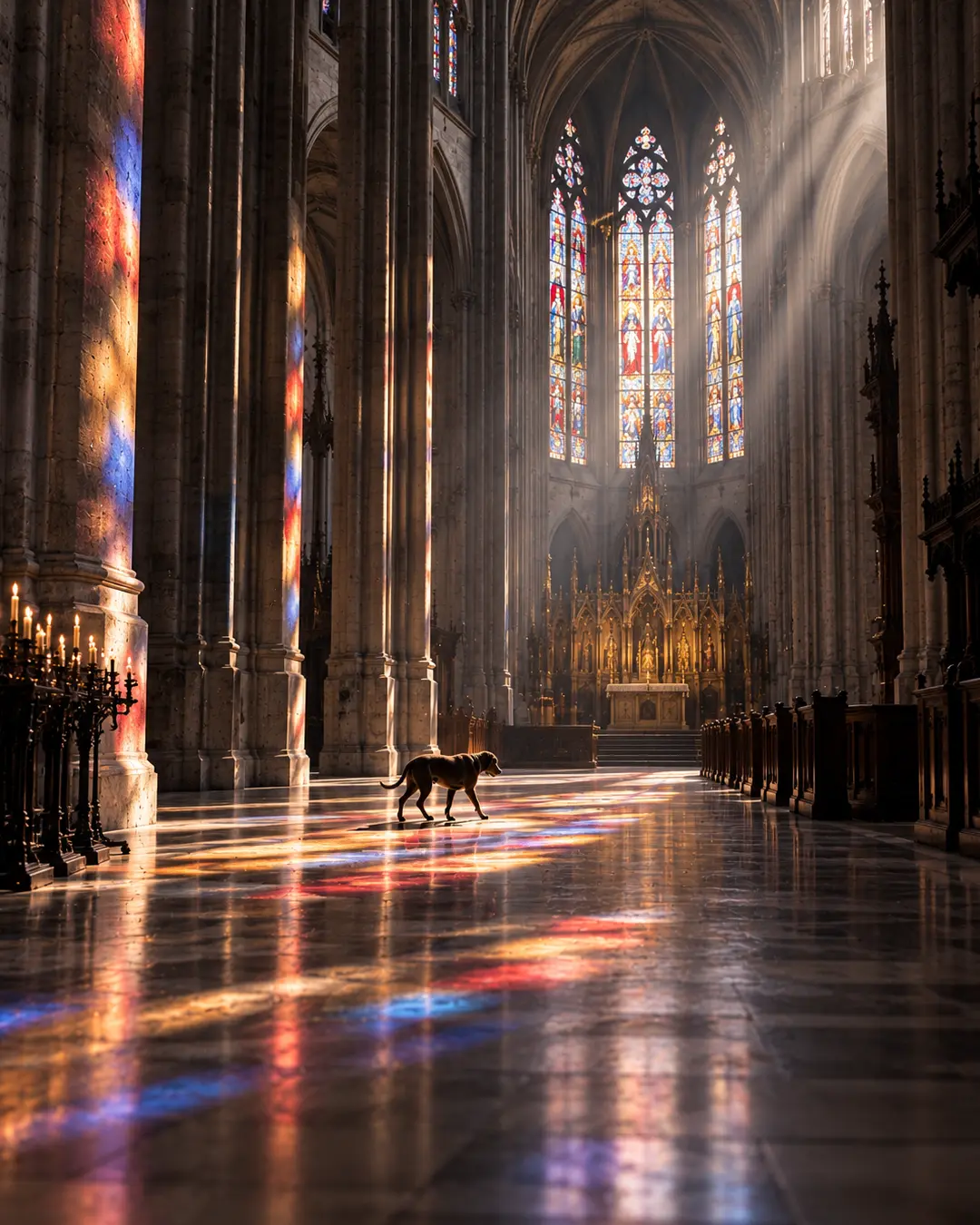
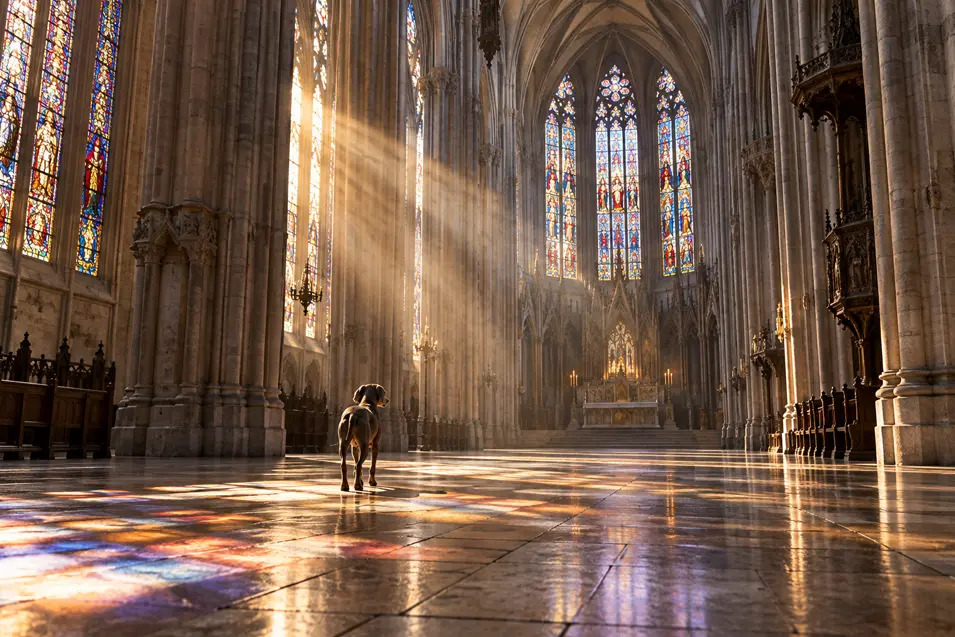
The cathedral doesn’t need help.
The height of the nave, the forest of stone columns, the distant altar and those extraordinary stained-glass windows already give the photograph more than enough to work with.
But the light is what holds everything together.
Colour spills through the glass, climbs the columns and stretches across the polished floor in great pools of red, blue and gold.
And right through the middle of it walks a dog.
Not posing.
Not looking at us.
Just crossing the cathedral as though this is somewhere he passes through every afternoon.
The architecture creates the spectacle. The dog makes it feel like a moment.
The Last Passenger
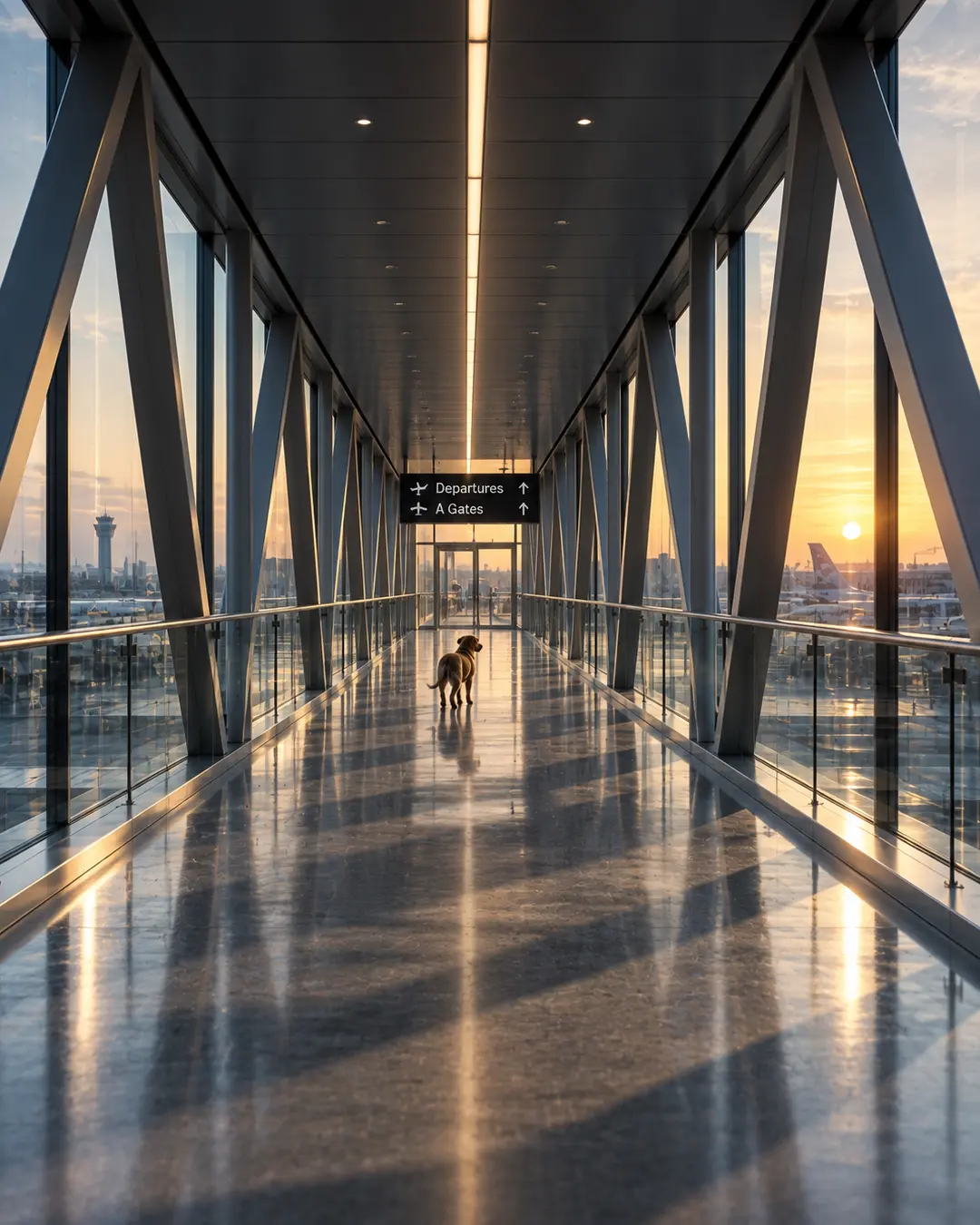
Airports are built around movement.
The repeating steel braces, glass walls and long polished floor all pull your eye toward one place: departures.
But nobody is departing.
There are no rolling suitcases. No families hurrying toward a gate. No one checking a phone while trying to remember where they put their passport.
There is just an empty skybridge at sunset.
And one dog standing almost perfectly at its centre.
Suddenly the photograph stops being about symmetry.
Now you want to know where he’s going.
Everything in Its Place
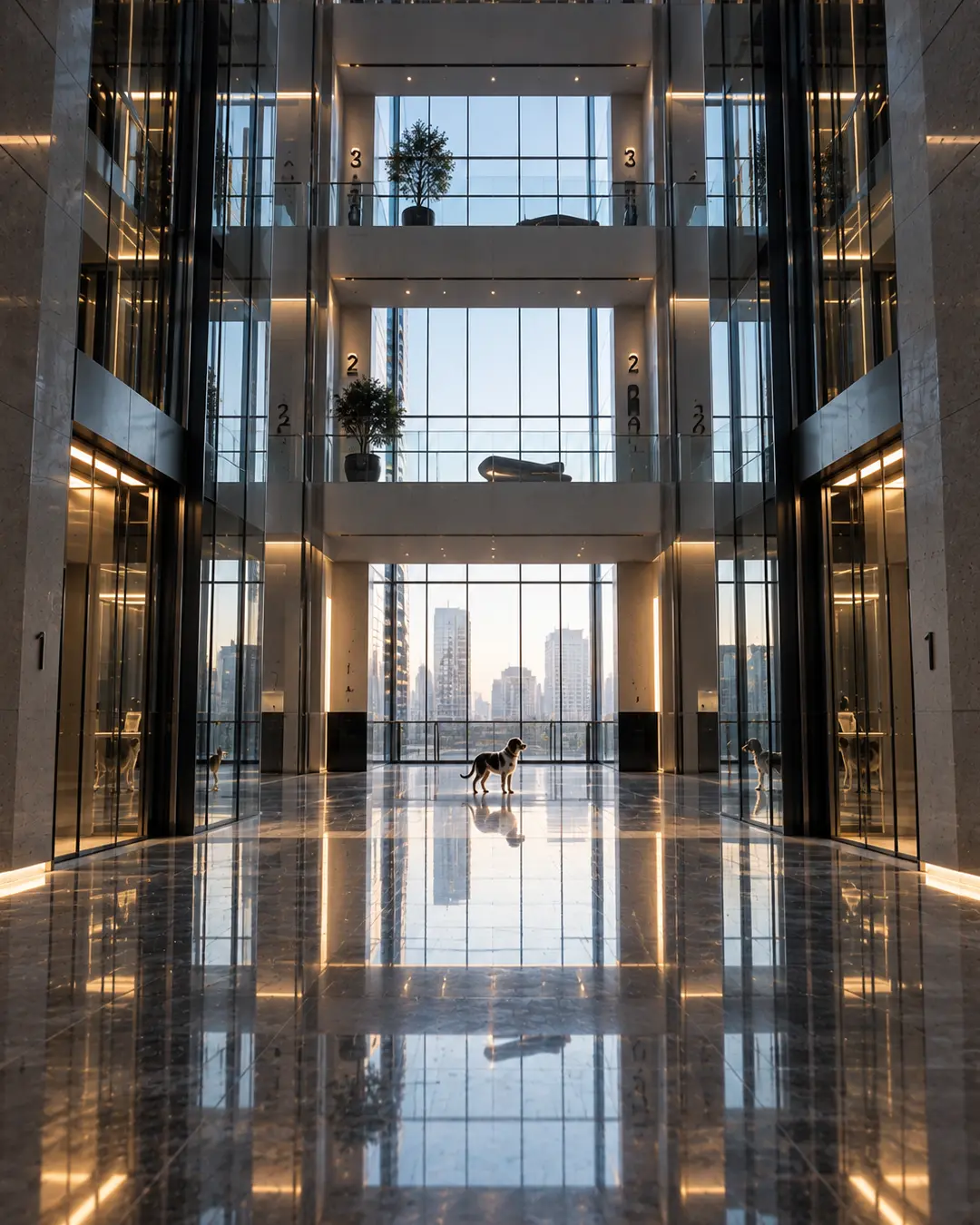
This building is almost aggressively ordered.
Three levels stack perfectly above one another. Elevators rise behind glass. Marble, steel and reflections turn the lobby into a grid of vertical and horizontal lines.
Even the city beyond seems neatly framed by the architecture.
And then, directly in the middle of all that precision, there’s a dog.
His reflections appear in the elevator doors, multiplying him across a building designed around symmetry.
Without him, this is an impressive lobby.
With him, you start looking for the dog everywhere.
A Small Question in a Very Large Library
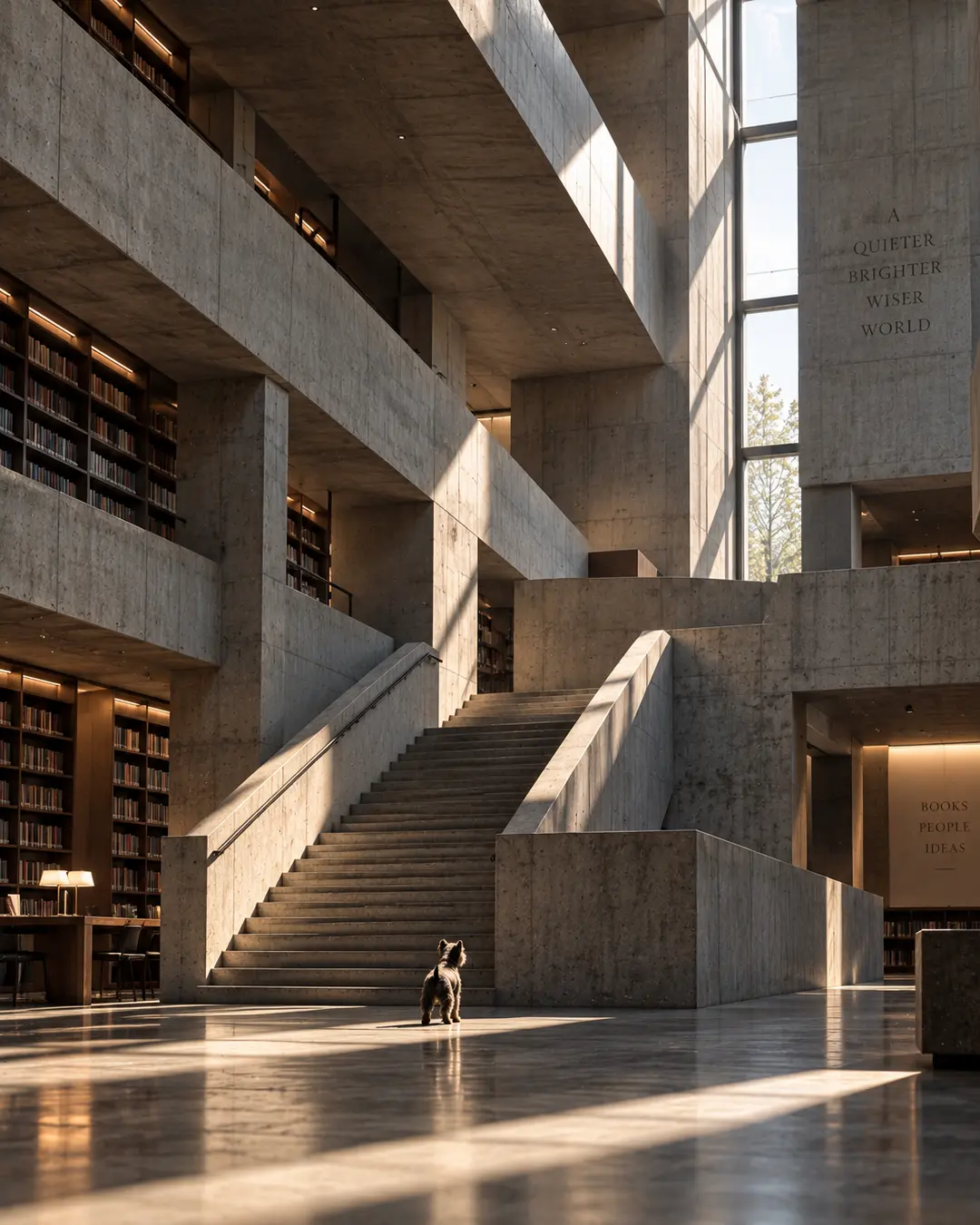
The staircase does most of the work here.
It rises through great slabs of concrete, surrounded by stacked floors of books, bridges, deep shadows and shafts of sunlight from windows several storeys high.
Everything about the building encourages you to look up.
So does the dog.
He’s tiny against the architecture, standing at the bottom of the stairs and staring toward whatever might be waiting above.
And suddenly those stairs feel much taller.
The library feels much bigger.
And somewhere between the dog and the top of those stairs, the photograph becomes a journey.
Before the Court
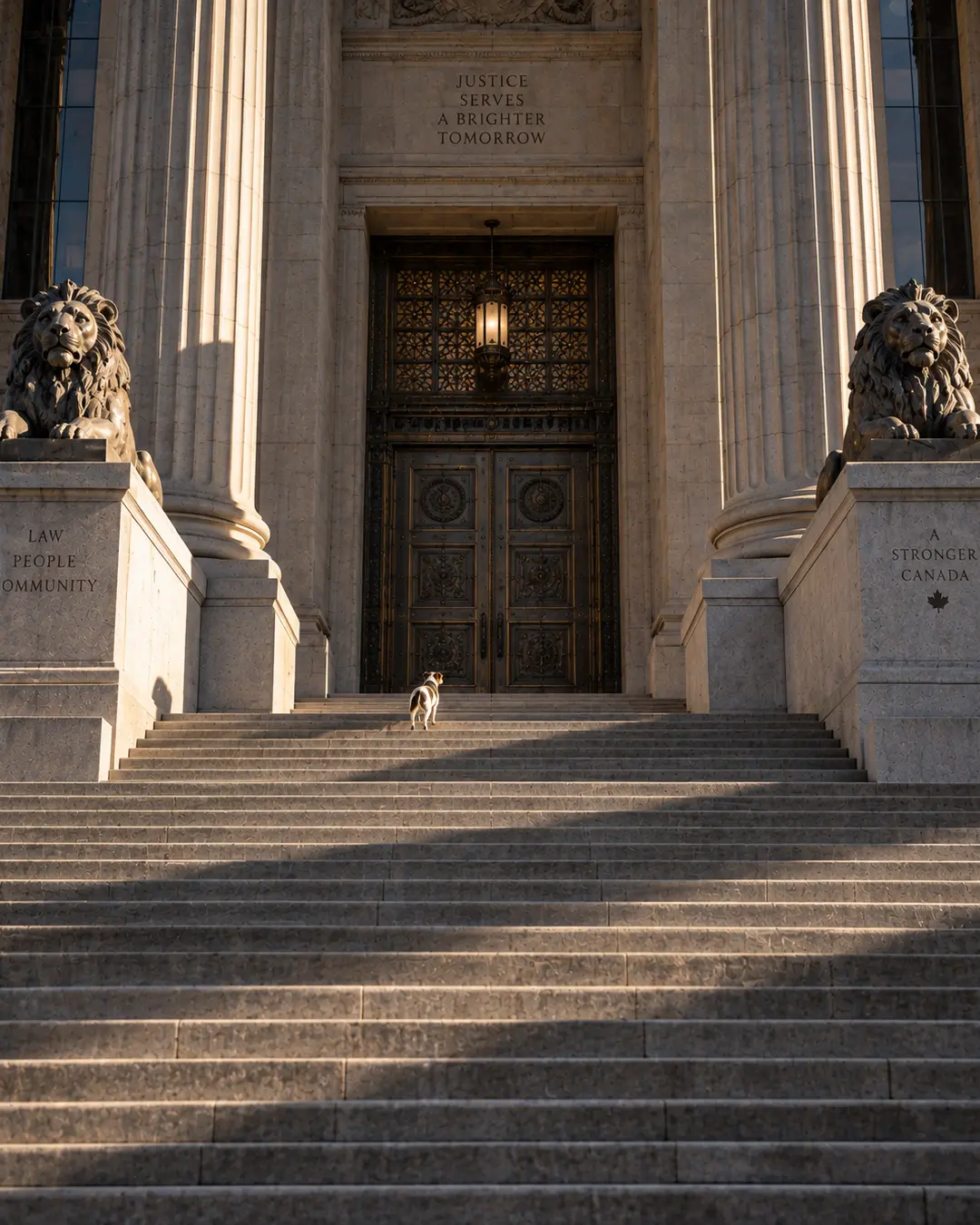
The building is designed to make you feel small.
Massive columns rise beyond the frame. Stone lions guard the entrance. A seemingly endless staircase leads to enormous bronze doors.
Everything about it says authority.
And halfway up those steps stands one very small dog.
He could turn around.
He could keep climbing.
Instead, he seems to be considering the situation.
For once, the architecture may have successfully intimidated a dog.
The Long Way Down
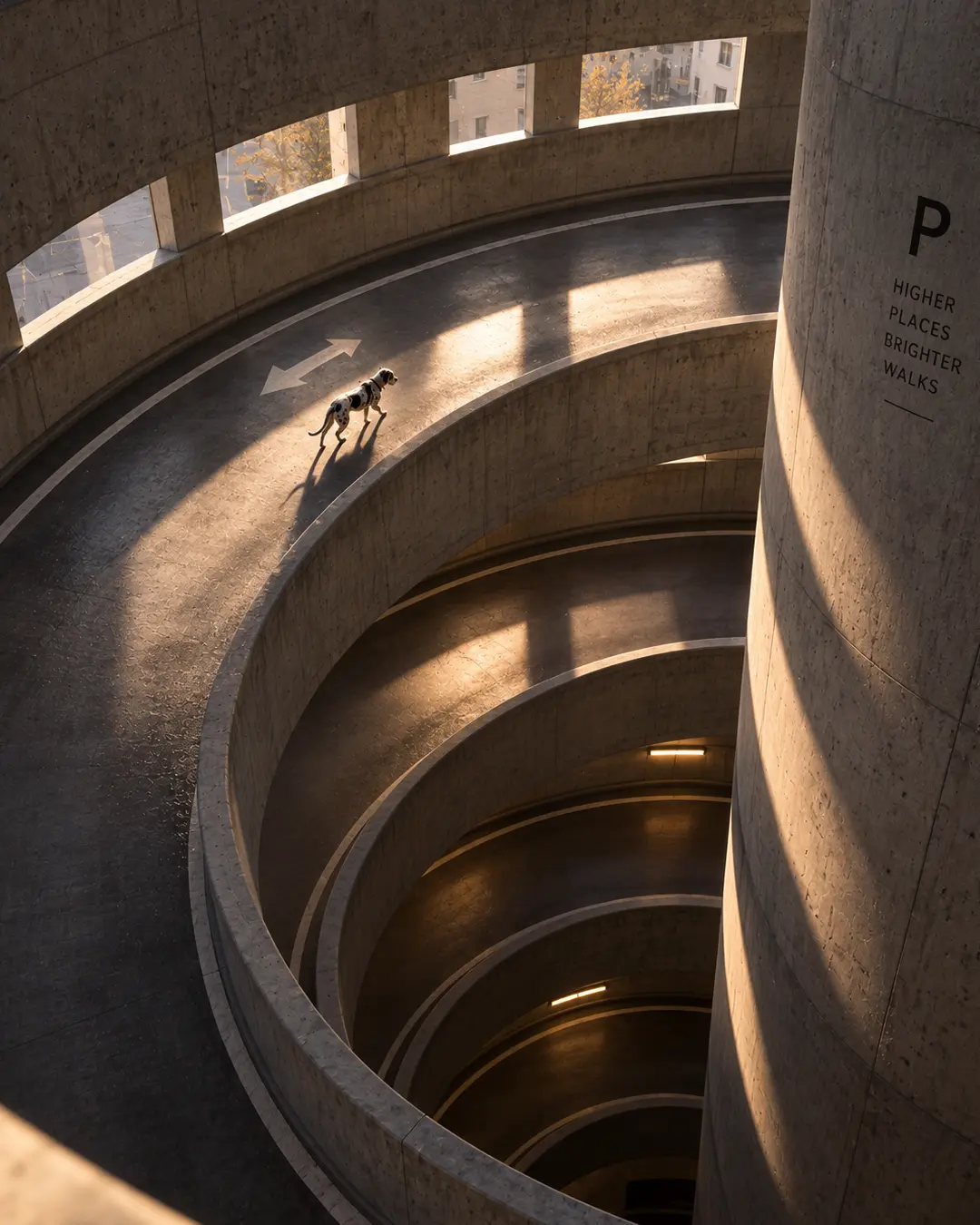
A spiral parking ramp is an exercise in repetition.
Concrete curves around concrete, level after level, disappearing into the darkness below. Sunlight enters through a handful of openings and briefly interrupts all that grey with perfect rectangles of gold.
Then one of those rectangles catches a dog.
He’s already partway around the curve, following a road that seems to have no beginning and, from this angle, no obvious end.
The arrow says he can go either way.
Naturally, he’s chosen his own direction.
The Audience of One
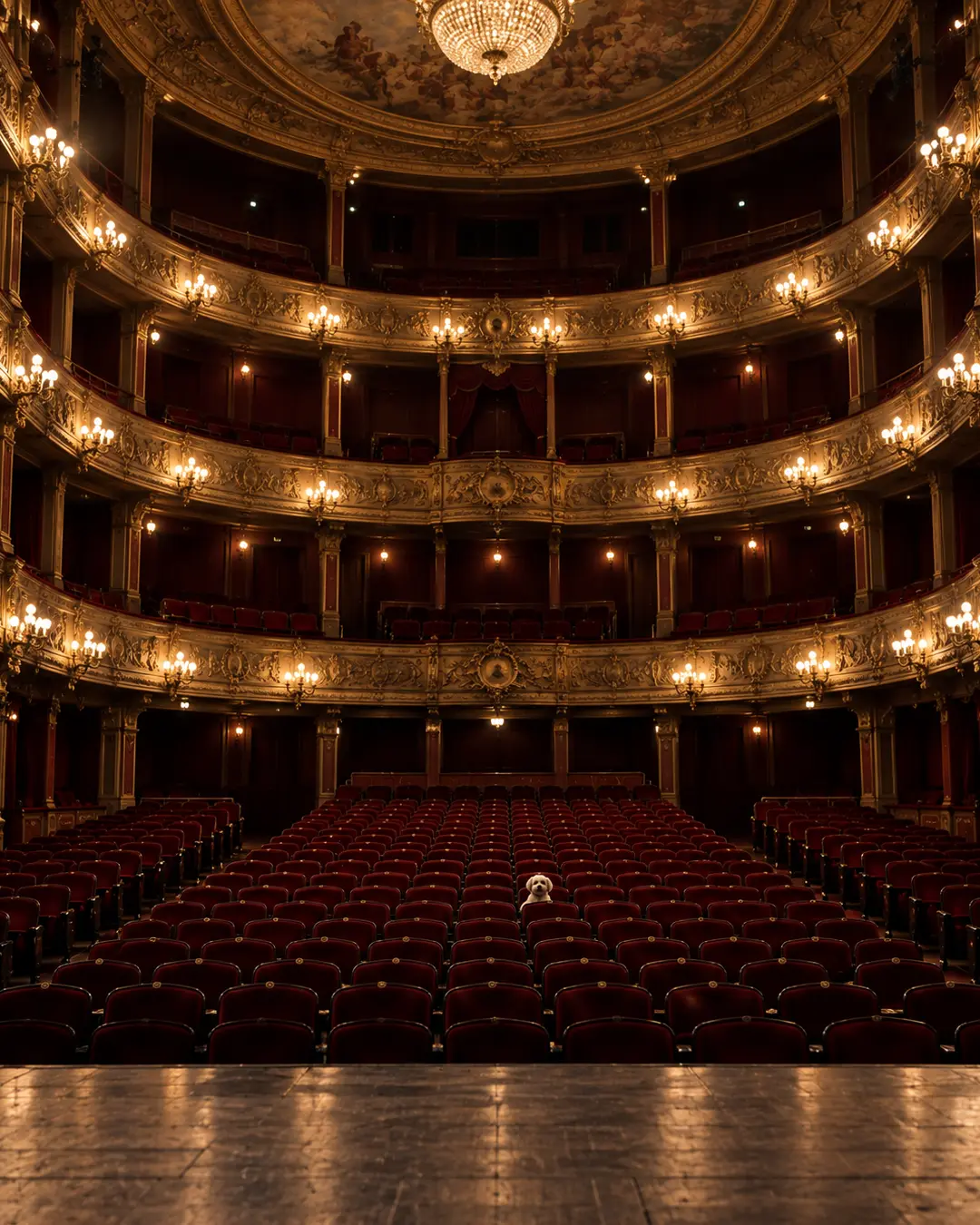
Before you notice him, this is a photograph of a magnificent old theatre.
Gilded balconies climb toward a painted ceiling. Hundreds of red velvet seats face the stage. Chandeliers and wall lights illuminate a room built for spectacle.
Except tonight, every seat is empty.
Almost every seat.
Right in the middle of the auditorium, one small dog is looking directly at the stage.
Suddenly the theatre doesn’t seem abandoned at all.
The house is open. The audience has arrived.
And apparently the show can begin.
The Staircase Does the Talking
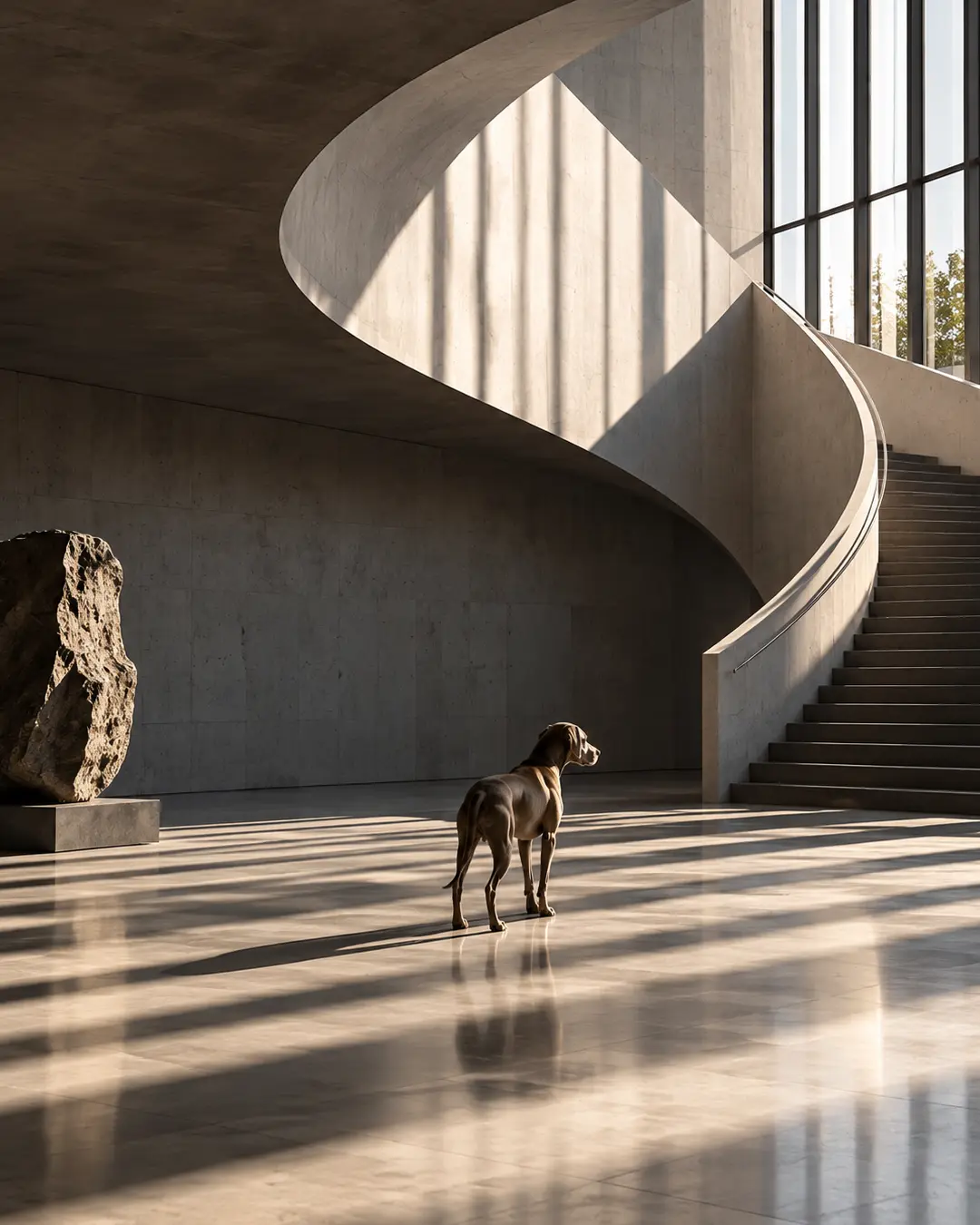
There are no signs telling you where to look.
The staircase takes care of that.
A single sweep of concrete rises through the building, curves overhead and disappears toward the light. Hard shadows from the windows cut across the floor, while one enormous stone sculpture sits quietly at the edge of the composition.
The dog has noticed the staircase too.
He stands beneath it, looking toward the first step.
For a second, he seems to be doing exactly what we are.
Trying to figure out where that beautiful curve leads.
The Dog Becomes Part of the Pattern
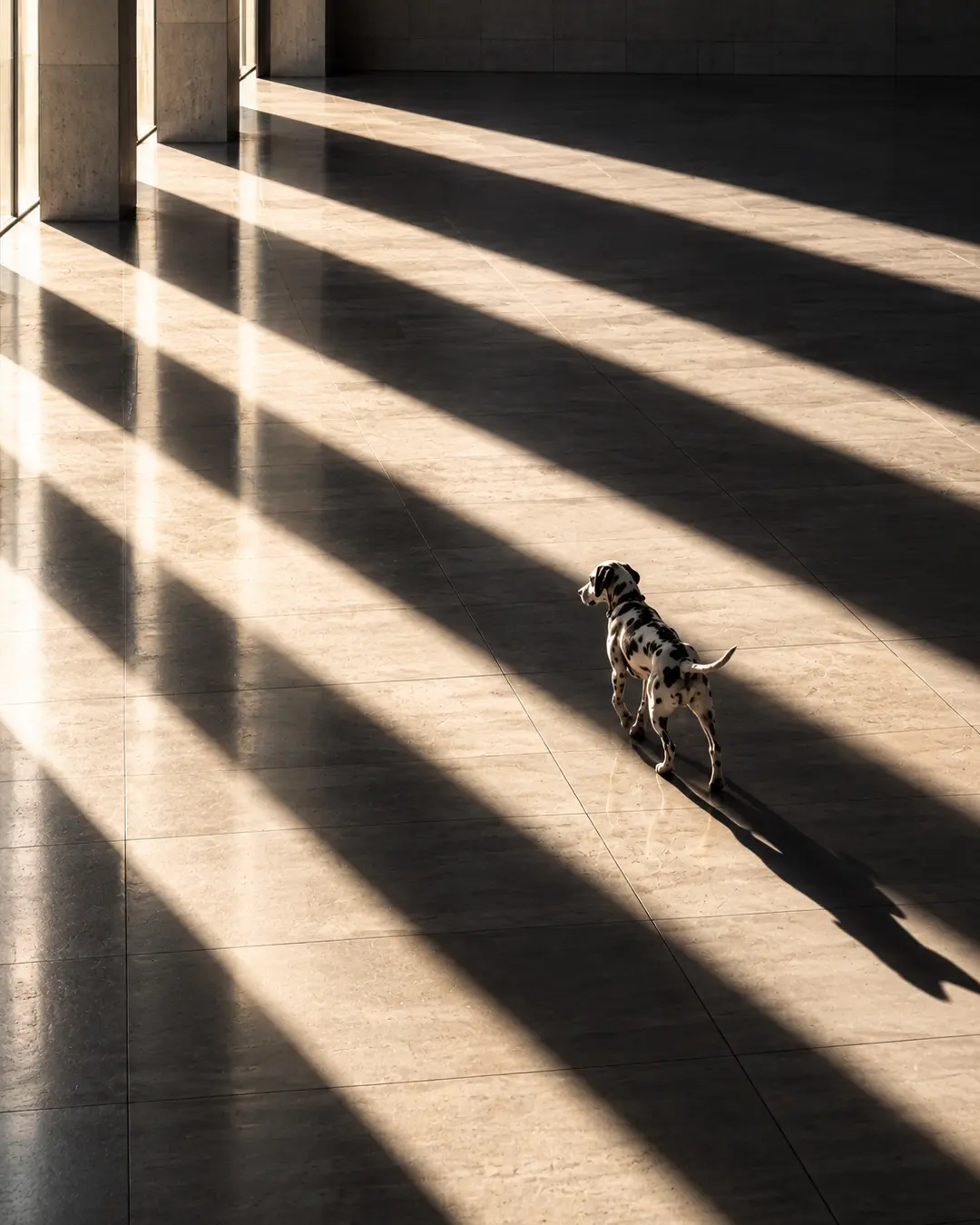
At first, this photograph is almost entirely about light.
Long bands of sunlight and shadow stretch across an otherwise empty stone floor, turning a very simple piece of architecture into something graphic.
Then the Dalmatian walks into the frame.
Black.
White.
Light.
Shadow.
Suddenly his spots aren’t just markings.
They’re part of the photograph’s geometry.
Put almost any other dog here and the image changes.
This one looks like he belongs.
Centre Ice
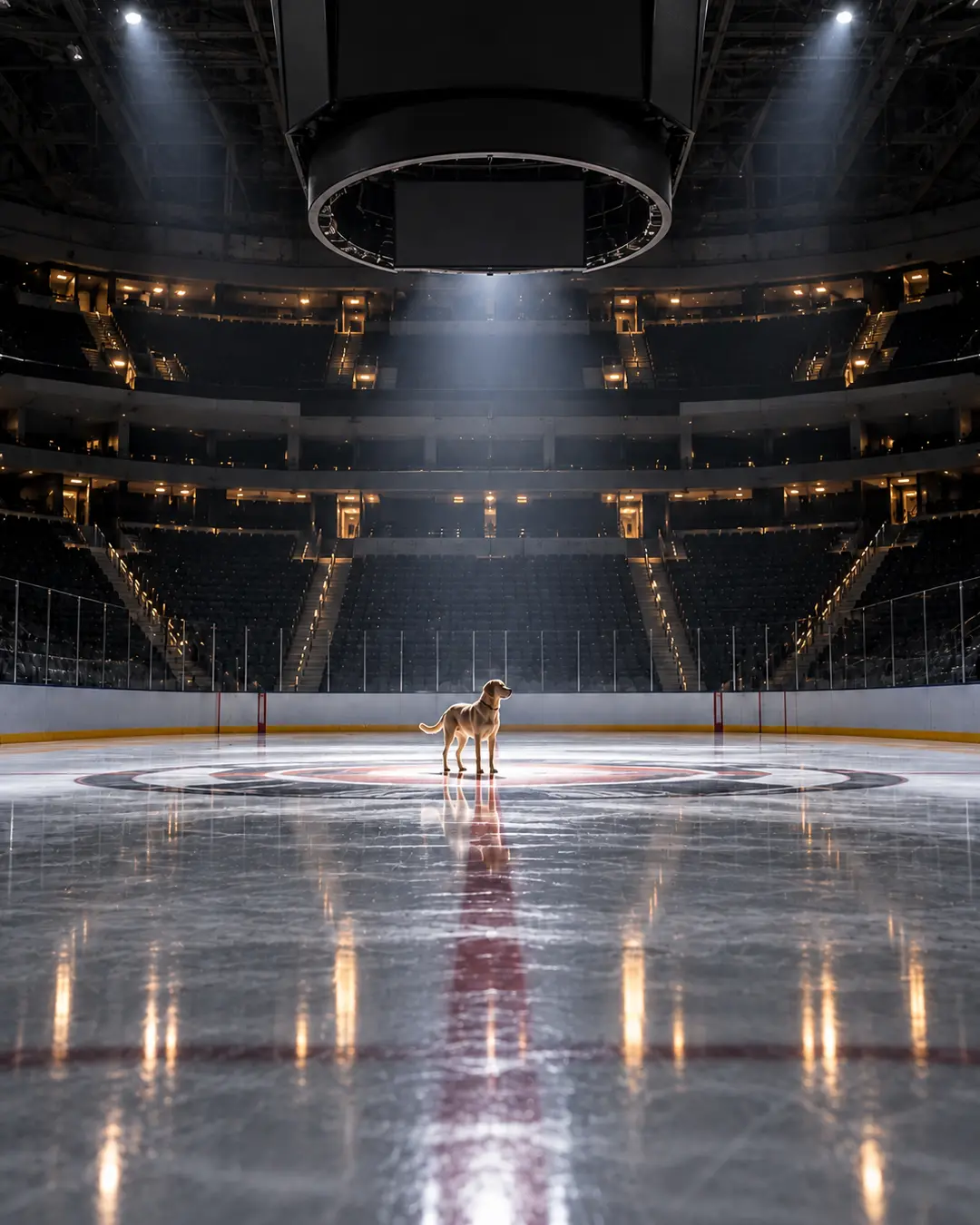
An empty arena is a very different building.
Without thousands of people, music, scoreboards and players moving at full speed, you notice its sheer size. The tiers of seats disappear into darkness. The enormous scoreboard hangs overhead. A few beams of light fall onto the ice.
And standing directly at centre is one dog.
He’s not doing anything particularly remarkable.
That’s precisely why it works.
Put one ordinary dog in the middle of an enormous empty arena and suddenly you understand the scale of the place better than any wide-angle photograph could explain it.
The Barn Has Been Waiting
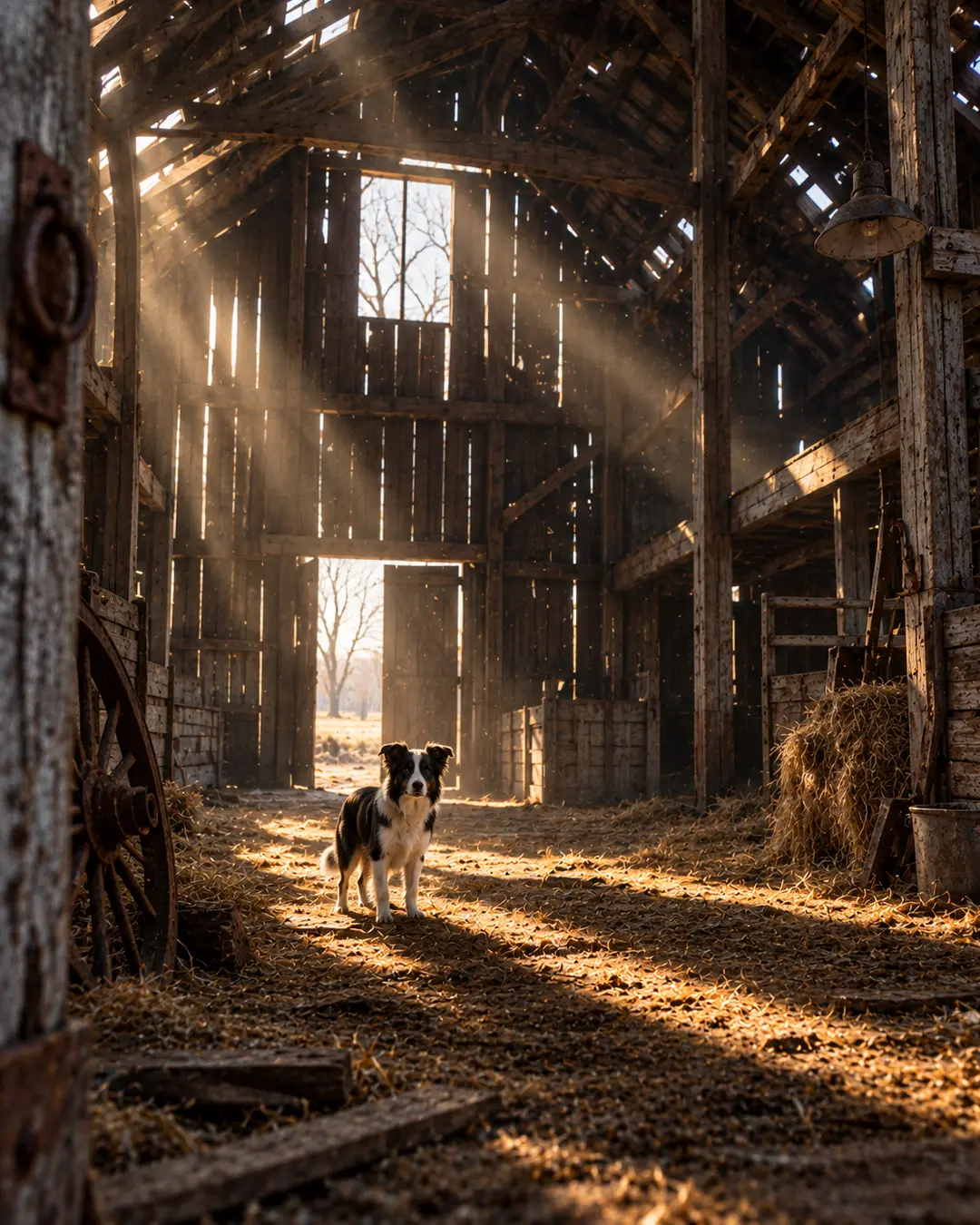
The roof is failing.
Boards are missing. Old machinery has been left where it stopped. Hay still gathers in corners, and sunlight now enters through places that were never meant to be windows.
It’s the kind of building that makes you imagine what it looked like when it was still being used.
Then you notice the dog.
Unlike the factory, the courthouse or the arena, he doesn’t seem particularly small here.
He seems at home.
Standing in that shaft of afternoon light, surrounded by timber, dust and straw, he does something none of the architecture can.
He makes the old barn feel occupied again.
The Quietest Pool in the City
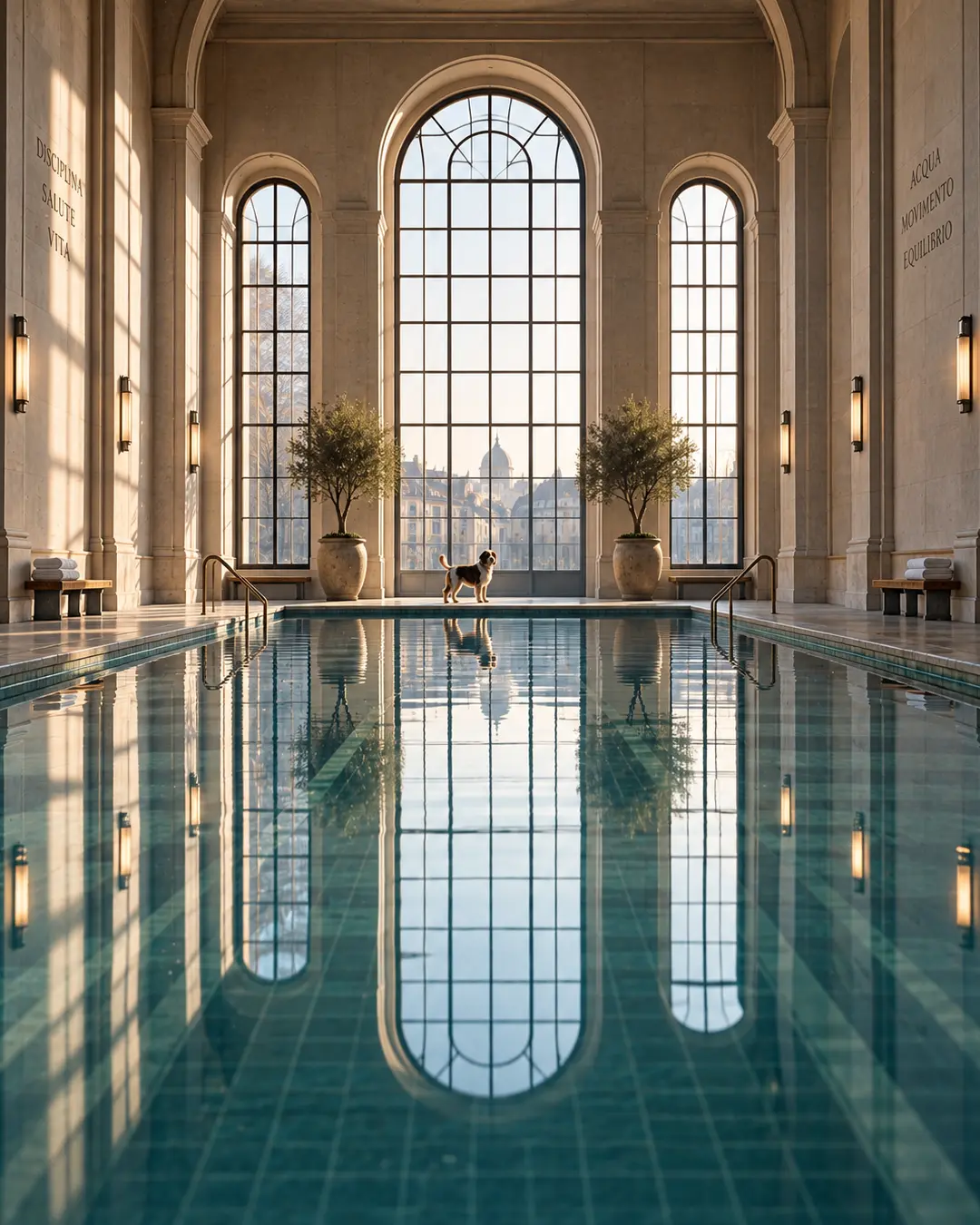
Everything here is built around symmetry.
Three enormous arched windows rise above the pool. The architecture repeats in the still water below, doubling the height of the room and pulling the city outside into the composition.
It is elegant, formal and almost unnaturally calm.
Then, at the far end of the pool, there’s a dog.
He’s small enough that you could miss him.
But once you see him, the entire photograph changes.
The beautiful empty pool becomes a place where something is about to happen.
And now we’re waiting to see if he jumps in.
And Then You See the Dog
Take the dogs out of these photographs and most of them would still work.
The cathedral would still be magnificent.
The factory would still catch the light.
The staircase would still curve beautifully through the concrete.
The pool would still reflect those enormous windows.
They don’t need dogs.
And that was really the point.
Because the interesting part isn’t what the dog adds to the architecture.
It’s what the dog does to us.
We understand the scale differently.
We start wondering where he’s going.
We imagine what happened before the photograph and what might happen immediately after it.
A building becomes a place.
An empty room becomes occupied.
And a photograph that initially seemed to be about concrete, steel, stone, light or symmetry suddenly has a story.
All because somewhere in the frame there’s a dog.
Which means, despite everything we’ve been telling ourselves…
Maybe the dog was the point after all.
Love Dog Art?
If you like seeing dogs turn up in places where great design is already doing most of the work, we have a few more collections worth exploring.
Dogs, Coffee & Art
Coffee, dogs and artwork that ranges from stylish to wonderfully strange. See how artists have turned one of our favourite everyday rituals into something worth putting on the wall.
Dog Sculpture in Beautiful Homes
Dog sculpture doesn’t have to be cute, novelty décor. We placed it in sophisticated interiors where the sculpture earns its place alongside the architecture, furniture and art.
See Dog Sculpture in Beautiful Homes →
Vintage Dog Bathroom Art
A little stranger, a little more playful and exactly the kind of art that can make a beautiful bathroom considerably more interesting.
Explore Vintage Dog Bathroom Art →