There are places where designing a house begins with choosing finishes, furniture and colours, and then there are places where much of the work has already been done for you.
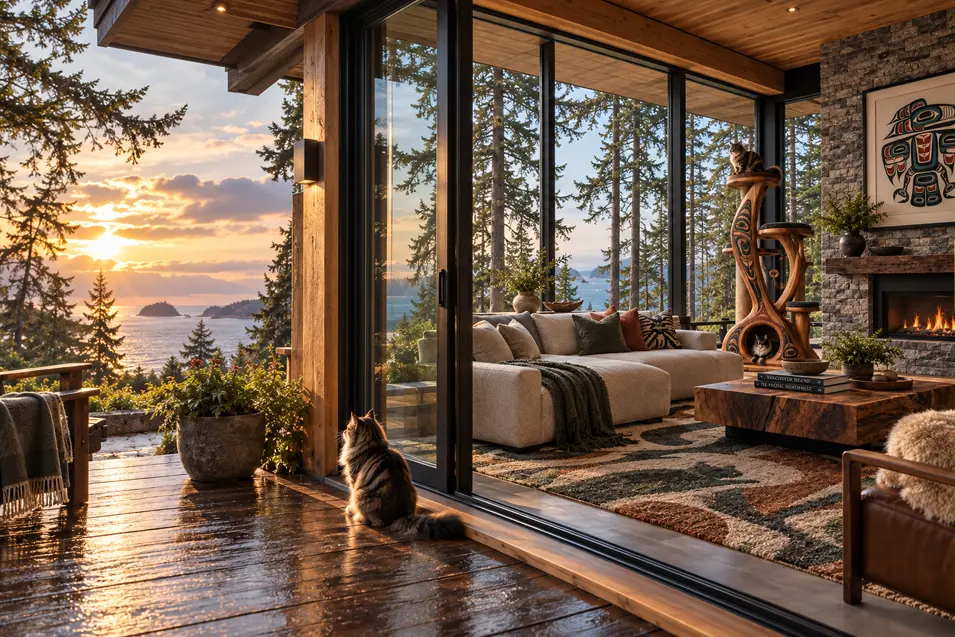
On the west coast of Vancouver Island, where enormous cedars and firs meet dark water and mountains disappear regularly behind mist, ignoring what lies outside the windows would seem almost impossible.
This imaginary home takes its cues from exactly that landscape.
Wood is everywhere, but rarely in the same way twice. Heavy structural timbers frame rooms lined with warmer cedar and walnut, while stone brings some of the ruggedness of the shoreline indoors. Wool, leather and linen soften the harder materials, and enormous expanses of glass allow the forest, ocean, changing sky and famously unpredictable West Coast light to become part of the interior.
It is the sort of house that might belong to someone who could live almost anywhere but deliberately chose to live here.
They appreciate architecture and beautifully made furniture, collect art because they genuinely enjoy living with it, and would rather own one remarkable handcrafted object than a room filled with fashionable ones.
They also happen to love cats.
Quite a lot, as it turns out.
That affection hasn’t resulted in a house covered in feline motifs. There are no paw-print fabrics, novelty cushions or rooms designed simply to announce that a cat person lives here. Instead, cats have joined the other things the homeowner values—nature, craftsmanship, art and good design—and occasionally those interests intersect in rather wonderful ways.
The result isn’t really a cat house at all.
It’s simply a beautiful West Coast home where the cats were never treated as an afterthought.
A Living Room Among the Trees
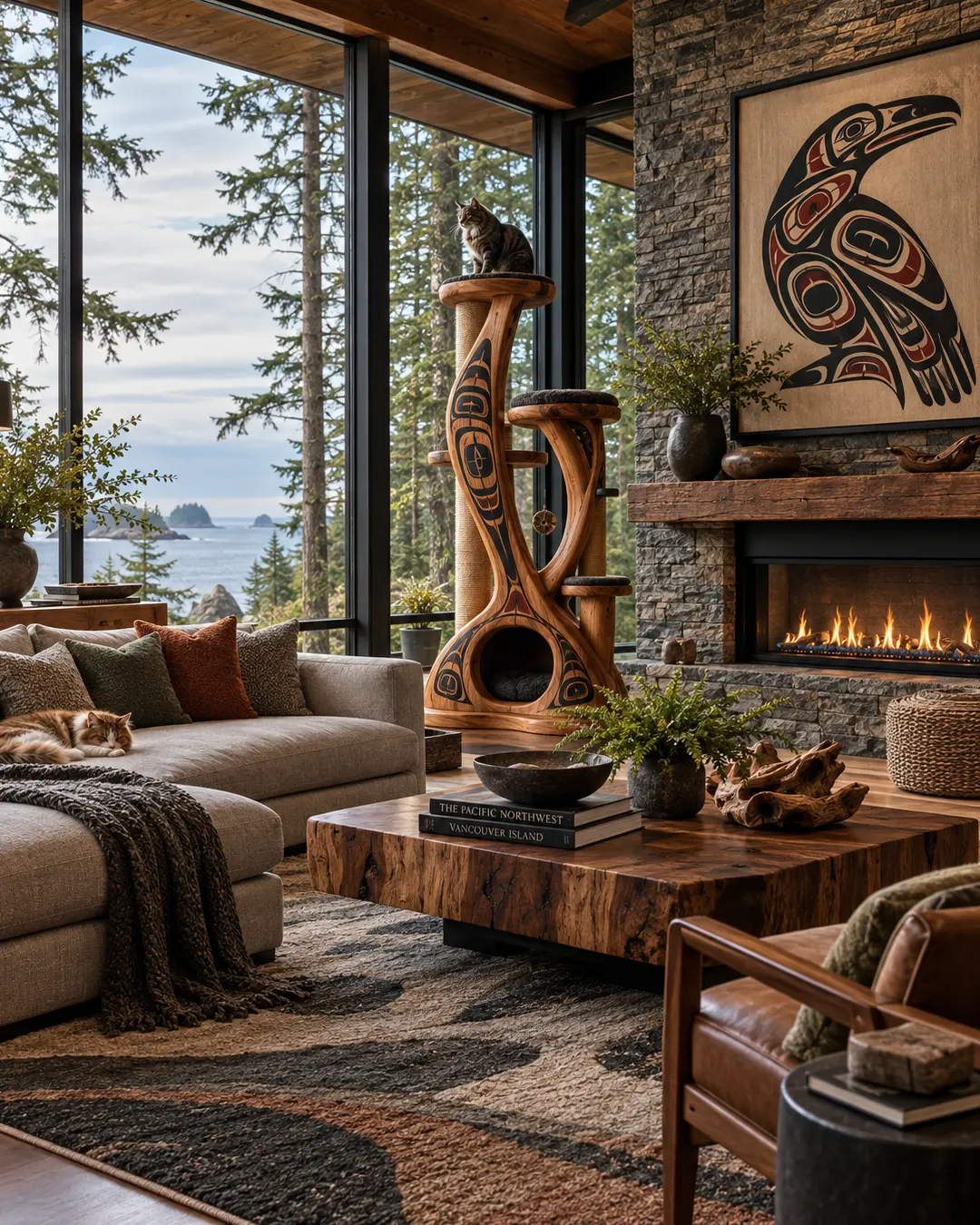
The main living space makes the relationship between the house and its surroundings immediately clear.
Glass stretches almost from floor to ceiling, allowing the trees to become a constantly changing backdrop. On bright afternoons, sunlight filters through the branches and warms the timber inside. On darker days, when rain moves through the forest and mist settles over the water, the room would take on an entirely different character.
The architecture doesn’t attempt to compete with any of it.
A substantial stone fireplace gives the room weight, while exposed timber overhead adds warmth without making the space feel rustic. The furniture sits low and comfortably within the room: generous upholstery, natural fabrics, leather and pieces of solid wood that feel capable of becoming better rather than worse with age.
The colours could almost have been sampled from a walk outside—moss, bark, stone, sand and the occasional warmer note of rust.
And then there is the cat tree.
Calling it that feels slightly unfair.
Rather than introducing a conventional piece of pet furniture into an otherwise carefully considered room, the climbing structure has been treated almost as a commission. Large pieces of timber twist upward beside the windows, creating platforms, perches and sheltered places among forms that resemble the old-growth trees beyond the glass.
It works because it belongs to the same material language as the rest of the house.
From across the room, it could almost be sculpture.
The cats know better.
Dinner on the Pacific
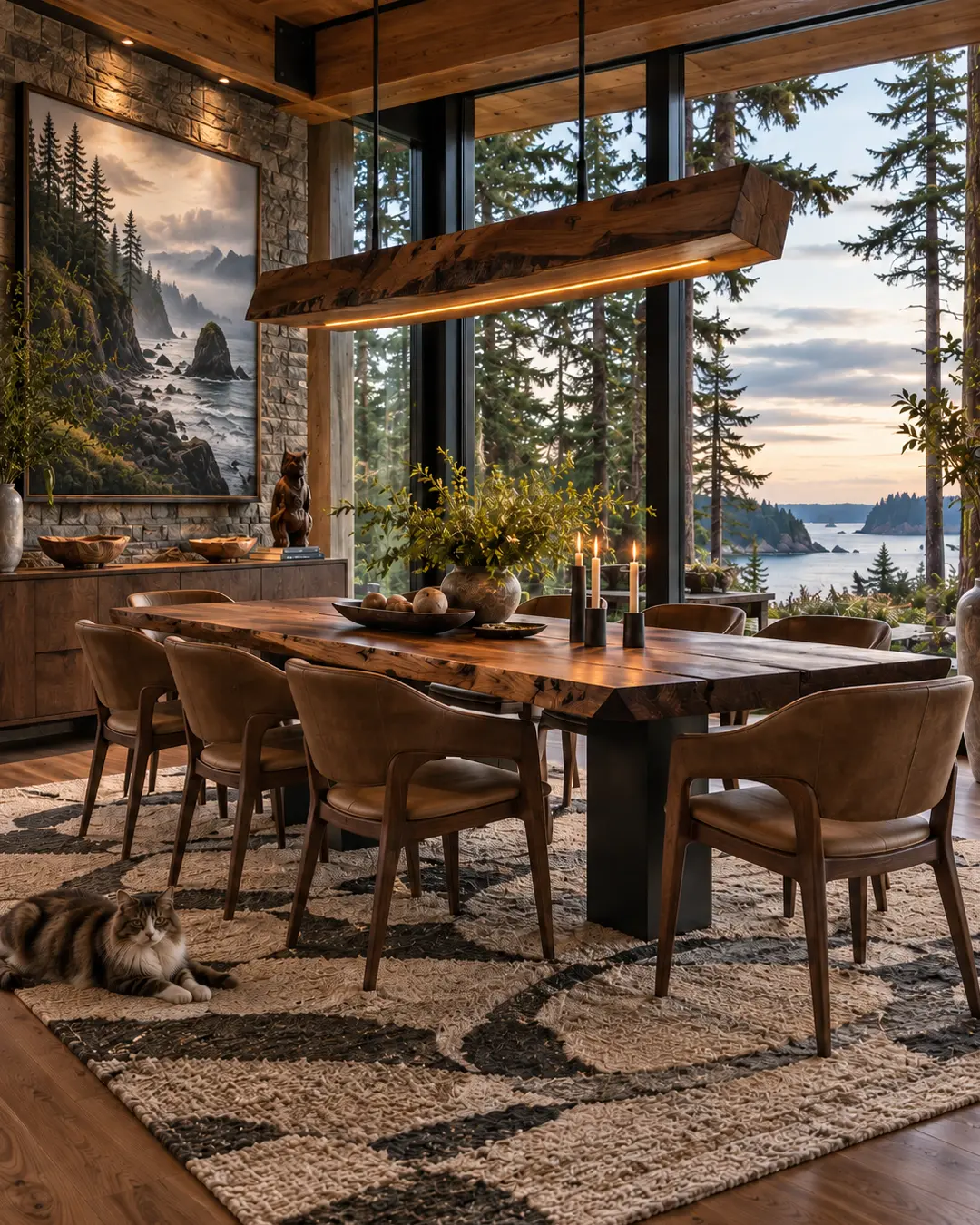
The dining room is noticeably quieter, and that restraint is important.
Not every room needs to prove that someone here loves cats.
A substantial live-edge table provides the centre of the space, surrounded by beautifully shaped leather chairs whose warmth plays against the timber overhead. A large pendant brings the scale of the ceiling down over the table, creating a more intimate place to gather even while the glass walls open toward the water and distant landscape.
Here, the art collection shifts as well.
Rather than repeating the stronger graphic work found elsewhere in the house, a large atmospheric landscape reflects another side of the West Coast: mountains softened by mist, dark forest and water catching the last light of the day.
It doesn’t match the view outside.
It converses with it.
That distinction matters throughout the home. The objects haven’t been selected to create a theme. They feel collected over time by someone interested in the place where they live and in the different ways artists interpret it.
There is, of course, still a cat in the room.
It requires no special introduction and no special piece of furniture. It simply stretches out near the table as though it has attended every dinner ever held here.
Which, presumably, it has.
A Bedroom Made for Quiet
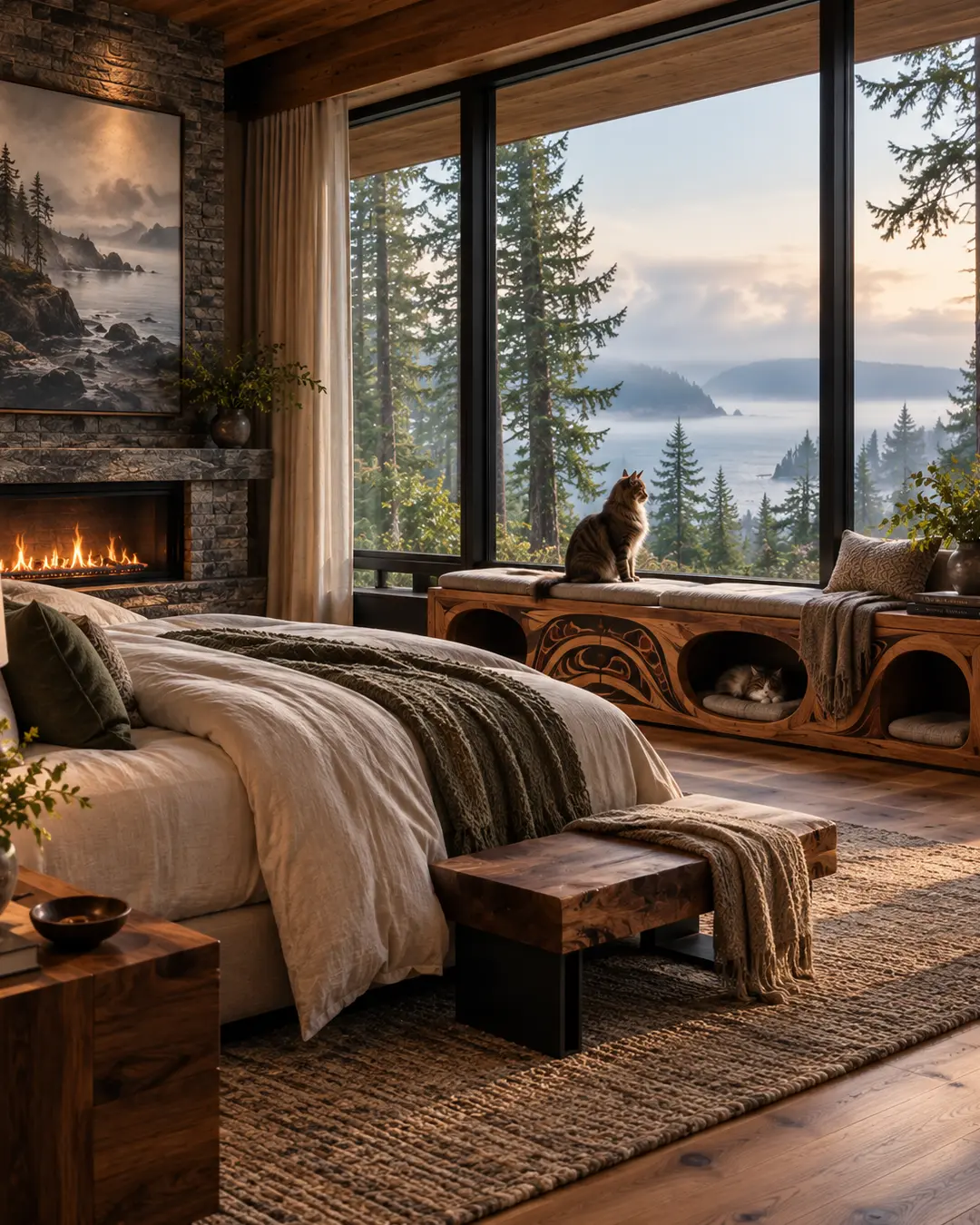
Upstairs, the relationship with the landscape becomes softer.
The bedroom is deliberately uncomplicated, allowing texture rather than decoration to do most of the work. Linen bedding, wool, warm timber and stone create a room that feels particularly suited to the quieter side of coastal life—the mornings when fog hangs outside the windows and there is nowhere especially urgent to be.
A low bed keeps the sightlines open toward the forest and water, while a fireplace makes the room feel less like a pristine retreat and more like somewhere meant to be occupied throughout the year.
The most unusual piece sits beneath the windows.
At first glance, the long cedar structure could be a beautifully made bench or low cabinet. Its proportions are simple, its construction substantial and its timber relates naturally to the rest of the room.
Then you notice the openings.
Built into the structure are sheltered sleeping spaces for the cats, while the broad upper surface provides exactly the sort of elevated window perch most cats would choose for themselves anyway.
It is unquestionably cat furniture.
It simply doesn’t look as though it came from the pet aisle.
And perhaps that is one of the most successful ideas in the entire house. Rather than asking where a cat bed can be hidden, the homeowner has asked what a cat bed might become if the same attention were given to it as any other piece of furniture.
The answer is something worth looking at.
Art Around the Corner
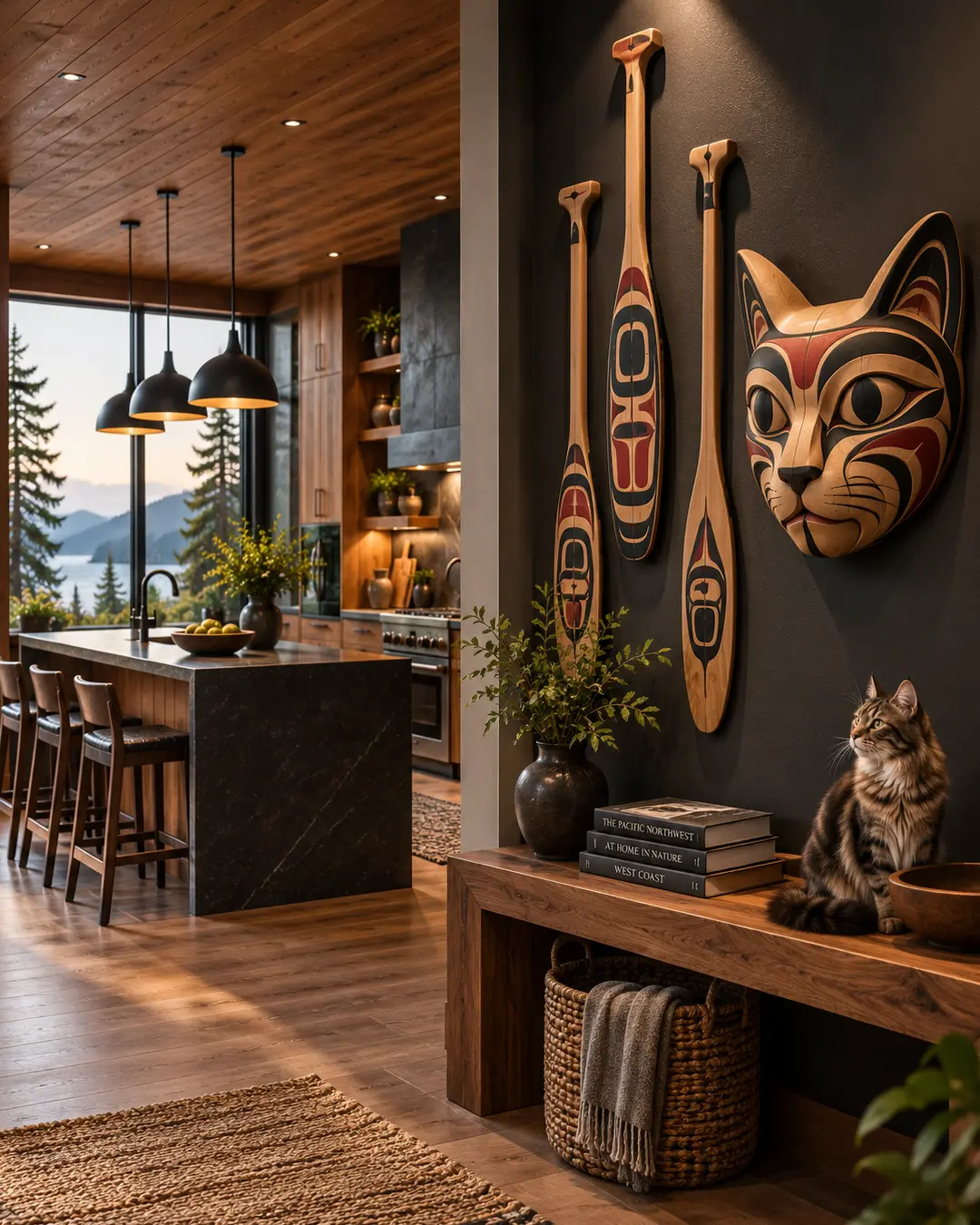
The kitchen itself remains remarkably restrained.
Warm cabinetry, dark stone and substantial timber do most of the visual work, while simple pendant lights provide softer pools of light over the island. Once again, glass opens the room to the forest and water, turning whatever the weather happens to be doing into part of the interior.
There is no need for cat-shaped cabinet hardware.
Thankfully.
Instead, the more personal side of the homeowner’s taste appears just beyond the working kitchen, where a darker wall creates a small gallery-like moment of its own.
A sculptural cat piece hangs above a simple timber bench, surrounded by objects chosen for their material and form rather than because they belong to a matching collection.
It’s a small moment compared with the scale of the house, but an important one.
Beautiful homes often reveal the most about their owners in these secondary spaces—the end of a hallway, the wall beside a kitchen, the little area beneath a staircase that didn’t technically need anything at all.
This one tells us that the homeowner appreciates serious art.
It also tells us, once again, that they are very fond of cats.
Naturally, a real cat has positioned itself directly beneath the artwork.
Curators are rarely consulted.
The Room That Belongs to the Cats
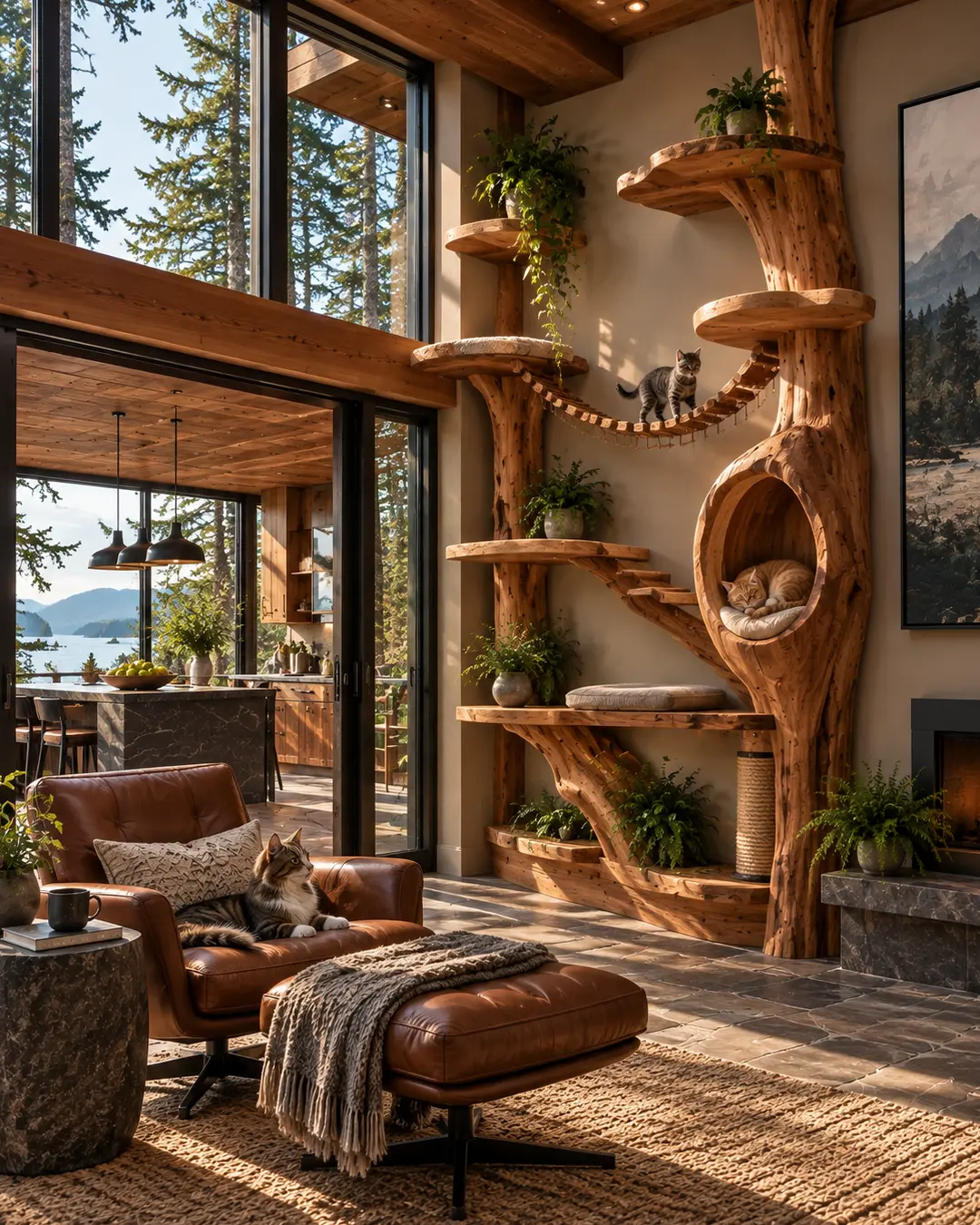
Eventually, all that restraint had to end somewhere.
The dedicated cat room is where the homeowner allows enthusiasm to win.
Even here, however, the architecture comes first.
The room occupies a spectacular glass corner of the house, surrounded by forest and filled with natural light. Stone continues across the floor, timber remains overhead, and a beautifully worn leather chair with an ottoman makes it clear that humans are welcome too.
One could quite happily sit here for an afternoon with a book while rain moves across the glass.
The cats have other plans.
Along one wall, enormous pieces of cedar rise into a custom climbing landscape. Platforms emerge from irregular timber forms, bridges connect different levels, scratching surfaces are integrated where they are useful, and small sleeping hollows disappear into the structure.
There are no bright carpet-covered tubes or plastic accessories trying to disguise themselves.
Instead, the installation borrows from the same things that inspired the house itself: trees, branches, natural forms and beautifully worked wood.
It is extravagant.
There is no point pretending otherwise.
But extravagance becomes considerably easier to forgive when it is this beautifully made.
And because the room hasn’t been surrendered entirely to the cats, it remains part of the home. The chair, artwork, stone and views give a person every reason to spend time here as well.
That may ultimately be what makes the room successful.
It isn’t somewhere the cats have been sent.
It’s somewhere everyone wants to be.
Letting the Place Lead
For all the custom work, beautiful furniture and spectacular architecture, perhaps the most interesting thing about this imaginary house is how little of its personality needed to be invented.
Most of it was already outside.
The forest supplied the palette. The shoreline supplied the stone and weathered greys. The trees suggested the warmth and irregularity of the wood. The ocean provided movement, while the enormous windows allowed natural light to change the rooms from hour to hour.
The interiors simply listened.
That doesn’t mean everything must be local, rustic or handmade. It means the house understands where it is. A leather chair can be modern. A kitchen can be beautifully precise. Contemporary art can sit beside rough stone and centuries-old trees.
The connection comes from material, colour, texture and restraint rather than from trying to decorate a room to look “West Coast.”
The same philosophy applies to the cats.
They haven’t become a decorating theme. Their presence has simply been considered alongside everything else that matters to the person living here.
Sometimes that means providing a sunny place beside a window.
Sometimes it means commissioning a beautiful piece of furniture that happens to contain several cat beds.
And sometimes, apparently, it means giving over an entire glass-walled room to an extraordinary cedar climbing structure because subtlety has its limits.
But none of those choices diminish the architecture.
They make the house more personal.
Because ultimately, the most memorable homes aren’t simply collections of beautiful things. They reveal something about the people who live in them—where they chose to live, what they notice, what they collect, what they value and what they’re willing to make room for.
Here, that’s the ocean, the forest, natural materials, beautiful furniture, art, craftsmanship and light.
And cats.
Definitely cats.
Love West Coast Art, Homes & Design?
If the combination of natural wood, coastal architecture, craftsmanship, art and cats speaks to you, explore our collection of 20 Luxury Cat Trees Inspired by the Indigenous Art of British Columbia.
It takes the idea even further, imagining sculptural cat furniture influenced by the materials, craftsmanship and artistic traditions of the West Coast.