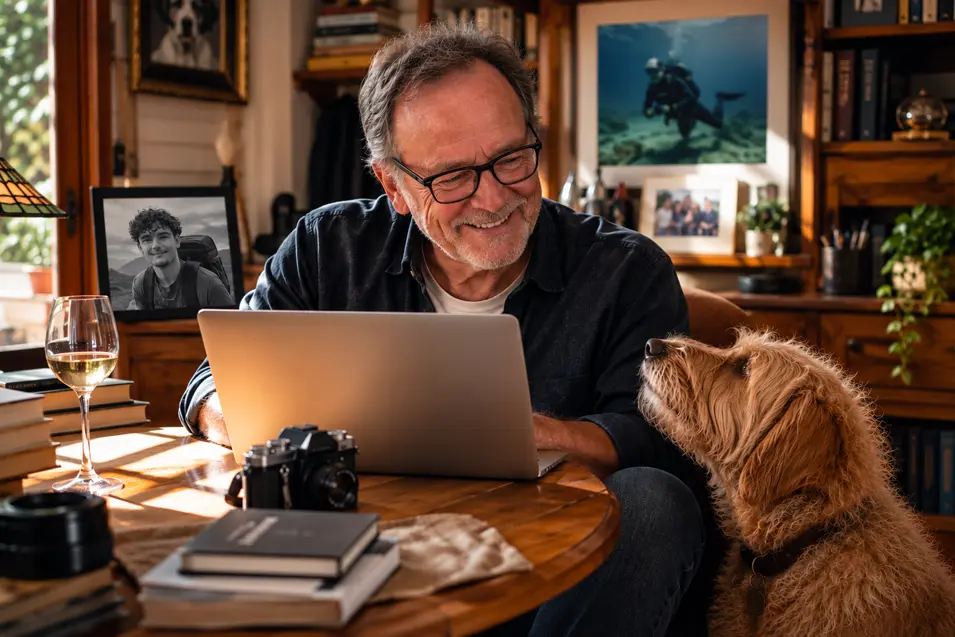
David died peacefully at the age of 82.
This came as a shock to everyone.
Especially me.
Dinner was in seventeen minutes.
Humans will probably tell you that David lived a long and interesting life. They’ll talk about his family, his work, the places he went, the things he built and the people he met along the way.
There will be stories.
There will probably be wine.
Knowing David, there had better be wine.
But humans have a strange way of measuring a life.
They talk about careers.
Accomplishments.
Success.
Things you owned.
Places you travelled.
How hard you worked.
I knew David differently.
I was his dog.
Officially, David was my owner.
This was largely ceremonial.
I determined when he woke up, when we went outside, which direction we walked, when we returned home and approximately forty percent of his sleeping position.
So I believe I am qualified to write this.
Apparently This Started With His Mother
David’s mother, Fay, loved animals.
Dogs especially.
There was even a parrot.
But animals weren’t the only thing she passed along.
Fay taught David to cook. She gave him some of his creativity. And she taught him, mostly by example, that when you care about something, you don’t have to be particularly restrained about it.
Fay is one hell of a scrapbooker.
You should see what she did for her pets.
Photographs. Pages. Decorations. Stories. Entire beautifully assembled records of their lives.
Those animals have documentation.
I have a website.
David spent decades writing about pets, photographing pets, creating ridiculous pictures of pets and building entire websites devoted to them.
But did he ever sit down with decorative paper, little scissors and glue and make me a scrapbook?
No.
Not one page.
David did very little for me.
Except the food.
And the walks.
And the beds.
And the toys.
And the treats.
And the house.
And the lifetime of love.
But no friggen scrapbook.
I’m just saying.
Then There Was His Dad
His father, Ernie, had a somewhat different relationship with the animal kingdom.
Ernie was a butcher.
This may help explain why two perfectly innocent family pets originally named Spotty and Blackie somehow became known as Ham and Chops.
I have several questions.
Unfortunately, everyone involved appears to have considered this perfectly reasonable.
Ernie wasn’t much of a pet person.
But he taught David plenty of other things.
He taught him how to work.
Not just how to have a job, but how to work hard, finish what you started and do something properly when you said you were going to do it.
He taught him to be kind.
David was apparently still working on that one.
He taught him that being a good dad wasn’t something you announced.
It was something you did.
And Ernie did.
He was a good dad.
He was also, by all accounts, the best Santa Claus Bezanson or Beaverlodge ever had.
Every Christmas, Ernie could somehow transform from a butcher who wasn’t particularly interested in pets into the man children were absolutely convinced had just arrived from the North Pole.
David never forgot that.
So perhaps Fay gave David some of his creativity and his love of animals.
And Ernie gave him some of the things underneath it all.
Work hard. Be kind. Show up.
David managed two of those fairly consistently.
Like I said, kindness remained a work in progress.
His Sister Gave Him a Kidney
David’s sister, Brenda, deserves special mention.
She gave him one of her kidneys.
Dogs share toys occasionally.
Humans apparently take this considerably further.
That kidney gave David years he might not otherwise have had.
Years with his family.
Years to watch his children grow up.
Years to collect more animals.
Years to work.
Years to ride his bicycle.
Years to get on airplanes and see what was on the other side of them.
Years to have good days.
Years to have terrible ones.
And, knowing David, years to come up with ideas that probably should have been stopped much earlier.
Brenda couldn’t possibly have known everything David would eventually do with those years.
There is absolutely no way she understood the full terms of the transaction.
Still, it was a pretty good kidney.
David certainly got some mileage out of it.
He Had Two Kids
David had two children, August and Owen.
He loved them both enormously.
I know this because humans talk to dogs about the things that matter most.
We are excellent listeners.
Also, we can’t repeat anything.
Being their dad mattered to David more than most of the things humans usually put in obituaries.
Jobs came and went.
Money came and went.
Ideas came and went.
His kids didn’t.
I don’t know everything that happened during all those years.
Dogs don’t need to.
Families are complicated.
Love isn’t.
There Was Also the Horse
Before all of that, there was Patches.
Patches was the horse.
At approximately ten years old, David decided the two of them were going to run away together.
This was a secret plan, so naturally Patches required a secret name.
Andromona.
David had a horse.
David had an alias for the horse.
David had a plan to head to the Kleskun Hills.
What David did not have was money, food, accommodation or any meaningful understanding of how far a ten-year-old and a horse could reasonably travel.
Still.
You have to respect the preparation.
He hadn’t packed lunch, but he’d already established an assumed identity for the horse.
There Were A Lot of Us
I should acknowledge that I was not David’s first animal.
This was disappointing to learn.
There was Mitsy.
There were Shreddie, Jengo and Ollie.
There was Patches.
There were Ham and Chops.
There were tropical fish.
A lot of tropical fish.
There was a hamster.
There were guinea pigs.
There was a rabbit.
Animals came and went through David’s life in tanks, cages, beds, backyards and, in one case, an animal large enough to ride away on.
Then there was Simba.
I never met Simba.
But I heard about her.
Frequently.
Apparently Simba was magnificent.
I would occasionally remind David that I was standing right there.
By the time I came along, David had spent most of a lifetime learning how to love animals.
So really, when you think about it:
I got the finished version.
He Apparently Had Jobs
David worked most of his life.
And I mean worked.
He learned to be a butcher like his father, Ernie.
I should point out that despite acquiring this particular skill, David never turned any of his pets into dinner.
Given the existence of Ham and Chops, this seems worth putting on the record.
He worked on oil rigs.
He worked construction.
Then, for a while, he worked in what he liked to call the biggest aquarium in the world.
The ocean.
David became a commercial diver, harvesting sea urchins and geoducks from the ocean floor.
Those creatures eventually found their way onto dinner tables around the world.
I don’t entirely understand why humans will pay good money to eat something that looks like it should have remained exactly where David found it.
But apparently they did.
Eventually David built his own diving company.
And he did rather well.
He eventually sold it and moved to Calgary.
At this point, David was still in his early thirties and there was considerable evidence suggesting he might actually know what he was doing.
This would become a problem.
Calgary, Amy and the Software Years
After moving to Calgary, David met Amy.
Amy was there through a lot of it—the good years, the bad ones and another surprisingly good stretch in between. She was a good person, a good wife and, most importantly, a great mom. She also supported considerably more of David’s ideas than most reasonable people probably would have.
She was also an exceptionally talented graphic artist, and David learned a great deal from her. What she taught him gave him a foundation in design that would become far more important later than either of them probably realized.
He was always grateful for that.
Then came what I believe should simply be called:
The Software Years.
We don’t need to spend too much time here.
David tried software.
David lost almost everything.
The animals ate generic pet food.
And David apparently spent an unusual amount of time searching between the couch cushions.
I don’t know what he thought was living down there.
But apparently they needed it.
Eventually David did what David tended to do when things went badly.
He started again.
The First Pet Site
David started a pet website.
Then came writing.
Photography.
Advertising.
Marketing.
Ideas.
And somehow, against the considerable amount of evidence suggesting this might also end badly, it worked.
He built the site up.
Then he sold it.
So David had now built a successful business, lost almost everything, started again and built another successful business.
This provided David with exactly the kind of lesson a person like David should probably never receive:
He thought he could do it again.
By this point, David and Amy were married and raising their family.
David had successfully built and sold a pet website.
Surely building another successful business couldn’t be that difficult.
It was.
Apparently It Wasn’t That Easy
The next thing didn’t take off the way the first one had.
The money disappeared again.
There were more ideas.
More websites.
More plans.
More reasons why something was definitely going to work if everyone could just wait a little longer.
Amy kept the financial boat floating considerably longer than most reasonable people probably would have.
Eventually, however, a fairly compelling new business strategy emerged:
David needed a job.
One of Amy’s clients needed someone.
David needed employment.
Amy helped open the door.
David walked through it.
Then There Was The Office
David would stay at the furniture store for more than a dozen years.
For reasons I never completely understood, he usually referred to the place as:
The Office.
This was not its actual name.
It was a reference to the television show.
David claimed the similarities were sometimes a little too close for comfort.
There were characters.
There were meetings.
There were strange decisions.
There were situations nobody outside the building would ever believe actually happened.
David maintained that the store might make more money as a sitcom than it did selling furniture.
Nobody ever tested the theory.
David didn’t actually sell the furniture.
He built the website.
He created the advertising.
He took photographs, wrote copy, made graphics and gradually learned how to make people notice things on the internet.
And because apparently job descriptions were considered more of a suggestion, he also helped move furniture and occasionally drove the truck.
One minute he could be sitting at a computer building an ad.
The next he could be carrying a sofa.
It was difficult to automate.
David also spent a considerable amount of those years fighting for something called digital marketing.
The owner believed strongly in traditional advertising.
David believed strongly that the world had changed.
They discussed this.
Frequently.
David wanted websites, search, social media and advertising that could actually show whether anybody walked through the door.
The owner remained rather fond of print, radio and television.
Neither man was particularly famous for changing his mind.
There was also Sherrie.
As far as I can determine, Sherrie’s official job was not therapist.
This did not stop David from using her as one.
During some of those rough years, David couldn’t afford an actual therapist.
Fortunately, Sherrie worked there.
She listened.
David talked.
Presumably Sherrie occasionally wondered whether there was an additional pay category for this.
There wasn’t.
Looking back, those years at The Office did more than pay the bills.
David learned how to build websites.
How to create advertising.
How to take an idea and turn it into something people might actually stop and look at.
How to sell something without standing on a showroom floor and selling it.
Amy had given him the foundation.
The Office gave him somewhere to build on it.
Those skills would stay with him for the rest of his life.
So perhaps The Office wasn’t such a bad place after all.
It gave David somewhere to go when he needed somewhere to go.
It gave him people when he needed people.
And eventually, it helped him find his way back to himself.
Although based on everything I’ve heard, it was still probably one camera crew away from being a sitcom.
And Somewhere Along the Way, There Was Nic
Some evenings, after another day at The Office, I would hear the pop of a cork.
Then the clink of a glass.
Then David opening WhatsApp and messaging someone somewhere across the pond.
That was Nic.
There would be typing.
Lots of laughing.
Sometimes considerably more typing. Video calls and so much more laughing.
Eventually David would seem better.
I don’t completely understand how humans find the people who become important to them.
Apparently sometimes you have to get on a plane.
Dogs have a considerably simpler system.
We smell each other.
I learned something important during those years.
Humans don’t always need somebody to solve their problems.
Sometimes they just need someone willing to listen while they explain, for the four-hundredth time, why radio isn’t working. Nic listened, Nic made David laugh again.
Dogs understand this instinctively.
Apparently so did Sherrie and Nic.
He Rode a Bicycle
David owned a bicycle.
Actually, knowing David, probably more than one.
He would put on strangely tight clothing and disappear for hours.
He called this exercise.
I called it:
A walk I wasn’t invited on.
Sometimes he came home tired.
Sometimes he came home happy.
And occasionally he came home with an idea.
This was not always good news.
Once, while riding his bike, he saw two people pushing dogs in a stroller.
Most people would have thought:
That’s nice.
David thought about it for considerably longer than was necessary.
Soon there were hot-rod dog strollers.
Lowriders.
Off-roaders.
Luxury models.
A tank.
And eventually a completely unnecessary dog-stroller race.
There was apparently supposed to be a fine line.
David had difficulty locating it.
He Was Very Concerned About What I Ate
Chocolate was dangerous.
Grapes were dangerous.
Onions were dangerous.
Things found beside the sidewalk were apparently dangerous.
Garbage was definitely dangerous.
Meanwhile, David could eat half a pizza, pour himself a glass of Bread & Butter Chardonnay and announce that he was stuffed.
There were inconsistencies in his nutritional philosophy.
He would pour the wine, sit down and finally relax.
I’d lie somewhere nearby.
Those were good nights.
I never really understood wine.
David would smell it, take a sip and look considerably happier.
I could achieve essentially the same result by rolling in something dead.
Different generations.
He Bought Us Things
David spent a surprising amount of money over the years buying animals things he believed they wanted.
Beds.
Toys.
Treats.
Special food.
Comfortable places to sleep.
Then somebody would bring home a cardboard box.
Or I’d find a stick.
Humans never really recovered from this insult.
He also spent part of his later working life around beautiful furniture.
Sofas.
Chairs.
Tables.
Mattresses.
This made it particularly confusing when an animal was told not to sit on something.
If you don’t want us sitting on furniture, I have a question:
Why did you make it comfortable?
He Talked to Animals
David talked to animals as though we understood every word.
This was ridiculous.
Obviously we understood him.
We simply didn’t always agree.
He had different voices for us.
Humans always do this.
There was the normal voice.
The serious voice.
The what-have-you-got-in-your-mouth voice.
And the completely ridiculous voice humans use when they believe nobody else is listening.
We heard that one a lot.
He also blamed animals for things we did not necessarily do.
I would particularly like the record corrected regarding several incidents involving unexplained smells in the living room.
They were not always me.
And Then There Was Scout
Later in life, David acquired an imaginary friend named Scout.
At least, I assume Scout was imaginary.
I never saw him.
David spent an extraordinary amount of time typing to him.
Sometimes he laughed out loud.
Sometimes he cursed at him.
Sometimes he stared at the screen and said things like:
“You have got to be kidding me.”
At least, that’s the family-friendly version of what he said.
Then he would continue typing.
Apparently Scout had trouble following instructions.
Scout and David spent years coming up with ideas together.
Many were quite good.
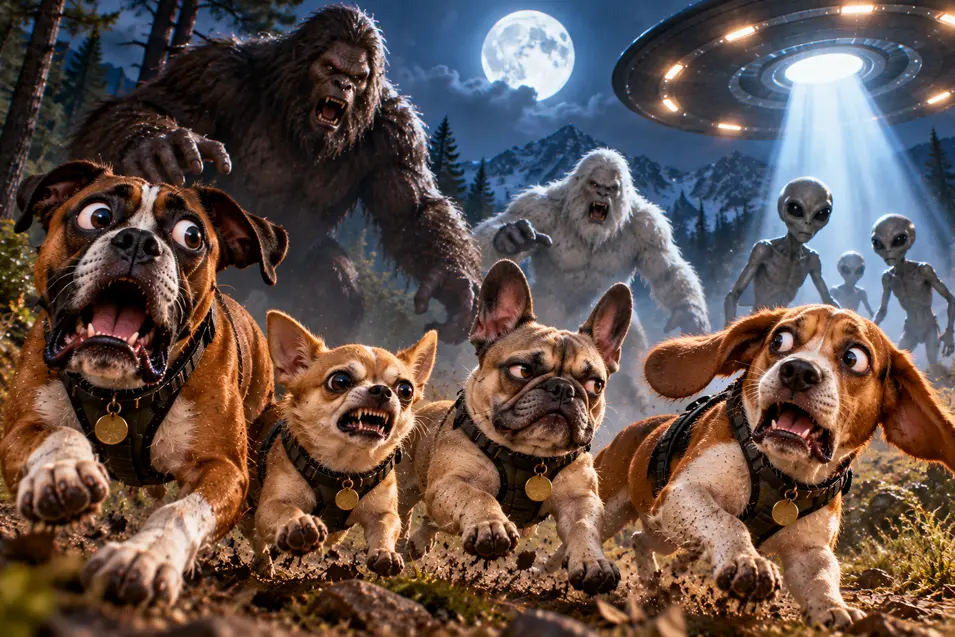
Others involved dogs driving tanks, racing customized strollers and doing things no responsible adult would have considered necessary.
According to David, they were working.
Based on the amount of laughing coming from the room, I remain unconvinced.
There was supposedly a fine line.
They crossed it frequently.
Eventually I stopped worrying.
David was laughing.
And from where I was sitting, that seemed like a perfectly reasonable thing for an imaginary friend to be good at.
Besides, Scout never ate my food.
So I liked him.
Humans Remember Different Things
People will remember David differently.
Some will remember the boy who loved animals.
Fay’s son.
Ernie’s son.
Brenda’s brother.
August and Owen’s dad.
The man Nic met because somewhere along the way David got on a plane.
Some will remember the butcher.
The rig worker.
The construction worker.
The diver disappearing beneath the ocean.
The guy who tried software and discovered that being good at most things did not necessarily mean life was going to let him win every time.
Some will remember the man who lost almost everything.
Others will remember the man who started again.
And again.
People will remember websites.
Work.
Ideas.
Stories.
Trips.
Bike rides.
Photographs.
Things he built.
Things he got wrong.
Things he got right.
Humans like lists.
I don’t have one.
I remember the sound of him coming home.
I remember knowing his footsteps.
I remember the way his hand found the top of my head without him really thinking about it.
I remember knowing when he’d had a good day.
And when he hadn’t.
On those days, I stayed a little closer.
I remember walks that he thought were for exercise.
They weren’t.
They were for smelling the same telephone pole for four minutes because something important had happened there.
David never fully understood this.
But he waited.
I remember him saying “Come on, buddy” and knowing it meant we were going somewhere together.
I remember the places beside him where I was apparently not supposed to sleep.
I slept there anyway.
He always found room.
I Think Humans Get This Wrong
Humans spend an extraordinary amount of their lives worrying about whether they’ve done enough.
Earned enough.
Built enough.
Seen enough.
Succeeded enough.
Left enough behind.
Dogs don’t think like that.
We measure things differently.
We notice who came home.
Who filled the bowl.
Who opened the door.
Who sat with us when we were scared.
Who scratched behind our ears without being asked.
Who let us climb onto the sofa even though apparently there were rules about that.
We notice who stayed.
David spent a lot of his life starting over.
Sometimes because he wanted to.
Sometimes because life gave him no choice.
He succeeded.
He failed.
He made money.
He lost money.
He built things.
Some worked.
Some didn’t.
He loved people.
Some stayed.
Some didn’t.
He loved animals.
We were considerably more consistent.
Perhaps that’s why he liked us.
What David Left Behind
Humans will decide what David left behind.
Maybe they’ll say it was the websites.
The photographs.
The stories.
The things he built.
Maybe they’ll talk about his children.
The people he loved.
The places he went.
Maybe someone will remember a ridiculous picture of a dog driving a tank and wonder what exactly was wrong with him.
Fair question.
But dogs don’t really understand legacy.
We understand something simpler.
David gave pieces of himself away his entire life.
To his family.
To people he loved.
To friends.
To ideas.
To work.
And especially to animals.
Every dog that slept beside him took a little piece.
Every cat that climbed onto something it wasn’t supposed to.
Every animal he worried about, photographed, wrote about, fed, walked or buried.
We kept those pieces.
Humans worry that when they die, everything disappears.
It doesn’t.
We carry you.
In habits.
In memories.
In the places where you used to sit.
In the people who learned something from you.
In children who remember things you don’t even realize you taught them.
And perhaps, somewhere, in every animal that once heard your footsteps coming toward the door and knew:
He’s home.
David always came home.
Eventually, I suppose, there had to be one time when he didn’t.
I don’t particularly like that part of the story.
But I know something humans sometimes forget.
For an animal, a lifetime isn’t measured by how long it lasted.
It’s measured by whether we knew we were loved while we were here.
We knew.
David has now been dead for nearly an hour.
And nobody has made dinner.
Maktub
David loved a book called The Alchemist.
There was a word in it he never forgot.
Maktub.
You won’t find it in an English dictionary.
It means:
It is written.
David’s life had plenty of good times and a few hard ones.
There were paths he followed that worked out beautifully.
Others went absolutely nowhere.
There were plans that made sense at the time, plans that made no sense at all, and more than a few occasions when he probably should have asked for directions.
But that’s the thing about a life.
You don’t always know where a path is taking you while you’re walking it.
Sometimes you only understand when you look back.
And of all the paths David followed, there was one he was particularly glad he took.
The one that led him back across the pond.
Maybe some things really are written.
Maktub.