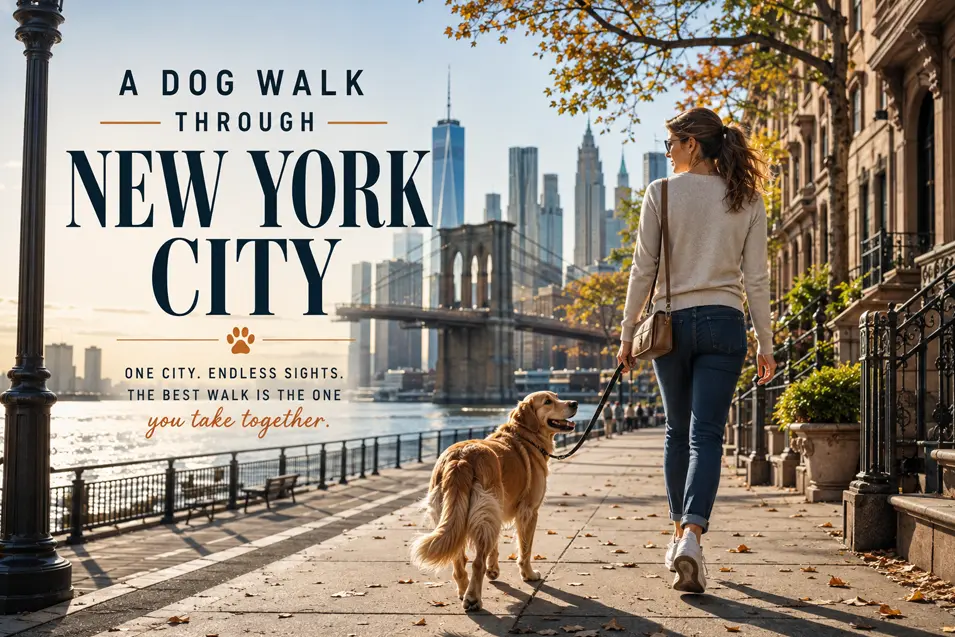
Most dogs know their neighborhood by smell.
The same trees. The same front steps. The same fire hydrant. The same corner where somebody dropped half a sandwich three weeks ago and, according to your dog, there is still every reason to investigate.
But imagine changing the neighborhood.
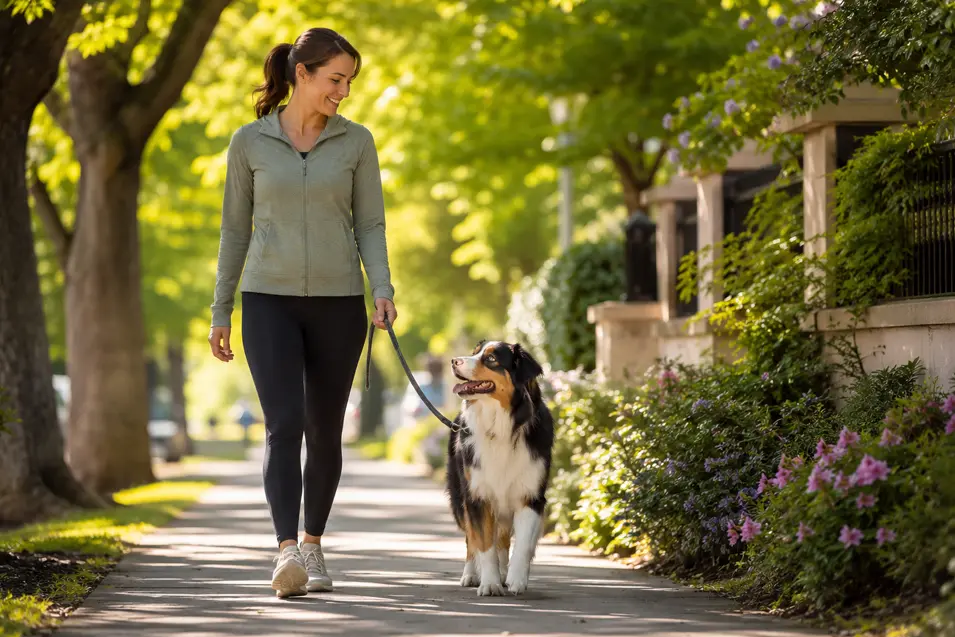
Imagine clipping on the leash one morning and stepping outside in New York City.
Suddenly, a walk isn’t just a walk.
There are thousands of people moving in every direction. Taxis roll past busy intersections. Food carts send unfamiliar smells down the sidewalk. Pigeons apparently have no respect for personal boundaries. Quiet brownstone streets give way to enormous parks, bridges, waterfront paths and some of the most recognizable architecture in the world.
For a dog, New York must be an extraordinary place to explore.
So grab the leash.
We’re going for a walk.
Early Morning in Central Park
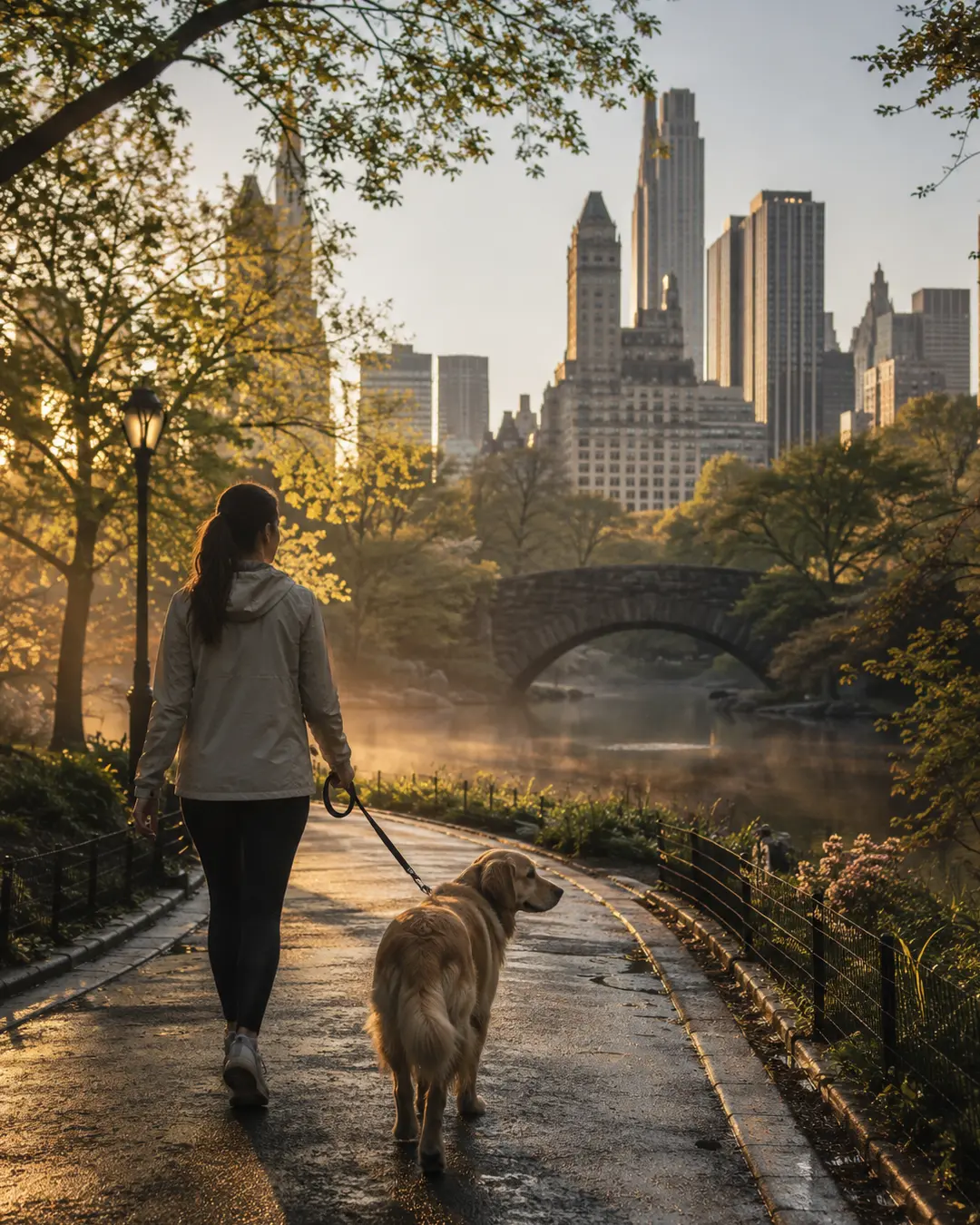
New York hasn’t completely woken up yet.
Morning light filters through the trees as our dog trots along one of Central Park’s winding paths. Joggers pass occasionally. A cyclist disappears around a bend. Somewhere beyond the trees, the tops of Manhattan’s buildings remind us that we’re still in the middle of one of the world’s largest cities.
But down here, it feels remarkably peaceful.
The dog doesn’t care about the skyline.
There’s a squirrel approximately thirty feet ahead.
New York can wait.
Beneath the Elms
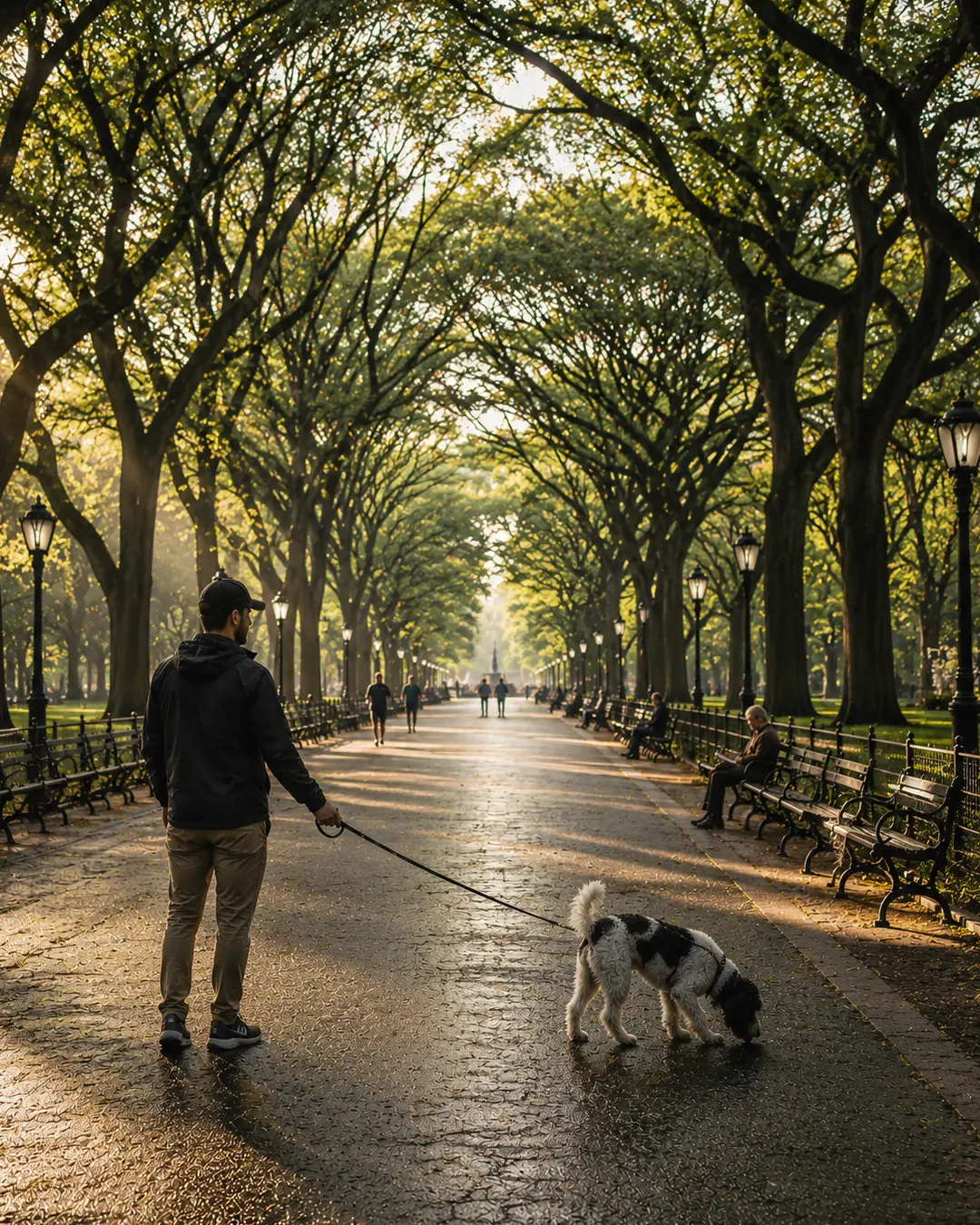
A little farther into the park, the path opens beneath an extraordinary canopy of American elm trees.
This is The Mall, one of those places that seems designed for a photograph.
The enormous trees curve overhead while benches line either side of the promenade. Our dog walks directly down the middle, occasionally stopping to investigate whatever fascinating information another dog left behind earlier that morning.
Humans see architecture and symmetry.
Dogs read the neighborhood news.
Apparently there’s a lot to catch up on.
Bethesda Terrace
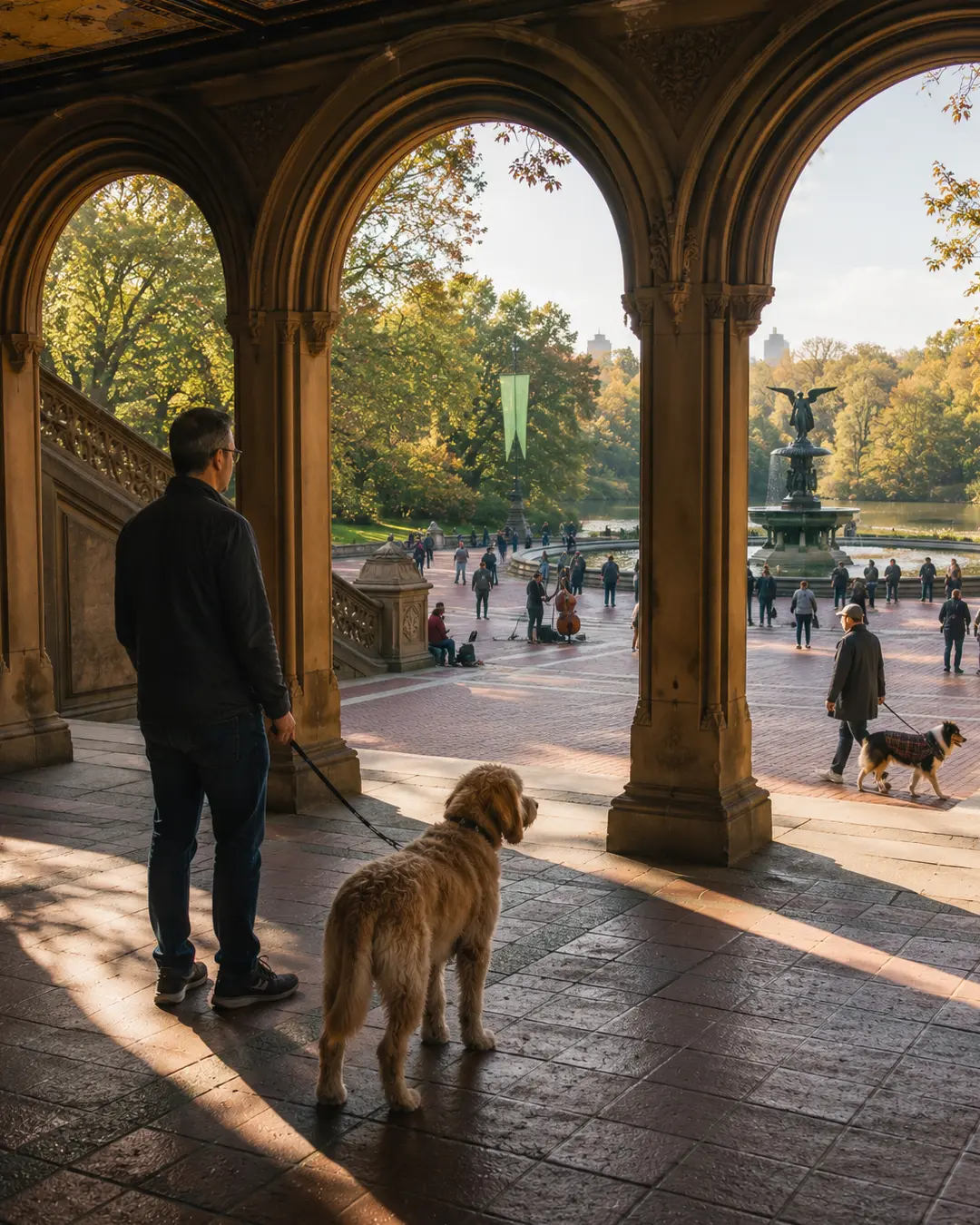
Eventually, the walk reaches Bethesda Terrace.
Stone staircases descend toward the fountain while the arcade provides one of the most beautiful architectural spaces in the park.
Our dog pauses near the edge of the plaza.
People are taking photographs. Musicians are setting up nearby. Another dog passes wearing a considerably more expensive-looking coat.
For perhaps three seconds, our dog appears impressed by the surroundings.
Then somebody opens a bag of food.
Focus shifts immediately.
The Upper West Side
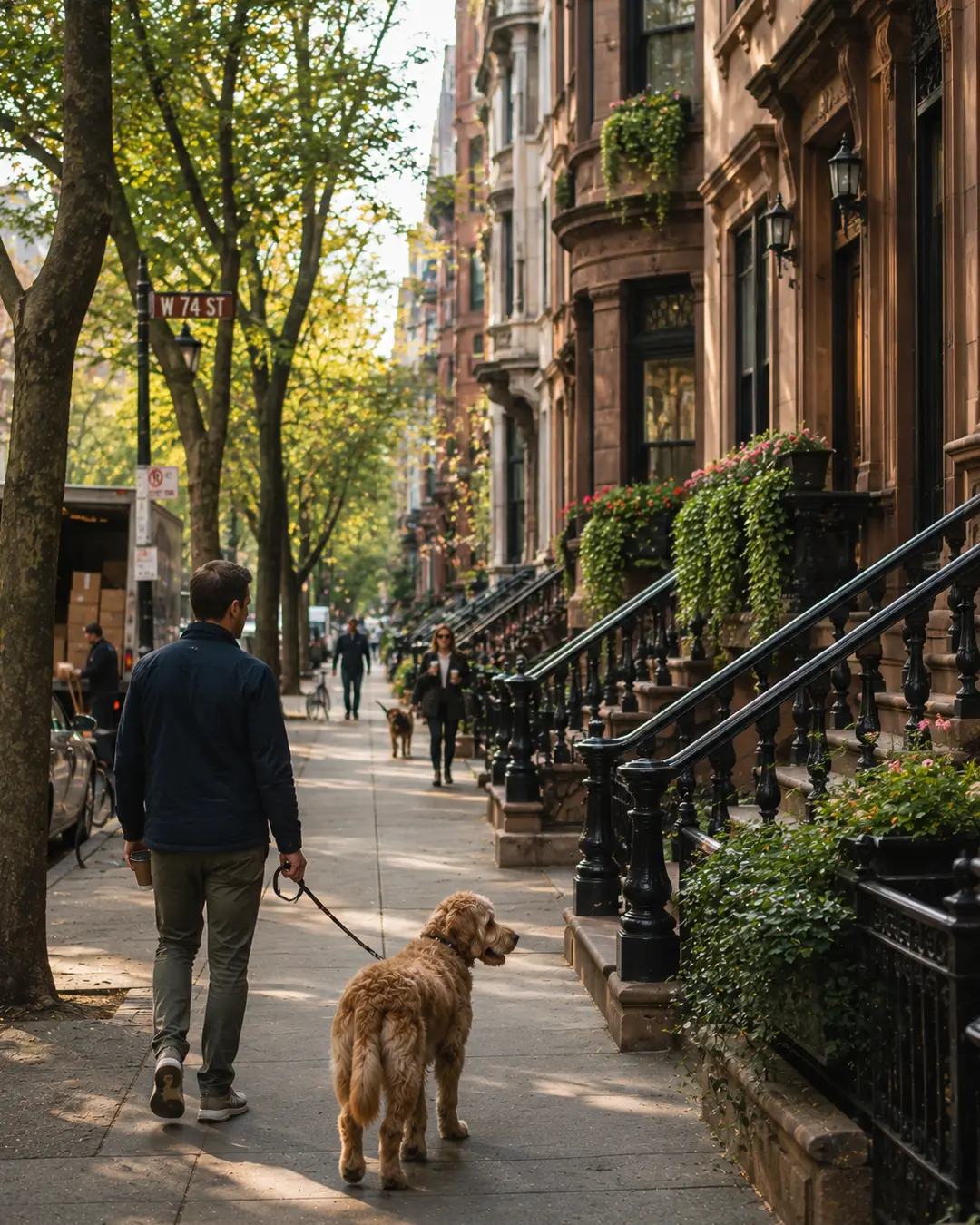
Leaving the park takes us onto a completely different kind of walk.
Tree-lined streets run between rows of brownstones and apartment buildings. Stairs rise from the sidewalk toward beautifully detailed entrances. Window boxes spill greenery toward the street.
This is neighborhood New York.
People are carrying coffee. Dogs are being walked before work. Delivery trucks squeeze into spaces that don’t appear remotely large enough for them.
Our dog fits right in.
There’s something wonderfully ordinary about walking a dog through a place that looks extraordinary to everybody who doesn’t live there.
The Morning Coffee Stop
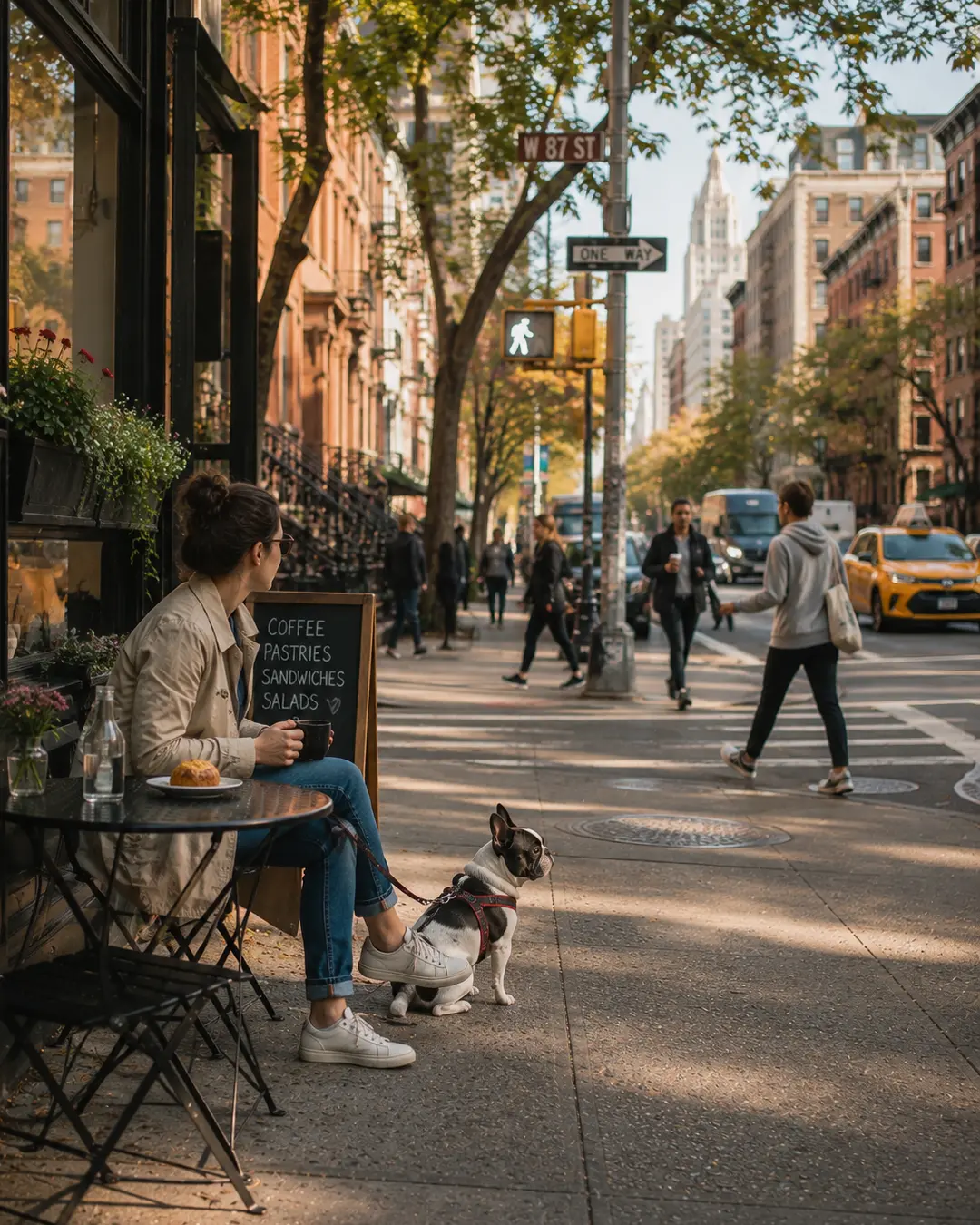
Every good dog walk eventually encounters coffee.
A small neighborhood café has a few tables outside, so we stop.
Our dog settles beside the chair while the city continues moving around us.
Coffee arrives.
Then breakfast.
This creates a significant injustice.
The dog would like it formally recorded that although he has walked several miles already, nobody ordered him a croissant.
A small treat from the pocket prevents further negotiations.
Crossing Fifth Avenue
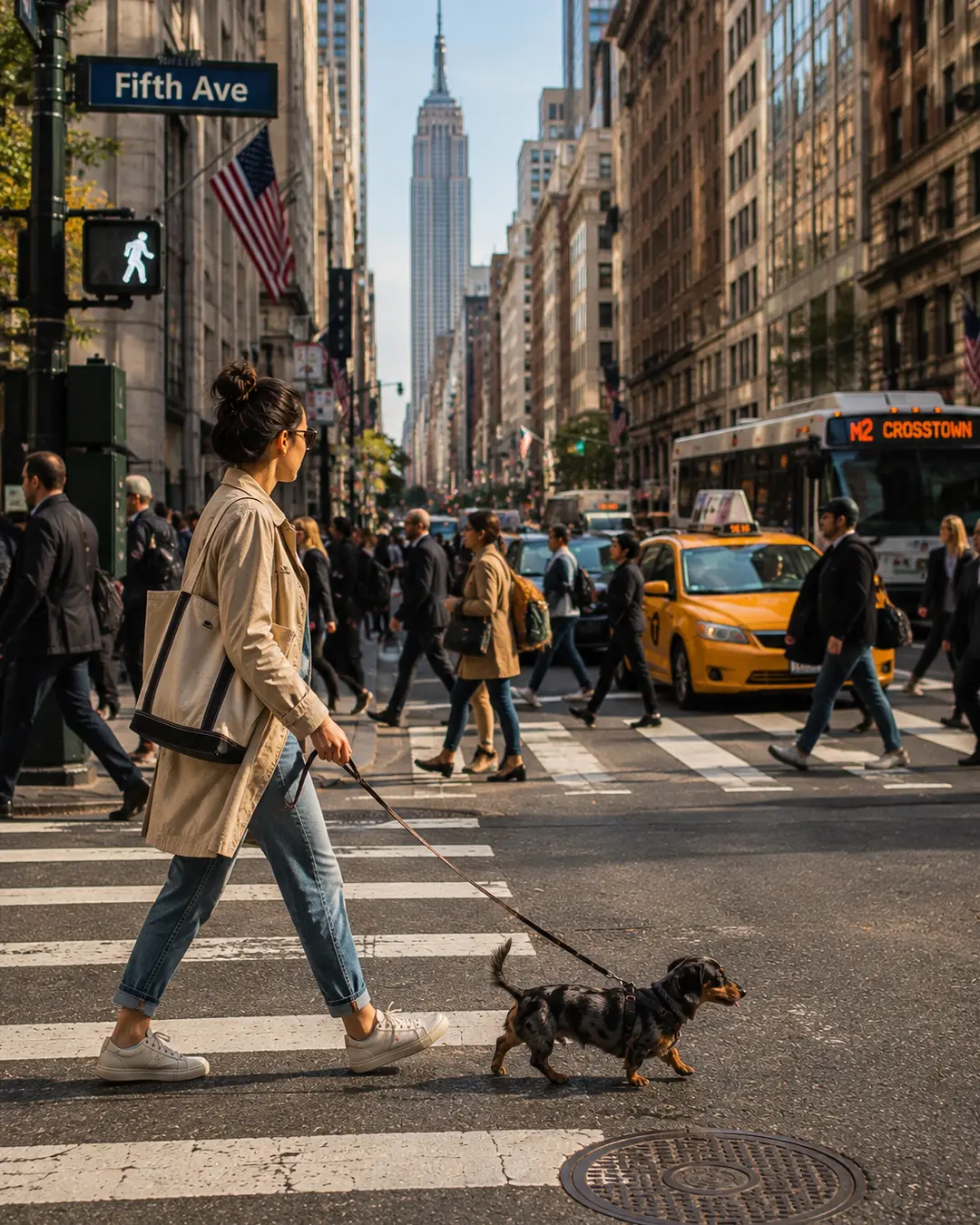
Later, we’re back in the heart of Manhattan.
The pedestrian signal changes and suddenly everyone moves.
Yellow taxis wait at the intersection. Buses rumble past. Cyclists weave through traffic. People cross from both directions while our dog trots confidently beside us.
It’s one of those moments that could only happen in New York.
The buildings rise overhead.
The traffic never really stops.
And somehow, in the middle of all that movement, one person and one dog are simply going for a walk.
SoHo
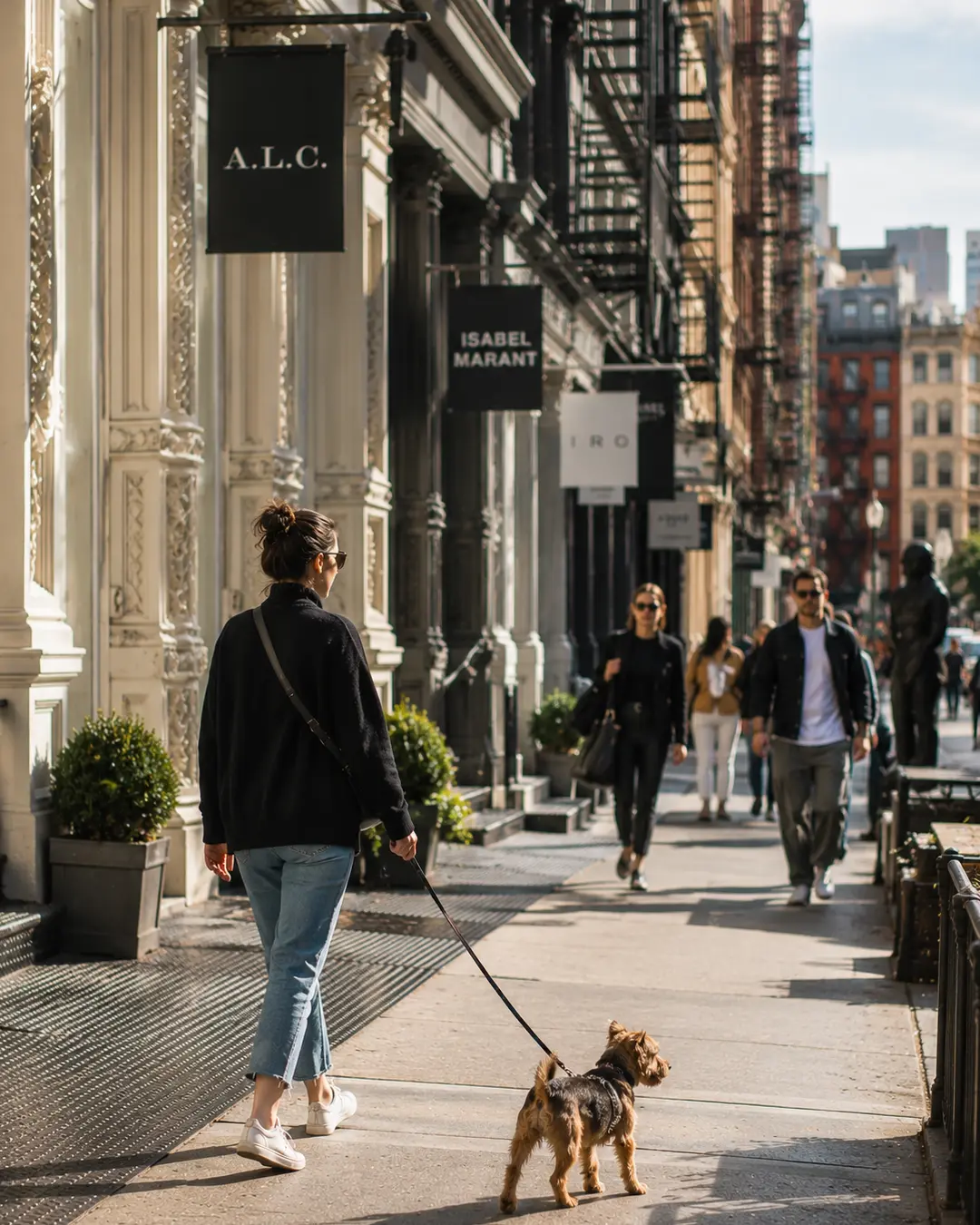
Downtown, the scenery changes again.
Cast-iron buildings line the streets of SoHo, their enormous windows reflecting the city around them.
The sidewalks become a runway of sorts.
Beautiful storefronts. Great architecture. People who appear to have put considerably more thought into getting dressed this morning than we did.
Fortunately, dogs are naturally fashionable.
Our companion requires no stylist whatsoever.
A collar.
A leash.
Done.
A Pastrami Detour
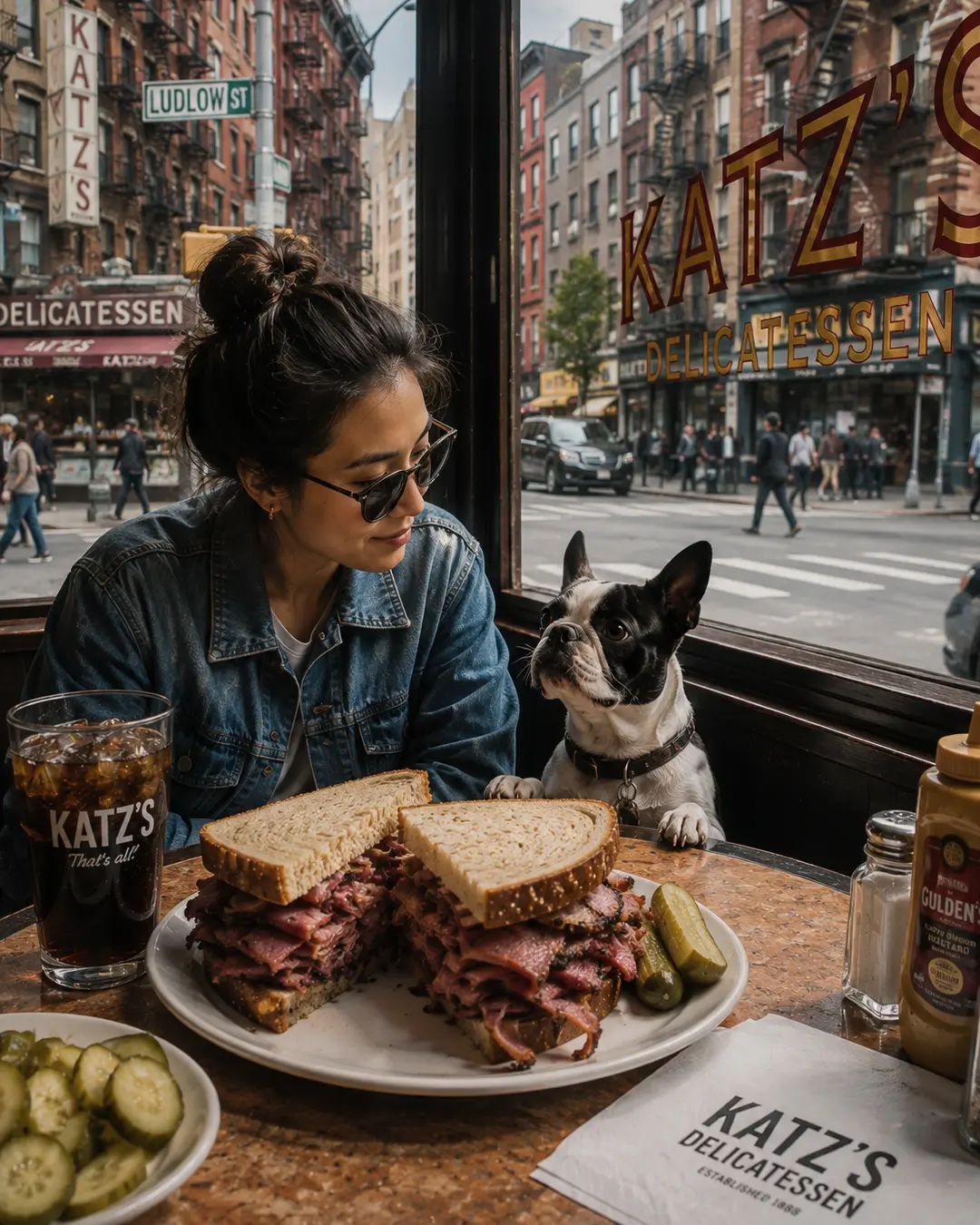
Eventually, walking several miles through Manhattan creates a problem.
Hunger.
Fortunately, New York has spent generations developing solutions to this particular emergency.
We stop for one of the city’s classics: a towering pastrami-on-rye sandwich, piled considerably higher than any reasonable sandwich needs to be.
Our dog watches the entire construction arrive at the table.
Bread.
Pastrami.
Mustard.
More pastrami.
There is suddenly an intense level of interest in lunch.
Unfortunately, heavily seasoned and fatty deli meat isn’t something we’re about to share, regardless of how persuasive the staring becomes.
The dog receives a treat of his own.
We receive the sandwich.
Everybody moves on.
Love a great sandwich? Take a detour from our walk and explore our guide: Can Dogs Eat Sandwiches? Why Most Are Better Left Off the Menu
Washington Square Park
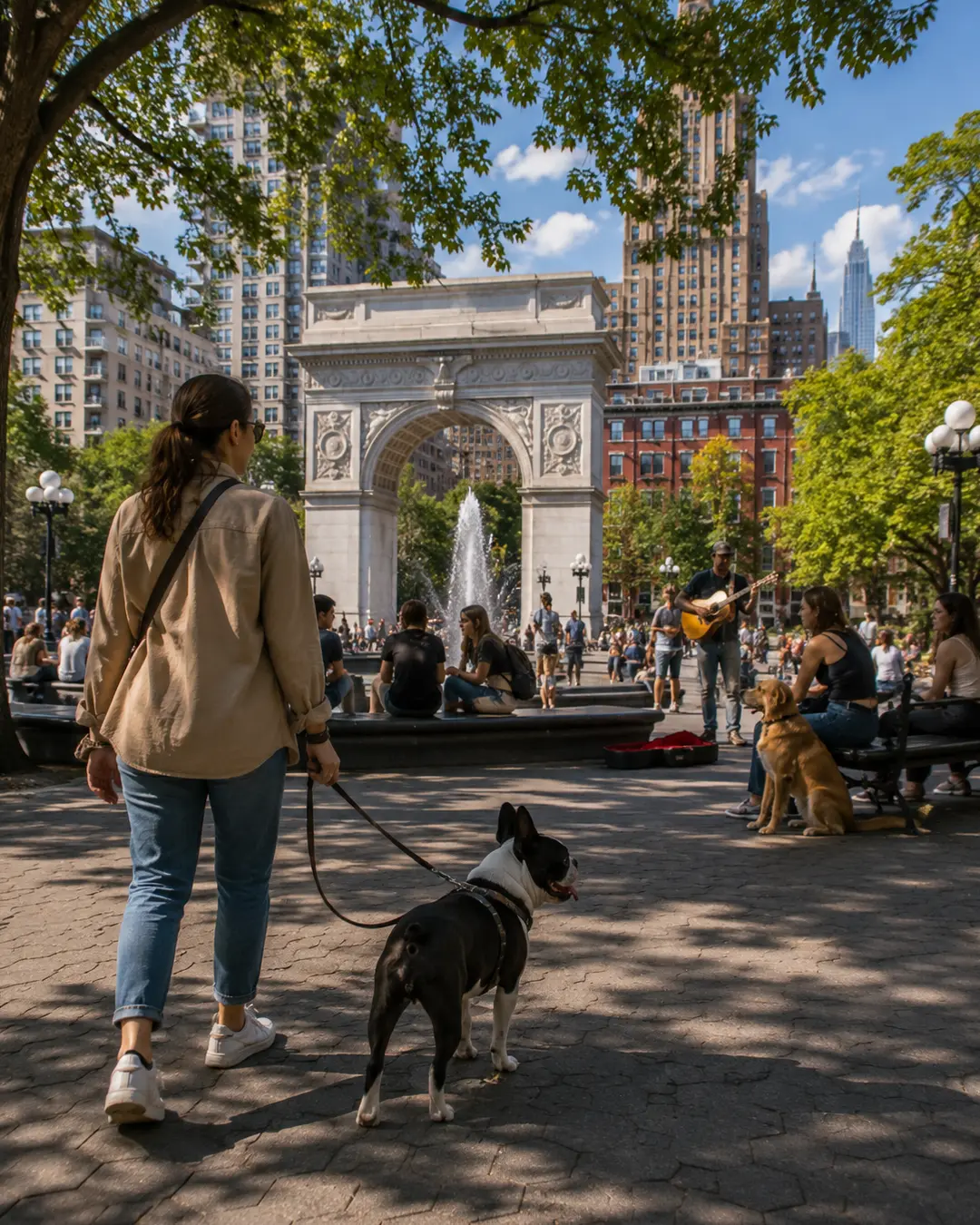
You know you’re approaching Washington Square Park before you reach it.
The arch appears between the buildings.
Inside, the park is alive.
Students sit around the fountain. Musicians play nearby. People talk on benches while dogs inspect one another with considerably less ceremony.
Our dog pauses beneath the trees and watches everything.
This is what makes walking a dog through a city so interesting.
You don’t simply pass through a place.
Dogs make you stop.
They make you notice the park, the people, the smells, the tiny patches of grass and the other dogs sharing the neighborhood.
You experience the city at walking speed.
Through Greenwich Village
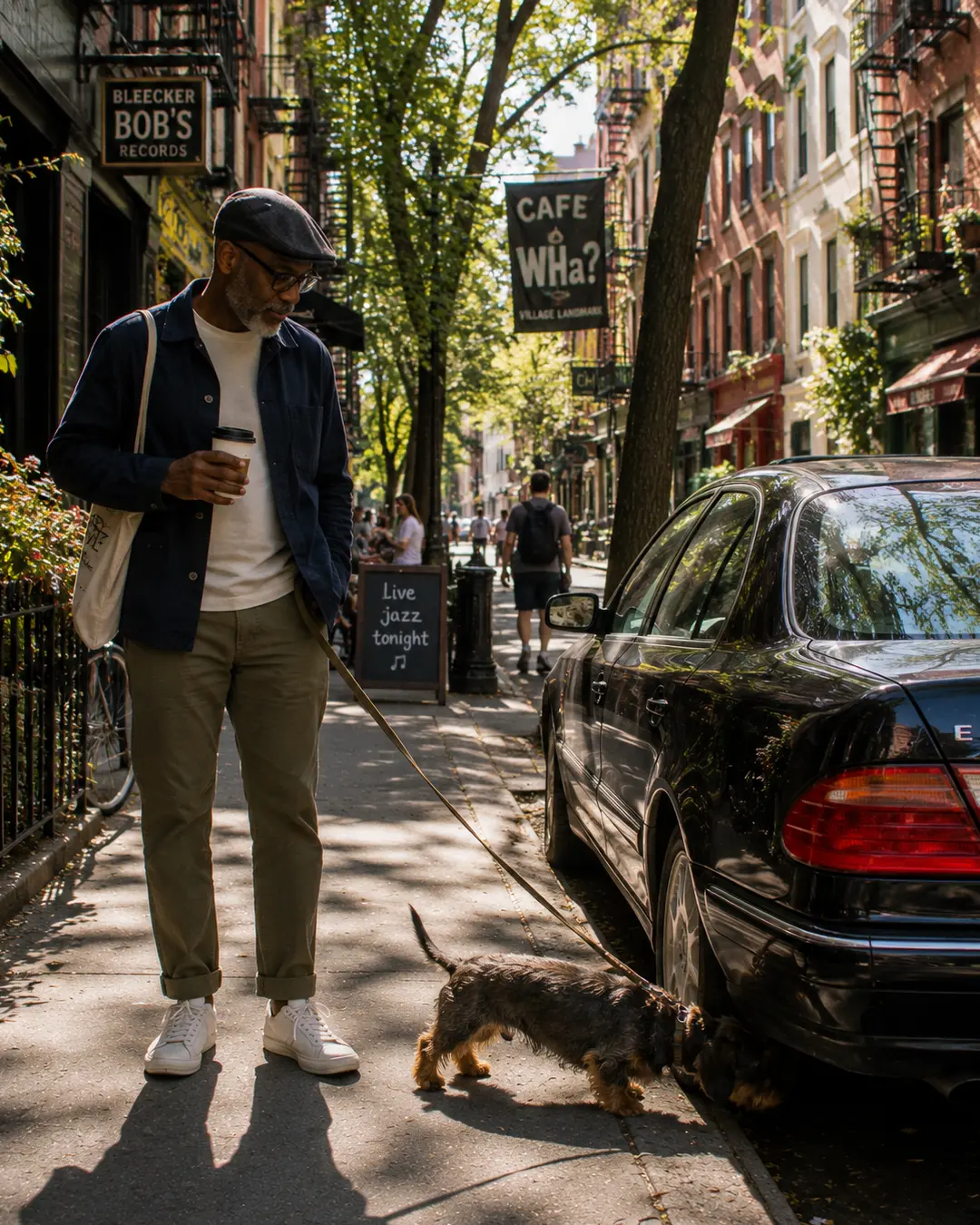
From Washington Square, we wander into Greenwich Village.
The streets become smaller.
Townhouses replace towers. Trees soften the sidewalks. Tiny restaurants and neighborhood shops appear around corners.
This feels like the kind of New York where you could forget you’re in New York.
At least until you reach the next intersection.
Our dog has discovered something beneath a parked car.
Whatever it is apparently deserves a complete forensic investigation.
We have time.
That’s the nice thing about walking.
A New York Dog Meets Another New York Dog
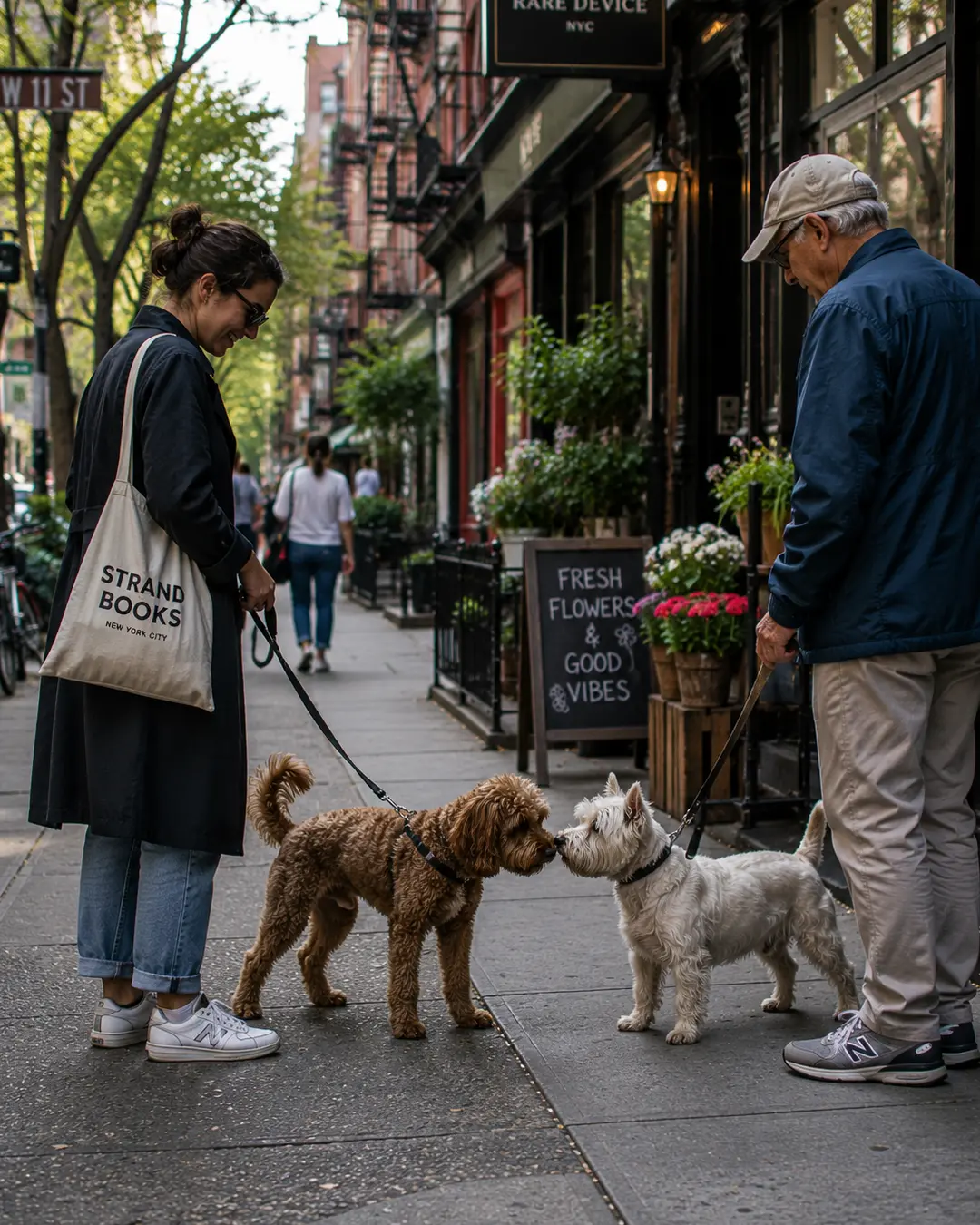
It was inevitable.
Outside a neighborhood shop, another dog approaches.
Both dogs stop.
There is the usual careful sniffing.
A little circling.
A brief exchange of information humans will never understand.
Then it’s over.
The dogs continue in opposite directions as if nothing happened.
Somewhere in New York, two complete strangers have just learned considerably more about one another than their owners ever will.
Across the Brooklyn Bridge
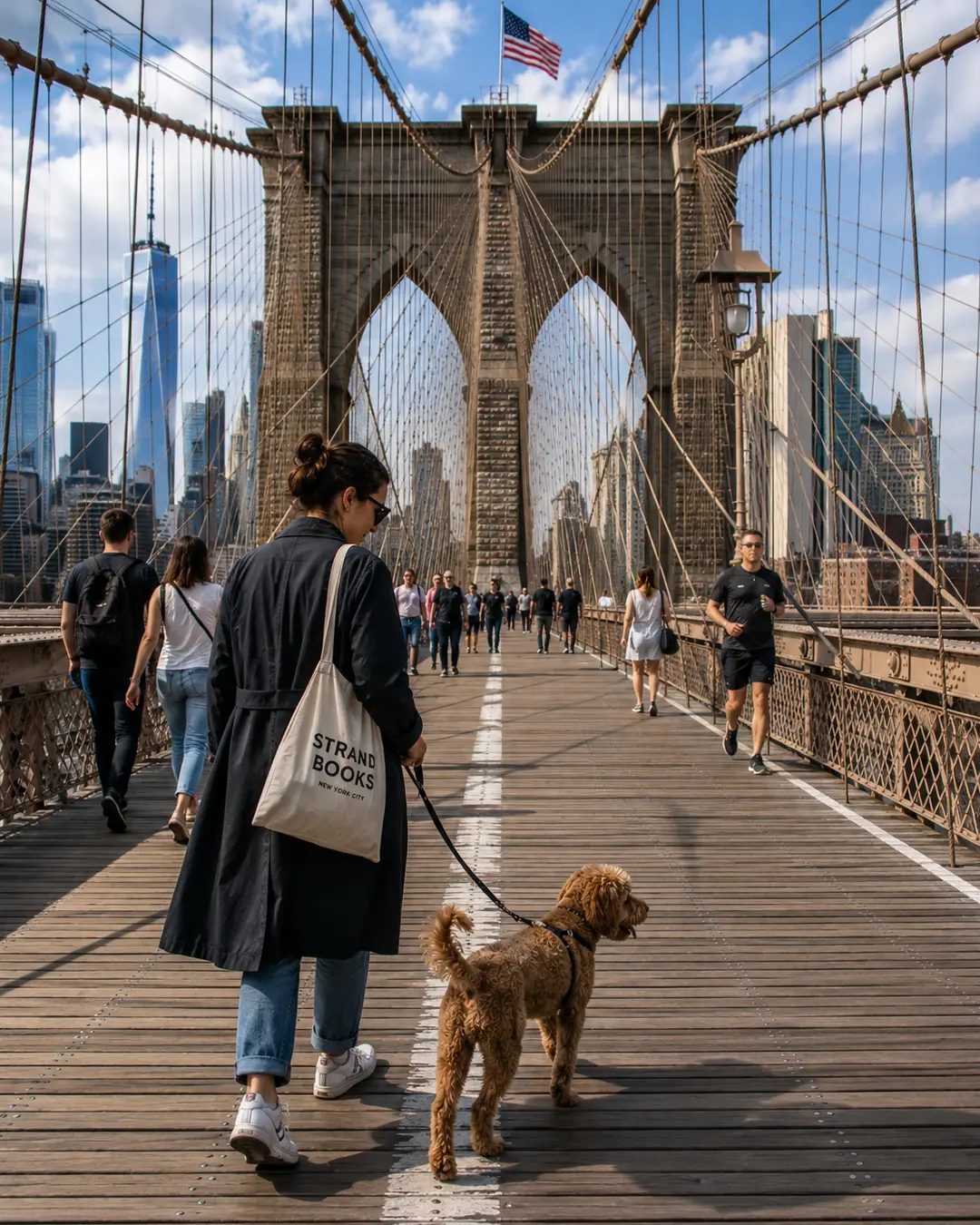
Now we need a little drama.
The Brooklyn Bridge delivers it.
Stone towers rise overhead while suspension cables create enormous geometric patterns against the sky. Manhattan stretches behind us and Brooklyn waits ahead.
Our dog walks across the wooden promenade with the confidence of someone who has absolutely no understanding of how famous this bridge is.
That’s probably for the best.
There are enough influencers here already.
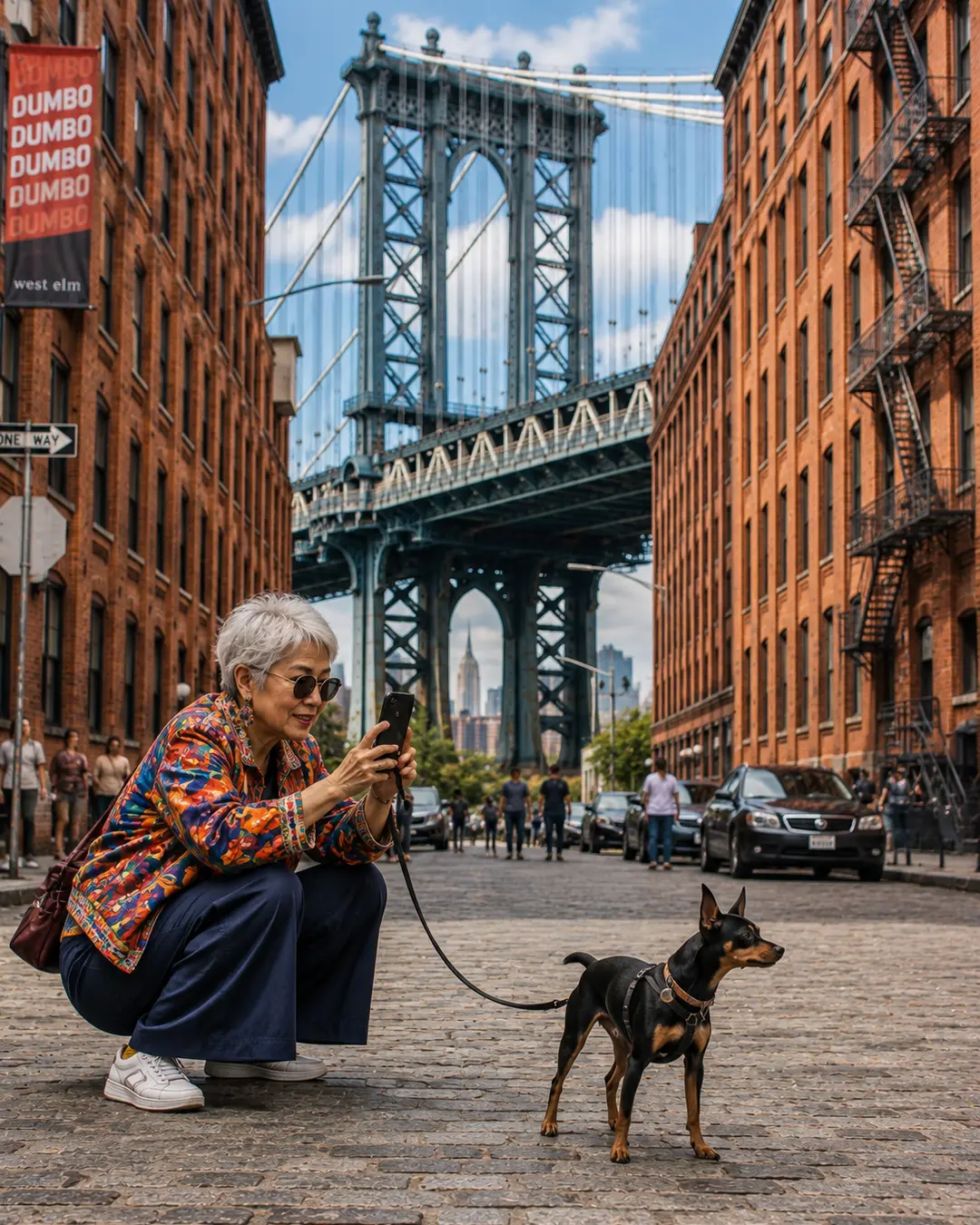
On the Brooklyn side, we wander into DUMBO.
Brick warehouses frame cobblestone streets. The Manhattan Bridge appears dramatically between the buildings.
It’s one of New York’s most photographed views.
Naturally, we attempt a photograph.
Our dog immediately looks in the opposite direction.
We try again.
He sits.
Perfect.
Someone drops something twenty feet away.
Photograph over.
That’s traveling with dogs.
Brooklyn Heights
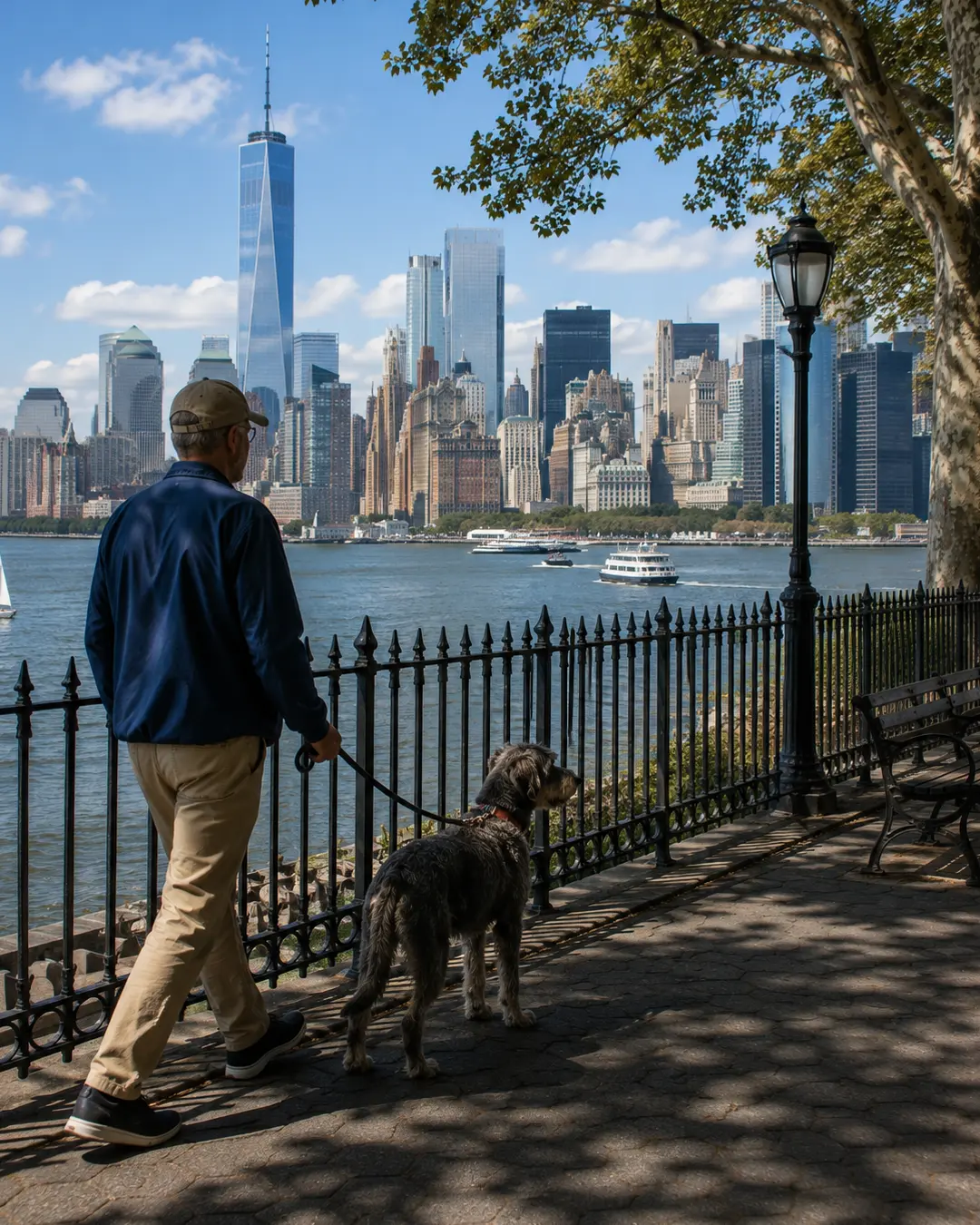
The pace slows along the Brooklyn Heights Promenade.
Across the water, Lower Manhattan rises into the sky.
Boats move along the river below while our dog stands beside the railing, nose pointed into the breeze.
Maybe he’s admiring the skyline.
Maybe somebody nearby has a hot dog.
We’ll give him the benefit of the doubt.
This is one of those places where walking becomes the entire activity.
There is nowhere we particularly need to be.
So we keep going.
An Afternoon in Prospect Park
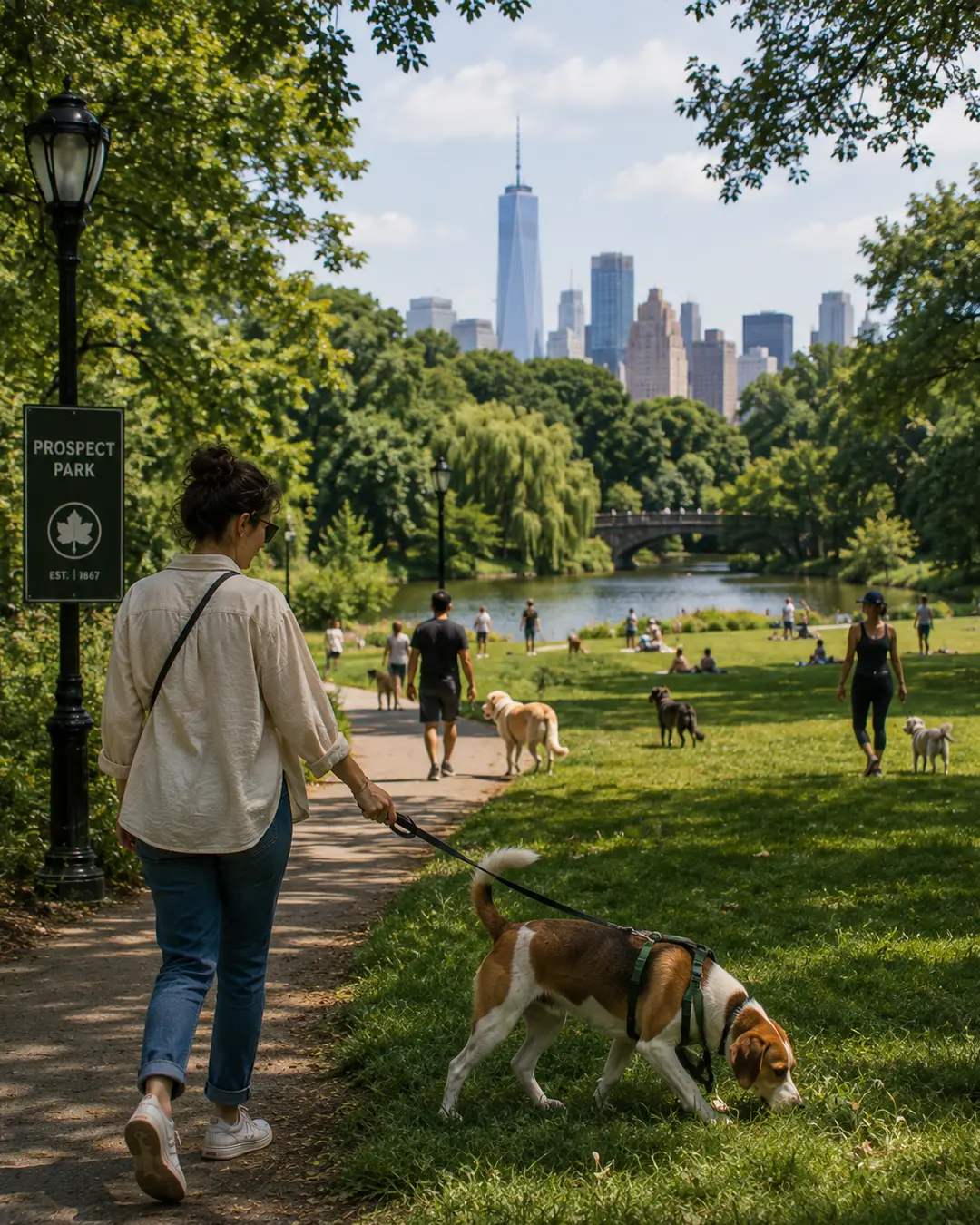
After so much pavement, Prospect Park feels like a reset.
There is grass.
Lots of it.
Paths wind through trees and open spaces while neighborhood dogs enjoy their own afternoon walks.
Our dog suddenly has more room.
The stride gets longer.
The nose drops toward the ground.
The city hasn’t disappeared, but for a while it moves into the background.
Every great city needs places where dogs can simply be dogs.
When It Rains in New York
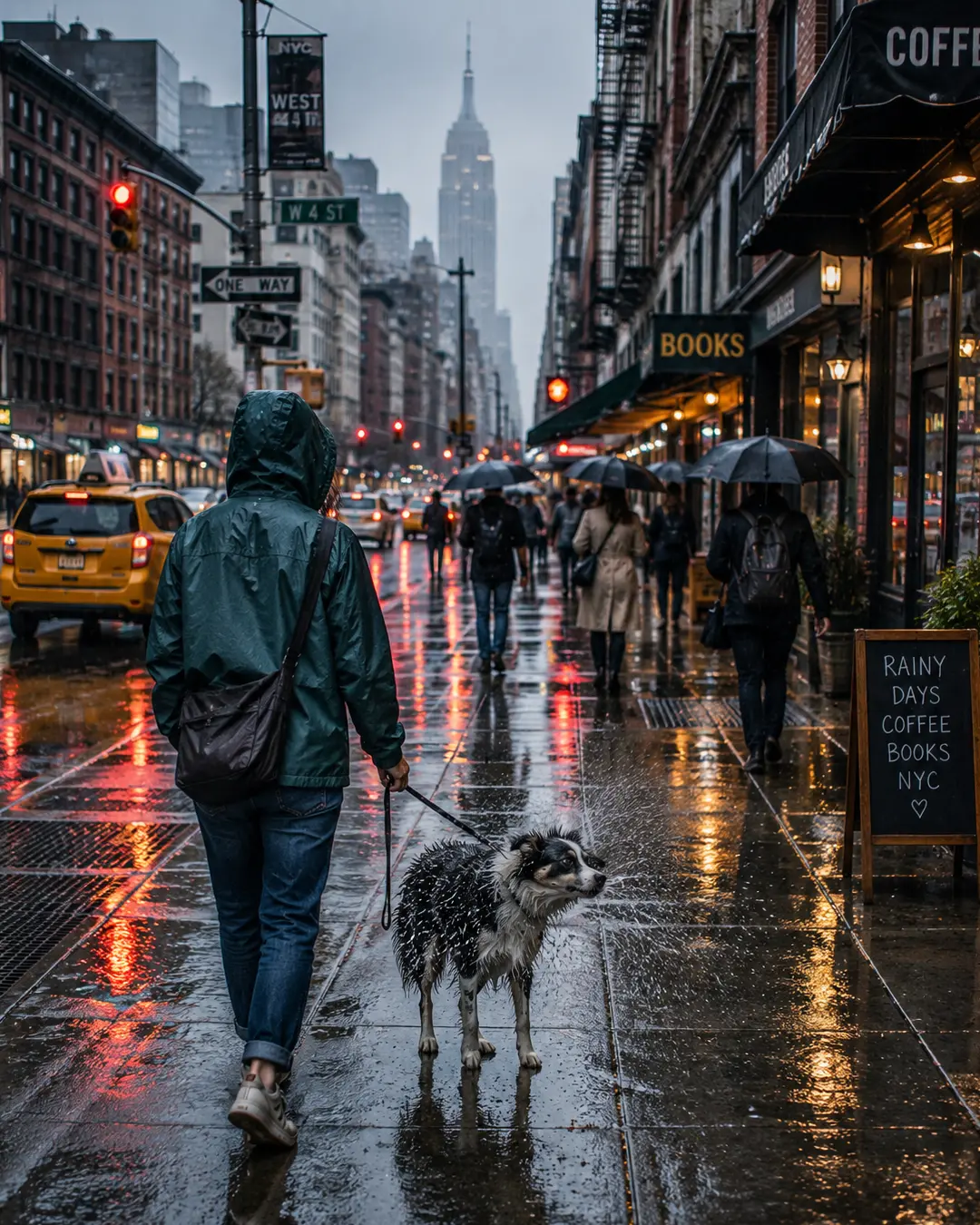
Of course, the weather doesn’t consult our itinerary.
Rain begins falling.
Umbrellas appear almost instantly.
The pavement turns glossy, reflecting traffic lights, storefronts and yellow taxis as people hurry beneath awnings.
Our dog?
Completely unconcerned.
There’s something cinematic about walking New York in the rain.
The city becomes darker, shinier and somehow even more New York.
We pull up our hood.
Our dog shakes water directly onto our pants.
The magic continues.
Autumn on a Brownstone Street
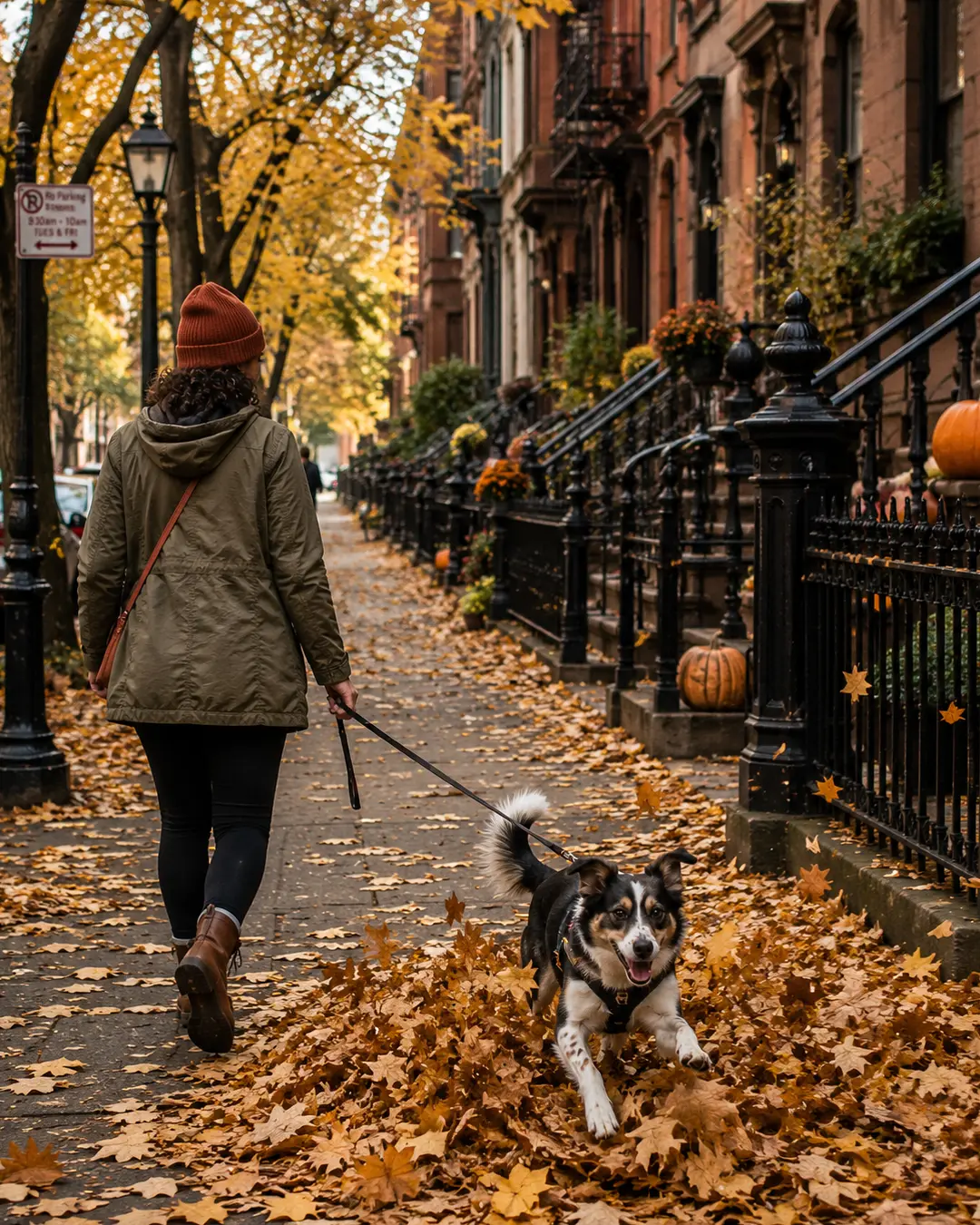
If we could choose one season for a long neighborhood walk in New York, autumn would make a strong argument.
Leaves gather along the sidewalk.
Brownstones rise behind iron railings decorated with pumpkins and seasonal planters. The air is cool enough that a long walk feels good.
Our dog moves through the leaves with considerable enthusiasm.
Some dogs walk around piles of leaves.
This is not one of those dogs.
Straight through.
Every time.
A Snowy New York Walk
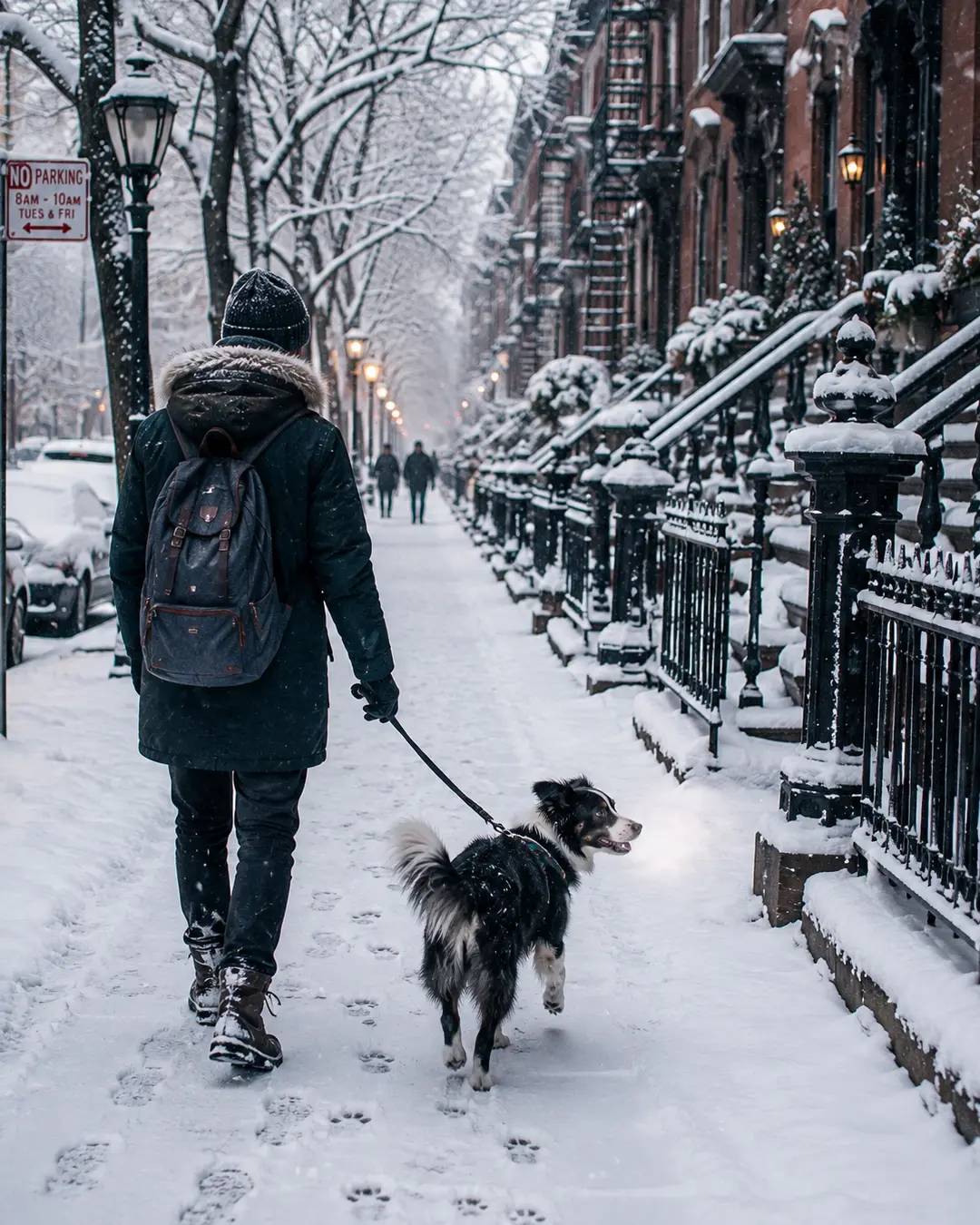
Then imagine the same street in winter.
Snow settles along the steps and parked cars. People are bundled into coats, scarves and hats.
Our dog’s breath hangs briefly in the cold air.
The city sounds different after snow.
Softer.
For a little while, even New York seems quieter.
Our dog trots through fresh snow, leaving paw prints behind him.
Those won’t last long here.
That’s okay.
Neither will the snow.
Times Square After Dark
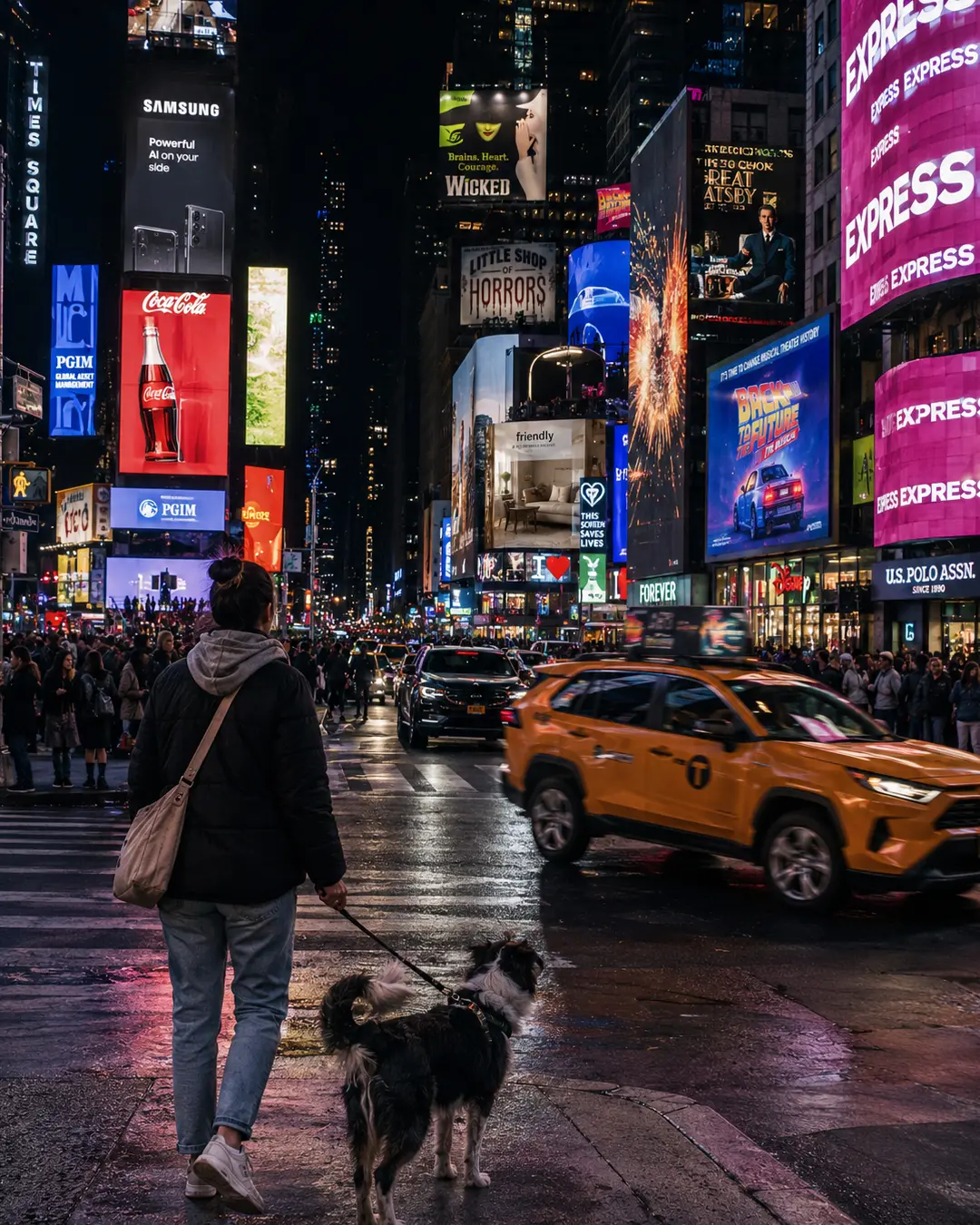
There are quieter places to walk a dog.
Considerably quieter places.
But we’re in New York.
We have to see it.
Times Square explodes with light.
Giant screens cover the buildings. Taxis move through the intersection. Tourists stop without warning in the middle of sidewalks. Everything flashes, moves and competes for attention.
And down at ground level, our dog walks beside us.
In a place designed to make humans look upward, having a dog reminds you to look down occasionally.
That’s where your friend is.
Along the Waterfront
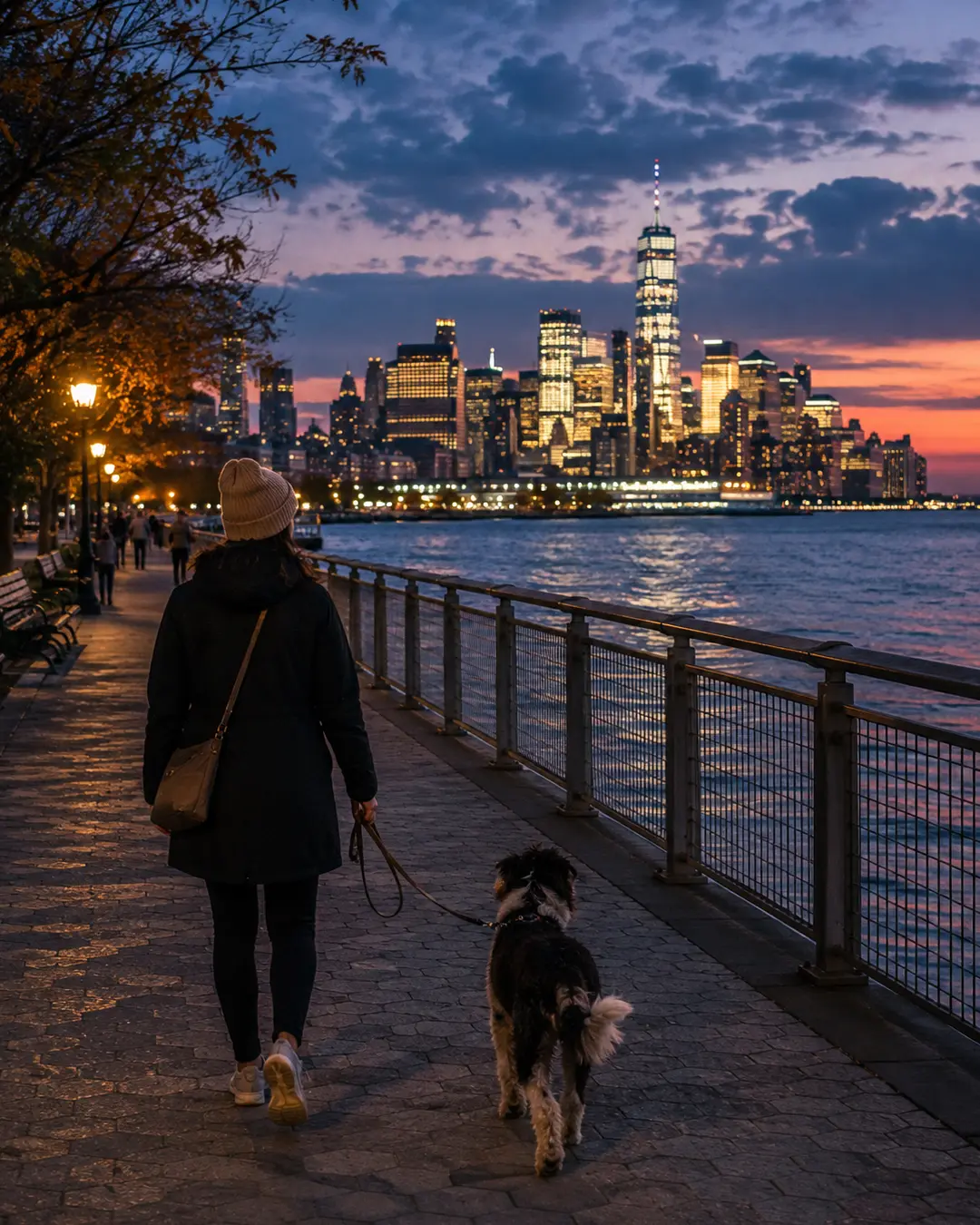
After the intensity of Midtown, we finish somewhere quieter.
The waterfront stretches ahead as evening settles over the city.
Manhattan glows across the river.
Our dog walks more slowly now.
So do we.
It’s been a long day.
Parks. Brownstones. Bridges. Coffee shops. Rain. Crowded sidewalks. Quiet neighborhoods.
Probably several hundred smells that will remain completely mysterious to us.
The leash hangs loosely between us.
There’s no hurry anymore.
The Walk Home
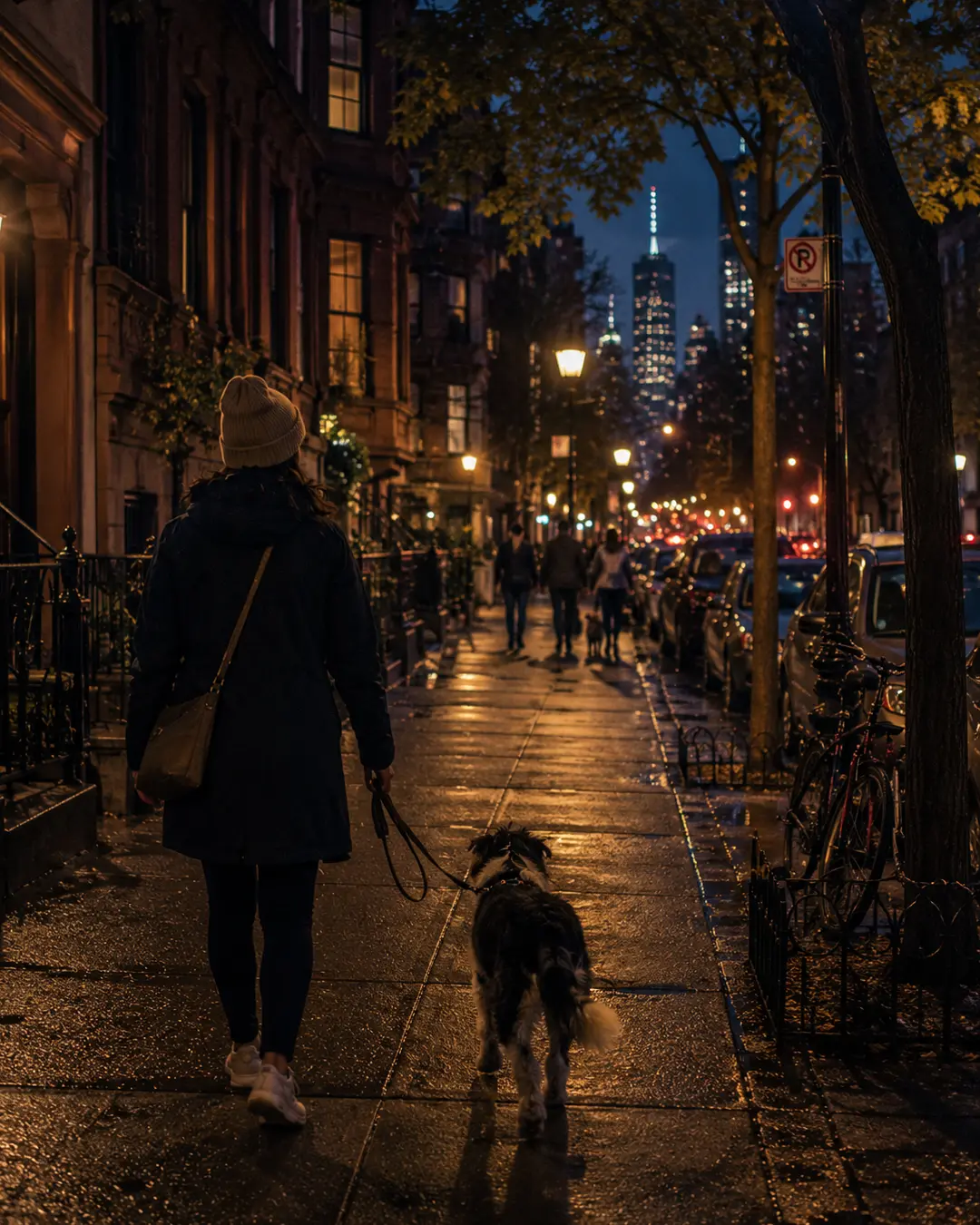
Eventually, every walk has to end.
We turn onto a quiet residential street.
Warm light spills from apartment windows. Cars line the curb. A few people are still walking their dogs before calling it a night.
Our dog is tired.
The kind of tired that comes from actually experiencing something.
Soon there will be water, dinner and an excellent place to sleep.
Tomorrow’s walk probably won’t include Central Park, the Brooklyn Bridge and Times Square.
That’s fine.
Dogs don’t need New York City to enjoy going for a walk.
They need us to take them.
A New York Souvenir
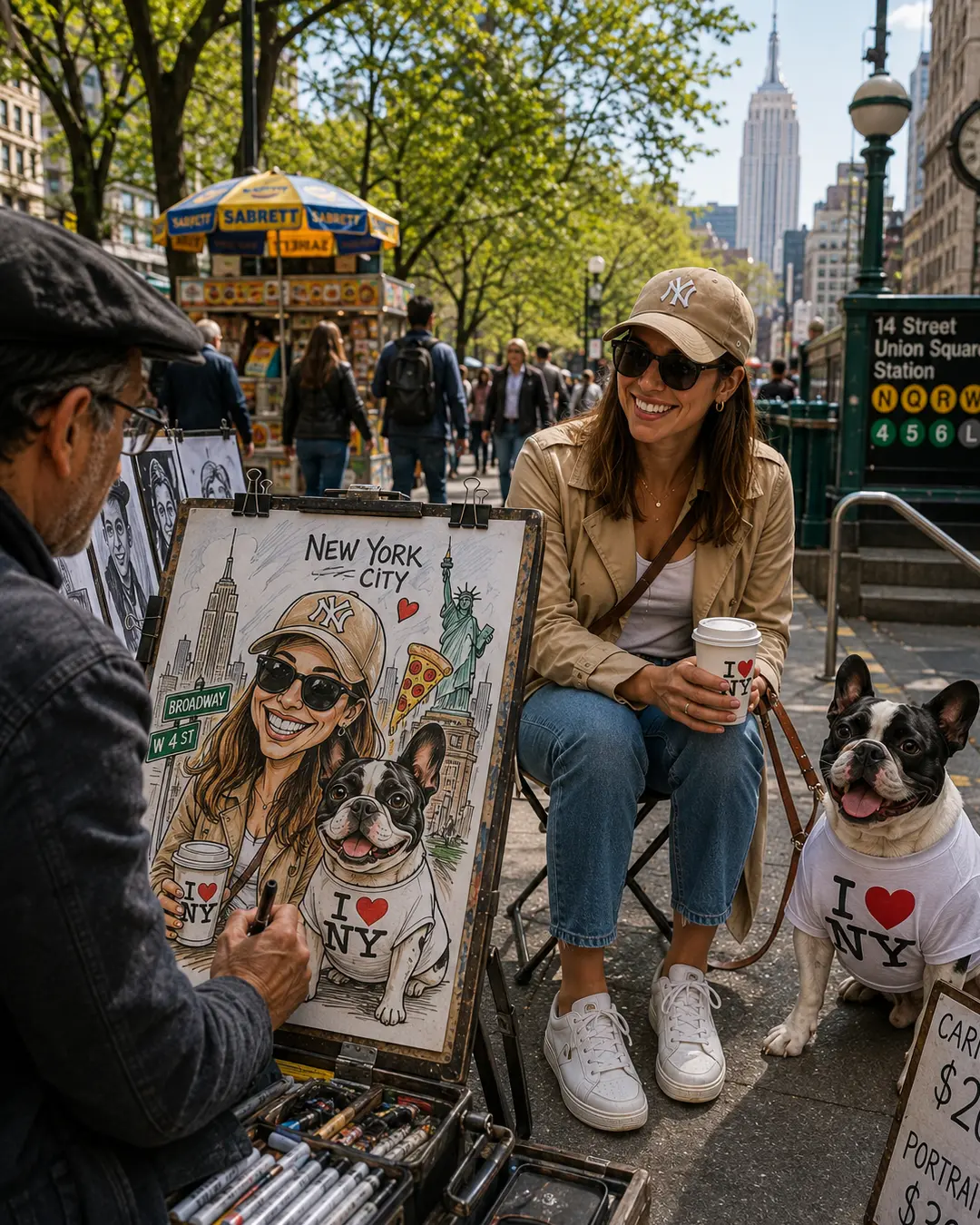
Near the end of the walk, we find a street artist sketching portraits of people passing by.
Naturally, we stop.
Our dog sits beside us while the artist gets to work, turning the two of us into a wonderfully exaggerated cartoon complete with a few unmistakable pieces of New York — a yellow taxi, the Empire State Building and a little slice of the city we’ve spent the day exploring.
The dog watches the portrait take shape with surprising interest.
Eventually, the artist turns the finished drawing around.
It’s fantastic.
Apparently we’ve both acquired considerably more New York attitude since this morning.
The dog would, however, like it formally recorded that his ears are not that big.
We leave with tired feet, one very happy dog and perhaps the best souvenir we could have brought home from New York.
The Best Walk Is the One You Take Together
We walk dogs because they need exercise.
That’s true.
But walks give dogs much more than physical activity.
They provide smells to investigate, environments to explore, people and animals to observe and opportunities to experience a world much larger than the rooms inside our homes.
And they give us something too.
Walking a dog forces us to slow down enough to notice where we are.
Whether that’s beneath the skyscrapers of New York City, through the streets of Tokyo, along a Colorado mountain trail or simply around the same neighborhood you’ve walked a thousand times, your dog probably doesn’t care whether the scenery belongs on a postcard.
He’s outside.
He’s exploring.
And you’re there with him.
That’s a pretty good walk.
A Few Things We Learned Along the Way
Spend an entire day walking through New York and you start collecting things.
Not souvenirs.
Little facts.
Stories about the places you passed. Things you noticed while waiting for the dog to finish sniffing a tree. Questions that occurred to you while staring at a bridge, a taxi or one of those strange wooden tanks sitting on top of a building.
So before we head home, here are a few things we picked up along the way.
Balto really is a New York celebrity.
The famous sled dog has had his own statue in Central Park since December 1925. Balto led the final leg of the relay that carried desperately needed diphtheria antitoxin to Nome, Alaska, and he was actually present in New York when his statue was unveiled.
Central Park isn’t nearly as natural as it looks.
Those woods, lakes, meadows and winding paths feel like a piece of wilderness that somehow survived Manhattan.
In reality, Central Park’s 843 acres were meticulously designed and constructed. Frederick Law Olmsted and Calvert Vaux were very, very good at making something artificial feel natural.
Early morning really is dog time in Central Park.
Dogs must generally be leashed between 9 a.m. and 9 p.m., but designated areas have off-leash hours from 6–9 a.m. and 9 p.m.–1 a.m.
Suddenly all those early-morning dogs we encountered make considerably more sense.
Those incredible elm trees we walked beneath are special.
The Mall isn’t just photogenic.
According to the Central Park Conservancy, its American elms make up the largest remaining collection of American elm trees in the world.
It’s also the only intentionally straight pathway in Central Park.
New York has a wonderfully New York rule about dogs on public transit.
MTA rules say animals generally have to be enclosed in a container and carried without annoying other passengers, with exceptions including service animals.
New Yorkers have famously interpreted the container requirement rather creatively — hence photographs of surprisingly large dogs being transported in very ambitious bags.
The rule says the dog has to be in a container.
Apparently nobody said it had to be a particularly sensible container.
Westminster started right here in New York.
The first Westminster dog show was held in Manhattan in 1877, with 1,201 dogs entered.
It’s now the second-longest continuously held sporting event in the United States — only the Kentucky Derby has been running longer.
Twenty-one elephants once crossed the Brooklyn Bridge.
Seriously.
In 1884, P.T. Barnum led a parade that included 21 elephants across the bridge, helping reassure a nervous public that the relatively new structure was safe.
Apparently an engineering report wasn’t quite dramatic enough.
New York’s yellow taxis weren’t always yellow.
Metered taxis were operating in the city by 1907, but it wasn’t until 1967 that all medallion cabs were required to be painted yellow.
Today, yellow taxis remain the only taxis permitted to accept street hails throughout all five boroughs.
Those wooden tanks on New York rooftops aren’t decorations.
In many taller buildings, pumps send water up to rooftop tanks.
Gravity then helps distribute it through the building.
It’s old-school engineering hiding in plain sight all over the skyline.
Washington Square Park nearly had traffic running through it.
Beginning in the 1930s, powerful city planner Robert Moses repeatedly pushed plans that would have sent a roadway through Washington Square Park.
The plans were ultimately defeated, leaving us with the pedestrian park we walked through today.
And perhaps that’s the other thing you discover when you walk New York instead of simply moving through it.
There’s a story on almost every block.
Sometimes it’s about a bridge.
Sometimes it’s about a dog.
And occasionally it’s about 21 elephants walking across the East River because P.T. Barnum apparently didn’t believe in doing anything quietly.