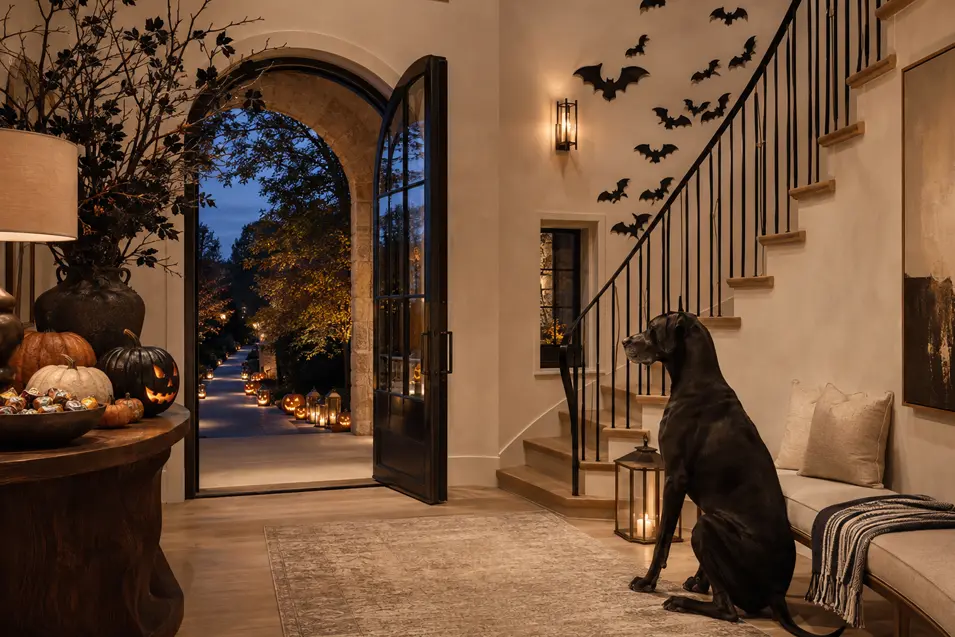
The entrance to a home is always important, but on Halloween it becomes part of the experience.
It is where trick-or-treaters gather, neighbours stop to admire the decorations and dogs watch the evening unfold from behind the door. It is also the one part of the home that almost every visitor sees, even if they never venture farther inside.
A memorable Halloween entrance does not require covering every surface with plastic decorations. Architecture, lighting, flowers, branches, art and beautifully arranged pumpkins can create far more atmosphere than a crowded collection of predictable props.
The most successful entrances also consider what happens inside the door. A bench provides somewhere to sit while costumes are adjusted, a console table becomes an elegant candy station, and a cabinet can hold extra treats out of reach of curious pets. These practical pieces quietly shape how the space works without making the entrance feel like a showroom.
The following ideas move from dramatic exterior displays to beautiful interior foyers, exploring how different homes might welcome Halloween guests in very different ways.
The Pumpkin Arch
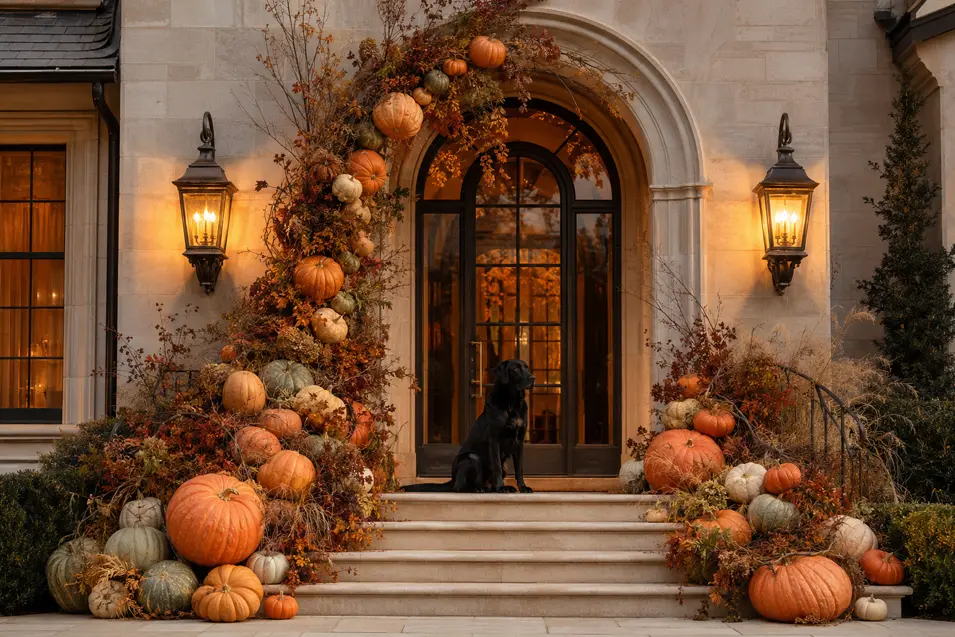
A monumental arch of pumpkins surrounds the entrance to a pale limestone home, following the shape of the tall doorway and transforming it into a glowing autumn portal.
The arrangement is deliberately asymmetrical. Large heirloom pumpkins gather near the base, while smaller orange, cream and green varieties appear to climb through dried grasses, twisting vines and branches covered with rust-coloured leaves. Nothing looks as though it came from a matching seasonal package.
Two oversized bronze lanterns stand at the top of the steps, their warm light illuminating the stone and revealing a large black dog seated beneath the arch. The animal wears no costume. Its dark silhouette provides all the Halloween drama the scene needs.
This is an entrance designed to be seen from the street. It respects the architecture of the home while making the doorway feel completely transformed for the season.
The Halloween Garden Walk
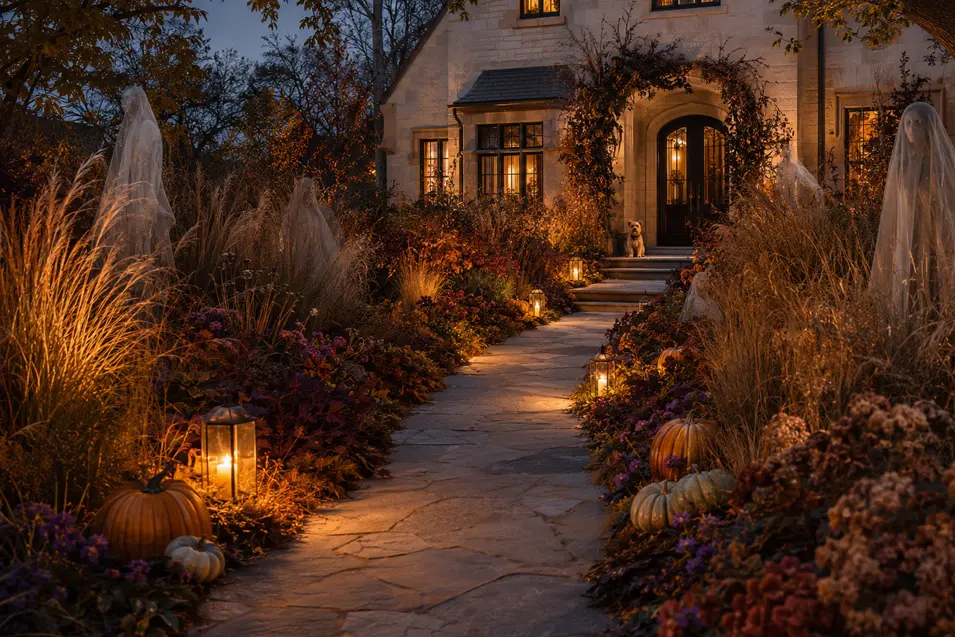
Halloween begins at the sidewalk, where a long garden path winds through ornamental grasses, deep purple flowers and masses of rust, gold and burgundy foliage.
Rather than placing every decoration on the porch, the entire landscape participates. Sculptural pumpkins appear between the plants, small lanterns mark the route and several almost-transparent ghosts seem to drift through the taller grasses. Some are immediately visible, while others reveal themselves only as visitors approach the house.
At the end of the path, a terrier waits on the porch beneath a wreath made from dark leaves and twisted branches. Warm light from the windows prevents the scene from feeling genuinely threatening.
The result is immersive without being cluttered. It treats the front garden as a sequence of discoveries rather than simply a space visitors must cross to reach the candy.
The Ghosts at the Door
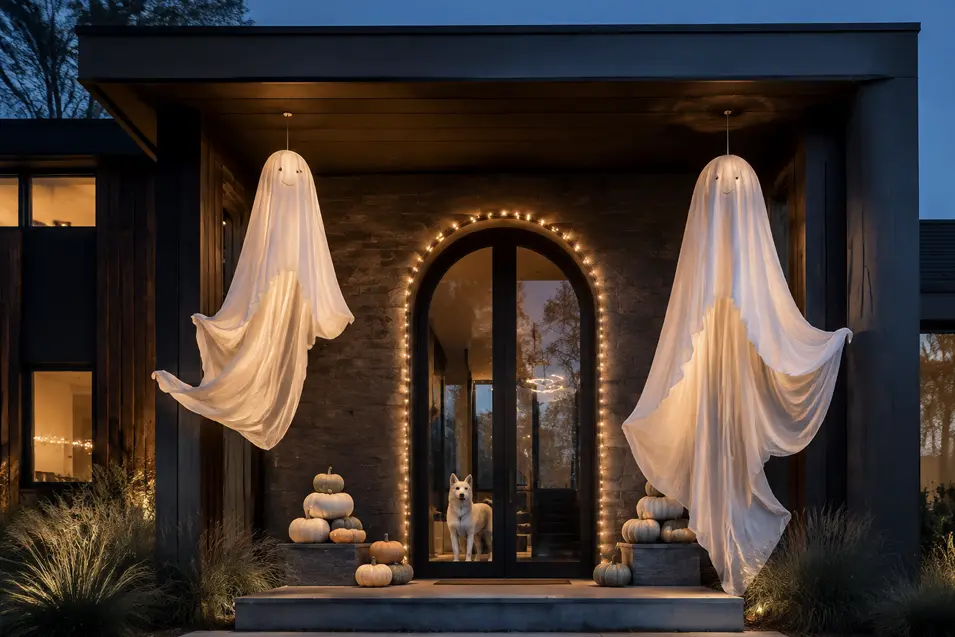
A contemporary charcoal-coloured entrance provides the perfect backdrop for a pair of beautifully made fabric ghosts suspended beneath the porch roof.
Their forms are simple and oversized, allowing the fabric to move naturally in the evening breeze. Warm white lights follow the curve of the doorway, illuminating stacks of pale pumpkins arranged on stone pedestals.
Behind the glass door, a white dog watches the porch with considerable suspicion. The contrast between the dark exterior, luminous ghosts and bright animal creates an image that is playful rather than frightening.
This idea works because it is restrained. There are no competing signs, characters or novelty props. Two memorable ghosts, several carefully chosen pumpkins and beautiful lighting are enough to give the home a clear Halloween identity.
The Skeleton Welcome Committee
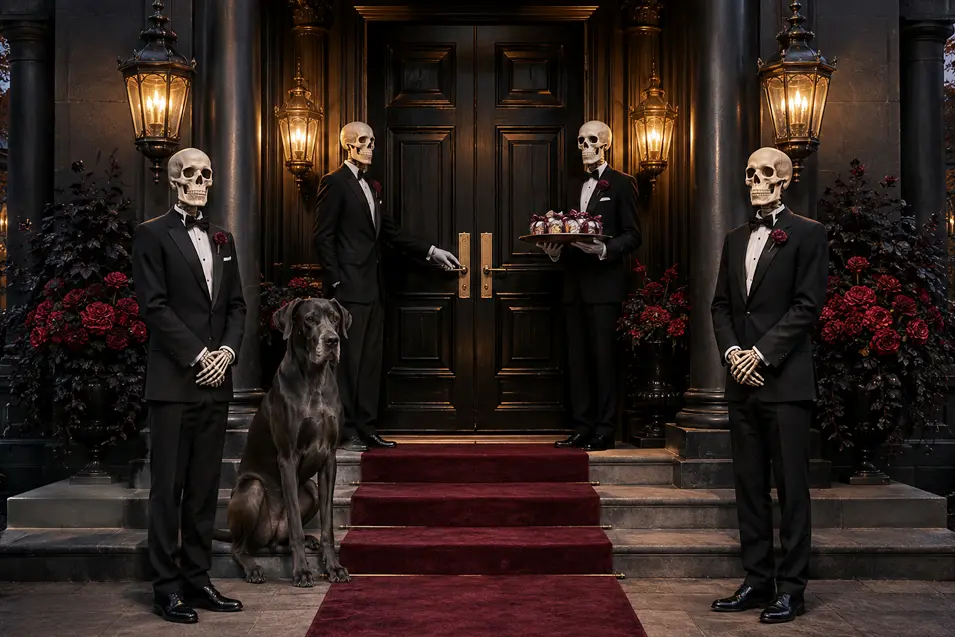
Four skeletons wait outside a formal black entrance as though they are members of the household staff.
Each wears an impeccably tailored black dinner jacket. One holds a silver tray filled with candy, another stands near the door as a doorman, and two more flank a burgundy runner leading up the steps. A Great Dane sits among them with the calm authority of the only guest who actually belongs there.
Black foliage frames the doorway, while tall lanterns and restrained arrangements of deep red flowers give the entrance the atmosphere of an extravagant evening event.
The humour comes from treating the absurd scene with complete seriousness. Nothing is cartoonish or carelessly arranged. The skeletons are not scattered decorations; they are characters participating in the welcome.
It feels less like a conventional Halloween porch and more like arriving at a very exclusive party hosted by someone with a wonderfully dark sense of humour.
The Witch’s Front Porch
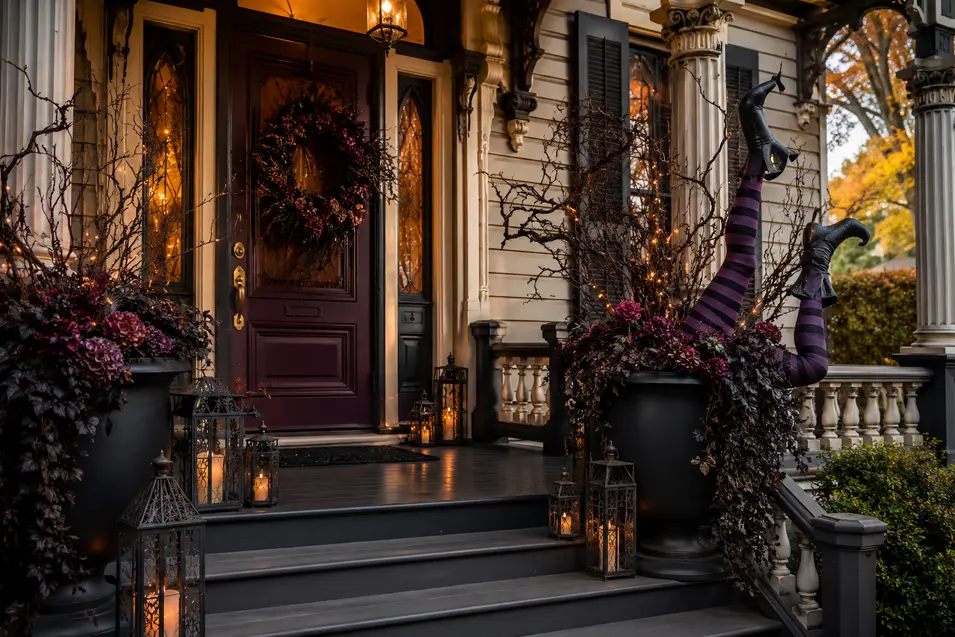
A Victorian porch becomes the entrance to a stylish witch’s home without relying on cauldrons, broomsticks and signs explaining who lives there.
Black urns overflow with twisted branches and dark trailing plants. Lanterns of different heights line the steps, and small points of amber light appear among the foliage. Near the door, striped legs and beautifully made pointed boots emerge from an enormous planter, suggesting that one unfortunate witch arrived too quickly.
The joke is immediately understandable, but it remains only one element within a much larger composition. Deep plum flowers, blackened vines and a dramatic wreath bring the colours together.
This is theatrical Halloween decorating handled with discipline. It allows one playful feature to command attention while the rest of the entrance supports it.
The Modern Pumpkin Entrance
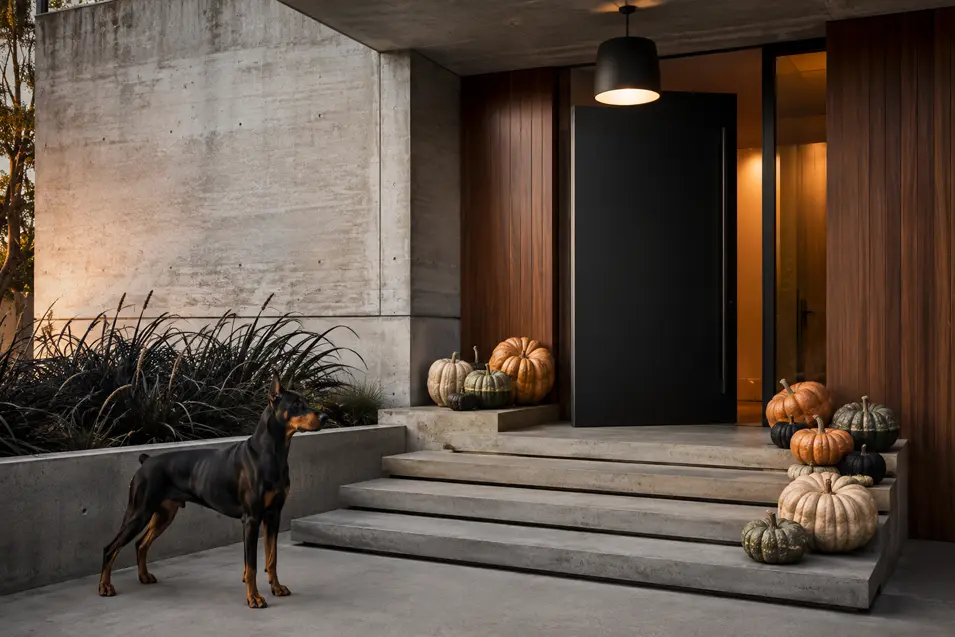
A modern concrete-and-wood home proves that Halloween decorating does not need to feel rustic, nostalgic or heavily ornamented.
The enormous black pivot door is surrounded by carefully stacked pumpkins in cream, burnt orange, muted green and almost-black. Their irregular organic shapes soften the severe architecture, while a single contemporary pendant throws warm light across the entrance.
A sleek Doberman stands beside a low stone planter filled with dark grasses. Like the dog, the house needs no costume. Its strong lines and restricted palette already provide an ideal background for Halloween.
There are no cobwebs, ghosts or plastic bats. The seasonal character comes entirely from colour, scale and contrast. It is Halloween interpreted through modern design rather than familiar symbols.
The Haunted Brownstone
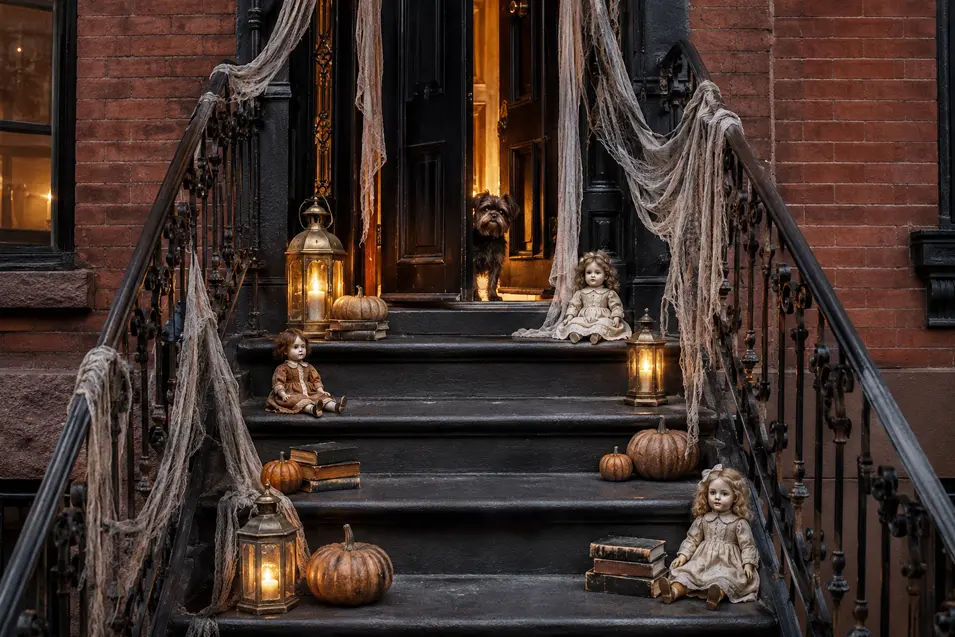
A narrow city entrance offers very little space, but its steep steps and dark doorway create natural drama.
Thin grey fabric has been draped loosely around the frame, catching on the iron railing and moving slightly in the wind. Antique-style lanterns illuminate a carefully arranged collection of pumpkins, weathered books and several unsettling vintage dolls seated on the steps.
The front door stands slightly open. Warm light spills onto the landing while a small dog peers cautiously through the gap, apparently uncertain whether the dolls have always been there.
This entrance is intimate rather than grand. Its success comes from using the height of the steps and the confined architecture to create suspense. Every object appears to belong to the same strange little story.
The Vampire’s Welcome
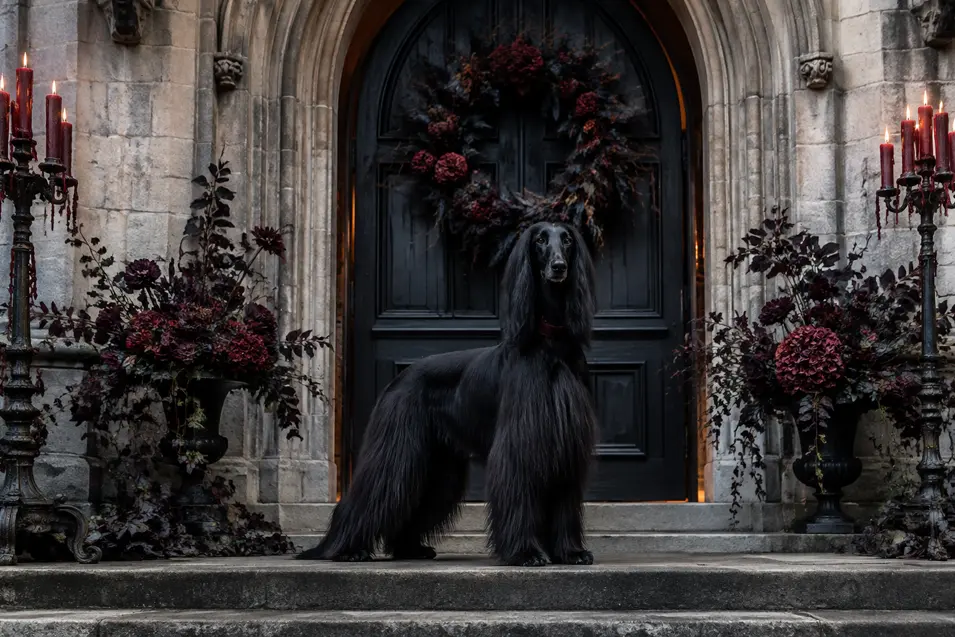
Deep burgundy flowers and black foliage frame the arched doorway of an imposing stone home.
Tall iron candlesticks stand on either side of the entrance, their red candles burned low enough for the wax to spill dramatically down the stems. A dark wreath made from feathers, berries and dried roses hangs on the door.
At the centre of the landing stands a black Afghan Hound wearing a narrow velvet collar. The dog’s long coat and dignified posture suggest the owner of the estate may have been expecting visitors for several centuries.
The scene is unmistakably Gothic, but it avoids the obvious cape-and-coffin approach. Colour, texture and the extraordinary dog carry the theme, allowing the entrance to remain elegant enough for the architecture surrounding it.
The Friendly Ghost House
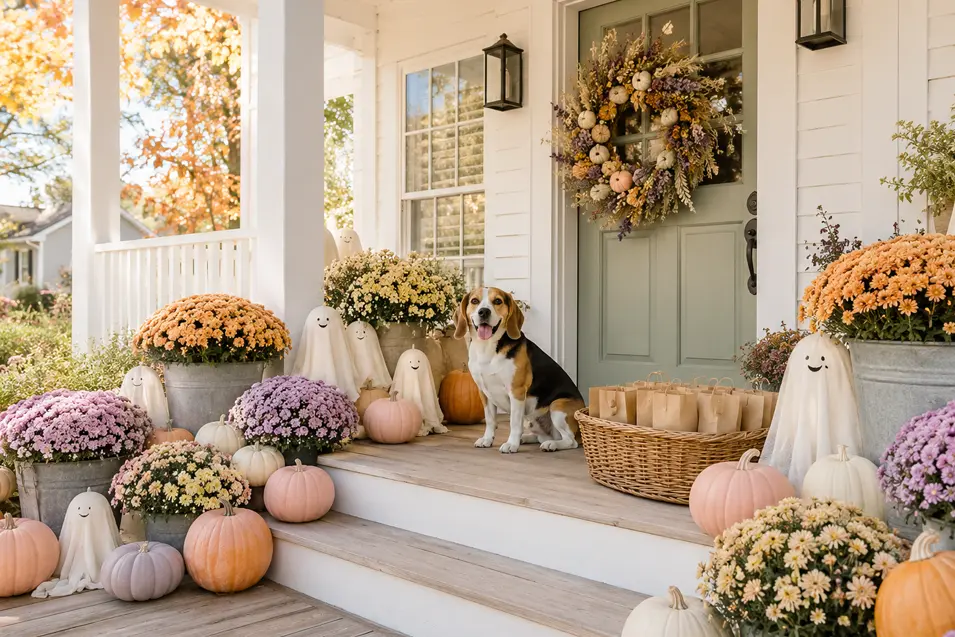
Not every Halloween entrance needs to be dark.
A bright white farmhouse porch is filled with soft orange, blush, cream and lavender pumpkins. Buckets of chrysanthemums line the steps, while several simple handmade ghosts peek out from between the flowers.
A cheerful dog sits beside a large woven basket containing individually prepared treat bags. Above it, a wreath made from pale leaves, seed heads and tiny pumpkins introduces the same gentle colours to the front door.
This entrance feels welcoming to young children while still offering plenty of visual interest for adults. It is colourful, generous and unmistakably seasonal without becoming loud.
For families who prefer the friendly side of Halloween, it shows how effectively flowers and an unusual colour palette can replace frightening decorations.
The Raven’s Door
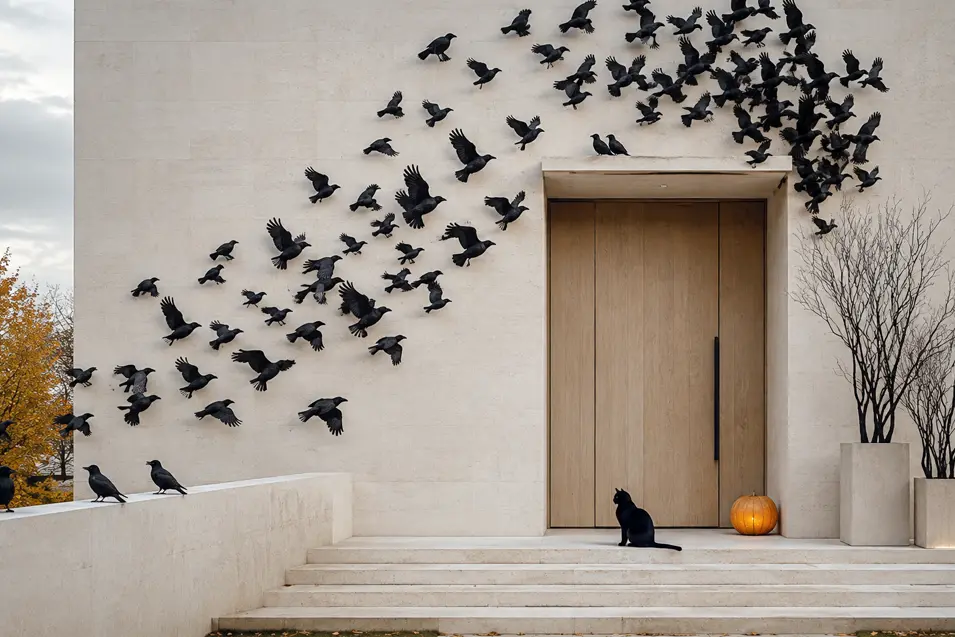
A flock of black ravens appears to sweep across the pale exterior of a contemporary home.
The birds begin near the garden wall, travel upward across the entrance and gather around an oversized front door. Their movement gives the entire composition energy, as though something in the garden has suddenly disturbed them.
Below, bare black branches rise from two simple stone planters. A single glowing pumpkin sits beside the door, and a black cat watches from the upper step.
The limited palette makes this entrance particularly graphic. From a distance, visitors see the dramatic movement of the flock. Up close, they discover the smaller details hidden around the doorway.
It is a simple idea executed at a scale large enough to become architecture.
Looking In From the Porch
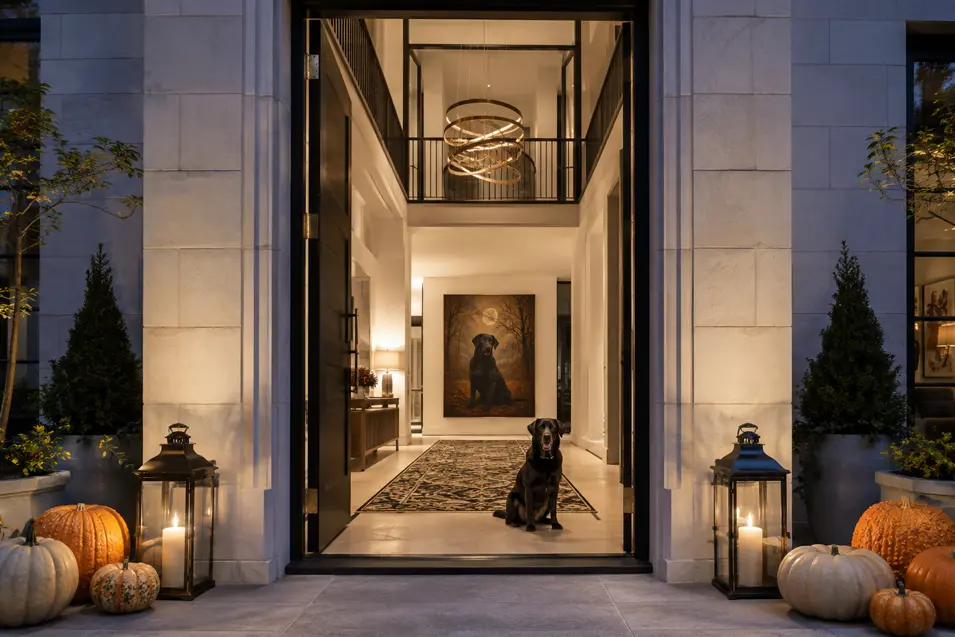
The open front door reveals that the Halloween experience continues beyond the porch.
Pumpkins and lanterns frame the exterior, but the view leads directly into a spectacular double-height foyer. A dramatic pendant hangs above a patterned runner, and an oversized piece of contemporary Halloween pet art is visible on the far wall.
A dog waits just inside the doorway, illuminated by the warm interior light. The animal appears ready to welcome visitors while remaining safely separated from the activity outside.
Photographed from the porch, the image gives viewers the feeling of arriving at the home themselves. The exterior decorations establish the season, but the glimpse inside creates curiosity.
It also demonstrates that an entrance should be considered from both directions. What visitors see through the doorway can be just as important as what surrounds it.
Looking Out on Halloween Night
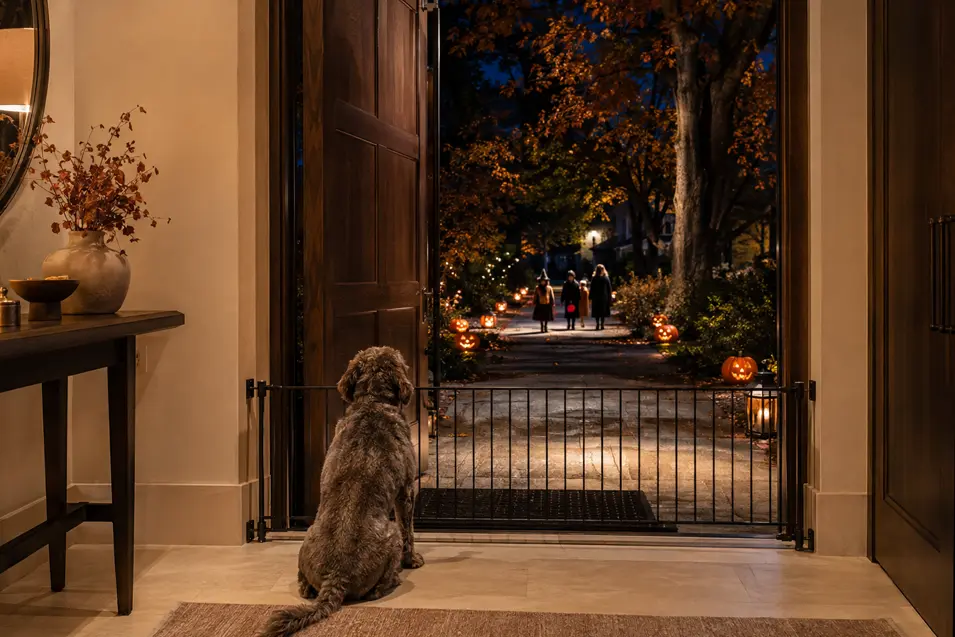
From inside the foyer, the open front door frames an entirely different Halloween scene.
Beyond the threshold, illuminated pumpkins line the path through autumn trees. Several trick-or-treaters can be seen approaching in the distance, softened slightly by the evening light. Their costumes are suggested rather than shown in detail.
Inside, a dog sits beside the door watching their arrival. A slim gate incorporated into the entrance keeps the animal secure without dominating the image.
The contrast between the warm, quiet foyer and the activity outside captures the feeling of Halloween night better than an elaborate display alone. This is not simply a decorated entrance; it is a home waiting for the evening to begin.
The Candy Console
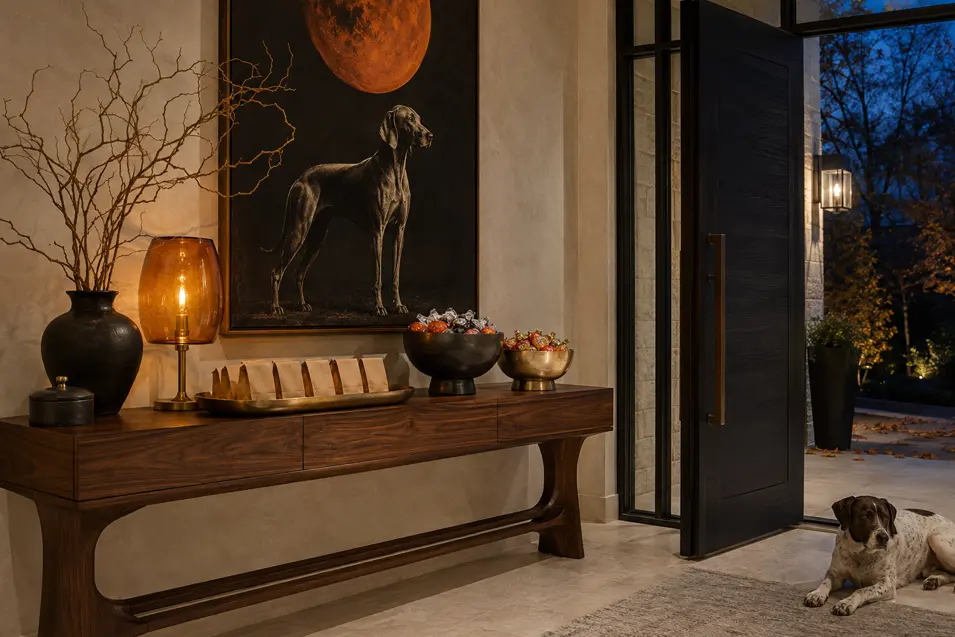
A sculptural dark-walnut console near the open front door becomes an elegant Halloween candy station.
Large ceramic and metal bowls hold wrapped treats, while individual paper bags are arranged in a shallow tray for children who prefer to choose quickly. An amber glass lamp casts a warm pool of light across the wood, and twisted branches rise from a heavy black vase.
Above the console hangs a bold contemporary portrait of a dog standing beneath an orange moon. The artwork establishes the Halloween mood without requiring the table to be crowded with decorations.
The console remains beautiful and functional, but it never feels like a product display. It belongs naturally within the entrance and solves a practical problem: keeping everything organized and within reach when the doorbell begins ringing.
A smaller covered container holds dog treats separately, while all chocolate and candy remain well above the reach of pets.
The Bench by the Door
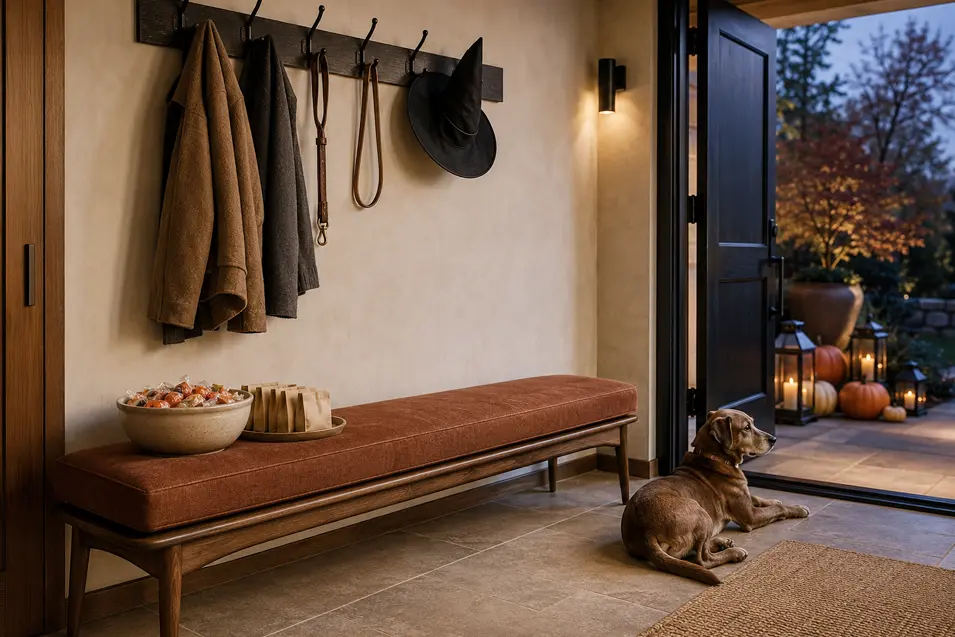
A beautifully upholstered bench anchors a warm modern foyer beside the open front door.
One end holds a large bowl of candy and several prepared treat bags. The remainder stays clear, providing somewhere for a child to adjust a costume, for an adult to put on shoes or for the household to sit between waves of visitors.
A dog waits beneath a row of hooks holding coats, leashes and a single black witch’s hat. Outside, pumpkins and lanterns are visible on the porch.
The Halloween details are memorable, but the image also demonstrates how valuable a well-placed bench can be near an entrance. It supports the evening without announcing itself as the subject.
This is product placement at its most natural: the furniture is useful, attractive and central to the way the room functions, yet the viewer remains focused on the complete Halloween scene.
The Butterfly Invasion
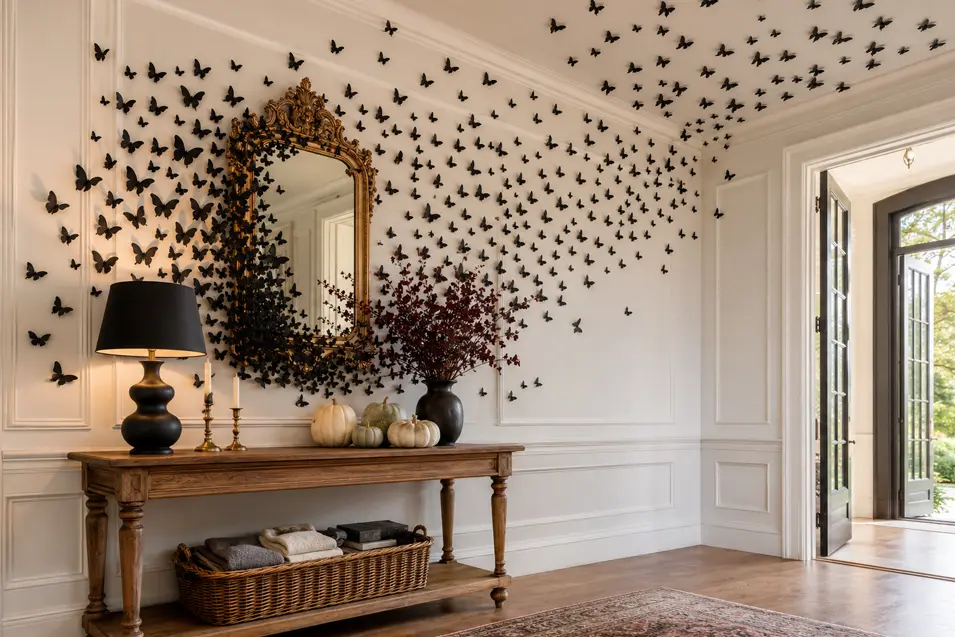
Hundreds of black butterflies sweep across the white-panelled walls of an elegant entrance hall.
The insects gather densely around an ornate gold mirror before dispersing toward the ceiling and nearby doorway. Their movement appears almost organic, as though the entire swarm entered through an open window.
Below the mirror, a refined wood console holds a matte-black lamp, antique candlesticks, pale pumpkins and a vase filled with dried burgundy branches. A woven basket on the lower shelf stores extra blankets and household items, keeping the arrangement grounded in real life.
The contrast between the traditional furniture and the strange movement across the walls makes the display memorable. It is easy to reproduce in a modest entrance, yet sophisticated enough to inspire a far grander interpretation.
The Halloween Gallery Hall
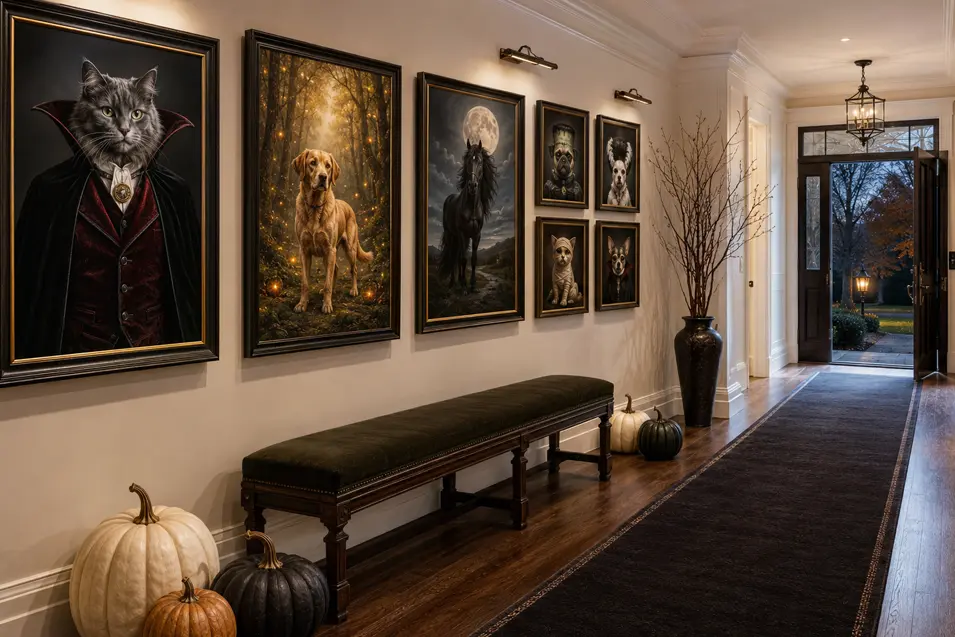
A long entrance hall becomes a temporary gallery devoted to the stranger side of pets.
Contemporary portraits show a dignified vampire cat, a dog standing in an enchanted forest, a black horse beneath a full moon and several small animals reimagined as classic movie monsters. The frames differ slightly in scale but share a disciplined colour palette.
A narrow upholstered bench sits beneath the collection, while a dark runner leads toward the open front door. Several sculptural pumpkins and one tall arrangement of branches are enough to connect the artwork to the season.
This entrance does not depend on decorations that disappear on November 1. Much of the art could remain in place throughout autumn, while the pumpkins and smaller seasonal pieces are easily removed.
It offers a particularly personal approach for homes where pets, art and Halloween are already taken seriously.
The Treat Cabinet
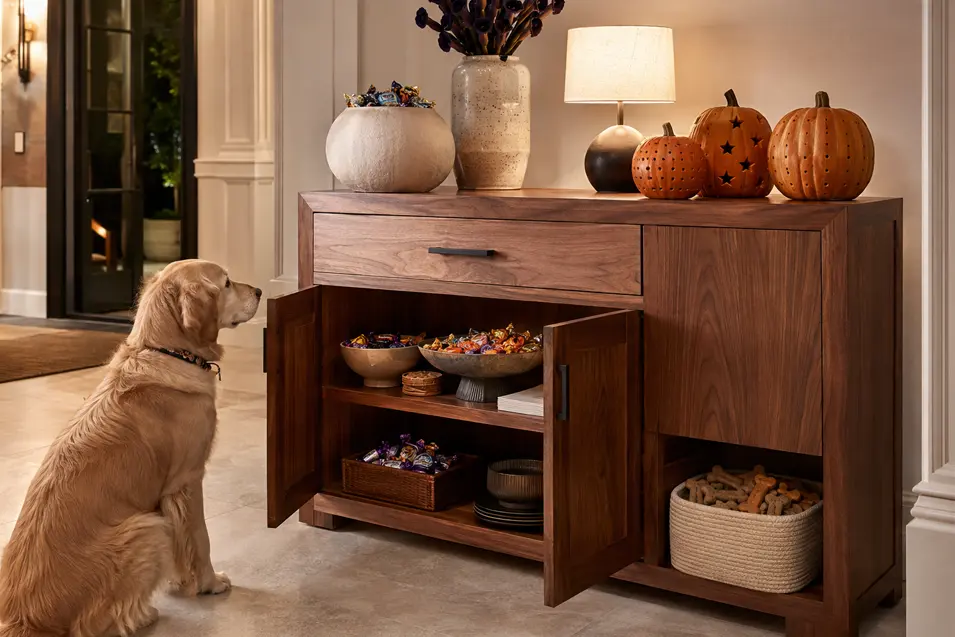
A beautifully crafted cabinet near the entrance becomes the practical centre of Halloween night.
The doors are open just enough to reveal additional candy, serving bowls and supplies arranged neatly inside. On top, two sculptural vessels hold treats, while a small lamp, dark flowers and several hand-carved pumpkins create a restrained seasonal display.
A drawer keeps chocolate and other unsafe foods securely away from the household dog. A lower basket contains pet-safe treats for canine visitors, clearly separated from anything intended for children.
Unlike a temporary folding table, the cabinet feels fully integrated into the room. After Halloween, it returns to storing gloves, leashes, keys and everyday entrance essentials.
The image quietly suggests that good furniture does more than fill a space. It makes special occasions easier without needing to be replaced when the season ends.
The Staircase of Shadows
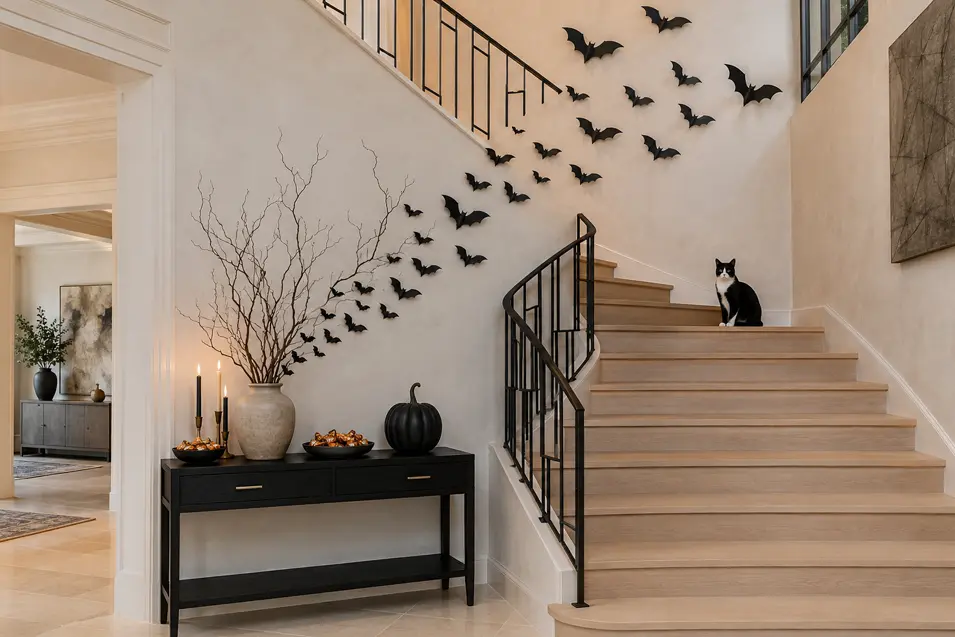
A sweeping modern staircase rises beside the entrance, carrying a flight of black bats upward toward the second floor.
The bats begin near a slim table at the bottom of the stairs, where they appear to escape from behind a vase filled with bare branches. As they climb the wall, the flock grows larger and more widely spaced, drawing the eye through the architecture.
The table holds bowls of candy, tall candles and one sculptural black pumpkin. A cat sits several steps above, watching the apparent invasion with complete calm.
This entrance uses vertical space that is often ignored. Rather than placing every decoration near the floor, the Halloween story travels upward and makes the entire foyer feel transformed.
The furniture remains secondary, but without it the composition would have no visual starting point.
The Mudroom Monsters
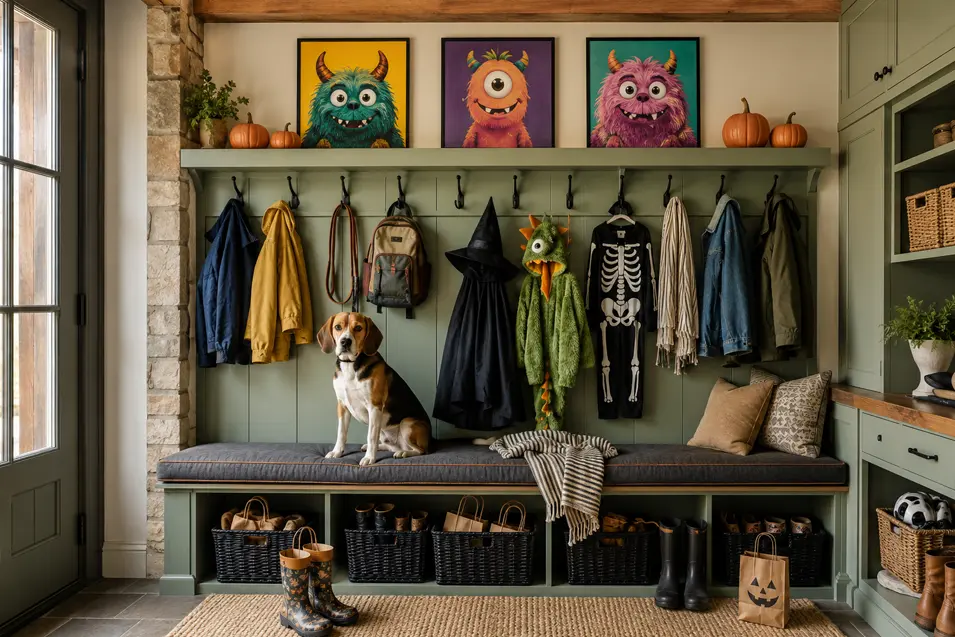
A family mudroom offers a more relaxed interpretation of the decorated entrance.
Built-in storage is filled with boots, jackets, pet leashes and several children’s costumes waiting for Halloween night. Playful monster portraits hang above an upholstered bench, while baskets below hold extra treat bags and outdoor accessories.
A dog sits beneath the hooks wearing no costume, surrounded by the evidence of a busy household preparing for the evening.
Small seasonal details bring the room together: orange stitching on the bench cushion, black storage baskets, a striped throw and several tiny pumpkins placed safely above the dog’s reach.
The scene feels achievable because the room remains functional. Nothing has been cleared away to create a perfect display. Halloween has simply been layered into a hardworking entrance used by pets, children and adults every day.
The Last Trick-or-Treater
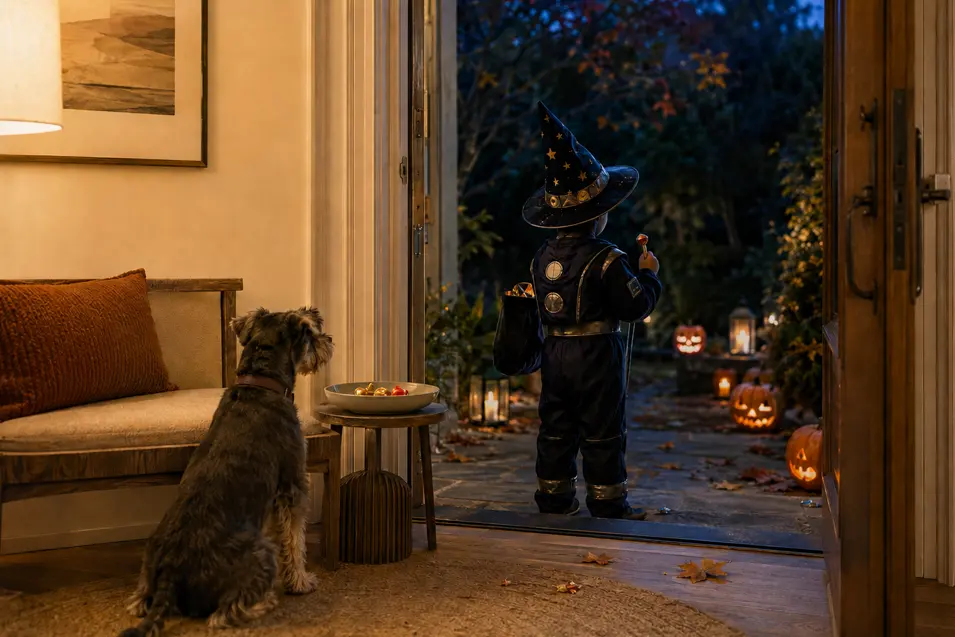
The final image is viewed from deep inside a warmly illuminated home toward the open front door.
Outside, lanterns glow among fallen leaves and the last pumpkins of the evening remain lit. A child in costume stands at the threshold receiving a treat, while the family dog watches from beside a beautiful entrance bench.
An almost-empty candy bowl rests on a small table, suggesting a long and successful night. A few wrappers and autumn leaves near the doorway add just enough imperfection to make the moment feel real.
The decorations are no longer the focus. What matters is the connection between the home, the visitor and the pet observing the ritual.
It is a quiet ending to an extravagant collection—a reminder that the best Halloween entranceways do more than impress people from the street. They create the setting for memories that begin the moment the door opens.
Creating an Entrance That Works for Your Home
A successful Halloween entrance does not need to include every familiar symbol of the season. Begin with the architecture and furnishings already present, then choose a single strong idea that suits the home.
A modern entrance may need only dramatic lighting, sculptural pumpkins and one extraordinary piece of art. A traditional porch can support richer layers of flowers, garlands and lanterns. A family mudroom may be transformed through colour, playful portraits and beautifully organized treat baskets.
Consider the entrance from several viewpoints. Look at it from the street, from the porch and from inside the home with the door open. The most memorable arrangements create a sense of arrival from every direction.
Furniture near the door should remain useful. A console can hold candy, a bench can provide seating and a cabinet can keep extra supplies organized and safely away from pets. Halloween should enhance the way the entrance functions rather than prevent anyone from using it.
Most importantly, allow the entrance to reflect the people and animals who live there. The result does not need to resemble anyone else’s Halloween display. It only needs to make opening the front door feel like the beginning of something special.