Wildfires can move frighteningly quickly. A fire that seems distant in the morning can lead to an evacuation alert—or an order to leave—hours later.
For pet owners, that creates an additional responsibility. You aren’t only figuring out how to get yourself and your family to safety. You need to know how you’re going to find the cat who has disappeared under the bed, get the dog into the vehicle, grab medications and supplies, and find somewhere that will accept all of you.
The worst time to make those decisions is when smoke is already in the air and everyone is being told to leave.
Whether you live in an area regularly affected by wildfires or somewhere that only occasionally faces the threat, a little preparation can make an enormous difference.
Make a Wildfire Plan That Includes Your Pets
Your household emergency plan should include every animal living in your home.
Think about how you would evacuate if you had only a few minutes to leave.
Where are the carriers? Where are the leashes? How quickly could you load everyone into the vehicle? Who is responsible for which animal?
Those questions become especially important in homes with several pets.
Keep dog leashes and harnesses somewhere immediately accessible. Cat carriers shouldn’t be buried beneath Christmas decorations in the basement. If you have several cats, ideally have a secure carrier available for each one.
It is also worth practising.
A dog that happily jumps into the SUV may be easy to evacuate. A frightened cat that hasn’t seen its carrier since its last veterinary appointment can be considerably more challenging.
Occasionally putting your pets into their carriers and taking them for short drives can make the real thing less stressful.
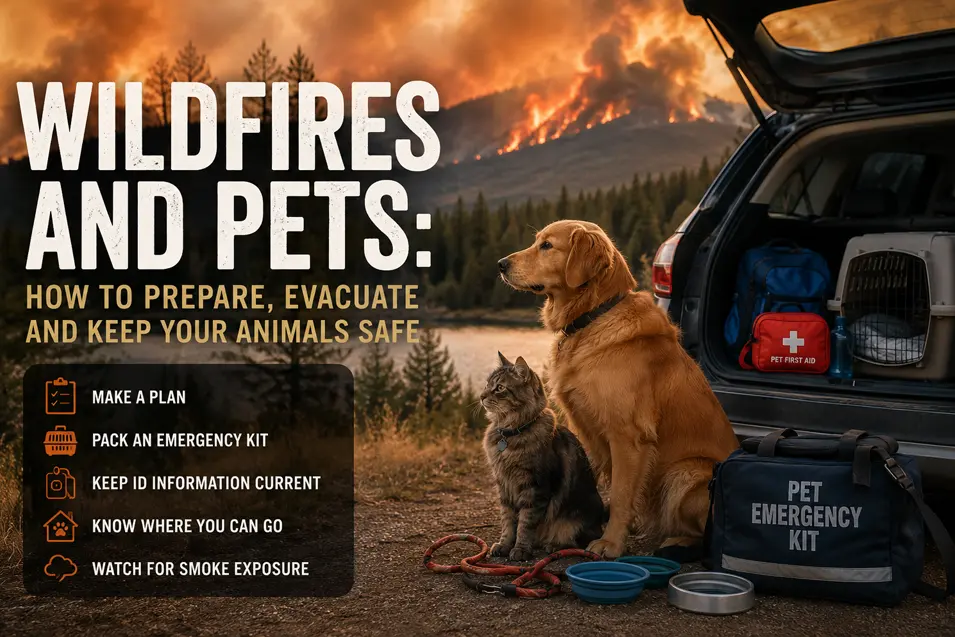
Prepare a Pet Emergency Kit
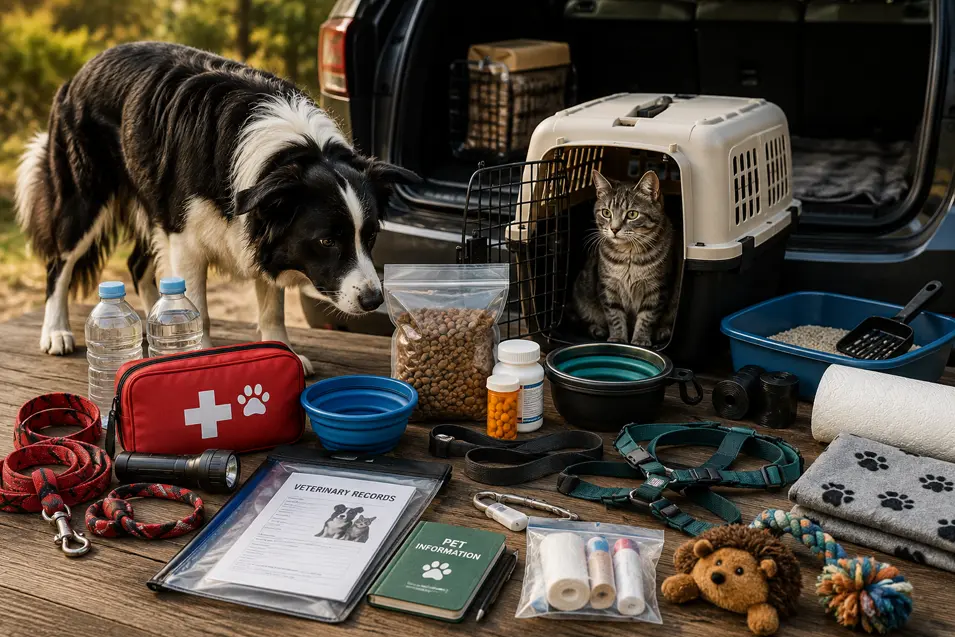
Keep your pet’s emergency supplies together somewhere they can be grabbed quickly.
A good pet evacuation kit should contain:
- Food and drinking water
- Food and water bowls
- Necessary medications and dosage information
- Copies of veterinary and vaccination records
- Your veterinarian’s contact information
- Recent photographs of each pet
- A spare collar, harness and leash
- Identification information
- A crate or carrier
- Waste bags
- Cat litter and a small litter box if necessary
- Paper towels or cleaning supplies
- A pet first-aid kit
- A blanket, towel or familiar comfort item
- A few favourite treats
The Government of Canada recommends keeping at least 72 hours of food and water in an emergency kit. If you live in a particularly fire-prone or remote area, keeping additional supplies available may be sensible.
Check the kit periodically. Food expires, phone numbers change and medications need replacing.
Make Sure Your Pet Can Be Identified
Wildfires are chaotic. Gates are opened, fences are damaged, frightened animals bolt and families can become separated from their pets.
Every dog and cat should have current identification.
A collar with an identification tag provides someone with an immediate way to contact you. A registered microchip provides another layer of protection if the collar disappears.
But a microchip is only useful when the registration information is current.
If you have moved or changed telephone numbers, check the information associated with your pet’s chip.
Keep recent photographs of your animals as well. Include clear pictures showing their face, body markings and anything else that could help identify them.
Having a photograph of you with your pet can also be useful if you ever need to demonstrate ownership.
Know Where You Can Go Before You Have to Leave
Don’t assume an evacuation centre will accept pets.
Some emergency shelters accommodate animals, while others accept only service animals. Rules can also change depending on the emergency and available facilities.
Before wildfire season, identify several possibilities:
- Pet-friendly hotels or motels
- Friends or relatives outside the danger area
- Boarding kennels
- Veterinary clinics
- Animal shelters or emergency animal facilities
Keep the phone numbers and addresses with your emergency information.
If you own several pets or a very large dog, finding accommodation can be more difficult, making advance planning even more valuable.
Have a Plan for When You Aren’t Home
Wildfires don’t conveniently wait until everyone is sitting in the living room.
You could be at work, shopping or several hours away when your neighbourhood is placed under an evacuation order.
Choose a trusted neighbour, friend or family member who could reach your pets if authorities permit access.
They should know:
- Where your pets are likely to be
- Where carriers and leashes are kept
- Where the emergency kit is located
- How to contact you
- Where you plan to meet
- How to safely handle your animals
Make sure that person can actually enter your home.
This is particularly important for pets that hide. Someone unfamiliar with your cat may have no idea that her favourite emergency bunker is behind the furnace.
Don’t Wait Until the Last Possible Moment
If authorities issue an evacuation order, follow it.
And if conditions are deteriorating and you’ve already been advised to prepare to leave, start getting your animals ready.
Put cats and small animals into carriers before the household becomes frantic. Put dogs on secure leashes or harnesses. Load supplies into the vehicle.
A frightened animal may behave very differently than usual.
The dog that has never left your yard may suddenly bolt. The normally sociable cat may hide. Animals that usually get along may become aggressive toward one another when frightened.
Preparation buys you time.
Take Your Pets With You
If you evacuate, your pets should leave with you whenever it is possible to do so safely.
Do not assume you’ll be able to come back for them later.
Roads can close. Evacuation zones can expand. Authorities may prevent residents from returning for hours or days.
Never leave an animal tethered outside during a wildfire evacuation.
Your safest approach is simple:
When you leave, they leave.
Cats Require a Little Extra Planning
Dogs frequently announce their presence the moment something unusual happens.
Cats have another strategy: disappear.
A frightened cat may squeeze beneath furniture, climb into a closet or hide somewhere you’ve never seen them go before.
Know your cat’s favourite hiding places before an emergency happens.
If an evacuation appears increasingly likely, consider placing cats in a closed room where they can be easily found and transferred into carriers.
Never transport a cat loose in a vehicle. Even an exceptionally calm cat can panic during an emergency.
Small Pets Need an Evacuation Plan Too
Rabbits, guinea pigs, birds, reptiles and other small pets can easily be overlooked when emergency plans are designed primarily around dogs and cats.
Have an appropriate transport carrier ready for every animal.
Depending on the species, you may also need to plan for temperature control, specialized food, water, bedding or other equipment.
Keep those supplies together rather than trying to assemble them while you’re evacuating.
What About Horses and Livestock?
Large animals require considerably more advance planning because they cannot simply be placed in the back seat of the car.
Horse owners should know where animals can be transported and have access to suitable trailers and towing vehicles. Horses should also be accustomed to loading into a trailer before an emergency.
If you rely on someone else’s trailer, arrange that relationship in advance.
Farm and ranch owners should develop evacuation plans appropriate to their animals, property and local emergency procedures. When large animals cannot be evacuated, follow the advice of local emergency authorities rather than putting yourself in danger attempting a last-minute rescue.
Wildfire Smoke Can Be Dangerous Even When the Fire Is Far Away
The flames don’t have to reach your community for a wildfire to affect your pets.
Smoke can travel hundreds or even thousands of kilometres and produce unhealthy air far from the actual fire.
When wildfire smoke causes poor air quality, reduce strenuous outdoor exercise and keep pets indoors as much as practical. Keep windows and doors closed when conditions warrant it and pay particular attention to animals that already have respiratory or cardiovascular problems, very young or elderly pets, and short-nosed breeds that may have greater difficulty breathing.
Watch for signs such as:
- Persistent coughing
- Difficulty or unusually rapid breathing
- Wheezing
- Eye irritation
- Unusual fatigue or weakness
- Disorientation
- Reduced appetite
If your pet appears to be struggling to breathe or becomes seriously ill, contact a veterinarian promptly.
For much more about smoke, pollution and protecting dogs when outdoor air becomes unhealthy, see our guide How to Protect Your Dog From Poor Air Quality, Wildfires and Pollution.
Keep Your Vehicle Ready
During periods of elevated wildfire risk, don’t routinely let the vehicle get close to empty.
Evacuations can involve long drives, heavy traffic and fuel stations that are closed, overwhelmed or inaccessible.
Keep enough fuel to get yourself, your family and your animals well outside the affected area.
It can also help to keep a few pet supplies permanently in the vehicle during wildfire season, such as bottled water, a bowl, spare leash and waste bags.
If You Become Separated From Your Pet
Despite good planning, animals sometimes escape during disasters.
Once you are somewhere safe:
- Contact local animal shelters and emergency animal facilities.
- Notify veterinary clinics in the surrounding area.
- Provide clear photographs and identification information.
- Report your pet’s microchip number and make sure your contact information is current.
- Use reputable local lost-pet groups and community networks.
- Check official disaster animal-rescue resources.
Don’t put yourself or rescuers in danger by illegally re-entering an evacuation zone.
Emergency personnel and animal-response organizations may already be searching properties and rescuing animals.
Returning Home After a Wildfire
An evacuation order being lifted doesn’t necessarily mean everything on your property is immediately safe for your pets.
Wildfire-damaged areas can contain hot spots, sharp debris, broken glass, damaged fencing, contaminated water, downed electrical lines and hazardous chemicals.
Keep dogs leashed when you first return.
Check your yard and fencing before allowing animals to roam freely. Cats should remain indoors while you assess the property.
Inspect outdoor water and food dishes before allowing pets to use them, and discard anything that may have been contaminated.
Pets may also behave differently after returning home. Familiar smells and landmarks may have changed dramatically, and some animals will remain anxious for days or longer after an evacuation.
Give them time to settle back into their normal routine.
Don’t Forget About the Humans
A pet evacuation plan only works if it doesn’t put people in unnecessary danger.
Never ignore an evacuation order because you are searching for an animal that cannot immediately be found, and don’t return to a restricted fire zone without permission.
This is precisely why preparing beforehand matters.
Carriers near the door, updated identification, a neighbour with a key and an emergency kit ready to grab may seem excessive on an ordinary summer afternoon.
When an evacuation order arrives, they suddenly aren’t.
Preparation Is the Part You Can Control
Wildfires are unpredictable.
Wind changes. Fires jump roads. Smoke travels enormous distances. Communities that appeared safe can suddenly find themselves preparing to evacuate.
You can’t control any of that.
You can make sure the carrier isn’t buried in the garage.
You can keep your pet’s identification current. You can prepare food, water and medication. You can decide where you’ll go. You can arrange for someone to reach your animals when you’re away.
Most importantly, you can make your pets part of your family’s emergency plan rather than trying to figure out what to do with them once the emergency has already begun.
Hopefully, you’ll never need that plan.
But when wildfire is moving toward your community, being able to grab the pets, grab the kit and go is considerably better than trying to invent one on the way out the door.