
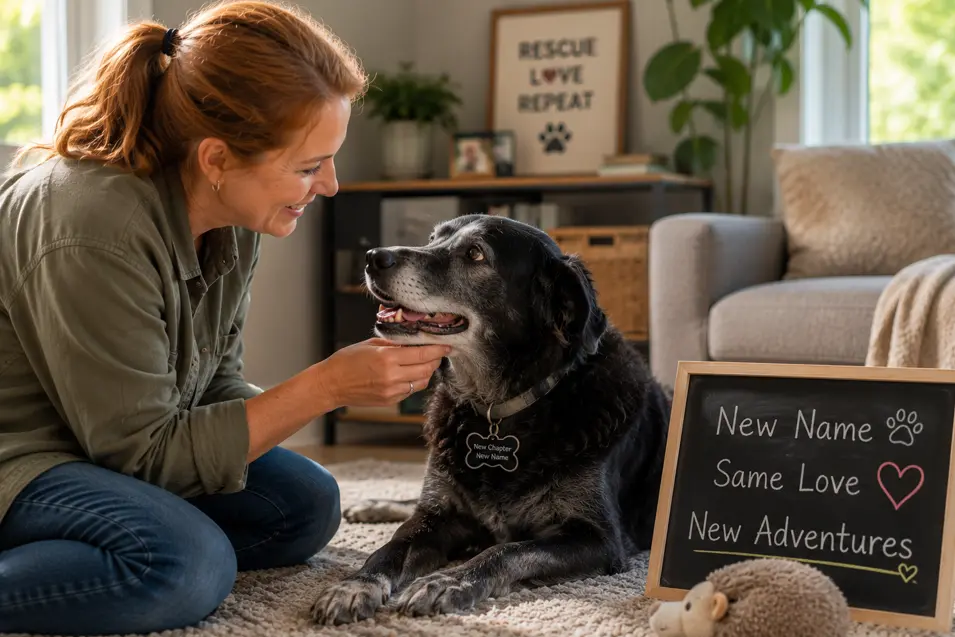
Many people assume that once a dog reaches adulthood, their name is permanent. After all, if a dog has answered to the same name for years, surely changing it would only create confusion.
Fortunately, that’s a myth.
Dogs of all ages are capable of learning a new name. Whether you’ve adopted an older rescue, inherited a family pet, or simply feel your dog’s current name no longer suits them, changing an older dog’s name is entirely possible.
The process may take a little patience, but most adult dogs adjust remarkably well when the new name is introduced with consistency and positive reinforcement.
The Short Answer: Yes
Yes—you can absolutely change an older dog’s name.
Dogs don’t think about names the way people do. They don’t see their name as part of their identity.
Instead, they learn that a particular sound predicts your attention, rewards, playtime, walks, or meals.
When you consistently replace one familiar sound with another, most dogs quickly learn the new association.
Why People Change an Older Dog’s Name
There are many good reasons to give an older dog a new name.
Some of the most common include:
- You’ve adopted a rescue dog.
- The previous name is unknown.
- The shelter assigned a temporary name.
- The name doesn’t fit the dog’s personality.
- Another pet in your home has a similar name.
- The current name is difficult to pronounce.
- You simply want a fresh start.
There isn’t a “right” reason. If a new name feels like a better fit for your dog and your family, that’s reason enough.
Will It Confuse My Dog?
For a short time, perhaps.
But not for long.
Think of it this way: dogs learn new words throughout their lives.
Many eventually recognize commands such as:
- Sit
- Stay
- Come
- Down
- Leave it
- Outside
- Walk
- Dinner
Learning one more word—their new name—is simply another association.
Most dogs adapt much faster than their owners expect.
Does Age Make a Difference?
Age isn’t usually the deciding factor.
Consistency is.
A healthy ten-year-old dog can learn a new name just as successfully as a one-year-old dog.
Older dogs often have better focus than young puppies, which can actually make training easier.
The biggest difference is simply that an older dog may already have years of responding to their previous name.
Replacing that habit takes repetition—not extraordinary effort.
How Long Does It Take?
Every dog learns at a different pace.
Many older dogs begin responding to a new name within several days.
Most respond reliably after one to three weeks of consistent practice.
Some confident, well-socialized dogs adapt almost immediately.
More anxious dogs may need additional time, especially if they’re adjusting to a completely new home.
Choose the Right New Name
Before introducing a new name, choose one you’ll be happy using for years.
Look for a name that’s:
- Easy to say.
- Easy to hear.
- Different from common commands.
- Comfortable to call in public.
- Suitable for every stage of your dog’s life.
One- and two-syllable names are often easiest for dogs to recognize, although longer names can work perfectly well with consistent use.
Introduce the Name Positively
Every time you say your dog’s new name, make it a positive experience.
For example:
Say:
“Harper.”
The moment your dog looks toward you, reward them with:
- A small treat.
- Enthusiastic praise.
- Gentle affection.
- A favorite toy.
Soon, your dog begins thinking:
“That sound means something good is about to happen.”
Practice Throughout the Day
Don’t limit training to formal sessions.
Use your dog’s new name naturally during everyday life.
For example:
- Before meals.
- Before walks.
- During play.
- Before tossing a toy.
- During cuddle time.
- Before opening the back door.
These small moments add up quickly.
Avoid Common Mistakes
Many owners unintentionally slow the learning process.
Avoid:
- Repeating the name several times.
- Using the name during punishment.
- Changing names repeatedly.
- Expecting instant results.
- Letting different family members use different names.
Simple consistency produces the fastest progress.
What If My Dog Ignores the New Name?
Don’t panic.
Ignoring the new name usually means one of three things:
- Your dog is distracted.
- They haven’t yet built a strong association.
- The environment is too exciting.
Move to a quieter location, use higher-value treats, and continue practicing.
Most dogs improve rapidly once distractions are reduced.
Should You Use the Old Name Too?
Some owners briefly pair the old and new names together.
For example:
“Buddy… now Harper.”
This can help during the first few days if your dog strongly recognizes their original name.
However, it’s usually best to transition fully to the new name fairly quickly.
Consistency speeds learning.
Signs Your Dog Has Learned Their New Name
Your dog has probably made the connection when they consistently:
- Turn toward you.
- Make eye contact.
- Pause what they’re doing.
- Come closer.
- Respond indoors and outdoors.
- Wag their tail after hearing the new name.
These are all excellent signs that the new name has become meaningful.
Frequently Asked Questions
Is it too late to change my dog’s name?
No. Dogs can learn new names at any age. Senior dogs are often just as capable as younger dogs.
Will my dog miss their old name?
There’s no evidence that dogs become emotionally attached to a specific name in the same way people do. What matters most is the positive relationship they build with the person using it.
How long does it take?
Most dogs begin recognizing a new name within a few days and respond reliably after one to three weeks of consistent training.
Should I use treats?
Yes. Rewards help create positive associations and usually speed up the learning process.
Can senior dogs really learn a new name?
Absolutely. Healthy senior dogs continue learning throughout their lives. Patience and consistency are much more important than age.
Final Thoughts
Changing an older dog’s name may feel like a big decision, but for most dogs, it’s simply another opportunity to learn something new.
Whether you’ve adopted a rescue, welcomed an older dog into your family, or simply found a name that suits them better, there’s no reason to worry that they’re “too old.
Use the new name consistently, pair it with positive experiences, and give your dog time to adjust.
Before long, your older companion will happily respond to their new name—proving that it’s never too late for a fresh start.