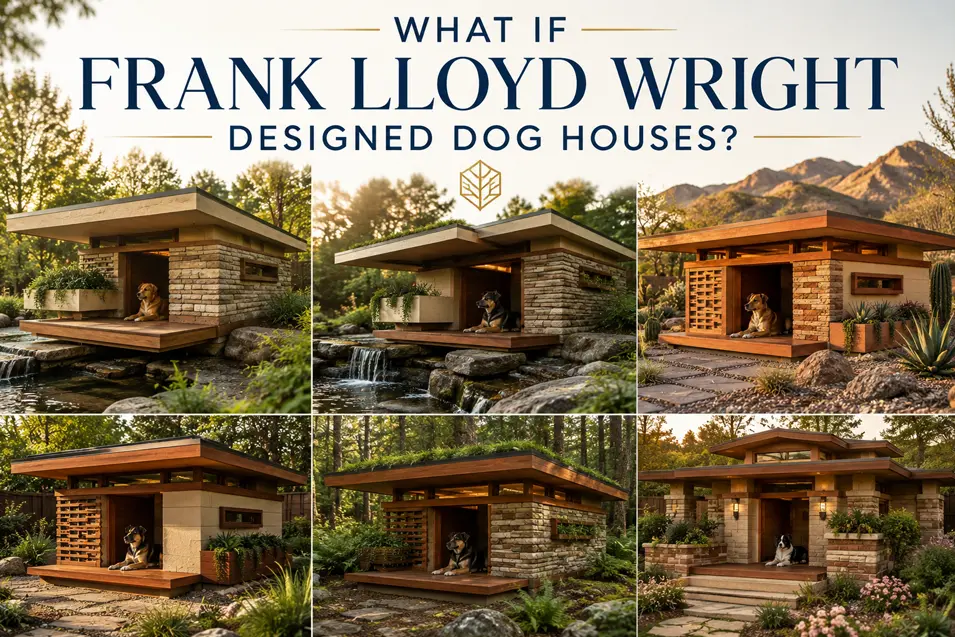
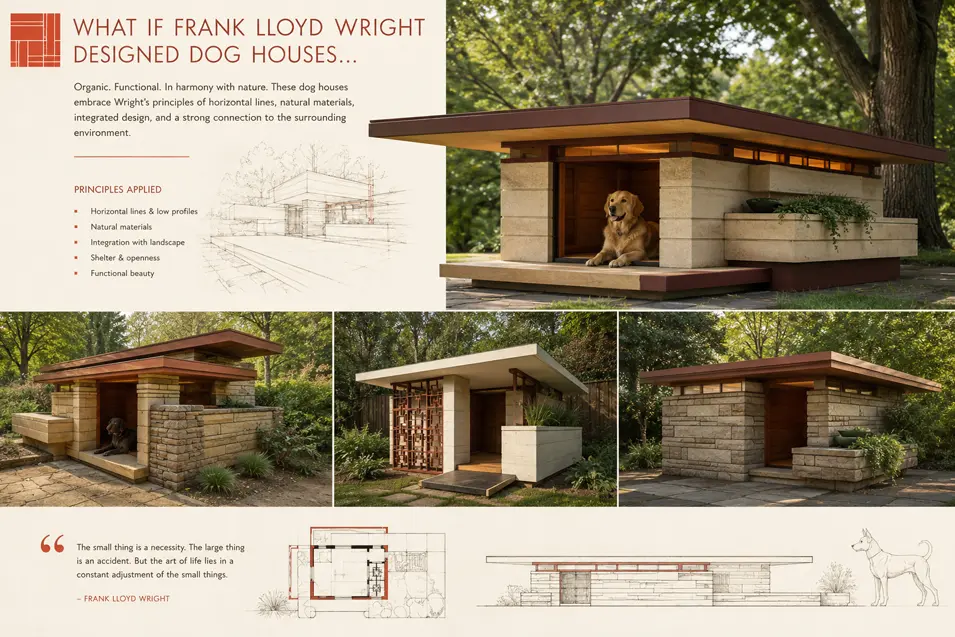
What if one of America’s most influential architects had turned his attention from houses for people to houses for dogs? Frank Lloyd Wright was famous for creating buildings that seemed to belong to the landscapes around them, using strong horizontal lines, natural materials, thoughtful proportions, and an approach he called organic architecture. His work transformed everything from family homes to museums, but it also raises a wonderfully unusual design question: what might a dog house look like if those same principles were applied on a much smaller scale? While Wright never created the designs imagined here, we can borrow ideas from his architectural philosophy to envision shelters that are practical, beautiful, and connected to their surroundings. From low Prairie-style rooflines and sheltered outdoor spaces to stone, wood, and carefully framed views of the backyard, let’s imagine what could happen if Frank Lloyd Wright designed dog houses.
The Prairie Dog House
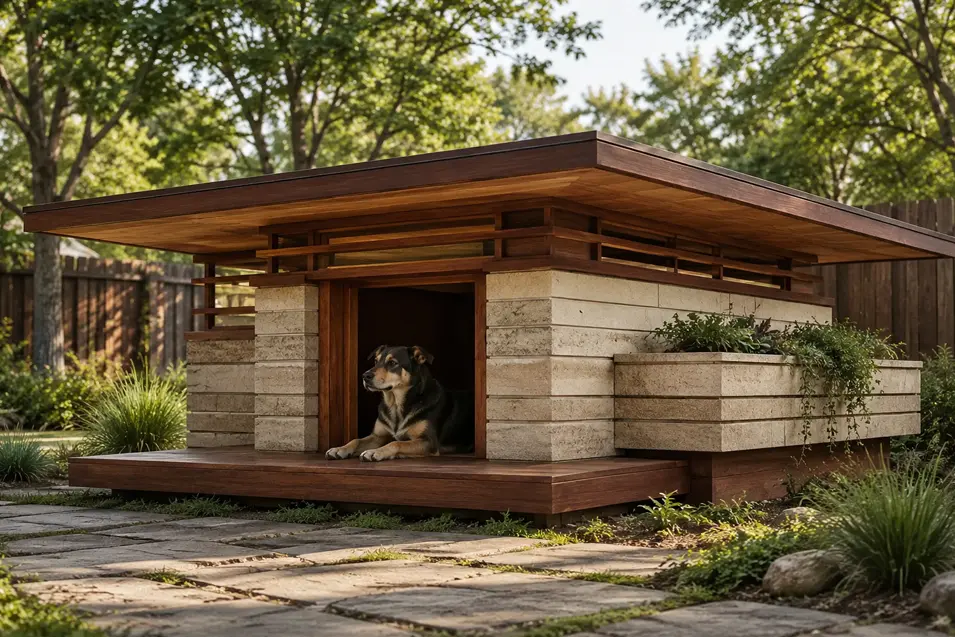
The Prairie Dog House takes its cues from the long, low profiles that became one of Frank Lloyd Wright’s architectural signatures. A broad roof stretches well beyond the walls, creating deep overhangs that provide shade and shelter while emphasizing the structure’s strong horizontal lines. Warm wood and natural stone help the little house feel connected to the landscape rather than simply placed within it, while the raised porch gives its resident a comfortable spot to relax and survey the backyard. It’s an appropriately dog-sized interpretation of a central Wright idea: a building should feel as though it belongs exactly where it stands.
The Fallingwater-Inspired Retreat
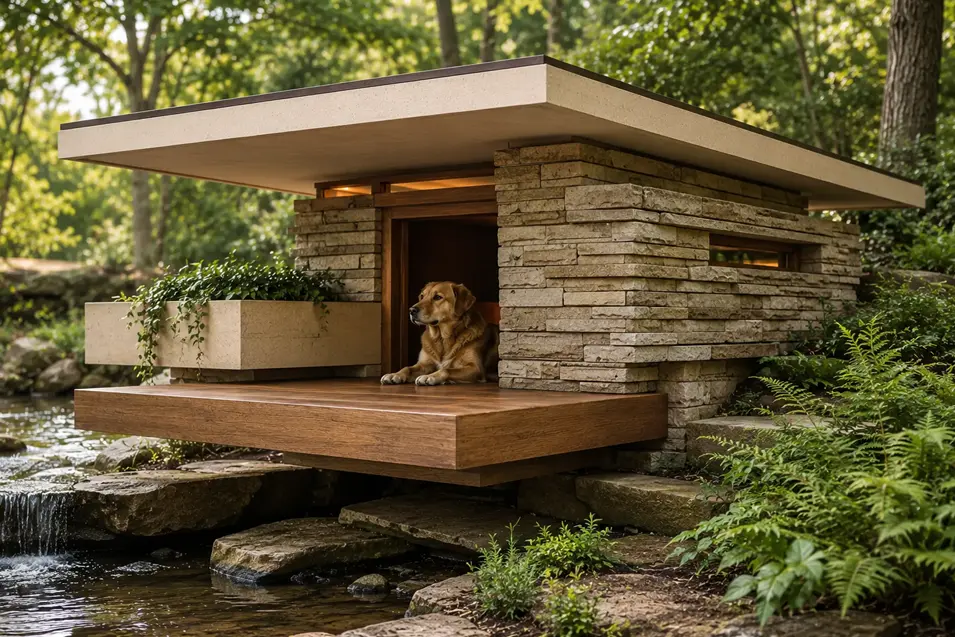
Inspired by Wright’s remarkable ability to unite architecture with the natural world, the Fallingwater-Inspired Retreat makes the landscape part of the dog house itself. Layered stone walls anchor the structure beside the water, while a dramatically cantilevered wooden deck appears to float above the stream. The broad roof provides a deeply sheltered resting place without closing the dog off from its surroundings, and the combination of stone, wood, water, and vegetation blurs the boundary between building and landscape. For a dog who enjoys keeping one eye on the yard while relaxing in the shade, it might be the ultimate woodland retreat.
The Usonian Dog House
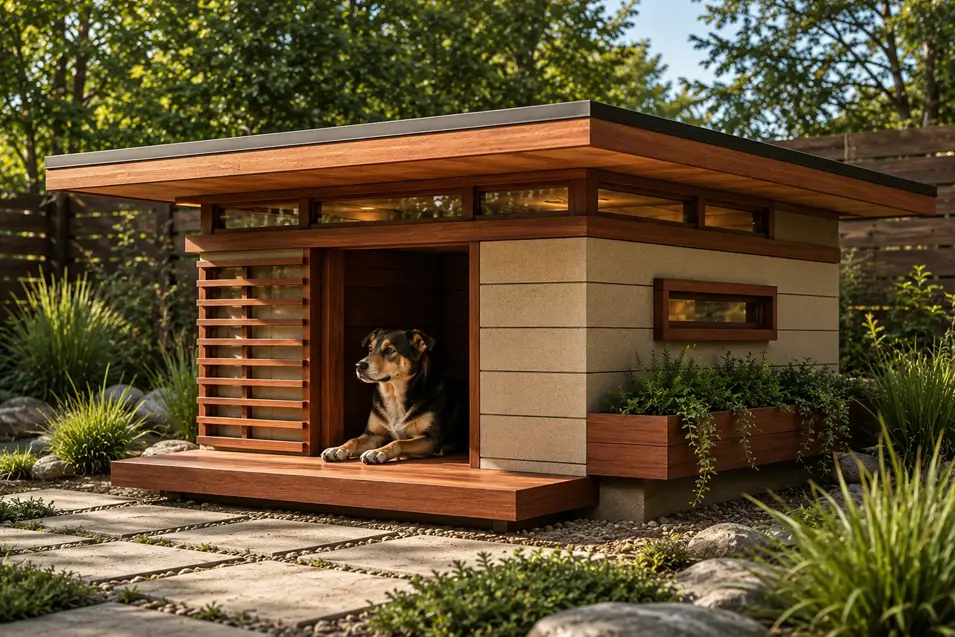
The Usonian Dog House embraces Wright’s belief that thoughtful architecture didn’t need to be enormous or excessively elaborate. Its compact footprint, simple geometric form, warm wood, understated wall panels, and continuous bands of windows create a shelter that feels carefully designed without being extravagant. Deep roof overhangs offer protection from the elements, while the screened opening and elevated windows allow light and air into the interior without sacrificing the cozy sense of enclosure dogs often enjoy. It’s a small, efficient home where every element has a purpose—a fitting canine interpretation of Wright’s Usonian philosophy.
The Organic Woodland House
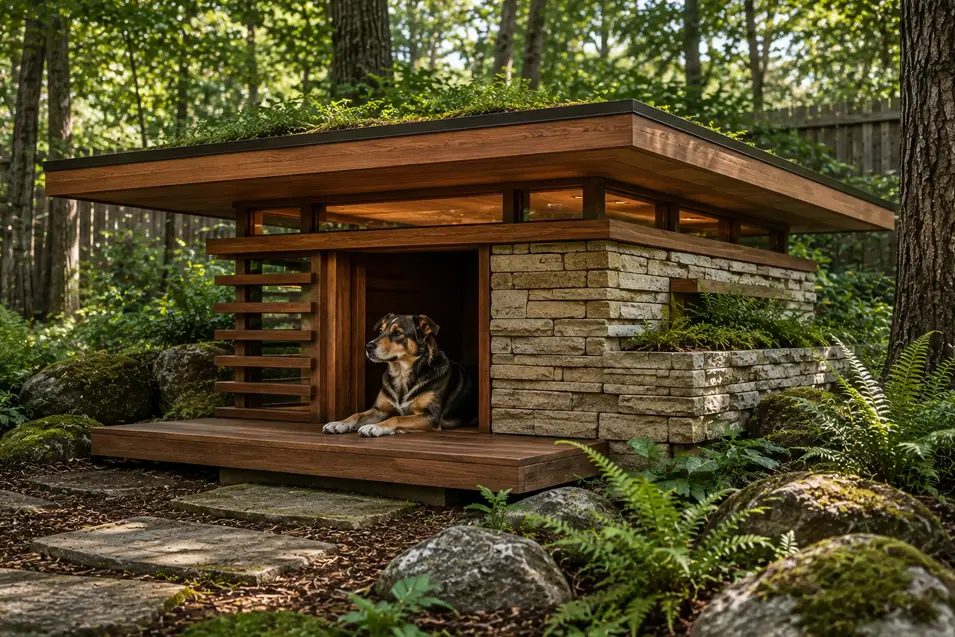
The Organic Woodland House takes Wright’s philosophy of designing with nature almost literally. Natural stone and richly toned wood allow the structure to settle comfortably into the forest floor, while ferns and other greenery growing across the roof make the little house feel like an extension of the landscape itself. Broad overhangs provide a protected porch, and bands of windows bring light into the shelter while maintaining a cozy interior. Surrounded by rocks, trees, and woodland plants, this is less a dog house placed in the forest than one designed to become part of it.
The Desert Dog House
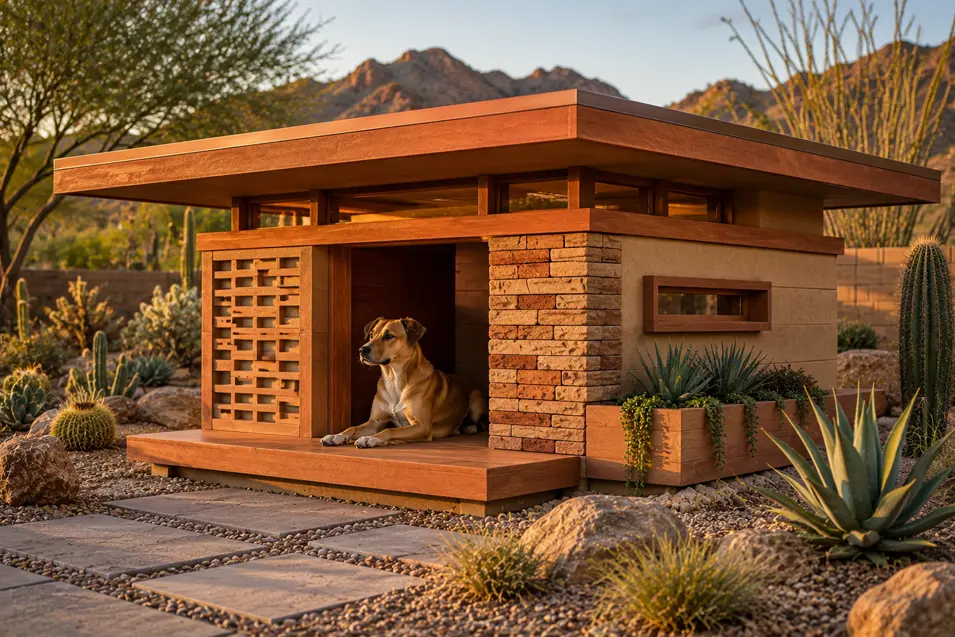
The Desert Dog House adapts Wright-inspired organic architecture to a landscape where shade and shelter take center stage. Its broad, deeply overhanging roof protects the interior from intense sun, while warm wood, earthy masonry, and natural stone echo the colors of the surrounding desert. Narrow windows maintain the structure’s strong horizontal character while allowing light into the sheltered interior, and the open porch gives its resident a shady place to watch the world outside. Surrounded by agave, cacti, gravel, and rugged mountains, the house feels rooted in its environment rather than imposed upon it.
The Midwestern Estate
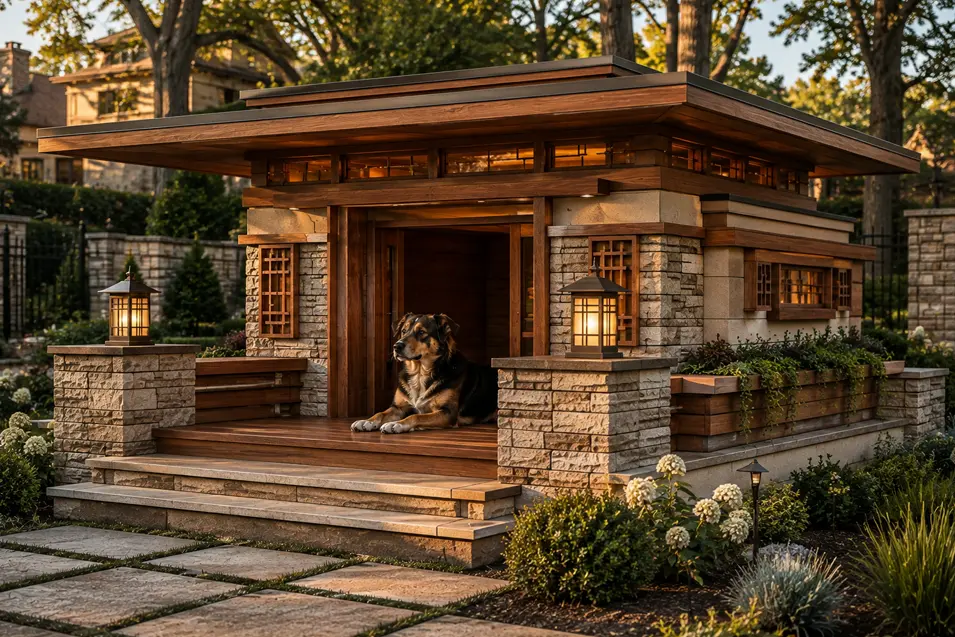
The Midwestern Estate takes the Prairie-inspired dog house in a grander direction, combining strong horizontal lines with substantial stonework, warm wood, broad overhangs, and carefully detailed windows. A generous covered porch creates a sheltered transition between indoors and out, while masonry columns and built-in planters make the structure feel like a miniature piece of estate architecture rather than a simple backyard shelter. Even with its more elaborate appearance, the house remains closely connected to the surrounding garden through natural materials and low, landscape-hugging proportions. It may be a little extravagant for the average backyard, but for a dog accustomed to the finer things, nothing less would do.
Good Design, Even on a Dog’s Scale
Frank Lloyd Wright never designed these dog houses, of course, but imagining what he might have created reveals something interesting about his architectural philosophy: many of its central ideas work remarkably well on a much smaller scale. Shelter from the elements, natural materials, thoughtful proportions, connection to the landscape, and comfortable transitions between indoors and outdoors are just as relevant to a dog house as they are to a human home.
From a woodland retreat tucked among ferns to a desert shelter built around shade, each of these imagined designs responds to its surroundings rather than relying on a one-size-fits-all approach. That may be the most useful lesson to borrow from Wright. A great dog house doesn’t have to resemble a miniature architectural masterpiece, but it should be designed with its occupant, its purpose, and its environment in mind. And if it happens to make the backyard look considerably better in the process, we suspect Wright would have approved.
Love Beautifully Designed Dog Houses?
Apparently, we have a bit of a thing for dog houses that take architecture seriously.
If you enjoyed these Frank Lloyd Wright-inspired designs, travel the world with The World’s Most Colourful Dog Houses, where local architecture inspires everything from Burano and Havana to Chefchaouen and Lunenburg.
Or stay closer to home with Dog Houses Across Canada, a coast-to-coast collection inspired by the landscapes, architecture and character of every province and territory.
Because apparently a rectangle with a triangular roof just isn’t enough anymore.