Pregnancy changes a lot of things.
Some are obvious. Your body changes, your routines change and, eventually, an impressive amount of tiny furniture begins appearing around the house.
Other changes are much more subtle.
Your hormones change. Your scent may change. You may sleep more, move differently, feel tired at unusual times or suddenly have very strong opinions about foods you previously didn’t care about.
You might not notice every one of those changes.
Your dog probably notices more of them than you think.
So, can your dog actually tell that you’re pregnant?
Your dog may be able to tell that something about you has changed, but that doesn’t necessarily mean they understand that you’re pregnant.
Dogs have an extraordinary sense of smell and are remarkably good at noticing changes in the people they live with. Pregnancy gives them plenty to notice.
Can Dogs Sense Pregnancy?
Possibly — but we need to be careful about what we mean by “sense.”
There isn’t good scientific evidence showing that dogs understand human pregnancy or can reliably identify a pregnant person.
What we do know is that dogs are exceptionally sensitive to scent, body language, behaviour and routine.
Pregnancy can change all four.
That means your dog doesn’t need to understand pregnancy to realize that something about their favourite person is suddenly different.
And considering how closely many dogs monitor us, they may notice those differences surprisingly early.
Can Dogs Smell Pregnancy?
This is probably the most interesting possibility.
A dog’s nose is enormously more sensitive than ours. Dogs can distinguish scents we would never notice and are capable of detecting chemical changes associated with a variety of biological processes.
Pregnancy causes major hormonal changes in the human body, including changes involving estrogen, progesterone and human chorionic gonadotropin (hCG).
Those changes may alter a person’s natural scent.
Could your dog smell the difference?
It’s certainly plausible.
What hasn’t been established is whether a dog smells those changes and thinks anything resembling, “She’s pregnant.”
The more realistic explanation is probably much simpler:
You smell different.
And your dog noticed.
Can My Dog Know I’m Pregnant Before I Do?
This is where the stories get interesting.
You’ll find plenty of people who swear their dog knew they were pregnant before they did.
A normally independent dog suddenly wouldn’t leave their side.
A dog started sleeping beside them instead of at the foot of the bed.
Another became fascinated with their stomach.
Then, a few days later, came the positive pregnancy test.
It’s a wonderful story — and it’s possible that a dog noticed subtle changes before their person consciously recognized them.
But we don’t currently have evidence showing that dogs can reliably diagnose pregnancy before a pregnancy test can.
Your dog may notice that your scent, behaviour or routine has changed very early.
Whether they know why it changed is another question entirely.
Your Behaviour Changes Too
Your scent isn’t the only clue.
Dogs spend an enormous amount of time watching us.
They know when you’re getting ready for work.
They know when you’re reaching for the leash.
They somehow know the difference between opening the refrigerator because you’re making dinner and opening it because there’s cheese involved.
They also learn your normal movements, moods and routines.
Pregnancy can change all of those things.
You may:
- go to bed earlier
- take more naps
- exercise differently
- experience morning sickness
- spend more time at home
- change your walking routine
- move more carefully
- sit or lie down more often
- experience changes in mood or energy
Individually, these may seem insignificant.
To a dog who has spent years studying you?
They’re information.
Your Body Eventually Becomes a Pretty Big Clue
Even if your dog misses every subtle hormonal and behavioural change, pregnancy eventually becomes difficult to overlook.
Your stomach grows.
Your posture changes.
You may walk differently.
You get up from the sofa differently.
There is less room for a 70-pound dog to climb directly onto your lap, despite their insistence that this remains entirely possible.
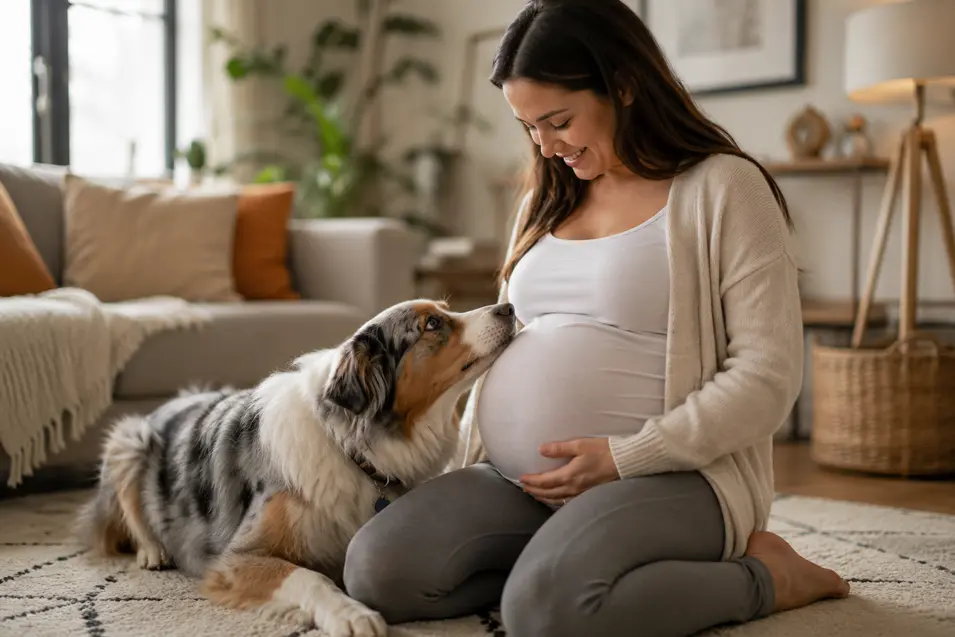
Your dog may also become increasingly interested in your belly.
Some dogs sniff it.
Some rest their head against it.
Some seem fascinated when they feel movement.
And some couldn’t care less.
All of those reactions are perfectly believable.
Dogs are individuals.
Can My Dog Hear My Baby’s Heartbeat?
This is another popular claim, and it’s a fascinating one.
Dogs can hear frequencies humans cannot and have extremely sensitive hearing.
That doesn’t automatically mean your dog is lying beside you listening to your baby’s heartbeat.
Inside the body, a fetal heartbeat is surrounded by layers of tissue and competing sounds from digestion, breathing, blood flow and the mother’s own heartbeat.
It’s difficult to know exactly what a dog can distinguish.
Later in pregnancy, your dog may certainly detect sounds or movements that you cannot perceive in quite the same way.
But claims that dogs routinely hear and recognize a fetal heartbeat should be treated cautiously.
Your dog may know something interesting is happening in there.
We just can’t ask them exactly what they’re hearing.
Why Is My Dog Suddenly Following Me Everywhere?
Some people notice their dog becoming unusually attached during pregnancy.
The dog follows them from room to room.
Sleeps closer.
Checks on them more frequently.
Sits beside them whenever possible.
That doesn’t necessarily mean your dog has appointed themselves official guardian of the baby.
Changes in your scent, behaviour, emotional state and routine can all affect your dog’s behaviour.
If you’ve been spending more time at home or resting more often, your dog may simply be responding to a new pattern.
And sometimes dogs discover that pregnancy has dramatically increased the amount of time their person spends sitting on the couch.
From a dog’s perspective, this may be the greatest development in human history.
Why Has My Dog Become More Protective?
Some owners describe their dogs as becoming more watchful or protective during pregnancy.
A dog may stay closer to their person, pay more attention to visitors or react differently in situations that previously didn’t bother them.
It’s tempting to interpret this as the dog consciously protecting the unborn baby.
The explanation may be less dramatic.
Dogs respond to changes in routine, body language and emotional state. If you are moving differently, behaving more cautiously or feeling anxious, your dog may respond to those changes.
A sudden increase in guarding, growling, barking or other concerning behaviour shouldn’t simply be dismissed as your dog “protecting the baby.”
Significant behavioural changes deserve attention, particularly before bringing a newborn into the home.
What If My Dog Doesn’t Act Differently at All?
That’s normal too.
For every story about a dog who supposedly detected pregnancy at three weeks, there’s probably another dog who didn’t appear to notice anything until a crib showed up.
Some dogs become clingier.
Some become more curious.
Some seem unsettled.
Some behave exactly as they always have.
And some may notice every change while simply deciding none of it warrants interrupting their nap.
There is no particular behaviour your dog is supposed to display when you’re pregnant.
Your Dog May Notice the House Changing
Eventually, pregnancy stops being something happening only to you.
It starts happening to the house.
A crib arrives.
Then a stroller.
Then a car seat.
Then boxes.
Then toys.
Then tiny clothes.
A room that previously had one purpose suddenly has another.
Your dog notices this too.
And unlike you, your dog hasn’t spent the last several months reading baby books and preparing for what’s coming.
From their perspective, humans have simply begun rearranging the house for reasons that have not been adequately explained.
This is where you can make the transition easier.
Start Preparing Your Dog Before the Baby Arrives
Don’t wait until you walk through the front door carrying a newborn to introduce every change at once.
The months leading up to the birth are an excellent opportunity to gradually prepare your dog.
If your dog’s routine will change after the baby arrives, begin making those adjustments beforehand.
That might mean changing:
- walking times
- feeding schedules
- sleeping arrangements
- access to certain rooms
- furniture privileges
- where your dog settles while you’re busy
Gradual changes are generally easier to adapt to than having your dog’s entire life reorganized overnight.
Introduce Baby Equipment Early
Let the stroller, crib, bassinet and other equipment become ordinary household objects before the baby arrives.
You don’t need to make them exciting.
In fact, boring is good.
Your dog can learn that the enormous wheeled contraption in the hallway is simply another piece of furniture rather than an object worthy of investigation every time it moves.
If there will be rooms or areas your dog won’t be allowed to enter once the baby arrives, establish those boundaries ahead of time.
The goal is simple:
When the baby comes home, not everything should change at once.
Think About Baby Sounds
Babies aren’t particularly committed to keeping the household peaceful.
Crying, squealing and other unfamiliar sounds can be startling for some dogs.
If your dog is sensitive to noise, you can gradually introduce realistic baby sounds at a low volume before the birth while pairing calm behaviour with positive experiences.
Watch your dog’s reaction.
The goal isn’t to overwhelm them until they “get used to it.” It’s to make unfamiliar sounds increasingly ordinary without creating fear.
Brush Up on Useful Skills
A few basic behaviours become remarkably valuable when you’re carrying a baby, pushing a stroller or trying to manage twelve things simultaneously.
Useful skills include:
- sit
- stay
- wait
- leave it
- drop it
- come when called
- settling calmly on a bed or mat
- greeting people without jumping
You don’t need a perfectly trained dog.
You need communication that works when life suddenly becomes much busier.
Give Your Dog Somewhere Quiet to Go
Dogs need breaks too.
Make sure your dog has a comfortable place where they can relax away from the activity surrounding the baby.
That might be a bed in another room, an open crate your dog already enjoys, or another quiet space.
As your baby eventually becomes mobile, this becomes even more important.
Your dog should always have somewhere they can retreat without being followed, grabbed or cornered.
Don’t Forget About Your Dog
Life changes dramatically after a baby arrives.
Your dog doesn’t need exactly the same schedule or amount of attention they received before.
They do, however, still need exercise, enrichment, affection and opportunities to behave like a dog.
A walk can be particularly valuable.
It’s exercise.
It’s mental stimulation.
It’s familiar.
And during a period when seemingly everything in the household has changed, familiar things matter.
Maintaining some of your dog’s favourite routines can help make the transition easier for everyone.
When Behaviour Changes Need Attention
Most changes during pregnancy are relatively minor.
Your dog may become a little clingier, curious or unsettled.
More significant behavioural changes shouldn’t be ignored.
Talk to your veterinarian or a qualified behaviour professional if your dog begins showing concerning behaviour such as:
- growling or snapping
- guarding you or household areas
- significant anxiety
- destructive behaviour
- extreme fear
- sudden aggression
- major changes in eating, sleeping or normal behaviour
It’s much better to address a problem during pregnancy than hope it disappears after bringing a newborn home.
And remember that a sudden behavioural change can sometimes have a medical cause unrelated to your pregnancy, so your veterinarian is a good place to start.
Never Assume a Dog Is Completely Safe Around a Baby
Even the gentlest family dog is still a dog.
Babies are noisy, unpredictable and eventually become toddlers who crawl, grab, fall and explore.
Dogs and babies should always be appropriately supervised when they’re together.
As your child grows, you’ll eventually have another job: teaching your child how to interact respectfully with the dog.
The relationship works both ways.
So, Can Your Dog Tell You’re Pregnant?
Probably not in the way you can.
Your dog doesn’t understand pregnancy tests, ultrasounds, due dates or why an alarming amount of tiny furniture has suddenly taken over the house.
But your dog understands you remarkably well.
They know how you normally smell.
They know how you move.
They know your routines.
They know when your behaviour changes.
And pregnancy can change all of those things.
So your dog may not understand that there’s a baby coming.
But there’s a very good chance they realize something about their person is different.
And, eventually, they’re going to find out why.