Spend enough time looking at dogs online and you could easily assume the Pomsky, Goldendoodle, Cavapoo and Bernedoodle are established dog breeds in the same way as the Labrador Retriever, Beagle or Pomeranian.
They even sound like breeds. They have recognizable names, dedicated breeders and plenty of enthusiastic owners. Some puppies also come with eye-watering price tags.
But a clever name and a high price don’t make a dog purebred.
Many of today’s most popular so-called designer dogs are deliberately created by crossing two established breeds. There’s nothing inherently wrong with being a crossbreed—some absolutely wonderful dogs fall into this category—but prospective owners should understand what they’re getting.
A crossbred puppy may inherit traits from either parent in combinations that aren’t always predictable. Size, coat, shedding, appearance, energy level and temperament can vary considerably, even among puppies from the same litter.
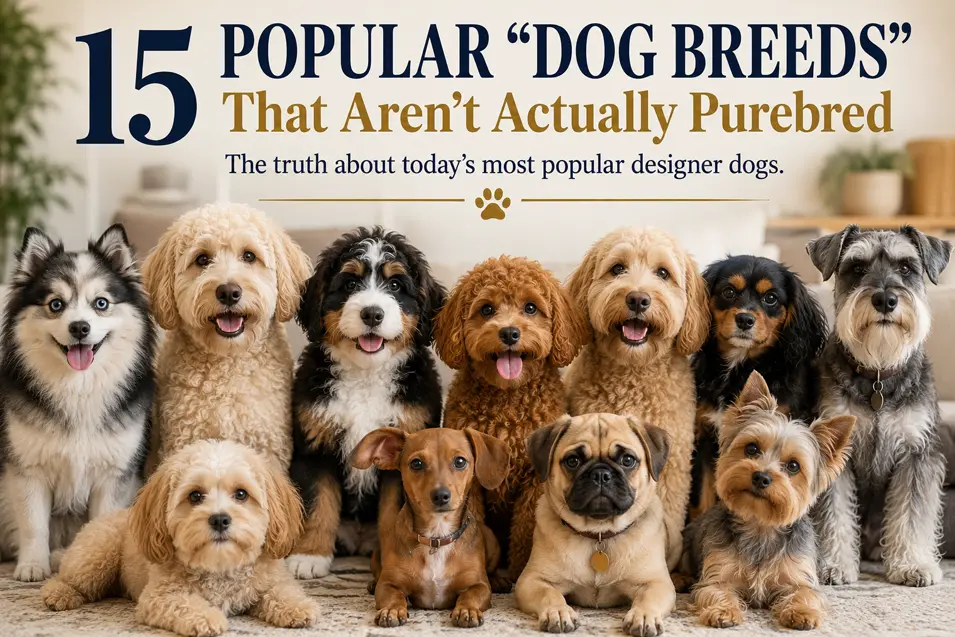
Here are 15 popular dogs you may hear described as breeds that aren’t actually purebred.
1. Pomsky
Pomeranian × Siberian Husky
The Pomsky might be one of the best examples of how quickly a popular cross can begin to feel like an established breed.
It’s easy to understand the appeal. The dream is essentially a smaller dog with the striking appearance of a Siberian Husky and the fluffy coat and compact size of a Pomeranian.
The problem is that genetics don’t take custom orders.
Pomskies can vary significantly in adult size, coat, appearance, energy level and temperament depending on their parents and the traits they inherit. Not every Pomsky will become the tiny, blue-eyed miniature Husky frequently seen in photographs online.
They’re also not purebred Siberian Huskies or Pomeranians, nor does giving their offspring the consistent name “Pomsky” turn them into a pure breed.
If you’re considering one, learning about both parent breeds—and not simply the Pomsky photos that attracted you to the dog—is an important place to start.
2. Goldendoodle
Golden Retriever × Poodle
Few designer dogs have become as recognizable as the Goldendoodle.
Golden Retrievers are famously sociable dogs, while Poodles are intelligent and have coats that shed differently from many other breeds. Put the two together and it’s easy to see why people hope for a friendly family companion with a lower-shedding coat.
But puppies aren’t guaranteed to inherit exactly that combination.
Goldendoodles can have different coat types and shedding levels, and their adult size depends partly on the size of the Poodle used in the breeding. Temperament can also reflect characteristics from either side of the family.
Calling a dog a Goldendoodle tells you about its ancestry. It doesn’t make the dog a purebred.
3. Labradoodle
Labrador Retriever × Poodle
The Labradoodle helped propel the modern “Doodle” phenomenon and is now so familiar that many people assume it must be an established breed.
It isn’t that simple.
A Labrador Retriever and Poodle can produce terrific puppies, but their offspring are crosses between two breeds. Subsequent generations may involve Labradoodles bred to Poodles, Labradoodles bred together or other combinations.
One particularly important misconception concerns the coat.
Having a Poodle parent doesn’t guarantee that every Labradoodle will have the same coat or shedding characteristics. Anyone choosing one primarily because they expect a particular coat should discuss the actual parents, generation and likely characteristics with the breeder rather than relying on the word “Labradoodle.”
4. Bernedoodle
Bernese Mountain Dog × Poodle
The Bernedoodle combines two dramatically different-looking breeds: the large, heavily coated Bernese Mountain Dog and the athletic, curly-coated Poodle.
Many people are drawn to the possibility of getting the Bernese Mountain Dog’s beautiful coloring and affectionate nature in a dog with some Poodle characteristics.
The results, however, can vary.
Bernedoodles may differ considerably in size, coat texture, markings and shedding. The size of the Poodle parent matters enormously, too, which is why dogs sold under the same Bernedoodle name can look surprisingly different from one another.
They’re intentionally bred crossbred dogs—not unusually fluffy purebreds that recently appeared on the scene.
5. Cavapoo
Cavalier King Charles Spaniel × Poodle
Small, fluffy and frequently photographed looking like a teddy bear, the Cavapoo has become an enormously appealing companion dog.
The cross generally combines a Cavalier King Charles Spaniel with a Miniature or Toy Poodle, although individual breeding programs differ.
As with other Poodle crosses, however, owners shouldn’t assume every Cavapoo will have precisely the same coat, adult size or temperament.
A puppy can inherit characteristics from either side of its family.
The cute name may make “Cavapoo” sound like a breed in its own right, but the name describes a cross.
6. Cockapoo
Cocker Spaniel × Poodle
Cockapoos aren’t newcomers to the designer-dog world. People have been deliberately crossing Cocker Spaniels and Poodles for decades.
That longevity can make their status particularly confusing.
Surely if people have been breeding something for that long, it must eventually become purebred?
Not automatically.
Creating a recognized breed requires much more than repeatedly producing a particular cross and giving it a name. A stable population, predictable characteristics, documented ancestry and an established breed standard are among the things that distinguish the development of a breed from simply crossing existing breeds.
The Cockapoo remains best understood as a Cocker Spaniel–Poodle cross.
7. Maltipoo
Maltese × Poodle
The Maltipoo combines two small companion dogs and has become particularly popular among people looking for a compact, affectionate pet.
Their small size can make Maltipoos seem fairly predictable, but there can still be meaningful differences between individual dogs.
Coats can vary in texture and grooming requirements, while personality may reflect different combinations of Maltese and Poodle characteristics.
And despite what prospective owners sometimes hear about Poodle mixes, don’t assume a Maltipoo is automatically a no-shedding or allergy-proof dog.
It’s a popular cross—not a guarantee of a particular set of traits.
8. Aussiedoodle
Australian Shepherd × Poodle
Combining an Australian Shepherd and Poodle can produce an exceptionally intelligent dog.
It can also produce a dog that needs considerably more mental stimulation and activity than somebody expecting a fluffy family pet anticipated.
Australian Shepherds were developed to work, and Poodles are intelligent, athletic dogs themselves. Those characteristics don’t disappear because their offspring have an adorable Doodle name.
Aussiedoodles can vary in coat, markings, size and temperament, but prospective owners should be particularly prepared for the possibility of an energetic, clever dog that needs something productive to do.
9. Sheepadoodle
Old English Sheepdog × Poodle
With their shaggy coats and often striking black-and-white coloring, Sheepadoodles can look almost impossibly cuddly.
Underneath all that hair, however, are genetics from two established breeds with their own histories and characteristics.
Coat type isn’t necessarily uniform, and maintaining all that fluff can require substantial grooming. Adult size can also surprise owners who have mostly seen Sheepadoodle puppies online.
“Sheepadoodle” is useful shorthand for the cross, but it shouldn’t be confused with a guarantee that every puppy will grow into the same kind of dog.
10. Schnoodle
Schnauzer × Poodle
The Schnoodle demonstrates another complication with designer-dog names: sometimes the name alone doesn’t tell you very much about the dog’s eventual size.
Schnauzers come in different sizes. So do Poodles.
Depending on the parents used, dogs described as Schnoodles can therefore differ substantially in size and appearance.
Both parent breeds are intelligent, and individual Schnoodles may inherit a fascinating mixture of their behavioral characteristics as well as their physical traits.
As always, knowing the actual parents is considerably more useful than relying on the designer name alone.
11. Puggle
Pug × Beagle
Not every designer dog involves a Poodle.
The Puggle became particularly fashionable by combining the Pug and Beagle—two extremely recognizable breeds with very different appearances and backgrounds.
The resulting puppies may show different blends of the parents’ characteristics. Some look considerably more Pug-like, while others strongly resemble Beagles.
Their personalities can be just as interesting.
Beagles are scent hounds with famously powerful noses, while Pugs have their own distinctive companion-dog temperament. Crossing the two doesn’t create a perfectly standardized midpoint between them.
It creates a Pug-Beagle cross.
12. Chiweenie
Chihuahua × Dachshund
The name alone deserves points for creativity.
Chiweenies combine Chihuahuas and Dachshunds, generally producing small dogs with an enormous range of possible appearances.
One puppy may inherit conspicuously short Dachshund-like legs and a longer body. Another may look much more Chihuahua-like. Ear shape, coat, coloring and body proportions can all vary.
Temperament isn’t manufactured according to a recipe either.
Anyone considering a Chiweenie should learn about both Chihuahuas and Dachshunds rather than assuming the designer name describes one standardized type of dog.
13. Yorkipoo
Yorkshire Terrier × Poodle
Yorkipoos are another small Poodle cross commonly marketed as companion dogs.
Yorkshire Terriers and Toy or Miniature Poodles are both small, intelligent dogs, but they’re distinct breeds with different histories, coats and characteristics.
Their crossbred offspring may inherit different combinations of those traits.
Adult size, coat texture, grooming needs and personality can therefore vary between Yorkipoos. Even puppies marketed under exactly the same designer name aren’t interchangeable.
The parents—and the quality of the breeding behind them—matter far more than the cute name.
14. Chorkie
Chihuahua × Yorkshire Terrier
Take two tiny dogs with big personalities and you get the wonderfully named Chorkie.
Usually.
What you don’t get is a newly created purebred dog simply because Chihuahua-Yorkshire Terrier crosses have become popular enough to acquire their own nickname.
Chorkies can inherit different coat lengths, colors, ear shapes and body types from their parents. Their temperaments can similarly fall anywhere across a range influenced by both breeds as well as socialization, upbringing and the individual dog.
Small doesn’t necessarily mean simple or predictable.
15. Goberian
Golden Retriever × Siberian Husky
The Goberian isn’t as universally recognizable as the Goldendoodle or Labradoodle, but the cross illustrates perfectly why buyers should look beyond appearance.
Golden Retrievers and Siberian Huskies are both beautiful dogs, but they were developed for very different purposes and can bring very different characteristics to their offspring.
A Goberian might inherit the Husky’s striking eyes or markings, the Golden Retriever’s coloring, or some unpredictable combination of both. Coat, size, temperament and energy can similarly vary.
Rather than thinking of a Goberian as a breed with a fixed list of characteristics, think of the name for what it is: a convenient description of a particular cross.
So What Actually Makes a Dog Purebred?
This is where much of the confusion begins.
Being popular doesn’t make a dog purebred.
Being expensive doesn’t make a dog purebred.
Having thousands of other dogs with the same designer name doesn’t make one purebred either.
A purebred dog comes from an established population in which dogs reproduce within the breed and have documented ancestry and sufficiently consistent characteristics that define that breed. Established breeds generally have detailed standards describing their expected structure, appearance, movement and temperament.
Designer dogs start somewhere different: two distinct breeds are deliberately crossed.
That’s why calling a first-generation Pomeranian–Siberian Husky cross a Pomsky doesn’t somehow change the fact that its parents belong to two different breeds.
None of this makes the puppy inferior.
It simply makes it not purebred.
Aren’t All Purebred Dogs Originally the Result of Crossbreeding?
In many cases, yes—and this is where the subject becomes more interesting.
Dog breeds didn’t magically appear fully formed. Humans developed breeds over generations by selecting dogs for particular jobs, physical characteristics and temperaments. Different populations and breeds sometimes contributed to that process.
But creating a cross is only the beginning.
Developing a true breed requires generations of selective breeding toward consistent, predictable characteristics within an established population. Eventually, dogs of that breed reproduce with other dogs of the same breed rather than continually requiring crosses back to the original parent breeds.
So could a designer dog eventually become an established breed?
Potentially.
But “people breed lots of them” and “this is now a pure breed” aren’t the same thing.
Designer Doesn’t Mean Better—or Worse
It’s easy for conversations about designer dogs to become unnecessarily judgmental.
A crossbred dog isn’t somehow worth less affection than a purebred dog. Your dog certainly doesn’t care what terminology appears on its paperwork.
There are fantastic purebred dogs, fantastic mixed-breed dogs and fantastic intentionally crossbred dogs.
There can also be poorly bred examples of all three.
What matters when choosing a puppy is much more important than whether somebody invented a catchy name for the parents’ offspring.
Responsible breeders should care about health, temperament and the welfare of their dogs. They should understand the health concerns present in both parent breeds and perform appropriate health testing rather than assuming that crossing two breeds automatically eliminates inherited problems.
A designer name shouldn’t distract buyers from asking those questions.
Don’t Buy the Name—Research the Dogs Behind It
If you’re considering a Pomsky, learn about Pomeranians and Siberian Huskies.
If you’re considering a Bernedoodle, research Bernese Mountain Dogs and Poodles.
If somebody is selling you an Aussiedoodle, you should understand what living with an Australian Shepherd might involve as well as what a Poodle can bring to the mix.
That’s ultimately the most important thing to remember about designer dogs.
The catchy names are useful. Some are admittedly brilliant.
But underneath every Pomsky, Cavapoo, Goldendoodle, Puggle and Chiweenie are genes inherited from actual parent breeds—and those genes don’t care what name somebody printed on the puppy’s advertisement.